

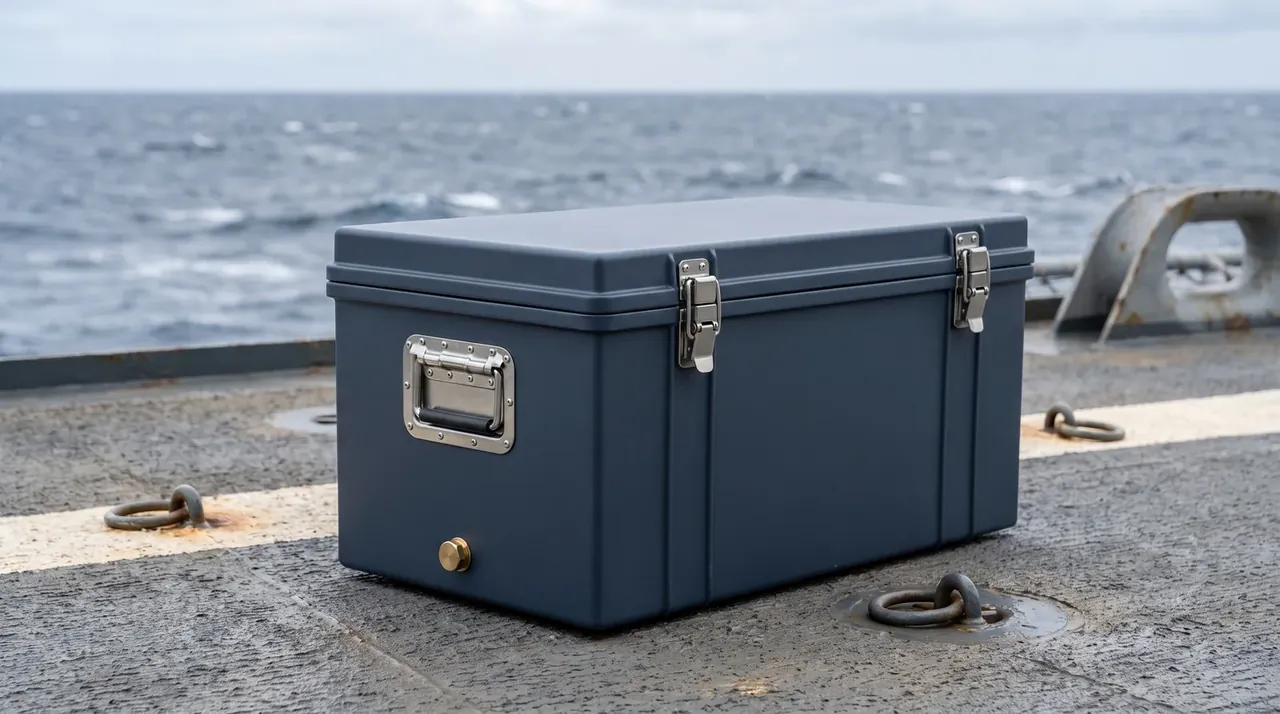
Quick answer: Case welding bonding carries what latches cannot: six latches alone hold 0.5 MPa while a 1.2 m free drop puts 4.6 MPa on the case seam.
Table of contents
- What a 1.2 m drop takes from the seam
- Ultrasonic welding: 0.6 mm director
- PP versus ABS: 235 °C and 255 °C
- Structural adhesive at 30 mN/m
- Inspecting the weld
- FAQ
1. What a 1.2 m drop takes from the seam
A 12 kg instrument case with six latches fell 1.2 m onto concrete and the lid tore 90 mm from the second latch hole. Peak stress at the seam reached 4.6 MPa while the latches held 0.5 MPa through preload, a factor of 9. Case welding bonding exists to turn that seam from clamped into continuous.
A latch locates and opens quickly, not carry shear: 1 mm of seam opening drops gasket compression from 35% to 12%.
| Location | Peak seam stress MPa | Latch capacity MPa | Joint |
|---|---|---|---|
| Front edge, 120 mm span | 4.6 | 0.5 | Continuous ultrasonic |
| Corner opposite the hinge | 6.2 | 0.3 | Full corner weld plus rib |
| Walls beside the handle | 3.4 | 0.6 | Hot plate |
| Bottom corner edge | 5.1 | 0.2 | Inner weld plus outer bead |
| Around the pressure valve | 1.9 | 0.1 | Structural adhesive ring |
Column two is from gauges, column three from the same latches at 0.4 N·m of torque. Ten latches reach 0.9 MPa while the peak stays at 4.6 MPa.
2. Ultrasonic welding: 0.6 mm director
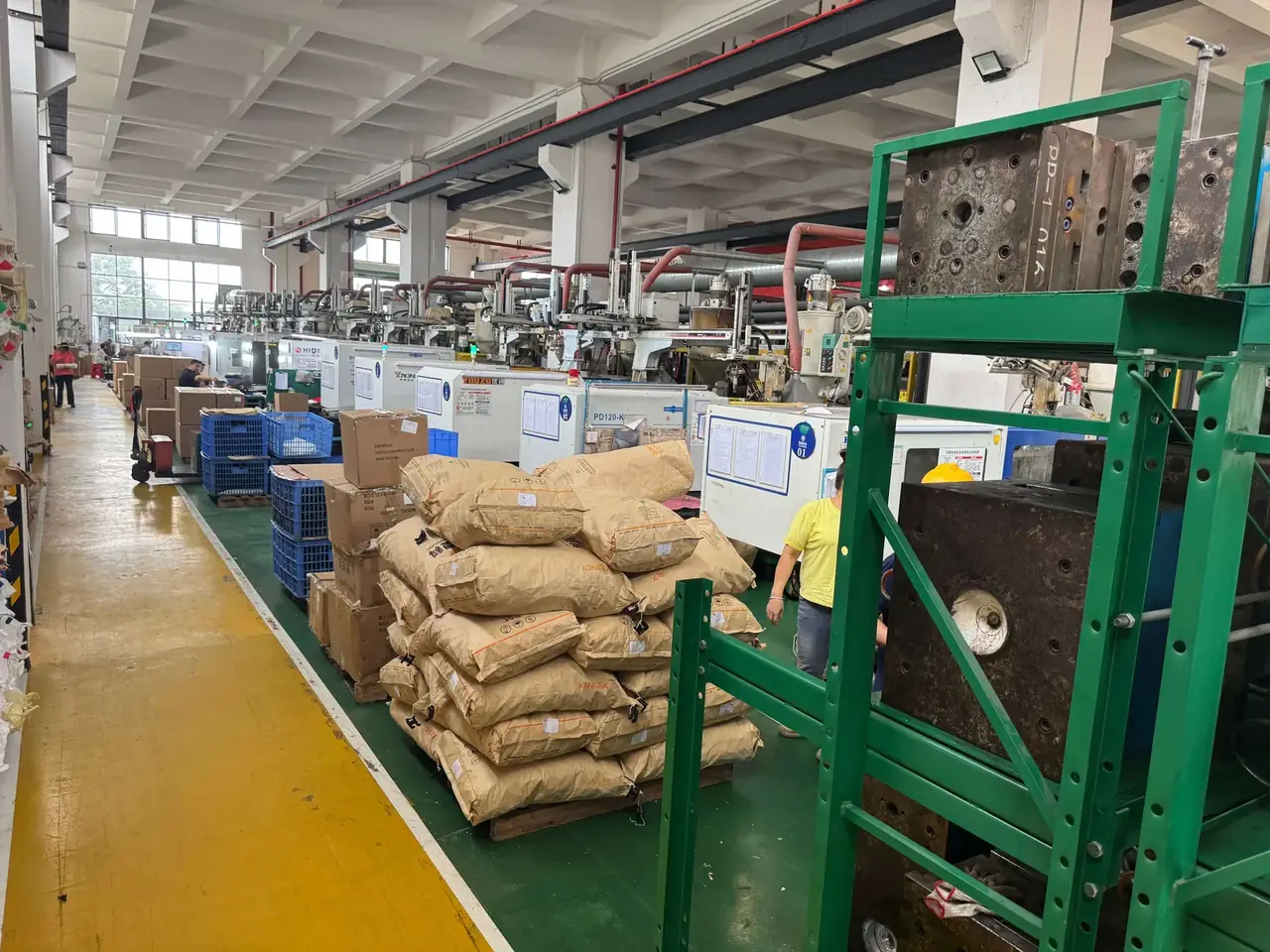
A 0.6 mm triangular energy director sits on a 2.5 mm weld land, driven at 20 kHz, 45 μm and 0.35 MPa, with 0.8 s melt and 0.6 s hold to 0.25 mm penetration. Shear reaches 4.1 MPa on PP and 4.8 MPa on ABS, an order above a latch.
Hold time is the first parameter squeezed. Cutting hold from 0.6 s to 0.2 s releases pressure before the melt freezes, leaving a 0.15 mm void and dropping shear to 2.6 MPa. Amplitude follows wall thickness: 45 μm at 2.5 mm, 60 μm at 3.5 mm, 30 μm at 1.5 mm. One 0.4 mm cold shut along a 120 mm seam fails the 0.3 bar hold at 0.06 bar of decay.
3. PP versus ABS: 235 °C and 255 °C
Hot plate settings are written per material: PP at 235 °C for 9 s to a 0.4 mm melt, ABS at 255 °C for 7 s. Swapping material on one machine stretches the cycle from 26 s to 38 s.
| Process | PP shear MPa | ABS shear MPa | Cycle s |
|---|---|---|---|
| Ultrasonic | 4.1 | 4.8 | 1.4 |
| Hot plate | 3.6 | 4.4 | 26–38 |
| Structural adhesive | 5.2 | 6.8 | 24 h cure |
PP welds well because a hydrocarbon backbone with no polar groups lets chains diffuse, so like welds to like; PP to ABS measures 0.8 MPa. ABS carries a butadiene phase that reaches 4.8 MPa, yet above 255 °C that phase degrades and shear falls 1.2 MPa.
With 8 °C either side of target, a 10 °C drift costs more than 1 MPa at both ends, so dissimilar pairs go to adhesive.
4. Structural adhesive at 30 mN/m
Two-part acrylic reaches 6.8 MPa of lap shear on ABS and 5.2 MPa on treated PP, at the cost of 24 h at 23 °C or 30 min at 80 °C. It fills the corners no weld head reaches.
PP refuses adhesive on surface energy: 30 mN/m against the 38 mN/m needed for wetting. Flame or plasma lifts it to 40 mN/m and takes lap shear from 0.9 MPa to 5.2 MPa, so the difference sits in 30 minutes of pretreatment. Bondline peaks at 0.15 mm and falls under 3 MPa at 0.05 mm or 0.4 mm.
After 500 h at 60 °C and 90% RH, acrylic falls from 6.8 MPa to 5.9 MPa, a 13% loss, while polyurethane drops 30%, so outdoor parts use the aged figure.
5. Inspecting the weld
Inspection runs three steps: visual for gaps, a section for penetration, a pressure hold on the case, and those three decide whether case welding bonding holds. Penetration has a 0.25 mm floor, anything under 0.3 mm counting as a cold shut, and width should land between 2.5 mm and 3.2 mm.
The hold is the case-level verdict: 0.3 bar charged, 60 s held, decay up to 0.02 bar. A case losing 0.05 bar weeps a water line after 30 min at 1 m depth. Load-bearing seams get 3 sections per lot, others 1 per 500 pieces, and every case gets the hold at 90 s. Welding a spot twice drops PP shear from 4.1 MPa to 3.2 MPa, so anything under 3 MPa is scrapped.
Conclusion
Selection reduces to one move: read what the location carries in a drop, then work back to a process. The front edge, dominated by lid-opening bending, takes a continuous 120 mm ultrasonic weld at 0.25 mm penetration. The corner opposite the hinge stacks bending on two axes at 6.2 MPa and has no answer other than a full weld with a rib. The walls beside the handle trade cycle time for strength, the bottom corner edge gets an inner weld plus an outer bead, and the valve boss at 1.9 MPa takes a ring of adhesive. Put those five rows on the drawing by location, then hang acceptance on three numbers: 0.25 mm penetration, 3.6 MPa shear and 0.02 bar decay.
| Location | Main load | Joint | Acceptance |
|---|---|---|---|
| Front edge, 120 mm | Lid bending 4.6 MPa | Continuous ultrasonic | Penetration ≥0.25 mm |
| Corner opposite hinge | Two-axis bending 6.2 MPa | Full weld plus rib | Decay ≤0.02 bar |
| Walls beside handle | Lift shear 3.4 MPa | Hot plate | Shear ≥3.6 MPa |
| Bottom corner edge | Compression shear 5.1 MPa | Inner weld plus bead | No weep at 1 m/30 min |
| Pressure valve boss | Local bending 1.9 MPa | Adhesive ring | Lap shear ≥5 MPa |
This article discusses container-side specifications and design implications only, and does not cover any handling, loading or use of the contents.
Related Reading
- How reinforcing ribs carry load
- Air leak and immersion test criteria
- Choosing between ABS and PP cases
Related Products
- 8 Series — Gun Cases; Military Equipment Cases; Camera Equipment Cases; Drone Cases; Watch Cases; Knife Cases; First Aid Cases; Electronics Equipment Cases
- WL8-2812 PP Gun Case — model WL8-2812
- All protective cases and toolboxes: 7 series, 158 models