

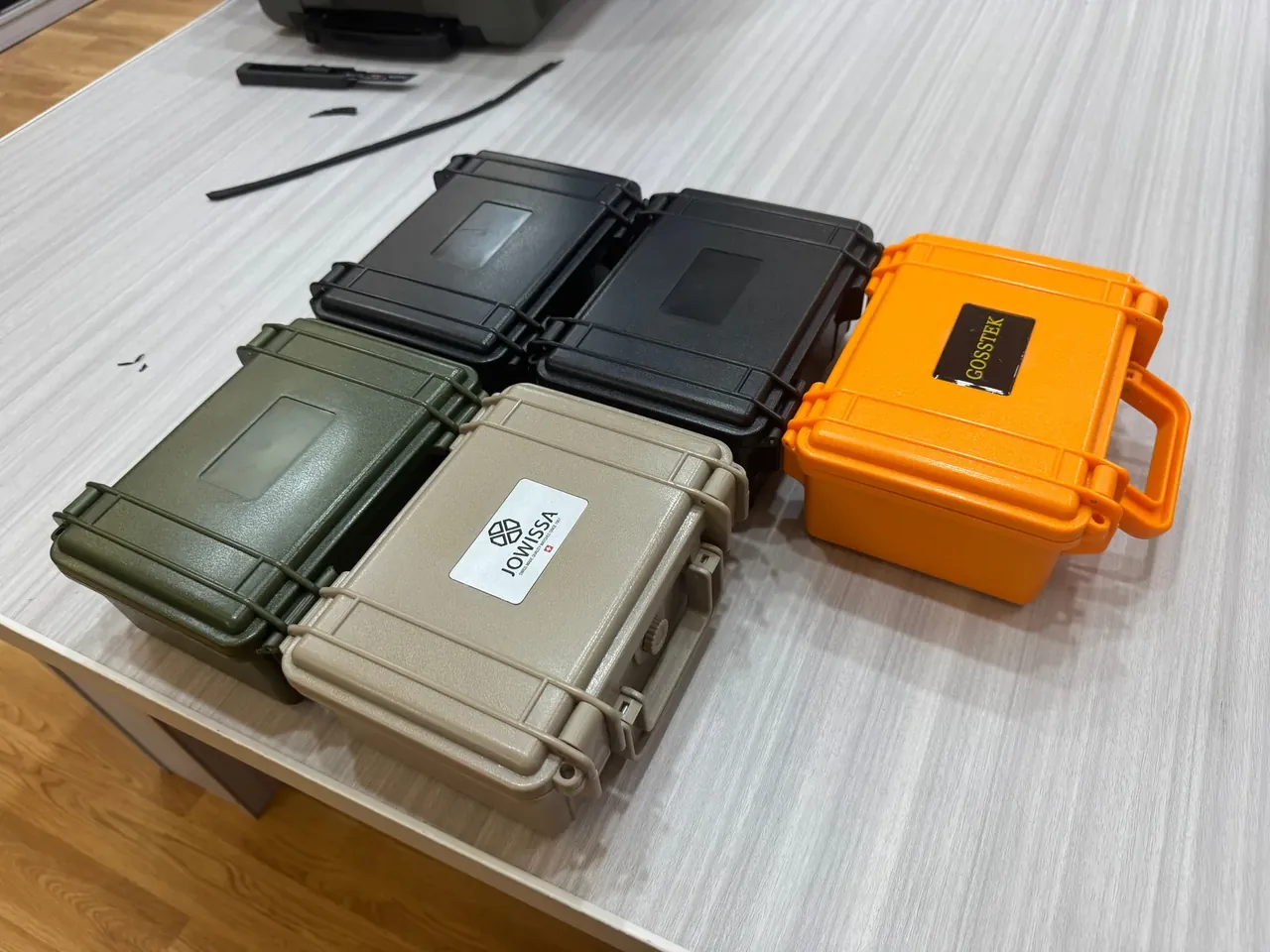
Quick answer: A charger spares case carries a 30 kg module and a 5 m cable in four bays, using a rail tray and a 330 mm drum to hold balance inside 30 mm.
Table of contents
- Why one shell cannot hold both loads
- The module bay: a tray that slides out
- The cable bay: five turns on a 330 mm drum
- Balance and moulding consistency
- Stacking three high, lifting with two people
- FAQ
1. Why one shell cannot hold both loads
Thirty kilograms of module and five metres of 32 mm cable do not share space politely. The module is dense and its corners are heat sinks; the cable is light but coils into half the floor. Stack one on the other and the jacket flattens from 32 mm to 28 mm.
The usual compromise is one 820 × 520 × 450 mm shell with everything thrown in. It runs 40 percent larger than a module-only box and needs two carriers instead of one, while splitting the interior keeps the load at 62 kg.
A shared cavity saves a shell but forces the coil out first. Two cases stay tidy at the cost of a second trip. Four bays keep a single lift.
| Cavity layout | Shell volume | Module out in one move | Loaded weight | Carriers |
|---|---|---|---|---|
| Shared cavity | 72 L | No | 66 kg | 2 |
| Two separate cases | 96 L for the pair | Yes | 70 kg | 2 |
| Four bays, one shell | 88 L | Yes | 62 kg | 2 |
| Two bays, one shell | 84 L | Partly | 64 kg | 2 |
2. The module bay: a tray that slides out
Reaching 400 mm down an 820 mm shell with the lid up is awkward, so the module rides a tray. The deck is 480 × 360 mm at 8 mm thick on two 25 mm rails rated 35 kg each, with 400 mm travel and detents at half and full.
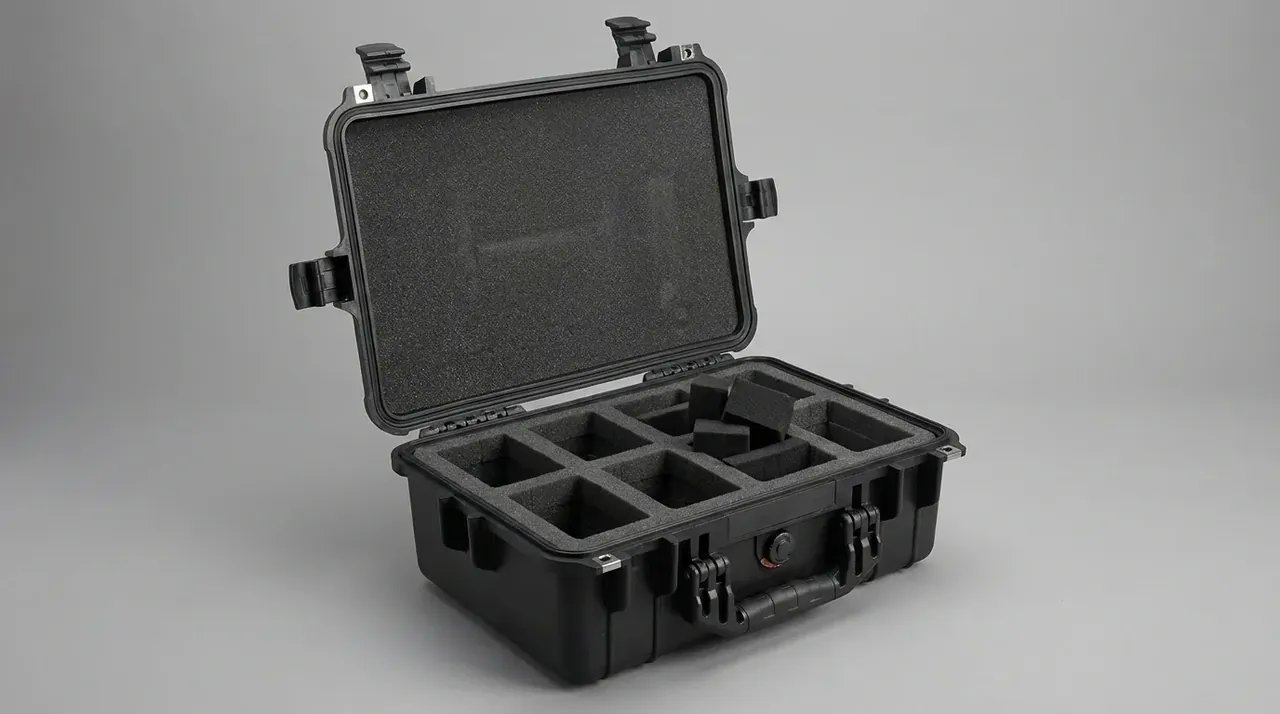
Between deck and module sit 5 mm of EPE and a 3 mm gap. The housing is a die casting within ±0.4 mm that grows 0.6 mm at 55 °C, so a tight fit crushes the foam into 2 mm of rattle.
The divider is 15 mm PP, not 8 mm. At 3 g a 30 kg module pushes about 880 N; an 8 mm board over 460 mm deflects 6 mm and grazes the fins, while 15 mm holds at 1.5 mm. Four slots at 40 mm pitch cover 400 mm to 520 mm.
| Divider thickness | Deflection over 460 mm | Divider mass | Module mass it suits | Slot width |
|---|---|---|---|---|
| 8 mm PP | 6.0 mm | 0.9 kg | up to 12 kg | 12 mm |
| 12 mm PP | 2.4 mm | 1.4 kg | up to 22 kg | 16 mm |
| 15 mm PP | 1.5 mm | 1.8 kg | up to 35 kg | 20 mm |
| 18 mm PP | 0.9 mm | 2.2 kg | up to 45 kg | 24 mm |
3. The cable bay: five turns on a 330 mm drum
A 32 mm jacket sets a 160 mm bend radius, five times its diameter. Bend tighter and the strands take a set while the jacket whitens along the crease. A 330 mm drum gives 165 mm, only 5 mm of margin, so that face is polished rather than textured.
One turn runs 1.04 m, so five turns cover 5.18 m and swallow the cable, leaving 180 mm in a 30 mm exit channel as strain relief. The 3 mm wall carries a 6 mm flange at each end to stop sideways creep during a lift.
The 1.5 kg head gets its own 180 × 120 × 90 mm bay, seven pins down onto 10 mm of EPE. Left with the coil, it swings on every carry, bends pins 0.3 mm and lifts insertion force from 90 N to 140 N.
4. Balance and moulding consistency
Balance comes from a four-point weighing. Empty is 9 kg, 39 kg with the module, 45 kg with the cable, 62 kg loaded. The module centre sits 90 mm off centre, the coil 250 mm opposite, the head 320 mm out; 30 × 90 less 6 × 250 and 1.5 × 320 leaves 720 kg·mm, which over 62 kg gives 11.6 mm, measured at 12 mm.
That 30 mm ceiling covers spare-part mixes: two modules with no cable, or a 7.5 m cable, pushes past 40 mm, and one 40 mm slot step brings it back under 20 mm.
The shell is moulded in one shot at 6 mm with five ribs. Shells from one cavity stay within 1.5 percent, about 135 g, because 135 g sitting 520 mm off centre is itself a 1.8 mm shift.
| Load combination | Total mass | Centre offset | Carriers | Stack position |
|---|---|---|---|---|
| One module only | 39 kg | 8 mm | 1 | Upper tier |
| Two cable coils | 21 kg | 15 mm | 1 | Upper tier |
| Module plus cable | 45 kg | 10 mm | 2 | Bottom tier |
| Loaded with head and tools | 62 kg | 12 mm | 2 | Bottom tier |
5. Stacking three high, lifting with two people
Three tiers put 186 kg on the bottom case. A 6 mm lid with five ribs takes 200 kg distributed for 24 hours with 2 mm deflection and still leaves 1.5 mm of gasket compression; a fourth tier reaches 4 mm, and humidity climbs 15 percent a day.
Two carriers split 62 kg into 31 kg each. Handles are rated 45 kg, and one taking the full load shows 0.4 percent strain at the root rib; with both hands on, each sees 31 kg.
Keep it level. A 15° tilt from mismatched carriers puts 7 kg sideways on the module and the detent; at 30° that reaches 15 kg and the detent clicks. Through a 900 mm door the 820 mm shell clears 40 mm a side.
Conclusion
Four numbers decide whether a charger spares case works: a 15 mm divider between a 30 kg module and a 5 m cable, a 330 mm drum holding the bend radius above 160 mm, a 12 mm centre offset inside a 30 mm ceiling, and 186 kg on the bottom case in a three-tier stack. Loosen any one and the case either will not lift or will not open in one move.
Related Reading
- Buffer design for charger module transport cases
- Protective structure for full-case module shipping
- Coiling radius for charging cables
- Handles and stacking on portable power cases
Related Products
- 8 Series — Gun Cases; Military Equipment Cases; Camera Equipment Cases; Drone Cases; Watch Cases; Knife Cases; First Aid Cases; Electronics Equipment Cases
- WL8-2812 PP Gun Case — model WL8-2812
- All protective cases and toolboxes: 7 series, 158 models