

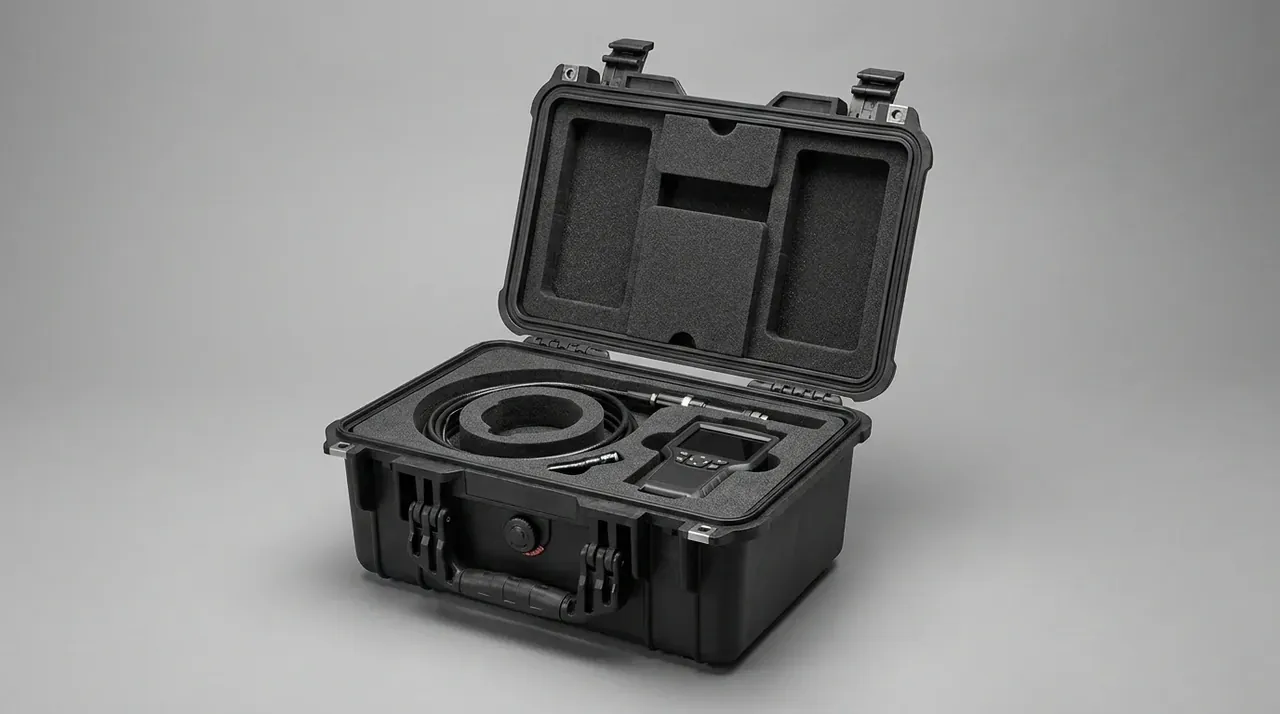
Quick answer: A charging om case separates gloves from testers: a 190 mm glove bay on a hangar bar, a 5 mm divider, 150 g of desiccant holding 50% RH, and 9 kg all in.
Table of contents
- Two Gloves Hanging, Not Folded
- A 5 mm Divider and a 1.5 m Tester in Two Halves
- Holding 50% RH with 150 g of Desiccant
- Nine Kilograms, Two Ways to Carry
- A 0.9 m Drop on the Shoulder-Side Edge
- FAQ
1. Two Gloves Hanging, Not Folded
Insulating gloves rarely fail from abrasion. They fail from creasing. A glove runs 410 mm from fingertip to cuff and 130 mm across the palm, and rolling a pair into a pouch leaves a fold the rubber remembers: 30 days later there is a 0.3 mm groove, and the next dielectric test finds it.
So the glove bay is built vertically. Clear width is 190 mm, depth 210 mm, height 260 mm, with a 12 mm bar across the top. Both cuffs go over the bar and the fingers hang 35 mm clear of the bay floor. Six 4 mm vents are staggered away from the bar, so moist air leaves downward.
With cuffs opened to 190 mm, air moves around the inside of the gloves and talc-dusted rubber never bonds to the wall. Squeeze them into 120 mm and the pull-out rolls the cuff bead loose.
| Glove bay clear width | Cuff opening | Draw time | Crease risk | Typical use |
|---|---|---|---|---|
| 120 mm | Collapsed | 8 s | High, cuff rolls | Short site runs |
| 190 mm | Hanging open | 4 s | Low, no wall contact | Daily station work |
| 240 mm | Open, side rests | 4 s | Low, bay runs large | Shared two-person case |
| Layered flat | None | 12 s | Highest, fixed fold | Not advised |
2. A 5 mm Divider and a 1.5 m Tester in Two Halves
Collapsed, the voltage tester measures 750 mm; extended it reaches 1.5 m, with a 32 mm shaft and a 90 mm head. Nothing that long lies down inside a 420 mm cavity, so it travels as two 750 mm halves, each in a channel cut by a 5 mm divider.
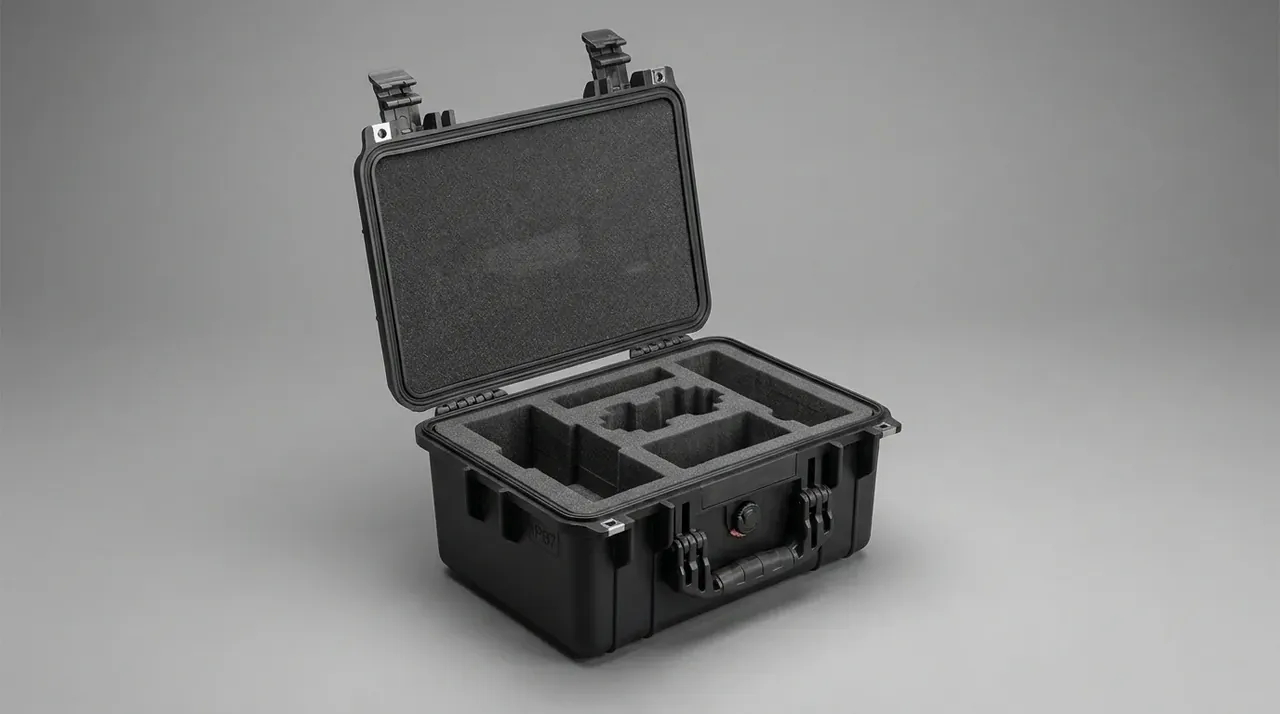
The divider is 5 mm homopolymer PP and each channel is 34 mm wide, 2 mm over the shaft, so the tester rotates but cannot slide. Channel walls stand 90 mm, 45 mm above the centreline, so a tipped case loads the divider, not the glove bay partition. Stack both halves in one channel and the 3 mm gap drums on every bump.
Why 5 mm over 3 mm: a 3 mm wall at 90 mm tall has 36% of the lateral stiffness, so 20 N at the top edge bends it 6 mm onto the shaft. The 5 mm wall bends 2.2 mm and keeps 0.8 mm of clearance.
3. Holding 50% RH with 150 g of Desiccant
Insulating tools lose margin fast with moisture. Let internal humidity climb from 45% RH to 65% RH and leakage across a glove surface rises from 0.4 mA to 1.1 mA at a 10 kV test. A retest follows.
A 150 g montmorillonite pack holds 50% RH for 45 days in a 20 L cavity. At 25 °C against 80% RH outside, the interior sits at 42–46% RH for 20 days, reaches 50% RH by day 30 and crosses 55% RH at day 45.
The pack rides in a lid pocket with three 5 mm holes, isolated from the glove bay. The indicator card mounts inside the lid: three patches for 10%, 40% and 60% RH, turning from blue to pink when spent. On the outside of a charging om case nobody sees it at all.
| Desiccant pack | Days held at 20 L | Humidity at day 45 | Retest interval | Cavity volume |
|---|---|---|---|---|
| 50 g | 18 days | 62% RH | 15 days | Under 8 L |
| 150 g | 45 days | 55% RH | 45 days | 15–22 L |
| 300 g | 90 days | 52% RH | 60 days | Over 30 L |
| None | 5 days | 78% RH | Weekly | Not advised |
4. Nine Kilograms, Two Ways to Carry
Nine kilograms is the working ceiling. Two gloves weigh 1.2 kg, the tester 1.1 kg, the meter 0.4 kg, spare heads and cleaner 1.3 kg, the shell 5 kg. Add 2 kg and an 800 m shoulder carry starts pressing on the collarbone.
The strap is 40 mm wide and 8 mm thick, spreading contact over 60% more area than a 25 mm strap and dropping pressure from 3.5 kPa to 2.2 kPa. Anchors sit 30 mm above centre on both sides, so the case rides against the small of the back; centre them and 9 kg pitches 20 mm every step.
The handle is a 25 mm arc with a 110 mm grip and a 3 mm TPE sleeve, and both modes share one set of anchors.
| Carry mode | Centre of mass | Comfortable range | Strap width | Limit |
|---|---|---|---|---|
| One hand | 60 mm | 200 m | None | Numb fingers past 3 kg |
| One shoulder | 90 mm | 800 m | 40 mm | Swap sides every 15 min |
| Both shoulders | 40 mm | 1500 m | Two at 40 mm | Case must come off to open |
| Cart hook | 150 mm | Unlimited | None | Case swings off-road |
5. A 0.9 m Drop on the Shoulder-Side Edge
The 0.9 m figure is measured. On a 1.7 m user the bottom of a shoulder-carried case hangs 0.85–0.95 m off the ground, and the first thing to land is the long edge nearest the body.
That edge is where lid and body overlap. Of the two seals, the outer one is a 6 mm solid gasket compressed 2 mm and the inner one a 3 mm lip. The latches take the impact: at 3 g each of the two shares 4.5 kg, or 27 N, and neither hook may show more than 0.2 mm of permanent set.
Walls run 5 mm and the lid 4 mm, so the floor dents 1.8 mm and springs back to 0.4 mm. Four feet move the contact point onto a flat: 8 mm tall, 30 mm across, compressing 1.5 mm before rebounding.
Conclusion
A charging om case solves two problems, separation and moisture: a 190 mm glove bay on a 12 mm bar, a 1.5 m tester split into two 750 mm halves behind a 5 mm divider, and 150 g of desiccant holding 50% RH for 45 days. Nine kilograms, a 40 mm strap and a 0.9 m drop set the carrying limits.
Related Reading
- Insulated tool cases for live-line work
- Bay layout and damp control in insulated tool cases
- Selection criteria for utility maintenance cases
- Transport protection for charger modules
Related Products
- 8 Series — Gun Cases; Military Equipment Cases; Camera Equipment Cases; Drone Cases; Watch Cases; Knife Cases; First Aid Cases; Electronics Equipment Cases
- WL8-2812 PP Gun Case — model WL8-2812
- All protective cases and toolboxes: 7 series, 158 models