

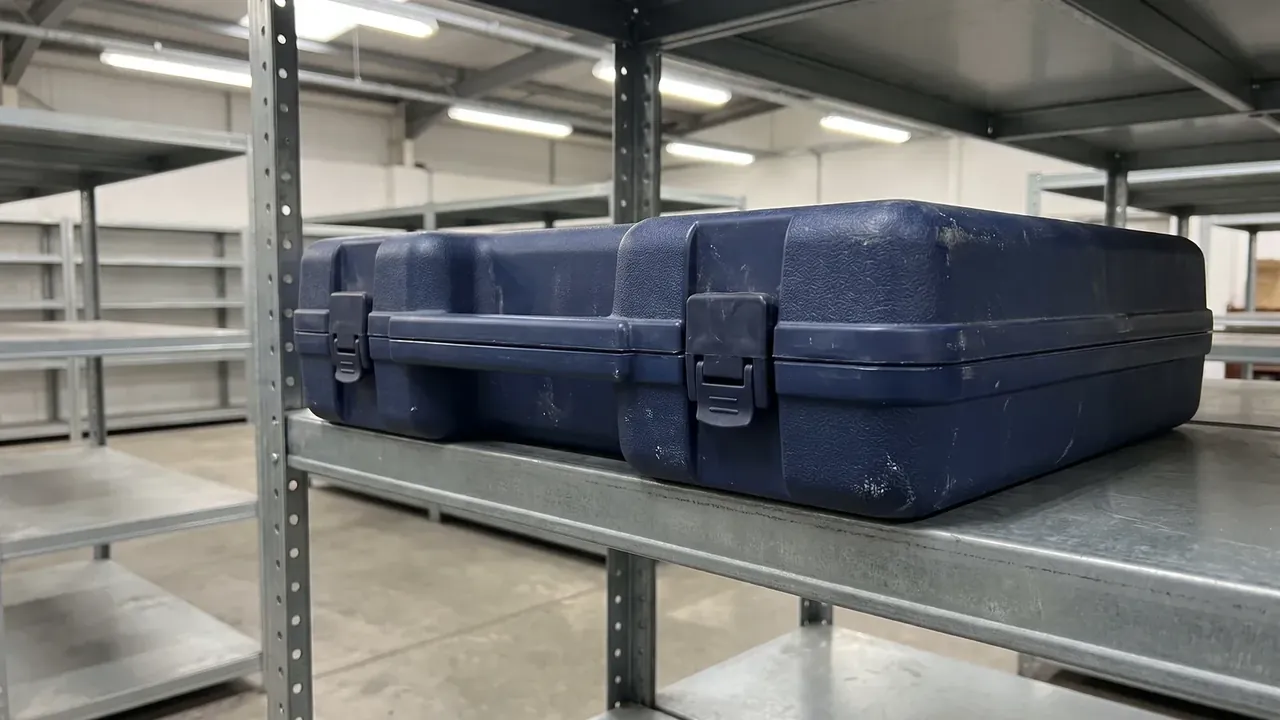
Quick answer: A Clinical trial drugs portable protective case pairs a Shore 60 A base pad to 105 mm rivet spacing, reading creep after 4 h at 25 degrees.
Table of contents
- Base-pad hardness of the Clinical trial drugs portable protective case
- Spacing of the handle rivets
- Creep measured on a 25 degree slope
- Looseness read after a lift
- Hardness setting for portable batches
- FAQ
1. Base-pad hardness of the Clinical trial drugs portable protective case
Base-pad hardness decides whether a portable case walks down a slope; rivet spacing sets the margin after a lift. The Clinical trial drugs portable protective case is 340 by 240 by 120 mm outside, 300 by 205 by 85 mm inside, with a 3.3 mm wall and one anti-slip pad. A soft pad grips but deforms under load, while a hard pad springs back and passes lift shake to the rivets. Its slope ledger lists hardness first and opens a fresh grade when pad stock or mould cavity changes.
Three shell groups rest on one 25 degree rig at Shore 55 A, 60 A and 65 A. Hardness off nominal distorts fourth-hour creep before rivet spacing shows up.
| Hardness grade | Base-pad hardness | 4 h creep |
|---|---|---|
| Softer grade | 55 A | 1.5 mm |
| Nominal grade | 60 A | 1.2 mm |
| Harder grade | 65 A | 0.8 mm |
The 55 A grade drags creep to 1.5 mm; 65 A pulls it to 0.8 mm but raises looseness to 0.31 mm. Only 60 A holds both. For a Clinical trial drugs portable protective case the softer pad is no grip failure: it yields over 4 h, and the shell slides down the rig.
2. Spacing of the handle rivets
Handle rivet spacing is fixed at 105 mm, the second quantity to lock down. It measures the gap between two lid rivets, not the handle width. Narrow spacing shortens the lever but swings the shell more; wide spacing steadies the lift while prying harder at the rivets. The pad's remaining lift margin is taken up by this gap.
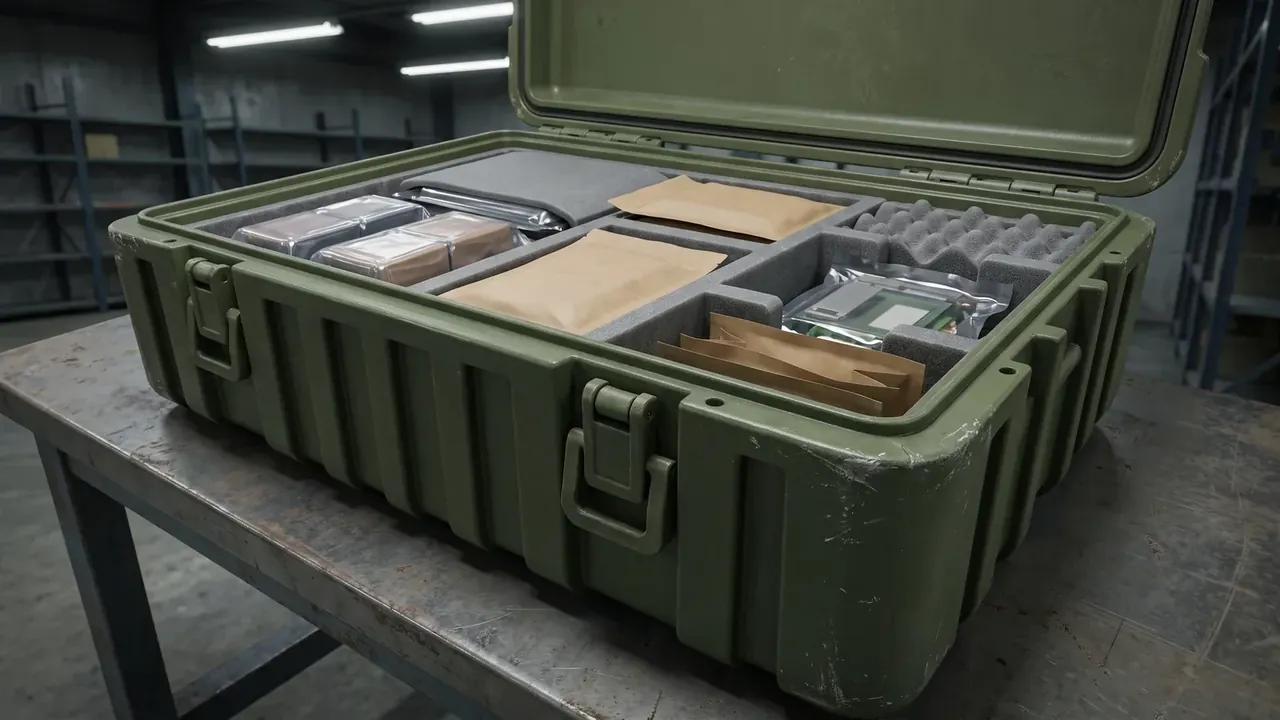
Two latches press at 260 N each on the same lid register. The bench holds 23 °C / 50% RH so the pad does not soften with moisture; without a matched recheck, high looseness is charged to hardness by mistake. A Clinical trial drugs portable protective case files 4900 open-close cycles with 105 mm, and a shell missing either item stays out of the slope ledger.
3. Creep measured on a 25 degree slope
Settling is fixed at 25 degrees for 4 h with the shell closed; at the mark, base displacement against a scribe is read on a dial gauge to 0.01 mm. Judgment takes the fourth-hour value, not the running total, since the test asks whether hardness and rivet spacing pin the shell. Earlier intervals are trend only.
| Settling interval | Cumulative creep | Interval gain |
|---|---|---|
| 1 h | 0.4 mm | 0.4 mm |
| 2 h | 0.8 mm | 0.4 mm |
| 4 h | 1.2 mm | 0.4 mm |
Creep reads 0.4 mm at 1 h, 0.8 mm at 2 h and 1.2 mm at 4 h, with equal gains in both halves, so the pad yields steadily rather than slipping at one instant. A 1.2 mm creep and a 0.25 mm looseness fill two cells of one grading card; both must land, or neither counts. Past 4 h the trace is sealed without a grade, and the ledger for a Clinical trial drugs portable protective case keeps only the fourth-hour row.
4. Looseness read after a lift
Settling does not end in a grade; the same shell gets one lift recheck. Looseness is the residual shift of a rivet against the lid scribe after the handle is raised and set down, read to 0.01 mm. Creep and looseness differ: a harder pad cushions lift shake less, so residual shift climbs.
| Creep value | Rivet spacing | Handle looseness |
|---|---|---|
| 1.5 mm | 95 mm | 0.18 mm |
| 1.2 mm | 105 mm | 0.25 mm |
| 0.8 mm | 115 mm | 0.31 mm |
Set side by side, 95 mm crosses creep at 1.5 mm, 115 mm reaches 0.8 mm but climbs to 0.31 mm past 0.25 mm, and only 105 mm stays inside both. A shell measured but never lifted earns no grade; for a Clinical trial drugs portable protective case this shift counts only after settling.
5. Hardness setting for portable batches
Portable batches close against one setting rule, not a reread of every interval. The hardness setting is the softest grade whose fourth-hour creep stays within 1.2 mm, and harder pads go to flat-surface transfer. A Clinical trial drugs portable protective case locks in 1.7 kg empty, 3 kg loaded, 23 °C / 50% RH, 4900 cycles and two latches at 260 N; new pad stock restarts settling and the lift recheck.
No single shell speaks for the whole batch. Hardness grade, rivet spacing, fourth-hour creep and lift looseness go onto each shell's own card; four aligned cells admit it, and one crossed cell sends only that shell back. Mould cavity, pad lot and rig number are tied to the batch. Forming settings and slope readings for a Clinical trial drugs portable protective case are archived apart, tolerances trace back to the rig, and the IP65 rating is logged as a reference-method entry rather than a certification claim.
Conclusion
Binding a Shore 60 A pad, 105 mm rivet spacing and a 0.25 mm looseness limit onto one card admits a Clinical trial drugs portable protective case to portable batches: after 4 h on the slope the shell moves no more than 1.2 mm, and one lift leaves the rivets no looser. A crossed column sends that single shell back, with no margin moved from elsewhere. Recheck logs covering 4900 open-close cycles are kept by JUNZHIJIA under each batch number; Kexin New Materials (Guangdong) Co., Ltd. issues a separate tolerance review sheet.
Related Reading
- Carrying Cases: Portable Structure & Everyday Handling Protection
- Replacing and Re-Cutting Case Foam: When to Repair and When to Start Over
- Pharmaceutical Cold-Chain Cases: Drug & Biologic Temperature-Controlled Protection
- Portable medical emergency equipment safety box
Related Products
- 8 Series — Gun Cases; Military Equipment Cases; Camera Equipment Cases; Drone Cases; Watch Cases; Knife Cases; First Aid Cases; Electronics Equipment Cases
- WL8-2812 PP Gun Case — model WL8-2812
- All protective cases and toolboxes: 7 series, 158 models