

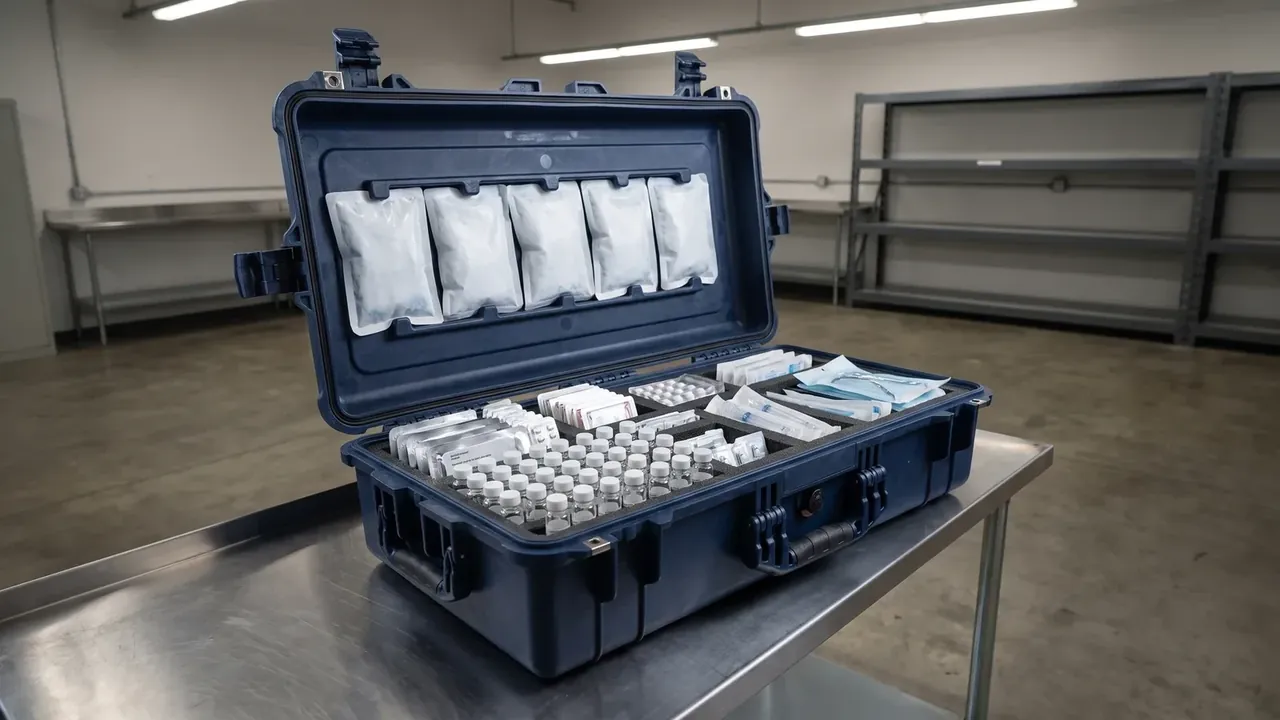
Quick answer: A Cold Chain Equipment Case keeps 2–8 °C for 18 h at 32 °C with a 38 mm foam wall and four 1.2 kg cold packs set opposite, not with a thicker spec sheet.
Table of contents
- Insulation thickness of a Cold Chain Equipment Case
- Cold pack layout and thermal bridges
- Hold time at thirty-two degrees
- How lid openings shift the warm-up curve
- Loading values for a cold chain batch
- FAQ
1. Insulation thickness of a Cold Chain Equipment Case
A nominal wall figure describes the mould rather than the foam. This shell is 600 by 440 by 320 mm outside and 520 by 360 by 260 mm inside: the 40 mm difference is total wall build, and after 2 mm of liner and gasket groove the foam carries 38 mm. Lid and base get only 30 mm of build, leaving 28 mm of foam and a 10 mm deficit that appears exactly where a warm-up curve bends upward.
Probe six side points and three lid or base points to 0.5 mm. Mark any shell whose spread exceeds 3 mm: foam under-fills at corners, and thin foam runs light, so resistance falls faster than thickness. A Cold Chain Equipment Case records 38 mm as a measured average, with probe positions kept in the shell file.
| Probe position | Wall build | Net foam |
|---|---|---|
| Long side | 40 mm | 38 mm |
| Short side | 40 mm | 37.5 mm |
| Lid | 30 mm | 28 mm |
| Base | 30 mm | 27.5 mm |
Two rows read below the average: 38 mm is an average, never a promise at every point. The thin lid sets the limit, since heat reaches the cavity from above however close the packs sit.
2. Cold pack layout and thermal bridges
Four packs at 1.2 kg each, 4.8 kg in total, work better placed opposite than stacked: two along the long sides of the cold cavity and two on the lid, so cold moves inward from four directions while the centre stays free for the 14 kg load. Stack all four on one side and the near wall condenses while the far end never drops. A Cold Chain Equipment Case sets packs opposite and symmetric, so every wall has a cold source against it.
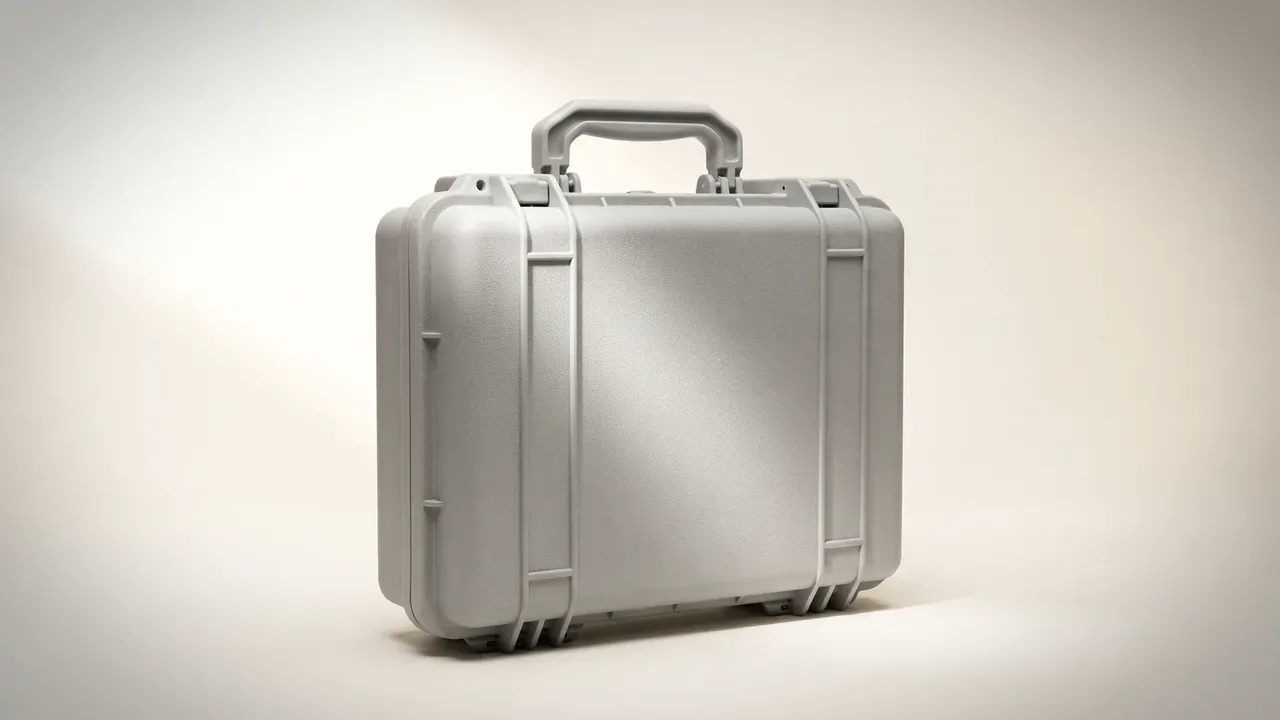
Thermal bridges form the second line. Handle bosses, wheel axles, hinge pins and logger ports pass through the wall, and metal conducts orders of magnitude better than foam, so a 3 mm solid section pipes outdoor heat onto the cavity face. Thin foam at a corner counts too, as heat then flows around the insulation. A Cold Chain Equipment Case fits a 6 mm pad under each handle boss and shrinks the penetration to two M5 bolts.
Judge bridges by spread: six inner-wall points differing by more than 1.5 °C at a moment mean heat is short-cutting, and more foam comes before more thickness.
3. Hold time at thirty-two degrees
In a 32 °C chamber with the lid clamped and packs fully frozen, the cavity starts at 4.6 °C and holds 2–8 °C for 18 h. The curve is not straight: the first 6 h climb fastest, the middle flattens, and the last stretch rises again because the lid carries only 28 mm. A Cold Chain Equipment Case logs whole hours, since release asks whether a stated hour crossed the line.
| Checkpoint | Cavity temperature | Rise per hour |
|---|---|---|
| 0 h | 4.6 °C | 0.00 °C |
| 6 h | 6.1 °C | 0.25 °C |
| 12 h | 7.2 °C | 0.18 °C |
| 18 h | 7.7 °C | 0.08 °C |
The reject line sits at 8 °C. The 18 h row ends at 7.7 °C, a 0.3 °C margin worth roughly 3 h at the late-stage rate of 0.08 °C per hour; at 35 °C the curve shifts up and that margin vanishes. A Cold Chain Equipment Case treats 32 °C as a rating condition, not an extreme, so a warmer batch goes back on the same rig.
4. How lid openings shift the warm-up curve
Six openings of 40 s each add 2.1 °C, spending roughly 5 h of the 18 h margin. The cost is not linear: the first two openings cost much the same, then each later one costs less as a boundary layer forms over the pack surfaces. A Cold Chain Equipment Case logs opening count beside cumulative rise, keeping single-opening rise as reference only.
The final hours hurt most. With 0.3 °C left, six openings pull the same shell to 8 °C by hour 13. Two fixes exist: pre-cool the packs 2 h longer so phase change completes, or finish every opening inside the first 6 h while margin is wide.
Log each opening with a stopwatch to 10 s and read cavity temperature before and after; a shell recording only a closing temperature cannot separate an opening from thin foam.
5. Loading values for a cold chain batch
Batches release case by case rather than from a sample. Empty weight 9.8 kg, load 14 kg, lid clamp 320 N, four packs at 1.2 kg and 38 mm of net foam must line up on one shell in one grade. A Cold Chain Equipment Case states values and check methods with no ranges, so a reviewer sees at a glance which item was skipped.
| Setting | Value | How it is checked |
|---|---|---|
| Empty weight | 9.8 kg | Weighed before packs go in |
| Load | 14 kg | Spread evenly, no offset |
| Lid clamp | 320 N | Read with all four latches closed |
| Cold packs | Four at 1.2 kg | Pre-cooled until phase change ends |
| Net foam | 38 mm | Average across nine probe points |
A 14 kg load over a 520 by 360 mm floor works out near 75 kg/m², and at that level the foam tray only divides the space while the 30 mm base carries the weight. Spread 320 N across two gasket lines: too little and cold air slips past the lid, so the curve steepens after hour 12; too much and gasket rebound pushes the latches loose. A Cold Chain Equipment Case reads clamp force after the latches close, never during the stroke.
Empty weight is the item most often skipped: 9.8 kg plus 4.8 kg of packs and 14 kg of load reaches 28.6 kg, and a dragged case loads its wheel axles sideways.
Conclusion
Grading a Cold Chain Equipment Case rests on three readings: 38 mm of net foam, four 1.2 kg packs set opposite, and a warm-up curve that stays under 8 °C for 18 h. All three must come from one shell in one grade. JUNZHIJIA files the hourly 32 °C records by batch, and drawing tolerances are issued by Kexin New Materials (Guangdong) Co., Ltd.
Related Reading
- Cold chain shipping case: specifications and verification
- Insulated box vs cooler: hold-time comparison
- How to specify an active temperature control case
- Case volume and usable cavity ratio
Related Products
- 8 Series — Gun Cases; Military Equipment Cases; Camera Equipment Cases; Drone Cases; Watch Cases; Knife Cases; First Aid Cases; Electronics Equipment Cases
- WL8-2812 PP Gun Case — model WL8-2812
- All protective cases and toolboxes: 7 series, 158 models