

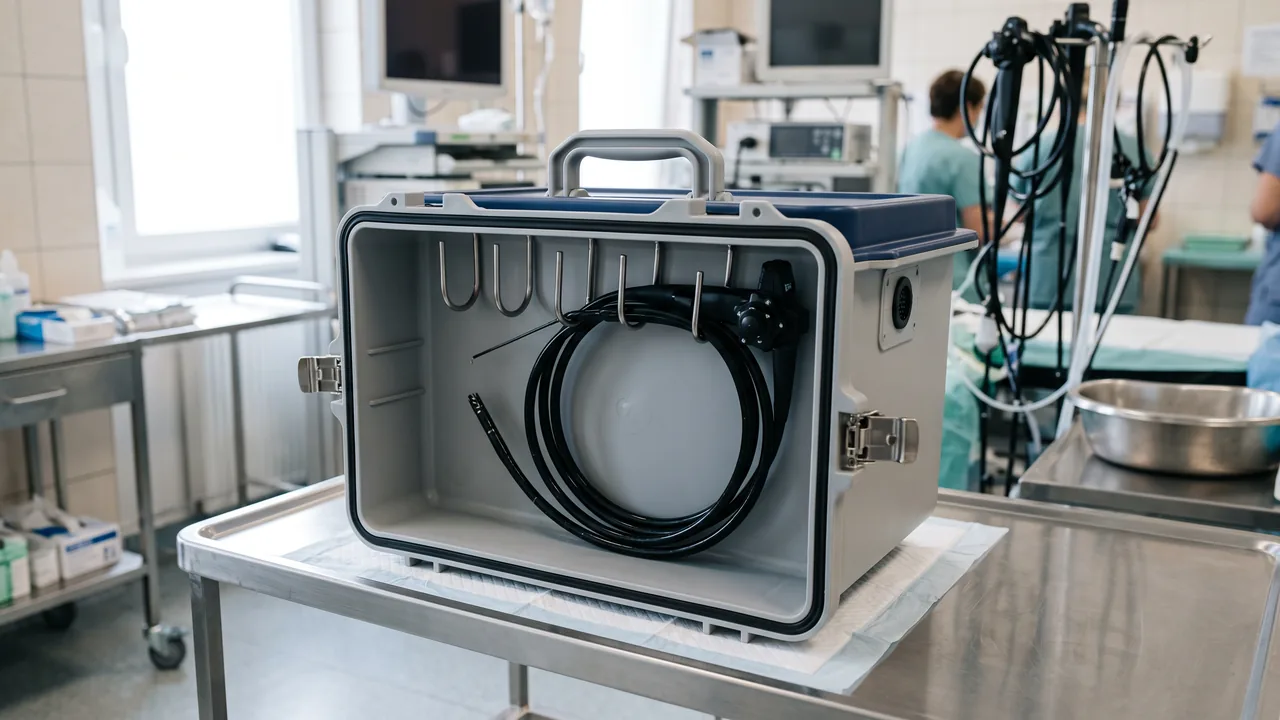
In the movement of precision instruments, biological preparations and field operation equipment, ambient temperature often causes more irreversible damage than shock or vibration. An active temperature-control protective case actively regulates the internal climate through thermoelectric cooling and heating, holding the compartment within a defined setpoint band and overcoming the limitation of passive insulated boxes that can only slow heat exchange. This article systematically reviews the engineering essentials of active temperature-control protective cases from four dimensions: structure, principle, selection and maintenance, helping procurement and design staff build a practical technical judgment framework.
1. Definition and Applicable Scenarios
An active temperature-control protective case is a protective container with built-in temperature-control actuators that can actively cool or heat to maintain a target internal temperature. Its fundamental difference from a passive insulated box is that a passive box relies on insulation to delay heat exchange and its temperature drifts over time, while an active box forms a closed loop with thermoelectric coolers, heating films and a controller to achieve constant temperature. Applicable scenarios include short-distance transfer of biological samples, low-temperature storage and transport of electronic components, constant-temperature protection of field testing equipment, and medical supply assurance that must remain stable across abrupt high-low temperature transitions. When the transit cycle exceeds the capability of passive insulation, active temperature control is the more reliable option. For the sealing fundamentals, refer to the Protective Case IP67 vs IP68 guide.
2. Working Principle of Thermoelectric Cooling
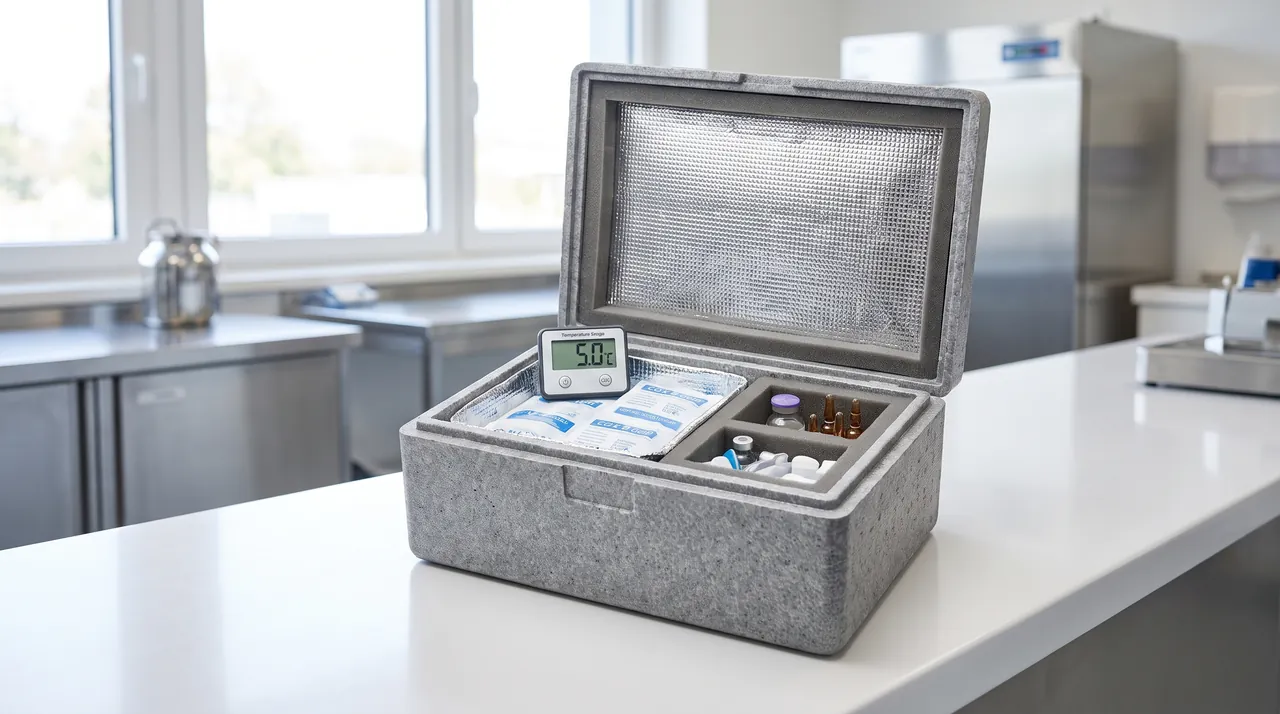
Thermoelectric cooling, also called Peltier cooling, uses a Peltier module as its core device. It is composed of multiple pairs of semiconductor thermocouple arms connected in series. When direct current passes through, one side absorbs heat and the other releases heat, realizing directional heat transfer from inside the case to the outside. Its advantages are no mechanical compression parts, no refrigerant, small size and bidirectional operation: reversing the current direction switches from cooling to heating. The disadvantage is a lower coefficient of performance than compression refrigeration, making it more suitable for small and medium power, precise temperature-control situations. In protective case applications, the cold side of the cooler attaches to the inner liner and the hot side attaches to the external heat-sink fins, with thermal grease and fans improving heat exchange. Selection must consider maximum temperature difference, maximum current and thermal load matching to avoid frost on the cold side or overheating on the hot side.
3. Core Temperature Bands for Constant Transport
Different materials have very different temperature requirements. Ambient-class electronic components usually require five to thirty-five degrees Celsius; biological reagents and vaccines mostly fall in the two to eight degrees Celsius refrigerated band; frozen samples need below minus twenty degrees Celsius; and some outdoor equipment must avoid low-temperature brittleness, requiring maintenance above zero. The target of an active temperature-control case should be based on the allowable fluctuation range of the material rather than a single nominal value. Engineering practice often uses the setpoint plus allowable deviation as the control bandwidth, for example refrigerated material set at five degrees with plus or minus two degrees bandwidth. The narrower the bandwidth, the higher the requirements for sensor accuracy and actuator response speed, and the corresponding cost rises.
4. Shell Structure and Insulation Design
The outer shell mostly uses modified engineering plastics or aluminum alloy, with polyurethane or vacuum insulation panels filled between the inner liner and the shell to reduce heat leakage. Wall thickness and the thermal conductivity of the insulation material are the key parameters determining static hold time, but because an active case has continuously working actuators, the requirement for static insulation can be moderately relaxed, with more attention paid to overall weight and structural strength. Box corners should be rounded and reinforced to withstand stacking and drop impact; latches and hinges need corrosion resistance. For the structural strength indicators emphasized in the Protective Case Selection Guide, evaluation can be synchronized at the selection stage. The insulation layer must also consider thermal bridging; metal fasteners passing through multiple layers create heat short circuits that should be isolated through broken-bridge design and insulating washers.
5. Temperature-Control System Composition and Sensor Layout
A complete temperature-control system consists of four parts: temperature sensor, controller, actuator and power supply. Sensors mostly use digital temperature sensors placed at two positions, the middle of the liner and near the door seal, with the average or the worst point participating in control. The controller executes a proportional integral derivative algorithm, adjusting the cooler current according to the deviation. Actuators may include, in addition to the cooler, a heating film, cooling fans and air ducts. The layout should ensure uniform circulation of cold air in the case, avoiding local overcooling that causes condensation or frost. For multi-compartment designs, it is recommended that each independent temperature zone be equipped with an independent sensor to prevent mutual interference.
6. Power Supply and Feeding Method Selection
Active temperature-control cases rely on continuous power. Common schemes include built-in lithium battery, external direct-current supply and vehicle cigarette-lighter tapping. The built-in battery scheme has the best portability but is limited by air transport and capacity; the external scheme suits fixed scenarios such as vehicles and laboratories. Design should account for power consumption and endurance under worst-case conditions, for example the relationship between cooler continuous operating current and battery capacity when the environment is forty degrees, the target is five degrees and the thermal load is full. It is recommended to configure low-battery alarms and temperature over-limit alarms, and switch to passive insulation buffering when power is lost. For compartments where a Custom Foam Lining requires a reserved battery bay, dimensions and safety isolation should be planned in advance.
7. Sealing and Protection Rating
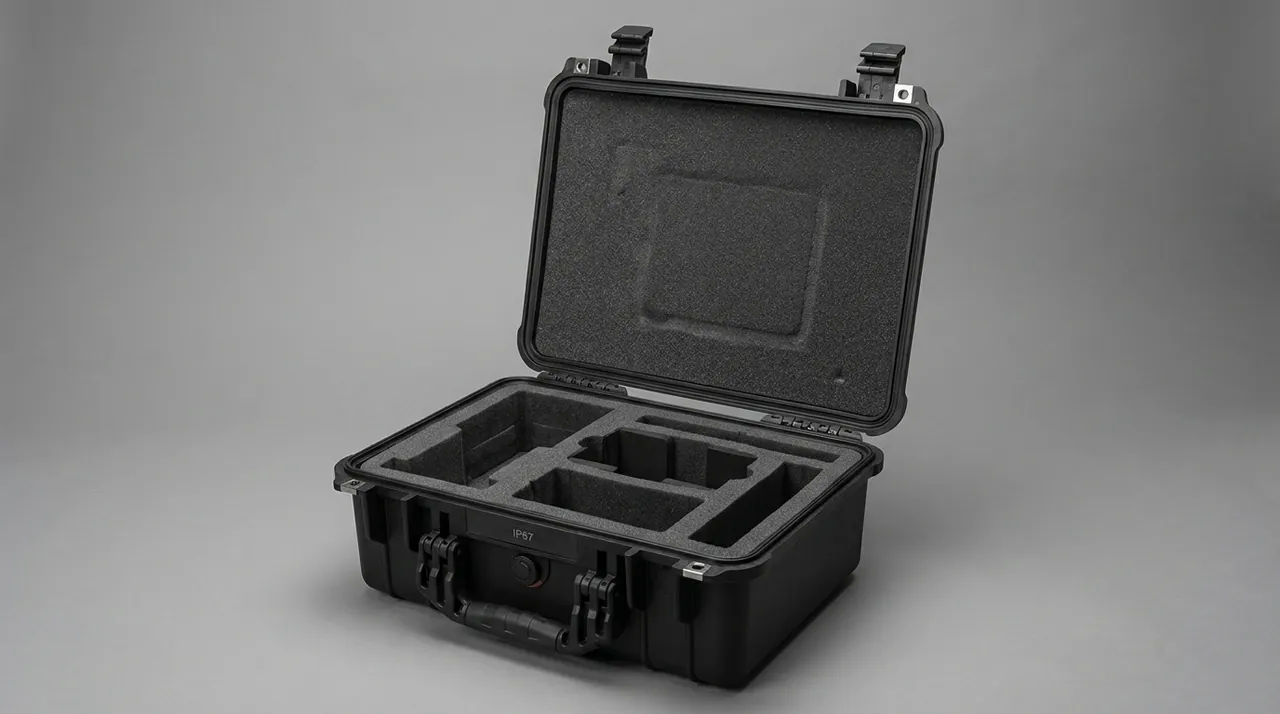
Active temperature-control cases are used in outdoor and vehicle environments, where sealing performance directly affects temperature-control efficiency and equipment safety. The case should achieve a high dust and water protection rating, with common indicators referencing protection grade standards. The seal strip material needs to balance low-temperature softness and aging resistance, commonly ethylene propylene diene monomer rubber or silicone. The door seal is a high-incidence area for heat leakage and water ingress, and should adopt double seals and compression latches. A pressure equalization valve can relieve the internal-external pressure difference caused by high-low temperature or altitude changes, preventing the door seal from being sucked tight or bulging. For details on rating differences, see Protective Case IP67 vs IP68. In wading and high-humidity environments, interfaces and charging ports should have independent sealed covers.
8. Liner Cushioning and Cavity Positioning
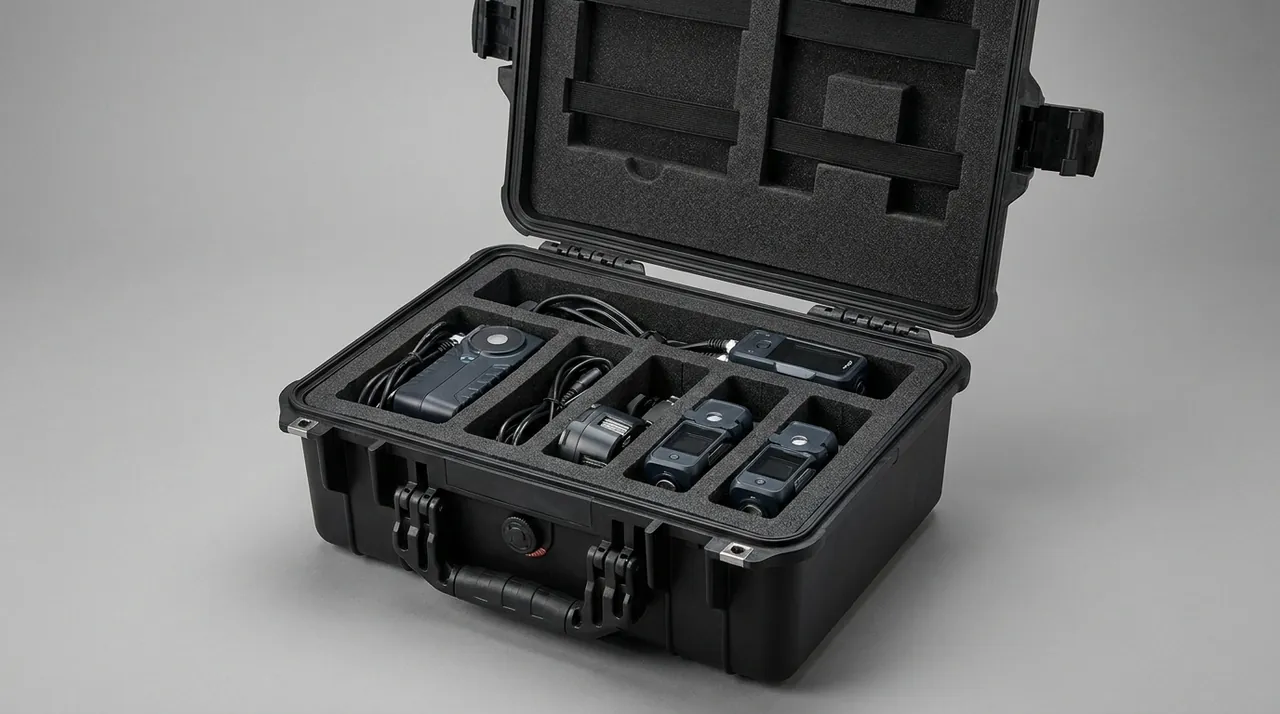
Temperature-control cases usually hold temperature-sensitive and fragile devices, so the liner must simultaneously provide cushioning and positioning. Custom foam cut to cavity profiles fixes each item in an independent slot, reducing vibration transmission during transport and ensuring uniform cold-air bypass flow. Liner materials can be cross-linked polyethylene, polyurethane and static-dissipative foam; the first has good resilience, the latter suits electronic devices for antistatic purposes. The cutting clearance should be slightly smaller than the device size for a tight fit, but not so tight as to make removal difficult. For precision instruments requiring Custom Foam Lining, it is recommended to provide a three-dimensional model for computer-controlled cutting by the manufacturer to ensure slot accuracy and consistency.
9. Typical Temperature Curves and Fluctuation Control
In laboratory verification, the typical temperature curve of an active temperature-control case shows a rapid approach to the setpoint after startup, followed by small oscillation within the control bandwidth. The fluctuation amplitude is affected by controller parameters, environmental disturbance and opening frequency. Engineering suppresses fluctuation by increasing sensor sampling frequency, introducing feed-forward compensation and door-switch detection. For materials with narrow allowable fluctuation, a temperature-equalizing block or phase-change cold-storage material can be added inside as a buffer to reduce instantaneous disturbance. During transport, frequent lid opening should be avoided; when necessary, fast open-close and temporary transition compartments should be adopted.
10. Battery and Endurance Management
The built-in power supply is the core of the portability of an active temperature-control case and also its limiting factor. The lithium battery pack should be equipped with a battery management system to prevent overcharge, over-discharge and cell imbalance. Endurance estimation needs to superimpose variables such as ambient temperature, target temperature, thermal load and opening times, giving a conservative value rather than an ideal value. To extend endurance, an intermittent operation mode can be enabled: reduce cooling power when the internal temperature is at the low end of the bandwidth and run at full power when at the high end. In low-temperature environments the battery capacity itself declines, requiring temperature compensation at the system level. For related low-temperature performance, refer to the testing experience of Extreme Temperature Case.
11. Selection Parameter Decisions
Selection should be developed around five core dimensions: temperature band and accuracy, endurance and power supply, protection rating, volume and cavity, certification and documents. First clarify the allowable temperature range of the material, then determine cooling capacity and control accuracy; choose battery capacity or external scheme based on transit duration and scenario; determine protection rating and sealing form according to the use environment; plan liner and cavity based on device shape; finally verify required test reports and certifications. The complete Protective Case Selection Guide provides a parameter decision checklist that can be used as an appendix to the technical agreement. For pharmaceutical and food chains, the compliance requirements of Pharmaceutical Cold Chain Case should also be considered.
12. Application Scenario Examples
In medical scenarios, active temperature-control cases are used for the last-mile distribution of vaccines and reagents, forming a traceable chain together with temperature recorders. In electronics manufacturing, they are used for low-temperature transport of optical modules and wafers, avoiding parameter drift caused by high temperature. In scientific field expeditions, they protect samples in hot or cold environments. In military and emergency support, they provide a constant-temperature cabin for testing instruments and medicines. Different scenarios emphasize weight, endurance and certification differently, but the core logic is consistent: lock the temperature within the allowable bandwidth at controllable cost. The special requirements of vaccine scenarios can also be found in Vaccine Cold Chain Case.
13. Maintenance and Calibration
Active temperature-control cases require regular maintenance to ensure long-term reliability. Maintenance includes cleaning seal strips and door seals, checking dust on heat-sink fins and fans, calibrating temperature sensors, testing battery health and verifying alarm functions. Sensor calibration is recommended annually or according to usage frequency, using a standard temperature source to compare reading deviation and replacing or correcting if out of tolerance. During long-term storage, keep a half-charge state and place in a dry environment to avoid battery passivation and strip aging. For condensate accumulation, refer to Condensation Control in Cases for desiccant or dehumidification design.
14. Typical Selection Calculation and Engineering Example
To move selection from experience-based judgment to quantifiable decision, the following gives a simplified heat-load and endurance estimation process for engineers to apply. The first step is to estimate leakage power: take the case surface area multiplied by the temperature difference and then divided by the insulation thermal resistance. For example, with a surface area of zero point five square meters, an internal-external temperature difference of thirty-five degrees and a comprehensive heat-transfer coefficient of about zero point eight watts per square meter per degree, the heat leakage is about fourteen watts. The second step superimposes equipment self-heating and heat brought by opening, and engineering often adds thirty to fifty percent of the leakage. The third step determines cooling capacity: the effective cooling capacity of a thermoelectric cooler at the target temperature difference is usually lower than the nominal maximum, so it should be selected according to the actual working curve and reserve about twenty percent margin. The fourth step accounts for endurance: divide the available battery energy by the system average power consumption to get duration, then multiply by an empirical reduction coefficient of zero point seven to get conservative endurance.
A concrete example illustrates this: a testing instrument needs to maintain five degrees Celsius inside at an ambient of forty degrees for eight hours of continuous transport. The leakage is about fourteen watts, and adding door opening and self-heating of about seven watts gives a total of twenty-one watts. Selecting a cooling module with effective capacity of thirty watts leaves about forty percent margin. If the system average total consumption is twenty-five watts and a two hundred watt-hour battery is equipped, the theoretical endurance is eight hours, but after reduction it is about five point six hours, which is clearly insufficient to cover eight hours, so external power or a larger four hundred watt-hour battery is required. This example shows that endurance must be measured based on worst-case rather than nominal values, otherwise it will fail midway.
Acceptance testing should form a checklist: no-load cooling curve test, recording the time from ambient to setpoint; load steady-state fluctuation test, continuously recording the highest and lowest temperatures and bandwidth compliance; power-loss passive hold test, recording the buffer time after power loss until temperature rises to the upper limit; sealing and protection rating retest; alarm function test; sensor calibration comparison. All tests should be performed in the real state with liner and equipment, and temperature recorder data should be retained as delivery evidence. For pharmaceutical and food chains, the test should also be included in cold-chain verification documents to meet the compliance requirements of Pharmaceutical Cold Chain Case.
In engineering implementation, it is recommended to write the above calculation and checklist into the appendix of the technical agreement as the basis for acceptance and re-inspection. When multiple supplier schemes are compared in parallel, use the same set of working-condition parameters to compare cooling capacity, power consumption and endurance horizontally, avoiding being misled by different test conditions. At the same time, the performance of Condensation Control in Cases in actual measurement should be paid attention to, and condensation risk should be included in acceptance. Only through quantitative calculation and standardized acceptance can the active temperature-control protective case truly create value in critical storage and transport scenarios, rather than staying at the level of promotional parameters.
15. Standards Compliance and Document Management
As both electrified equipment and storage containers, active temperature-control protective cases involve multiple standards and compliance requirements that should be sorted out in advance during procurement. In terms of electrical safety, refer to low-voltage electrical installation and relevant safety requirements to ensure insulation, withstand voltage and leakage current meet limits. In terms of electromagnetic compatibility, refer to general electromagnetic compatibility standards to prevent the cooling module and controller from interfering with surrounding equipment or being disturbed. In terms of protection and environment, flame retardancy can refer to plastic flammability rating assessment, and hazardous substance restriction refers to relevant environmental directives to ensure material compliance. In terms of transport environmental adaptability, military environmental test methods and transport packaging test procedures can be used for reference to verify reliability under high-low temperature, vibration and drop.
Document management is the link that implements compliance. It is recommended to establish one-case-one-file: including design drawings, bill of materials, key device specifications, test reports, calibration records and factory inspection sheets. For pharmaceutical and food chains, temperature recorder data and cold-chain verification reports should also be attached to form a traceable chain. Export products need to additionally check destination regulations and certification mutual recognition to avoid customs clearance obstruction due to missing documents. When suppliers change or designs are revised, files should be updated in time and version differences retained. Good document management not only satisfies acceptance and audit, but also provides basic data for later maintenance, spare parts and recall.
The selection of standards should be based on the actual use region and industry rather than piling up names. For example, domestic projects prioritize equivalent national standards, while exports focus on mandatory destination certification. Transforming standard clauses into executable test conditions and acceptance thresholds and writing them into the technical agreement can avoid "compliance with standards" becoming empty talk. When multiple standards overlap, take the stricter one as the bottom line. Through the two-wheel drive of standards and documents, the active temperature-control protective case can serve stably in a rigorous engineering system and truly guarantee the storage and transport safety of high-value and temperature-sensitive materials.
FAQ
Q: What is the main difference between an active temperature-control case and a passive insulated box? A: The fundamental difference lies in whether active regulation capability exists. A passive insulated box only delays heat exchange through insulation material, and its internal temperature continuously drifts with the environment and time, suiting short-distance scenarios where temperature rise is controllable. An active temperature-control case has built-in thermoelectric coolers, heating films and a controller forming a closed loop, able to stably maintain temperature within a set bandwidth, suiting long-distance, harsh temperature zones or high-value materials. The cost is that the active case needs power, has more complex structure and higher cost. In decision making, first estimate transit duration and allowable temperature rise; if a passive scheme can cover it, prefer the simpler option, otherwise adopt active temperature control for reliability. Document the decision with the estimated transit time, worst ambient temperature and the passive case measured drift curve, so the choice is auditable later. When the same fleet serves both short and long routes, mark which units are active and label their power requirements clearly, because mixing the two types on one shelf often leads to charging mistakes. A simple color code on the latch keeps the wrong case from being grabbed in a hurry. Keep the passive alternatives listed too, since comparing them side by side strengthens the justification. This habit also simplifies insurance claims after any transit incident.
Q: Thermoelectric cooling is not highly efficient, so why is it widely used in protective cases? A: Although thermoelectric cooling has a lower coefficient of performance than compression refrigeration, it offers no moving parts, no refrigerant leakage risk, small size and instantaneous reverse heating, which are ideal for protective cases requiring small space, precise control and high reliability. A protective case usually does not need to move large amounts of heat but maintains a small temperature-difference steady state, where the response speed and control accuracy advantages of semiconductors are obvious. In addition, the static vibration-free characteristic avoids interference with sensitive devices. Engineering rationally matches thermal load, strengthens heat dissipation and optimizes control algorithms to achieve stable constant temperature at acceptable power consumption. Cost planners should also weigh service life: a thermoelectric module has nothing to wear out mechanically, so the practical life limit usually comes from fan bearings and gasket aging rather than the cooler itself. That makes preventive maintenance simple and predictable, which matters when the case supports fieldwork far from a workshop. Spares are small and cheap. Document the fan noise level as well, since some laboratories restrict it. Request the module datasheet for the project file, since acceptance teams sometimes ask for it.
Q: How to determine the target temperature and allowable fluctuation bandwidth of an active case? A: The target temperature and bandwidth should be determined by the technical specification of the stored material, not by experience. First check the storage temperature range of the material, take its midpoint as the setpoint, then form the control bandwidth with the allowable deviation, for example a two to eight degrees refrigerated material can be set at five degrees with plus or minus two degrees bandwidth. The narrower the bandwidth, the higher the requirements for sensor accuracy, control algorithm and actuator response, and the higher the cost. For samples sensitive to fluctuation, a temperature-equalizing block or phase-change material buffer can be added inside. The final value should be written into the technical agreement and verified with a temperature recorder during acceptance to confirm the whole process stays within the bandwidth. When several materials with different windows share one shipment, either assign separate compartments with independent sensors or split them into dedicated cases, because a single bandwidth cannot satisfy both. Record the final setpoint, bandwidth and sensor positions in the shipment documents so receiving staff can judge the data without calling the sender. Sensor drift over a year should also be part of the tolerance discussion. For multi day trips, agree in advance who may adjust the setpoint en route.
Q: How to estimate the endurance of an active temperature-control case reliably? A: Endurance estimation must be based on worst-case rather than ideal conditions. Variables such as ambient temperature, target temperature, thermal load, opening times and battery degradation need to be superimposed. The common method is: first calculate the continuous power consumption of the cooler under high ambient temperature and low target temperature, then multiply by an experience coefficient to obtain average current, and finally divide the available battery capacity by that current to get conservative endurance. It is recommended to configure low-battery and temperature over-limit alarms, and rely on passive insulation buffering after power loss. Low-temperature environments themselves reduce available battery capacity, so the system should provide temperature compensation. Delivery should include endurance test reports under typical conditions rather than only nominal values. Re-test endurance after every battery replacement, because new cells from a different batch can shift the result more than expected. Keep the test ambient, load mass and opening pattern identical between runs, otherwise the numbers cannot be compared and the improvement cannot be proven to an auditor. Mark each battery pack with its first use date to support this. Log the ambient temperature alongside the endurance result for future reference.
Q: How should condensation or frost inside the case be handled? A: Condensation originates from the dew point reached by the moisture content in the internal air on a cold surface, while frost is moisture crystallizing directly below zero degrees. Treatment methods include drying the devices and liner before transport and placing desiccants; using air-duct design so the cold surface is not directly exposed to the stored surface; shortening opening time in high-humidity environments; and predehumidifying for below-zero operation. A long-term solution can integrate a small dehumidification module inside or choose low-absorbent liner. During maintenance, regularly clean accumulated water and replace desiccants. For more engineering practices on condensation treatment, refer to the related topic of condensation control in cases. Package hygroscopic items in sealed inner bags before they enter the case, because paper labels and cardboard release moisture for hours after loading. If frost keeps forming on the same spot, check whether a liner rib is blocking the duct, since local airflow short cuts often explain repeat condensation better than the weather does. A small mirror helps inspect the duct behind the liner without dismantling it.
Q: What certifications and test documents does an active temperature-control case need? A: Depending on the use, it may involve electrical safety, electromagnetic compatibility, protection rating, material flame retardancy and environmental compliance. Common references include electrical equipment safety and electromagnetic compatibility requirements, protection rating test methods, flame-retardant rating assessment and hazardous substance restriction directives. Pharmaceutical and food chains may also require cold-chain verification documents and temperature records. During procurement, request corresponding test reports from the manufacturer and clearly define acceptance criteria and responsibility boundaries in the contract. For export products, also check destination regulations. The complete certification list should be confirmed item by item based on material attributes and usage region to avoid missing items that block customs clearance or acceptance. Build the document set once and reuse it across tenders, updating only the model specific pages, because assembling papers from scratch under deadline pressure is how pages go missing. Keep a checklist that names every certificate, its issue date and the laboratory that issued it, and store digital copies in the shipment folder. Regulators in some markets also ask for the original test laboratory scope, so keep that page handy. One master folder per model avoids duplicate requests to the factory.
Q: Does custom liner affect temperature-control effect? A: It does, and usually positively. Custom foam cut to cavity profiles fixes devices and leaves cold-air bypass channels, reducing vibration transmission and avoiding devices directly attaching to the cold wall causing local overcooling. The thermal resistance and moisture absorption rate of the liner material also change the internal thermal behavior; low-absorbent, low-conductivity foam is more conducive to stability. But if the liner is too thick or blocks the air duct, it weakens circulation and increases temperature difference. When customizing, provide the three-dimensional size of the device so the manufacturer can balance cushioning and temperature uniformity, and if necessary perform sample-box temperature-field testing. For precision instruments, include liner design and temperature-control verification together in the technical agreement. Ask for the foam data sheet together with the cutter files, so a later re-order uses the same material rather than a lookalike with different thermal behavior. After the first article is approved, photograph the fitted liner and attach the photos to the agreement, giving both sides a clear reference for future repeat orders. Keep one spare slot in the layout empty for paperwork or a data logger.
Q: Can materials be frequently taken out by opening the lid during transport? A: Frequent lid opening introduces environmental heat and moisture, causing instantaneous temperature deviation and possibly triggering condensation, so it should be avoided as much as possible. If mid-way access is necessary, adopt fast open-close, or design independent transition compartments and small-opening partitions to expose only the required part. After each opening the system needs time to reconverge to the set bandwidth, during which alarms should be monitored. For critical materials, plan cavity layout by usage order before transport, placing later items inside and earlier items outside to reduce overall exposure. Long-distance transport should be accompanied by a temperature recorder to retain full-process data for verification. Brief the drivers as well as the packers, because many temperature excursions start with a courier leaving the case in a sunny van bed while waiting at a gate. A short written handover that names who may open the case and when removes most of these avoidable events without any hardware change. Review the handover rule whenever the courier company changes.
Q: What precautions apply to long-term storage of an active temperature-control case? A: Before long-term storage, clean the inside and outside of the case, dry the seal strips, remove the battery and store it separately at half charge in a dry ventilated environment away from direct sunlight. Long-term full or empty charge accelerates battery passivation, so keep about half charge and replenish periodically. Seal strips should avoid contact with oil and solvents to prevent aging and cracking. The storage environment temperature and humidity should be mild, as extreme dry-wet cycles shorten seal life. When re-enabling, first charge, calibrate the sensor, run a no-load test to verify temperature control and alarm functions are normal, then put into formal storage and transport. Establishing storage and enablement records helps trace device status. Store the removed battery away from the case itself and label both with the same asset number, so a unit never returns to service with a mismatched pack. Before the first trip after storage, run one full duty cycle on a bench and compare the cooling curve with the acceptance record, because slow convergence often reveals a tired battery or a blocked duct early. Do not stack other cases on top of a stored active unit, since foam takes a set under long load.