

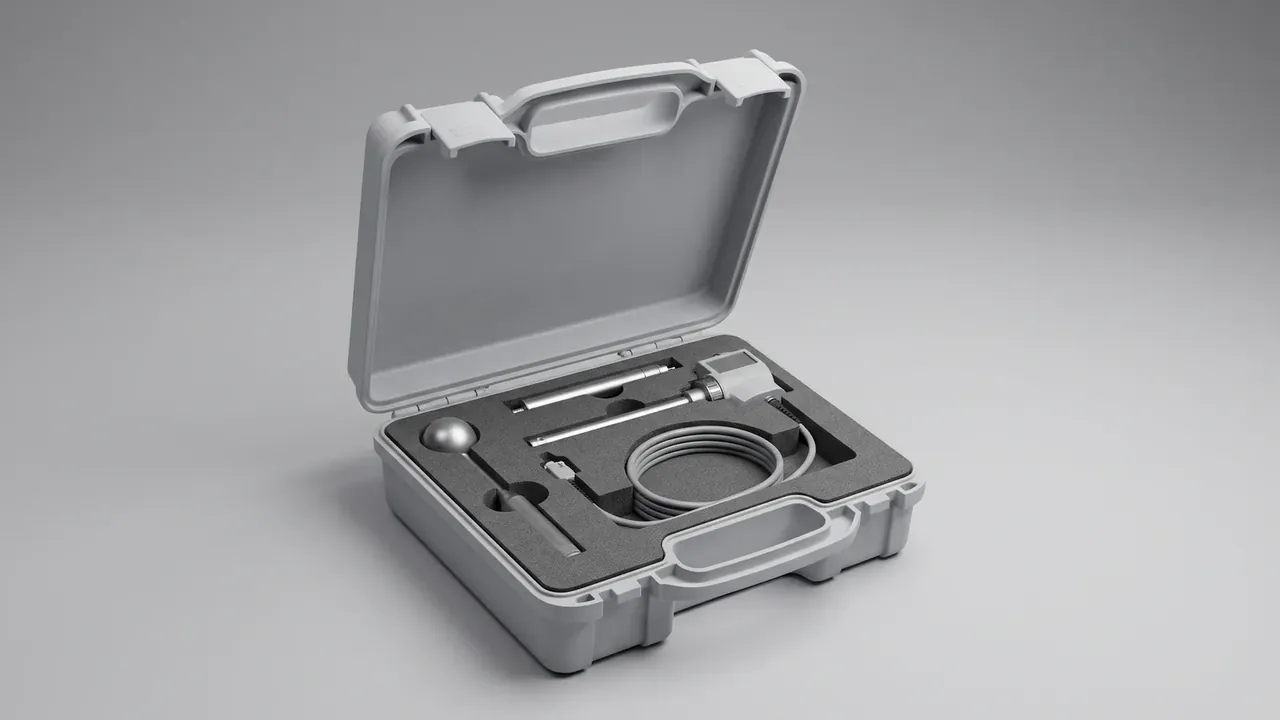
Quick answer: When you specify custom color instrument cases, the order of decisions matters more than the shade. Fix the entry point first — a colour card for speed, a Pantone number for repeatability, a physical sample for accuracy — then fix the process: paint below 100 units, moulded-in colour above 500, tolerance deciding the band between. Close with a ΔE 2.0 limit under D65, and add about 8 C inside a black shell. Written into the specification, those steps are what keep custom color instrument cases stable into a second batch.
Table of contents
- Three Routes to a Custom Colour: Card, Pantone, Sample
- Where 100-Unit Painting Ends and 500-Unit Moulding Begins
- Judging a 2.0 Colour Difference on a D65 Booth
- Dark Shells in Sun: 8 Degrees at 60 C
- Adhesion Across Print, Laser and Paint
- FAQ
1. Three Routes to a Custom Colour: Card, Pantone, Sample
One shell, two logics: custom color instrument cases at 100 units on a paint line and 500 moulded do not hold colour alike.
For custom color instrument cases a colour card is the lightest route: somebody photographs a chip from an RAL or Pantone deck and sends it. Paper ink and polymer pigment bend light differently, so ΔE 3 to 5 on moulded plastic is normal.
A Pantone number is the working route. Four or six digits buy three A4 plaques, two posted and one retained as the standard. The number turns an adjective into a coordinate and lets masterbatch be costed.
A physical sample is surest. A worn case or a length of extrusion goes to the lab, a spectrophotometer reads L\*a\*b\*, and the masterbatch is back-calculated. Five to seven working days.
| Entry point | What the customer sends | First plaque | Where it fails |
|---|---|---|---|
| Colour card | A photograph of one chip | 2 to 3 working days | Paper ink against polymer, ΔE 3 to 5 typical |
| Pantone number | Four or six digits | 3 to 5 working days | Recipe written for ink, needs rebalancing |
| Physical sample | A worn case or extrusion | 5 to 7 working days | Aged sample has yellowed, reading skewed |
Most custom color instrument cases programmes run two in parallel: a Pantone number for production, a retained plaque for disputes.
2. Where 100-Unit Painting Ends and 500-Unit Moulding Begins
Paint is cheap to cost. Lid, base and hardware each need masking, twenty minutes a unit; primer and topcoat run two passes; the oven holds 60 to 80 C for thirty minutes. One mix covers 15 to 20 units, so below 100 pieces paint undercuts a masterbatch — the usual first step in custom color instrument cases sourcing.
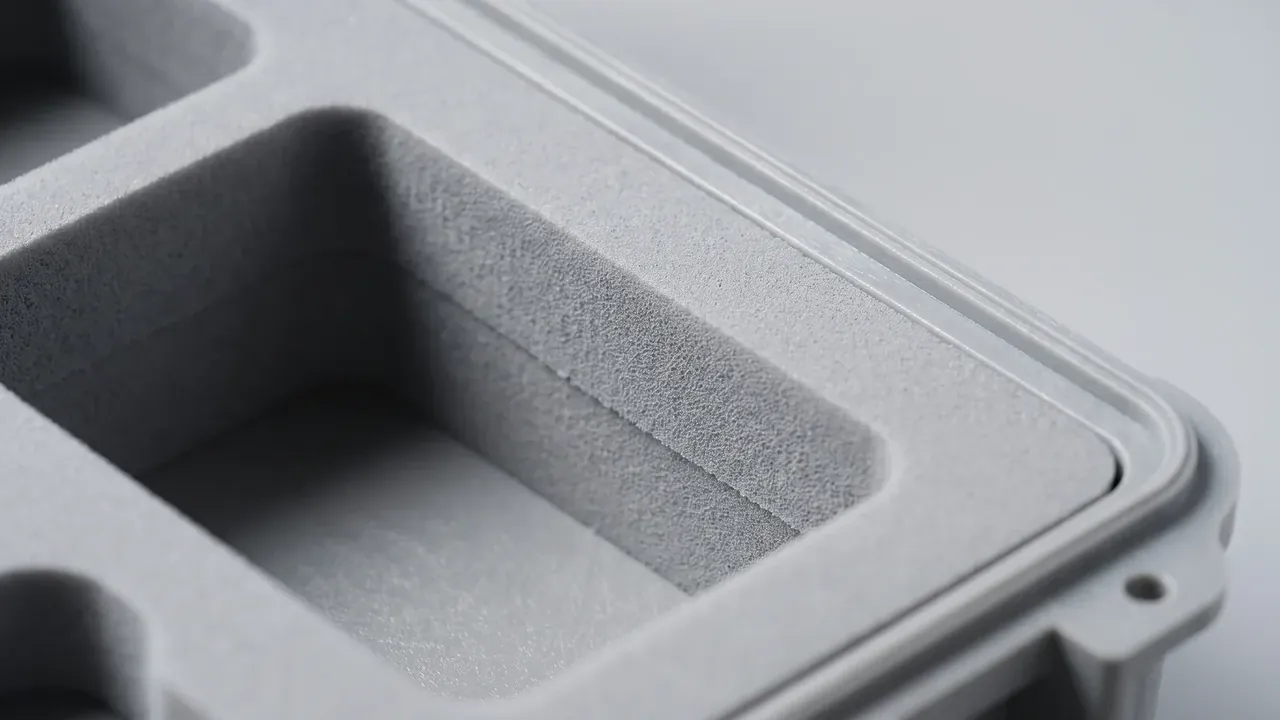
Moulded-in colour is costed by the colour change, not the unit. Masterbatch runs at 2 to 4 percent, and each new shade purges the barrel, pushing 5 to 8 kg out as scrap. Across 500 units that purge falls under one yuan a case, and the colour survives abrasion.
Two hundred to three hundred units is the hard band: paint still carries masking, moulding still carries a purge. The compromise: one purge per material, shades batched into a shift.
| Lot size | Route | Colour-change loss | Wear behaviour |
|---|---|---|---|
| 50 to 100 units | Paint | Mixing plus gun cleaning | Base colour shows through wear |
| 200 to 300 units | Paint or masterbatch, by schedule | 5 to 8 kg purge | Comparable either way |
| Above 500 units | Moulded-in colour | One purge across the lot | Colour through the wall |
3. Judging a 2.0 Colour Difference on a D65 Booth
D65 simulates average daylight at 6500 K. Light the shell from 45 degrees, view along 0 degrees at 30 to 40 cm, booth walls neutral grey near L\* 50.
ΔE 2.0 means visible side by side and unremarkable apart. Below 1.0 most observers cannot separate two panels; at 2.0 a hue shift shows once they touch; past 3.0 a single protective case looks dull alone. So 2.0 serves as a batch ceiling, 1.0 as a within-batch target.
Fix the routine before the first delivery: three units per lot beside the retained plaque, rotated through three angles under D65, with the ΔE reading and the verdict recorded. When they disagree, the eye wins. Most disputes trace back to an unspecified viewing condition, not a wrong batch.
4. Dark Shells in Sun: 8 Degrees at 60 C
A shell reaches 60 C in sun easily, black first: absorptance runs 0.9 against 0.3 for pale grey, and two hours leaves them 15 to 20 C apart.
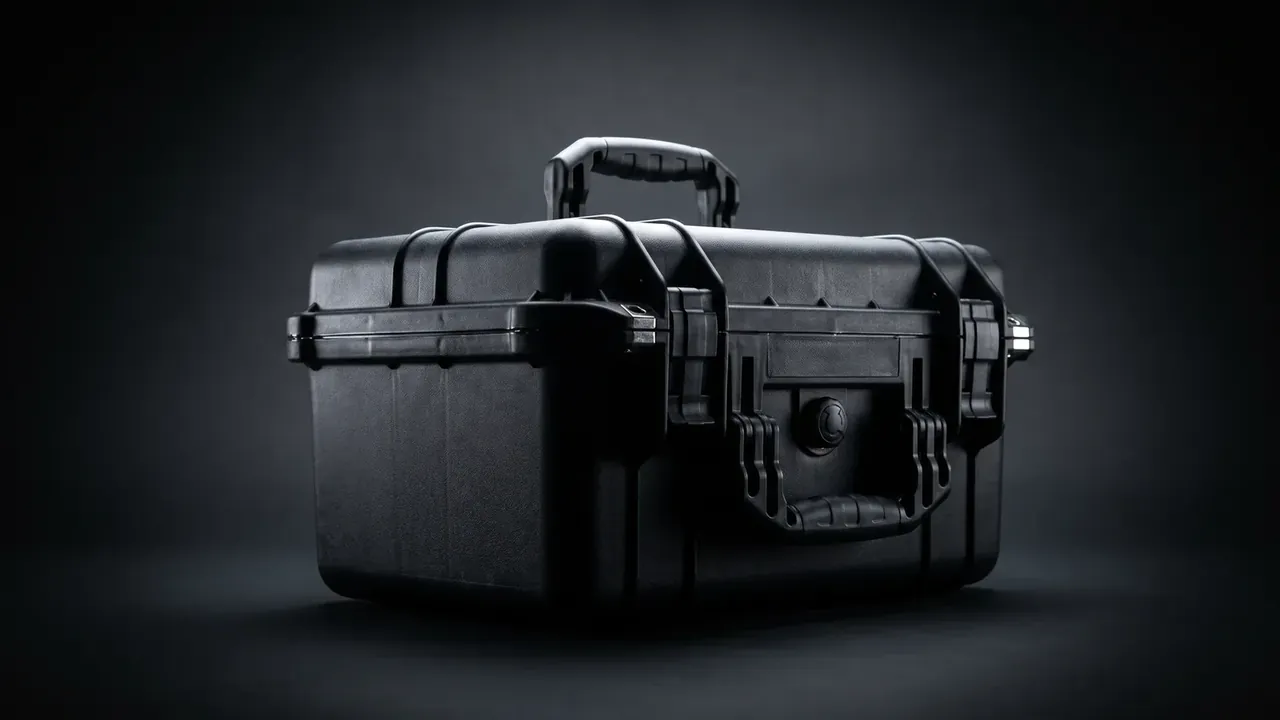
The gap travels inward: a black case at 60 C runs 8 C hotter inside than pale grey. Metal shrugs at 8 C. EVA foam above 60 C creeps out of shape and gasket set climbs, so the lid springs back slowly.
| Shell colour | Solar absorptance | Shell after 2 h in sun | Internal rise |
|---|---|---|---|
| Pale grey | About 0.3 | About 45 C | Reference |
| Mid blue | About 0.6 | About 53 C | 4 to 5 C higher |
| Black | About 0.9 | About 60 C | About 8 C higher |
Mitigation is cheap: a pale lid, brand-coloured sides, or a fine matte texture that scatters light. Black custom color instrument cases trade thermal headroom for recognition — make it deliberately.
5. Adhesion Across Print, Laser and Paint
Each marking method grips differently. Two-part screen ink bonds through polarity and needs 70 C for thirty minutes to crosslink fully. Laser vaporises surface resin into a grey scale 0.05 to 0.1 mm deep, well inside the wall. Paint keys primer to substrate, topcoat to primer — routes custom color instrument cases often combine.
Sequence decides whether it holds. Print within four hours of the oven, while surface energy is still high; past eight hours the ink stops wetting. Print first, clear-coat later, and the solvent must not lift the ink.
| Method | Preparation | Cure | Adhesion check |
|---|---|---|---|
| Screen print | Flame or corona, dyne value above 38 mN/m | 70 C for 30 min | 1 mm cross-hatch, three tape pulls, under 5% loss |
| Laser | Degreased, release agent removed | None | 0.05 to 0.1 mm deep, crisp edges |
| Paint | Dust and oil removed | 60 to 80 C for 30 min | Under 5% loss after cross-hatch, hardness HB |
A cross-hatch knife settles it: a 6 by 6 grid at 1 mm, 3M tape, a pull at 60 degrees, loss read along the cuts. That is where custom color instrument cases finish — colour in the shell, not on it.
Related Reading
- Colour difference at 2 and 5
- How an instrument case is built
- Usable cavity ratio and corner loss
- Foam inserts for instrument cases
JUNZHIJIA
Related Products
- 8 Series — Gun Cases; Military Equipment Cases; Camera Equipment Cases; Drone Cases; Watch Cases; Knife Cases; First Aid Cases; Electronics Equipment Cases
- WL8-2812 PP Gun Case — model WL8-2812
- All protective cases and toolboxes: 7 series, 158 models