

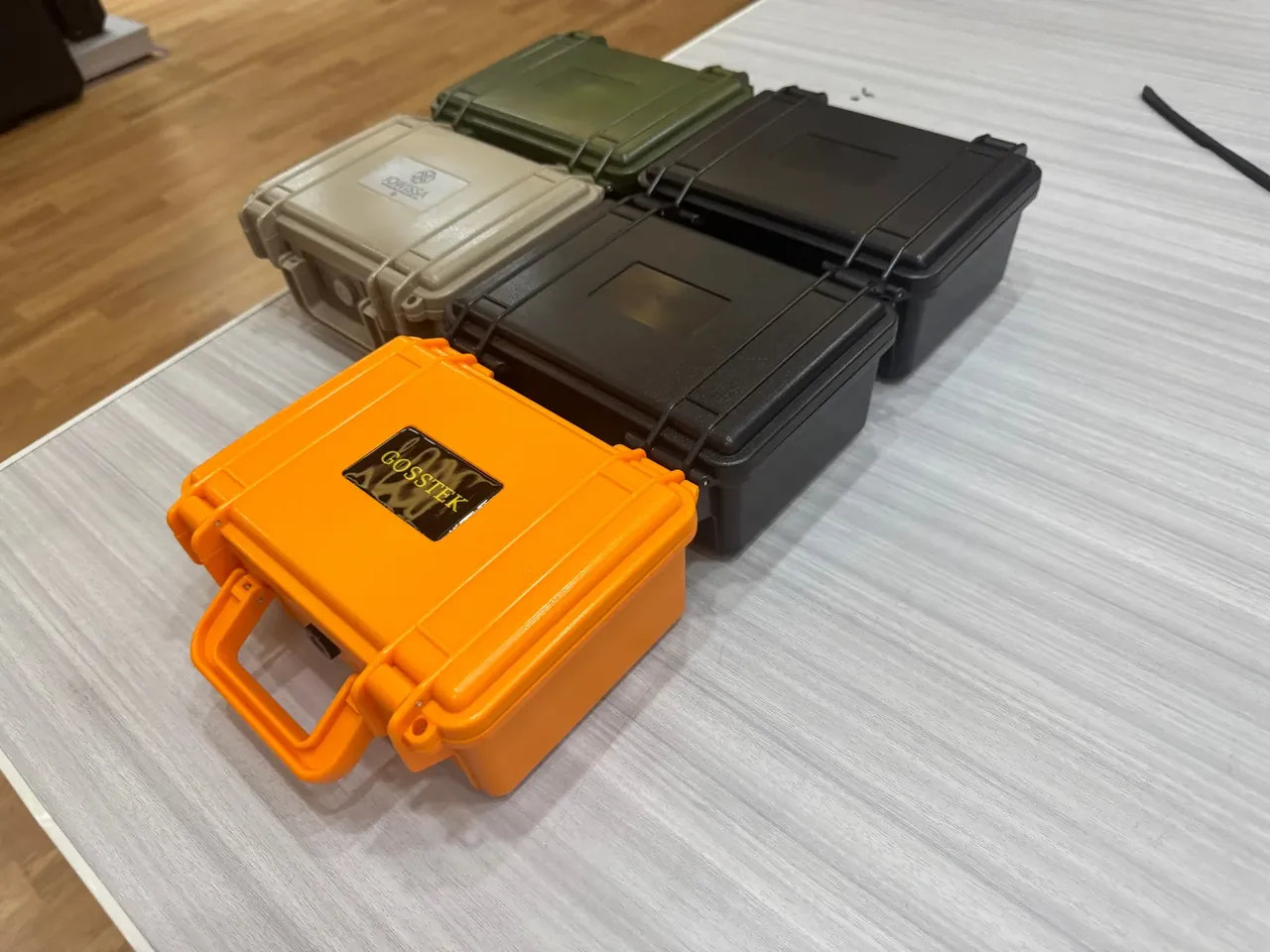
Quick answer: Case colour difference verdicts flip on the formula: one pair reads ΔE76 2.1, ΔE00 1.4 and 2.2 on a sphere, so a line of 2 or 5 needs both fixed.
Table of contents
- Same batch, failed verdict
- ΔE76 and ΔE00: 2.1 against 1.4
- 45/0 against integrating sphere
- Masterbatch lots and mould temperature
- FAQ
1. Same batch, failed verdict
A batch of protective cases sat side by side, identical to the eye, and the spectrophotometer returned ΔE 5.2, failing them. The same case on another instrument read 2.3. Nothing on the case had moved; the verdict had, and the cause is formula and geometry.
Two quantities need separating: ΔE is the total difference, and the formula decides how it is calculated, while the geometry decides how much reflected light reaches the detector. The first turns 2.1 into 1.4, the second turns 1.4 into 2.2, and together they produce the gap between 5.2 and 2.3.
Case colour difference readings split into parts: 0.7 from the formula, 0.8 from the geometry and 3.7 from measurement conditions such as illuminant, viewing angle and sample temperature. A 200-case run of dark grey bodies shows what that costs: 7 cases over 5.0 on ΔE76, 2 on ΔE00, and 4 on the sphere. One batch, three verdicts.
2. ΔE76 and ΔE00: 2.1 against 1.4
Take two cases: A reads L* 62.4, a* −1.8, b* 3.6, and B reads L* 61.2, a* −0.7, b* 5.0. That gives ΔL* 1.2, Δa* 1.1 and Δb* 1.4, and the square root of the sum of squares is ΔE76 2.1, right on the line.
| Component | Difference | ΔE76 weight | ΔE00 divider |
|---|---|---|---|
| ΔL* | 1.2 | 1 | 1.6 |
| Δa* | 1.1 | 1 | 1.05 |
| Δb* | 1.4 | 1 | 1.1 |
| Total | — | 2.1 | 1.4 |
The same pair scores 1.4 on ΔE00, moving from marginal to safe. The gap sits in three weights, lightness SL, chroma SC and hue SH, plus a rotation term RT for the blue region. At L* 62 the divisor is about 1.6, so a 1.2 lightness gap shrinks to 0.75 and the total drops from 2.1 to 1.4.
Plastics use kL = 1; borrowing kL = 2 from textiles scores the same pair at 1.0 and quietly turns a line of 2 into a line of 4, so the firmware default goes in the annex.
Dark parts are more sensitive. Near L* 25 the divisor falls to 0.8 and the same 1.2 gap expands to 1.5, so a line of ΔE 2 equals roughly 1.6 on ΔE76 for a dark case and 2.6 for a pale one.
3. 45/0 against integrating sphere
The two geometries collect different light. A 45/0 instrument illuminates at 45° and views at 0°, excluding the specular component and reading diffuse colour; a d/8 sphere takes that component in SCI mode and removes it with a gloss trap in SCE.
On the same pair, 45/0 returns ΔE00 1.4 and the sphere in SCI returns 2.2, a gap of 0.8 sitting in the gloss of the grey lid.
Writing integrating sphere into a contract is not enough: SCI and SCE differ by 0.5, and 45/0 needs an aperture figure, since 8 mm and 4 mm apertures read 0.3 apart on a ribbed lid.
4. Masterbatch lots and mould temperature
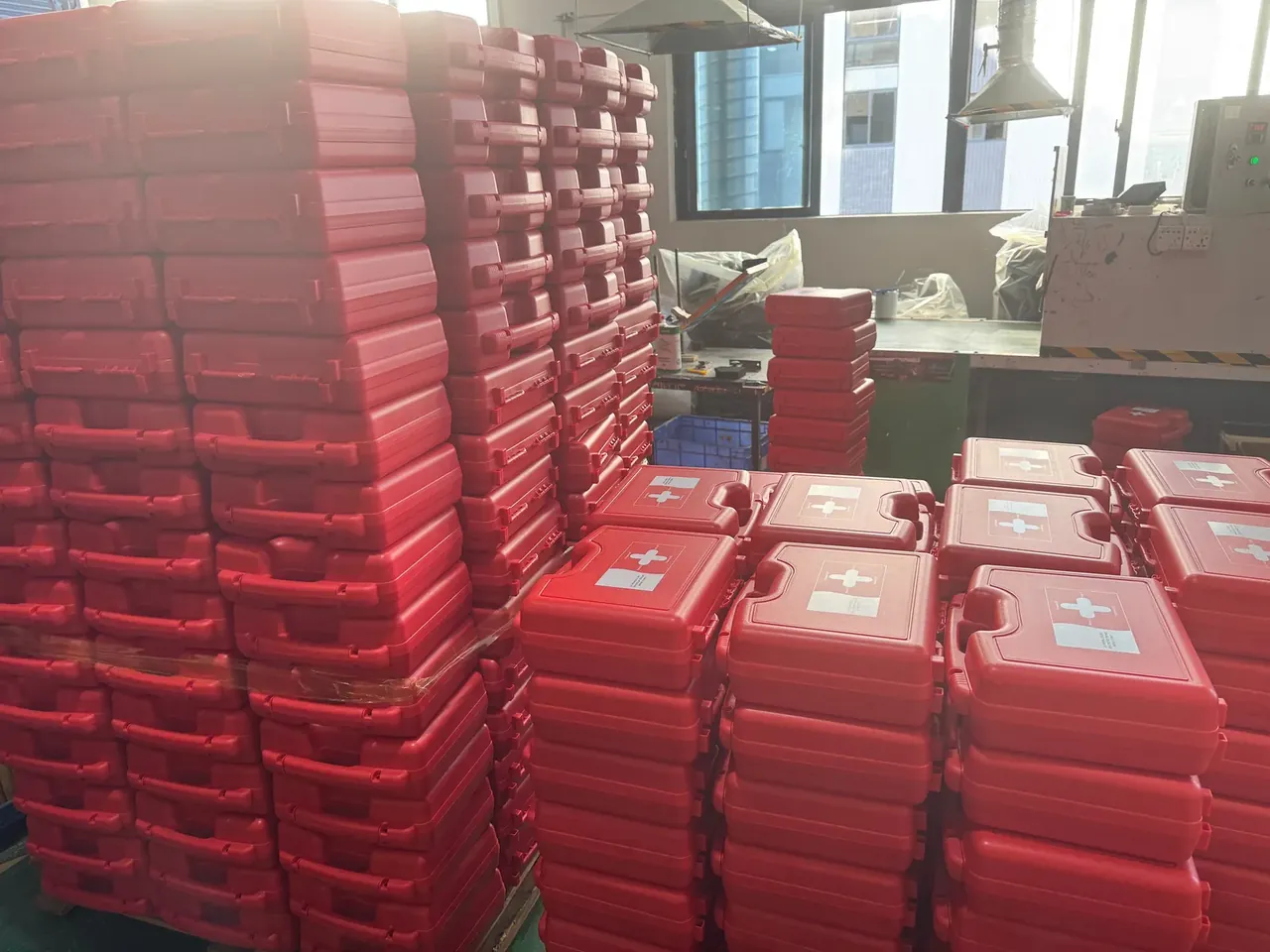
Case colour difference from the process has two sources: pigment loading and mould temperature. Two lots of one grade at 2.4% and 2.6% pigment shift the finished b* by 0.9, which the eye reads as one case looking yellow.
A spread of 8 g/10min disperses poorly and leaves 0.2 mm pale streaks, moving ΔE by 0.6; averaging three points brings that back to 0.2.
Mould temperature works differently. On one tool at 40 °C and 65 °C the lid differs by 1.8 in L*, and by 2.4 on dark parts, with crystallinity 3% apart so the skin shifts from semi-matte to slightly bright. The instrument records a lightness gap; the eye records two different blacks.
Colour changes also need a purge: 30 barrel positions from pale to dark, 60 the other way, and 0.3% residual masterbatch pulls a beige part down by 1.2 in L*. Holding the mould within ±3 °C closes the lightness gap to 0.6.
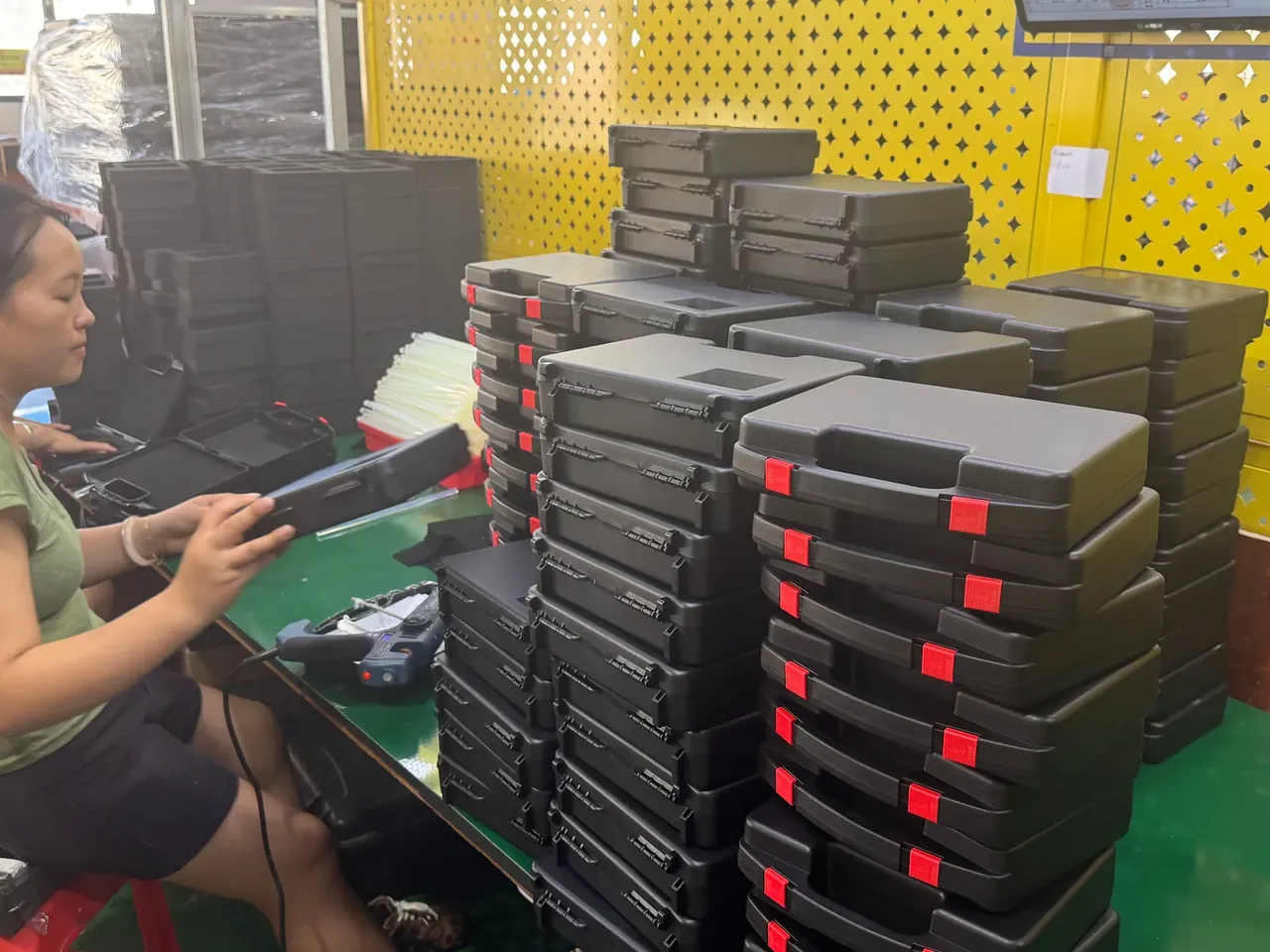
The order is instrument, then eye. Sample five cases per batch, record the largest ΔE00, then have three people judge at D65, 1000 lux, 45° and 30 cm.
Conclusion
Case colour difference clauses only work when they end in sampling numbers and thresholds. Take 3 cases at first-off and open the line only under ΔE00 1.5; take 5 per 500 pieces through the run, release at or under 2.0, add 10 more between 2.0 and 5.0, and reject the lot above 5.0. Keep one retention case per batch for 12 months and compare it before quoting a repeat order, because a reordered batch is judged against the sample rather than the drawing. Write the conditions into the annex: ΔE00, kL = 1, 45/0 or sphere SCE, D65, 8 mm aperture, since a clause missing any one of them cannot be enforced on either side, and the line then reproduces at both plants.
| Stage | Sample | ΔE00 limit | Action |
|---|---|---|---|
| First-off | 3 cases | ≤1.5 | Open the line |
| In run | 5 per 500 | ≤2.0 | Release |
| In run | 5 per 500 | 2.0–5.0 | Add 10 cases |
| In run | 5 per 500 | >5.0 | Reject the lot |
| Retention | 1 per batch | Archive | Keep 12 months |
This article discusses container-side specifications and design implications only, and does not cover any handling, loading or use of the contents.
Related Reading
- Managing case colour on the line
- Masterbatch, colour and surface heat
- Choosing between ABS and PP cases
- Colour control on case hardware
Related Products
- 8 Series — Gun Cases; Military Equipment Cases; Camera Equipment Cases; Drone Cases; Watch Cases; Knife Cases; First Aid Cases; Electronics Equipment Cases
- WL8-2812 PP Gun Case — model WL8-2812
- All protective cases and toolboxes: 7 series, 158 models