

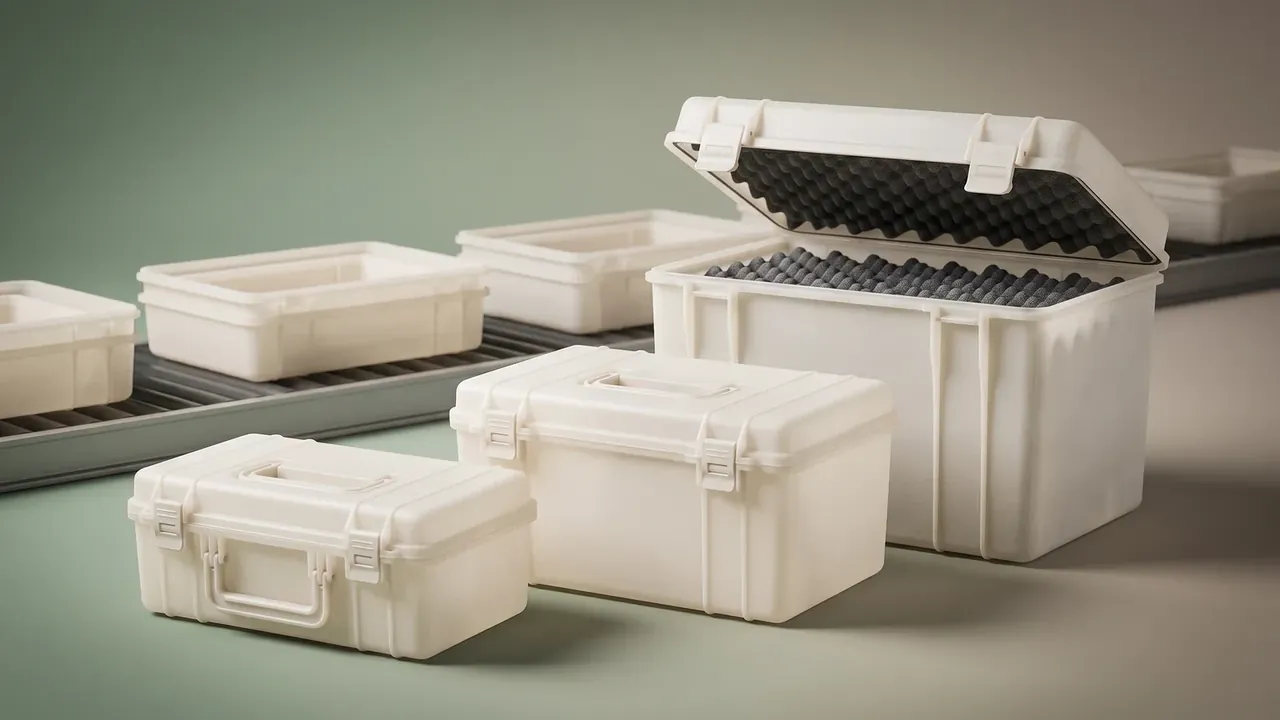
Quick answer: A shade that shifts between batches is rarely a wrong code. It is masterbatch dosing, melt and mould temperature never locked. A custom color plastic case needs the code translated into a dosing ratio, a Delta E limit and a retained sample.
Table of contents
- Custom color plastic case: where the colour drift enters
- From masterbatch ratio to Pantone 4195C
- Delta E 1.5 is measured, not judged by eye
- Sealed samples, retained samples and batch control
- 1000 hours outdoors: UV colour fastness
- FAQ
1. Custom color plastic case: where the colour drift enters
A customer once put three months of dark grey shells on a table and pointed at the middle batch: it read faintly red. All three ran the same Pantone 4195C from one supplier. Colour is the only property of a custom color plastic case guaranteed by a recipe, not a dimension.
Drift is never one thing: base tint, dispersion, drying, residence time and mould temperature each move a little.
| Stage | Symptom | Control point |
|---|---|---|
| Masterbatch dosing | banding within a batch | loss-in-weight, ±0.05%, every 30 min |
| Resin base tint | half-step shift on resupply | 200 g sample, plaqued first |
| Drying | milky haze on pale parts | 80 °C, 2 hours, dew point −20 °C |
| Melt and residence | local yellowing on dark parts | 225–235 °C, under 4 minutes |
| Mould temperature | cavities differing in shade | 60 ±3 °C, spread under 2 °C |
Dosing is hardest to hold: a 0.1 point slip at 2% hides in black and streaks in ivory.
2. From masterbatch ratio to Pantone 4195C
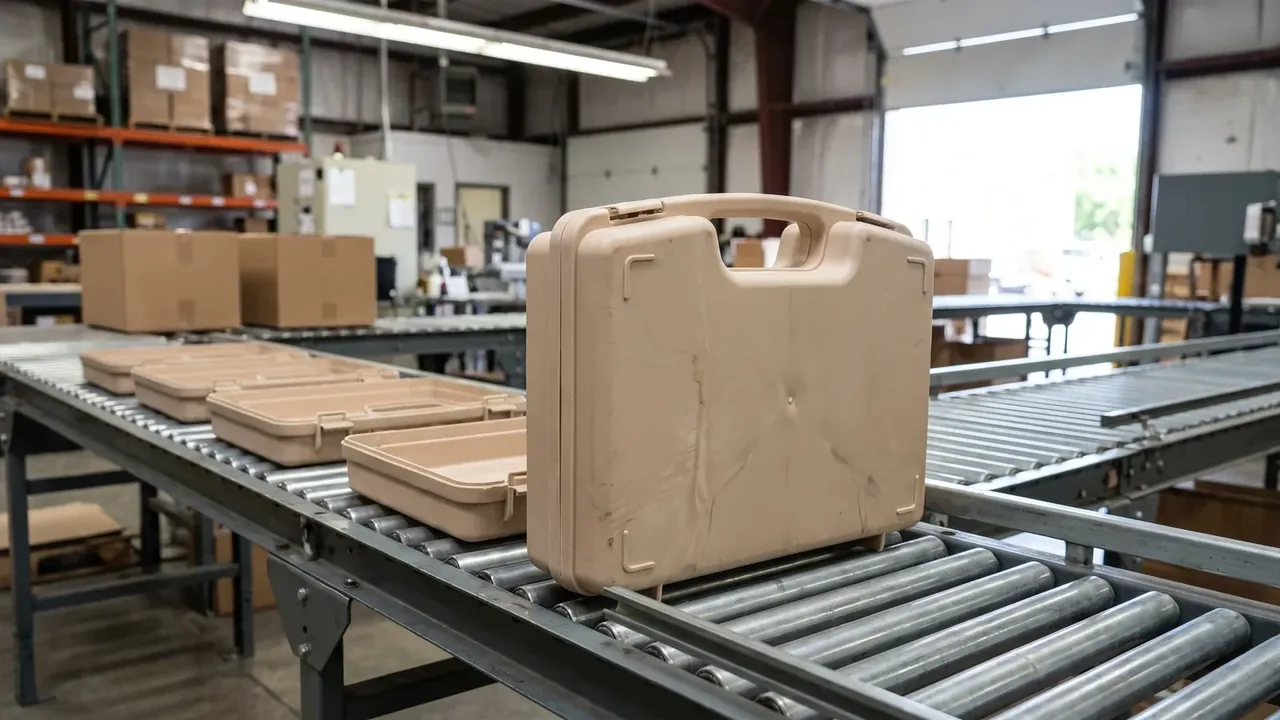
A custom color plastic case code cannot be tabled into a recipe; resin, opacity and texture sit in between. The same 4195C on gloss ABS and textured PP differs by 0.4 points.
| Colour class | Ratio | Minimum run | Proofing |
|---|---|---|---|
| Pale and ivory | 0.8–1.2% plus 0.3% titanium dioxide | 300 pcs | 5 days |
| Mid grey and olive | 1.5–2.2% | 300 pcs | 5 days |
| Dark grey and black | 2.5–3.5% | 300 pcs | 6 days |
| Fluorescent and metallic | above 3.5% plus pearl | 500 pcs | 8 days |
The 300-piece minimum falls out of the pack size: one 25 kg bag at 2% colours 1.25 tonnes, close to 300 shells at 1.8 kg. Below that the bag is bought whole; a colour change adds 40 minutes of purging and 8 kg of scrap.
Pale and dark fail in opposite ways: pale shades rely on titanium dioxide, and one extra point turns them dull; dark shades rely on concentration, and thin walls go translucent. On one shell, a 3 mm wall and a 4.5 mm wall read half a step apart.
3. Delta E 1.5 is measured, not judged by eye
Visual comparison only screens. Judging needs a spectrophotometer at D65, 10 degree observer, 45/0 geometry, three readings averaged.
Delta E splits into Delta L for light and dark, Delta a for red and green, Delta b for yellow and blue. Delta L is what the eye catches: on dark grey, 0.6 reads as a paler batch, while 0.6 in Delta b is blamed on lighting.
Set limits by position: under 0.8 within a batch, 0.8 to 1.5 between batches and against the sealed sample, above 1.5 a rework. Buy a custom color plastic case without those numbers and the argument goes to whoever speaks loudest.
4. Sealed samples, retained samples and batch control
When the first 300 pieces of a custom color plastic case come off the line, five are pulled as sealed samples: three stay at the plant, one goes to the customer, one enters the retention cabinet with the colour code, masterbatch lot and temperature ranges on the label.
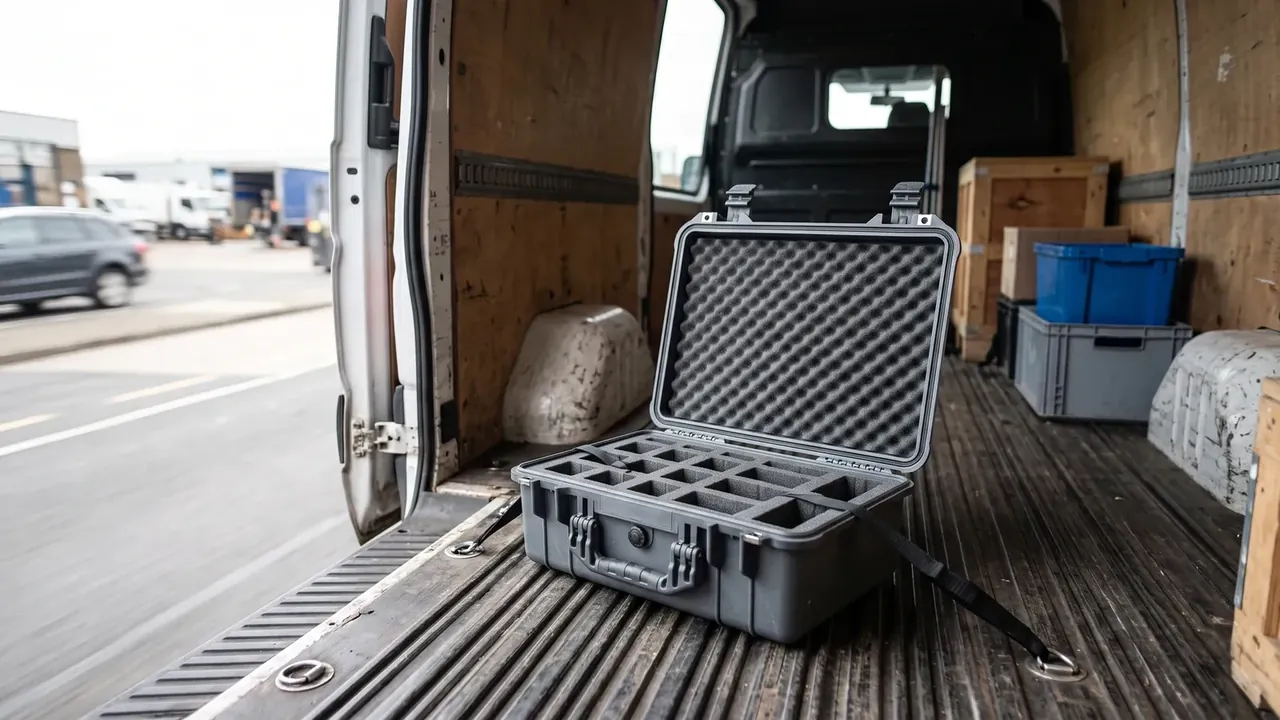
Retention is not paperwork. The cabinet stays dark at 23 ±5 °C, samples are re-read each 12 months, and any code in production beyond 24 months triggers a supplier check.
Batch control runs on three rules: buy the masterbatch for a whole order at once, re-plaque after any lot change, and hold the line when a five-piece trial reads above 1.5. The second bag can carry the same grade name one dispersion class lower; dark parts then cloud at Delta E 1.2, passing on the instrument and failing in the hand.
5. 1000 hours outdoors: UV colour fastness
Outdoor use adds a test unrelated to matching a code. Xenon arc exposure runs to four fixed conditions:
- Irradiance 0.51 W/m² at 340 nm, black panel 65 °C
- 50% humidity, 18 minutes spray and 102 minutes dry per cycle
- 1000 hours accumulated, roughly two years of sun
- Pass at grey scale 4 or better, Delta E no higher than 3
Olive and mid grey stay under 1.5 at 500 hours; by 1000, a compound without UV additive jumps past 3 and fades visibly. Adding 0.5% hindered amine light stabiliser with a weather-grade masterbatch pulls 1000-hour Delta E back under 2.
Conclusion
Colour is settled by paper, not by eye: a code turned into a dosing ratio and a minimum run, Delta E into 0.8 in-batch and 1.5 between, retained samples into 24 months of traceability. A custom color plastic case carrying all three argues about numbers, not perception; outdoors, add 1000 hours of UV.
This article discusses only the container (case body) side of specifications and design intent, and does not cover any handling, loading or use of the contents.
Related Reading
- Where the colour of a coloured case comes from
- Colour codes and acceptance limits
- Specification logic for instrument cases
- Structure and cushioning in shockproof cases
Related Products
- 8 Series — Gun Cases; Military Equipment Cases; Camera Equipment Cases; Drone Cases; Watch Cases; Knife Cases; First Aid Cases; Electronics Equipment Cases
- WL8-2812 PP Gun Case — model WL8-2812
- All protective cases and toolboxes: 7 series, 158 models