

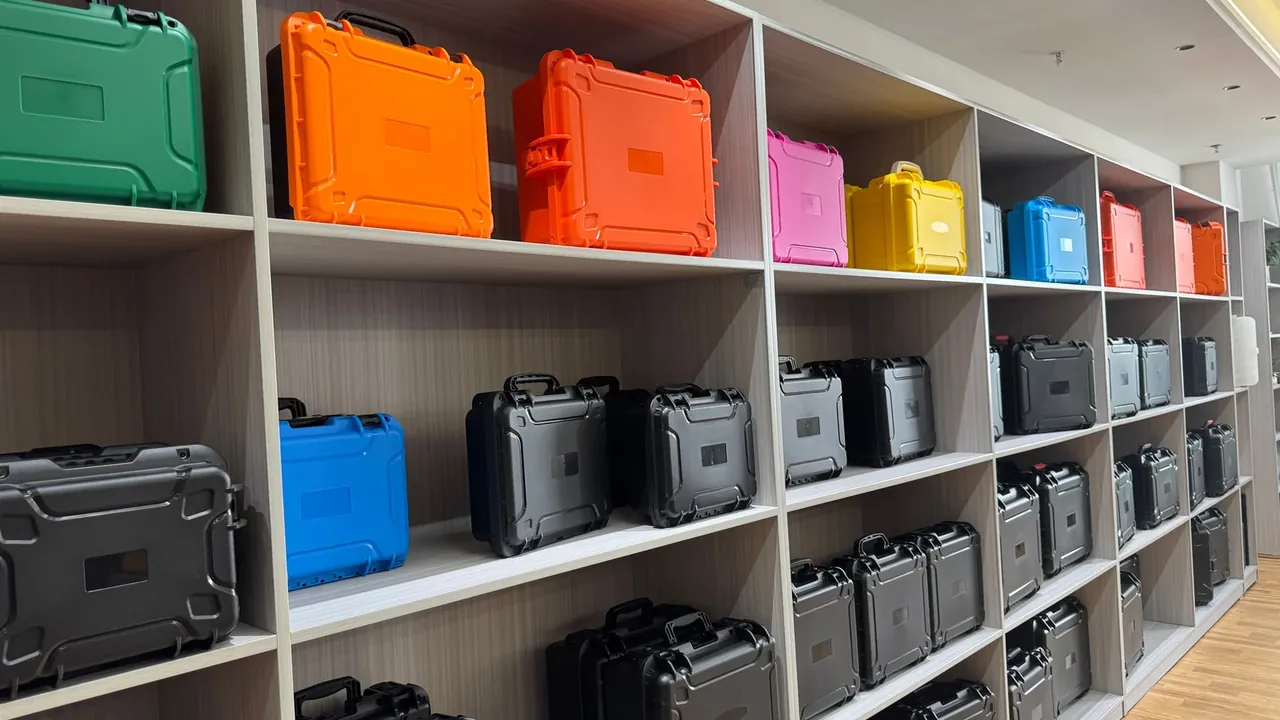
Quick answer: Custom Colors for Industrial Cases starts with a swatch and ends with ΔE: colour code, masterbatch ratio, gloss and a signed panel in the order.
Table of contents
- Where the Colour Code Comes From
- Masterbatch Ratio and Dispersion
- Accepting Batch Colour Difference by ΔE
- Gloss and Surface Texture Pull Both Ways
- Outdoor Fading and Weather Testing
- FAQ
1. Where the Colour Code Comes From
The brief arrives as a chipped shell with a note asking for this exact colour. For Custom Colors for Industrial Cases, matching it is the easy half; matching it again three months later is where projects slip. A printed fan is paper; a customer sample is already faded; a library repeats only if every code carries a retained panel.
Custom Colors for Industrial Cases begins by fixing the reference, not by picking a shade. Read the sample at five points, skip scratches and curves, and take the median; treat the fan as direction only and let the moulded panel decide. A library of 12 codes covers olive, orange, red, yellow, blue, pink and black, each tied to one masterbatch recipe.
Make 3 panels from one shot on one tool: one to the customer for sign-off, one sealed in the file, one on the line as a comparator. Mix batches and the comparison is worthless. Sampling runs 7 days including matching, moulding and measurement.
| Colour code | Industry | Masterbatch | Gloss |
|---|---|---|---|
| Olive 12 | Outdoor gear, survey kits | 3.5% | 10 GU |
| Safety orange 04 | Rescue, road works | 4% | 9 GU |
| Deep black 01 | Instruments, audio | 3% | 12 GU |
| Warm grey 07 | Medical, test equipment | 2.5% | 8 GU |
2. Masterbatch Ratio and Dispersion
In Custom Colors for Industrial Cases, ratio is the first gate on colour stability. The working band is 2%–4%: below 2% the resin base shows through and hue drifts across one moulding; above 4% the colour overshoots while impact strength and finish fall, at extra cost. Once the ratio is in the order, leave it alone mid-run.
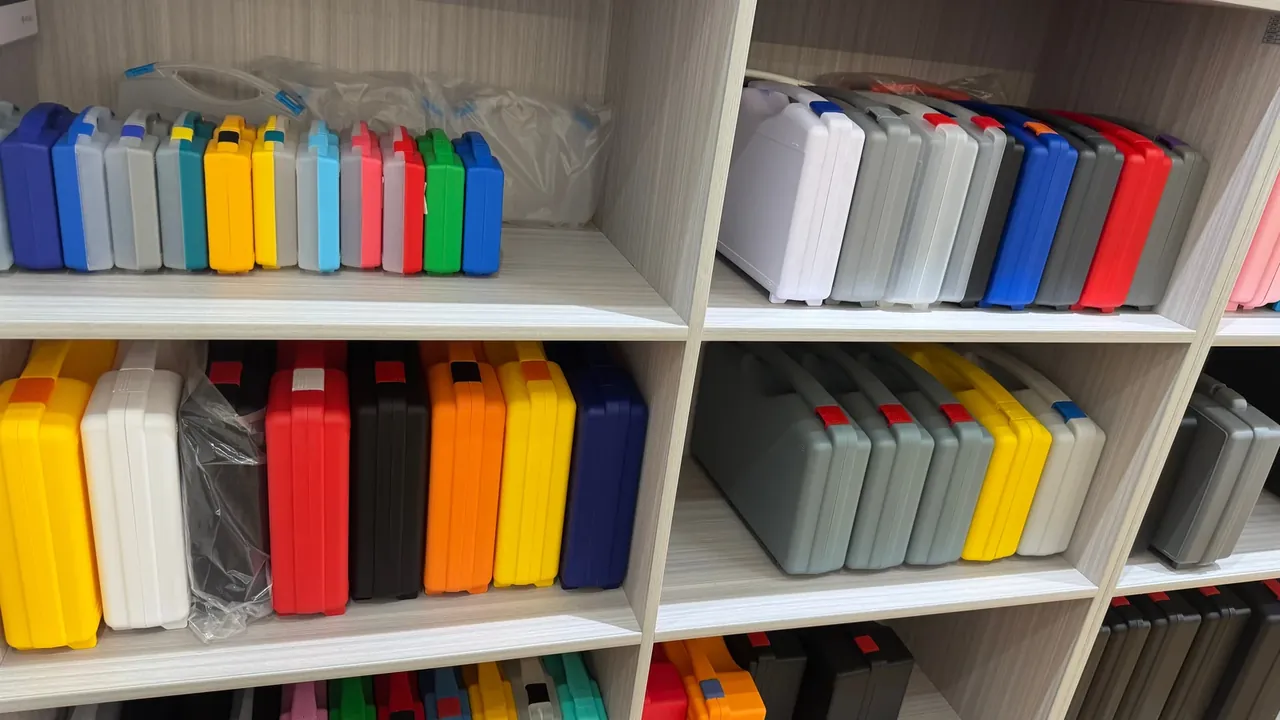
Dispersion is harder to hold than ratio. When masterbatch and resin differ by one step in melt flow index, the screw cannot blend them and the surface shows specks or cloud-like streaks. Low back pressure leaves the melt under-sheared and stretches those streaks along the flow path; an overheated barrel degrades pigment for good. Cut a section through a trial part: if the core matches the skin, dispersion passes.
Colour changes hide another cost. Dark to light needs purging compound, since a trace in the screw or hot runner marks every pale part; light to dark still needs several shots to settle. That scrap belongs in the quotation, especially under 500 pieces.
3. Accepting Batch Colour Difference by ΔE
ΔE turns colour difference into one number, the CIELAB distance between a standard panel and a submitted part. Two lines apply: ΔE ≤2 across batches, ΔE ≤1.5 within a batch. The first asks whether a repeat order joins the earlier shipment; the second whether cases side by side look like one product.
Fix geometry and illuminant first: a 45/0 spectrophotometer, D65 light, 10° observer, calibrated on the white tile, measured on a flat area and averaged over three points. Visual checks go in a booth under D65 and TL84 in turn, because metamerism only shows when the source changes.
Put the rejection rule in the contract: sample 5 cases per batch, and if any single one exceeds ΔE 2 against the standard panel, Custom Colors for Industrial Cases sends that batch back for colour matching.
| Check item | Limit | Sample size | Verdict |
|---|---|---|---|
| Batch-to-batch ΔE | ≤2 | 5 pcs per batch | Above 2, rematch colour |
| Within-batch ΔE | ≤1.5 | 5 pcs per batch | Above 1.5, sort |
| Against signed panel | No visual gap | 3 pcs per batch | Dispute, re-measure |
| Specks and streaks | None visible | 100% | Scrap the part |
4. Gloss and Surface Texture Pull Both Ways
One colour code looks like two colours on a polished face and on a leather grain. A 60° gloss of 8–12 GU sits in the matte band, where light scatters and the shade reads deep; push gloss higher and specular reflection lifts measured lightness by half a step. Custom Colors for Industrial Cases ties gloss to the code for this reason: colour passes while the object still looks wrong.
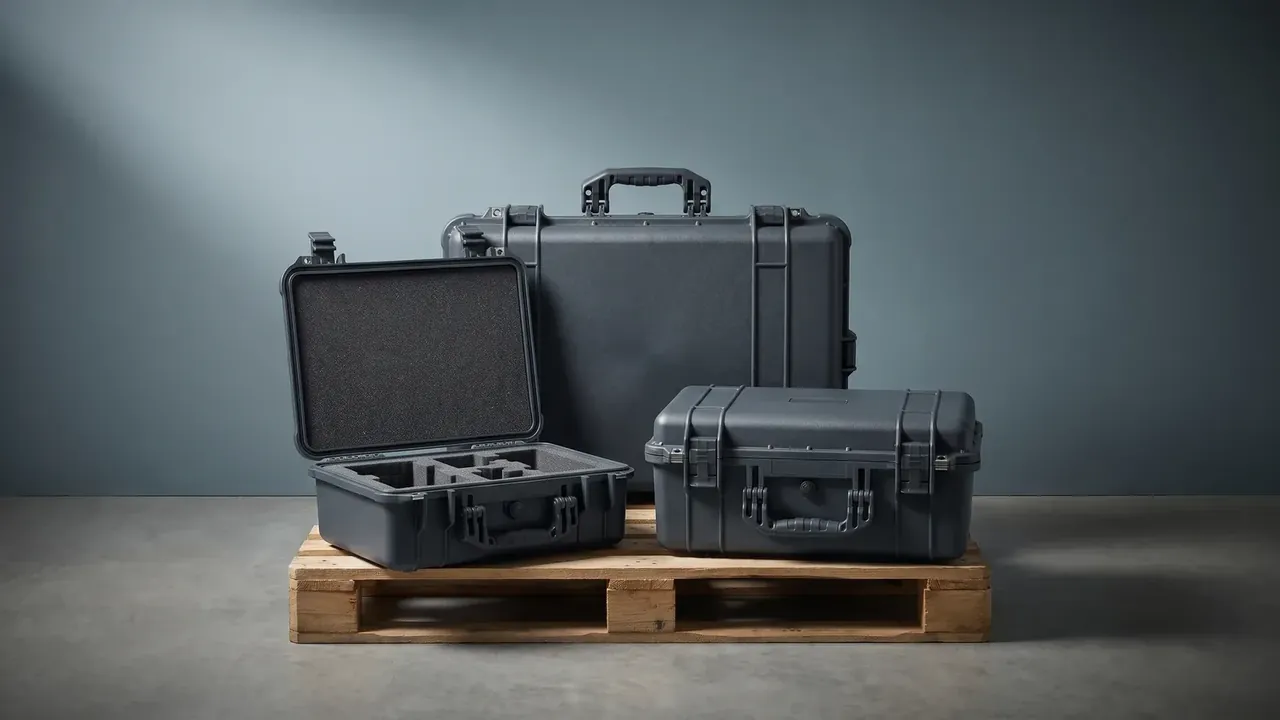
Grain depth sets how well a surface hides scratches. Fine grain shows every deep mark but stays even and cleans easily; coarse grain swallows service scuffs at the price of trapped dust and a half-step drop in lightness. Grain comes from the etch in the tool, and re-etching means cutting steel, so settle texture and gloss before signing a code in Custom Colors for Industrial Cases. Reverse the order and the panels are made twice.
| Texture | Suggested gloss | Scratch hiding | Typical use |
|---|---|---|---|
| Fine sand | 8–10 GU | Weak, shallow marks show | Medical, test gear |
| Medium grain | 10–12 GU | Moderate, daily scuffs hide | Instrument cases |
| Coarse peel | 8–9 GU | Strong, knocks vanish | Outdoor, site work |
| Flat matte | 10–12 GU | Weak, needs upkeep | Showroom, rentals |
5. Outdoor Fading and Weather Testing
Sunlight and heat erode colour together, which is why Custom Colors for Industrial Cases treats xenon-arc exposure as the first outdoor gate. A run of 300 h approximates a year of temperate sunlight; compare the exposed panel with the retained one, and a ΔE above 2 rules the recipe out. Dark shells absorb more heat and reach 60 °C on a summer lid, so pigment fades faster, olive and navy worst of all.
Weathering has to be judged with gloss. Fading arrives with chalking: ultraviolet breaks the surface resin, the face feels chalky and gloss drops below 5 GU. The colour reads unchanged while the finish is aged. Outdoor grades carry UV absorbers and hindered amine stabilisers, which lift the price; small orders skip them and pay two summers later.
Two-tone parts add a joint to the problem. Mould each colour separately and the sides must still sit within ΔE ≤1.5, or the assembly looks like two materials; overmoulding both in one tool holds the match tighter but raises the bar on tooling. At JUNZHIJIA the colour code, texture and gloss sit on one process card, and changing any one requires a new signed panel.
Related Reading
- What a custom colour specification has to state
- Running colour visual management on the line
- ΔE 2 against ΔE 5 in practice
- Cartons against plastic cases for e-commerce
Related Products
- 8 Series — Gun Cases; Military Equipment Cases; Camera Equipment Cases; Drone Cases; Watch Cases; Knife Cases; First Aid Cases; Electronics Equipment Cases
- WL8-2812 PP Gun Case — model WL8-2812
- All protective cases and toolboxes: 7 series, 158 models