

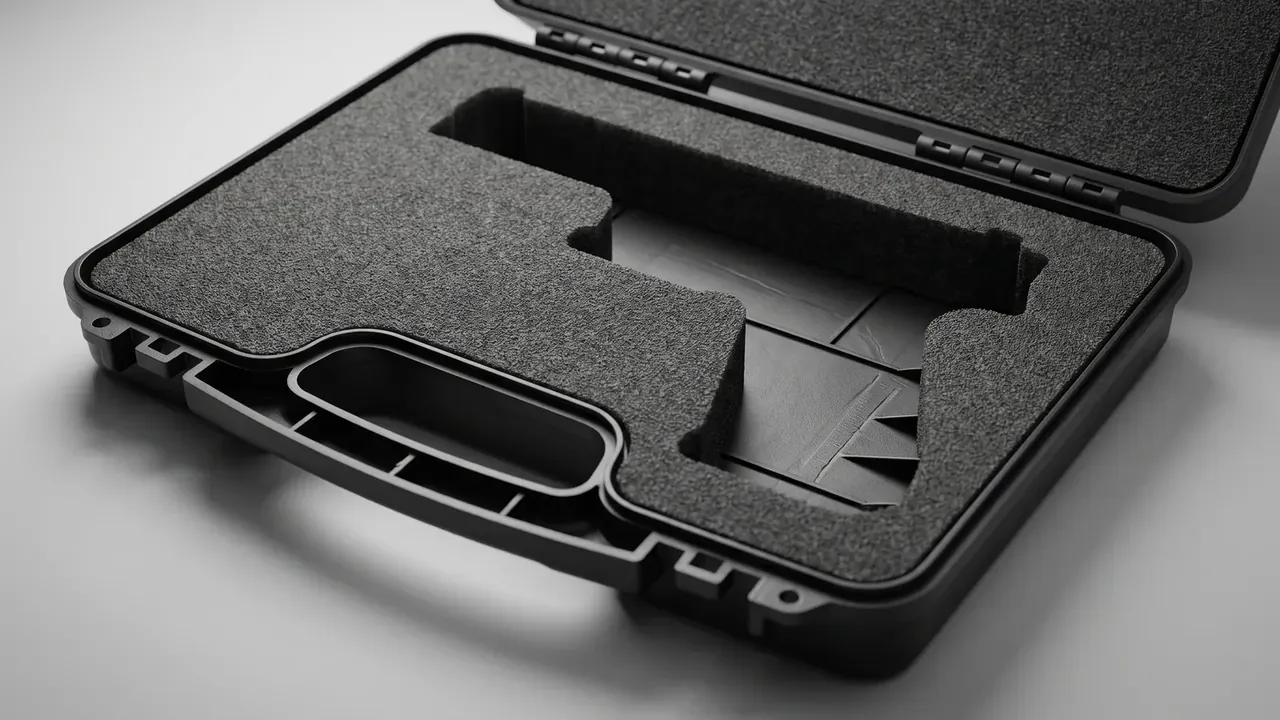
Quick answer: The Custom Construction Tool Case Factory sets lid ribs at 62 mm centres and 3.8 mm height, so a 12 kg drop from 1.2 m keeps the dent radius under 1.4 mm.
Table of contents
- Drop Conditions Facing a Custom Construction Tool Case Factory
- Lid Rib Spacing and Dent Radius
- Dust Lip Height
- Closing Force After the Sand and Dust Test
- Fixed Rib Spacing for Site Batches
- FAQ
1. Drop Conditions Facing a Custom Construction Tool Case Factory
A 12 kg object falling from 1.2 m lands on a lid spanning close to 500 mm, and dent depth is settled by rib spacing before anything else. Couplers, pipe offcuts and hand tools dropped on site weigh 8 kg to 15 kg, and they strike the lid centre or the narrow strip near the rim, where stiffness is lowest. At 585×405×235 mm outside and 520×345×175 mm inside, a 4.4 mm wall acts as a flexible plate: it bends first, then dents.
The Custom Construction Tool Case Factory reads three points: lid centre, a strip 40 mm inside the rim, and the area above a latch seat. Each follows a different support path, and the strip, held on one side only, spreads widest.
Openings cut the rib run. A window or handle slot drives impact toward the corner, so an 8 mm collar rib at 3.8 mm height carries load into the next cells; a lower collar just creates a new weak point.
Site dust joins the drop. Airborne grit runs 20 μm to 80 μm, each open-close cycle lays a film on the joint, and the Custom Construction Tool Case Factory logs closing force and dent radius at one bench.
2. Lid Rib Spacing and Dent Radius
Spacing of 62 mm with 3.8 mm rib height comes from lid span and impact points together. Tighten to 48 mm and radius falls another 0.2 mm, but roots crowd, cooling slows and sink marks reach the lid face; open to 78 mm and a centre impact pushes radius past 1.4 mm.
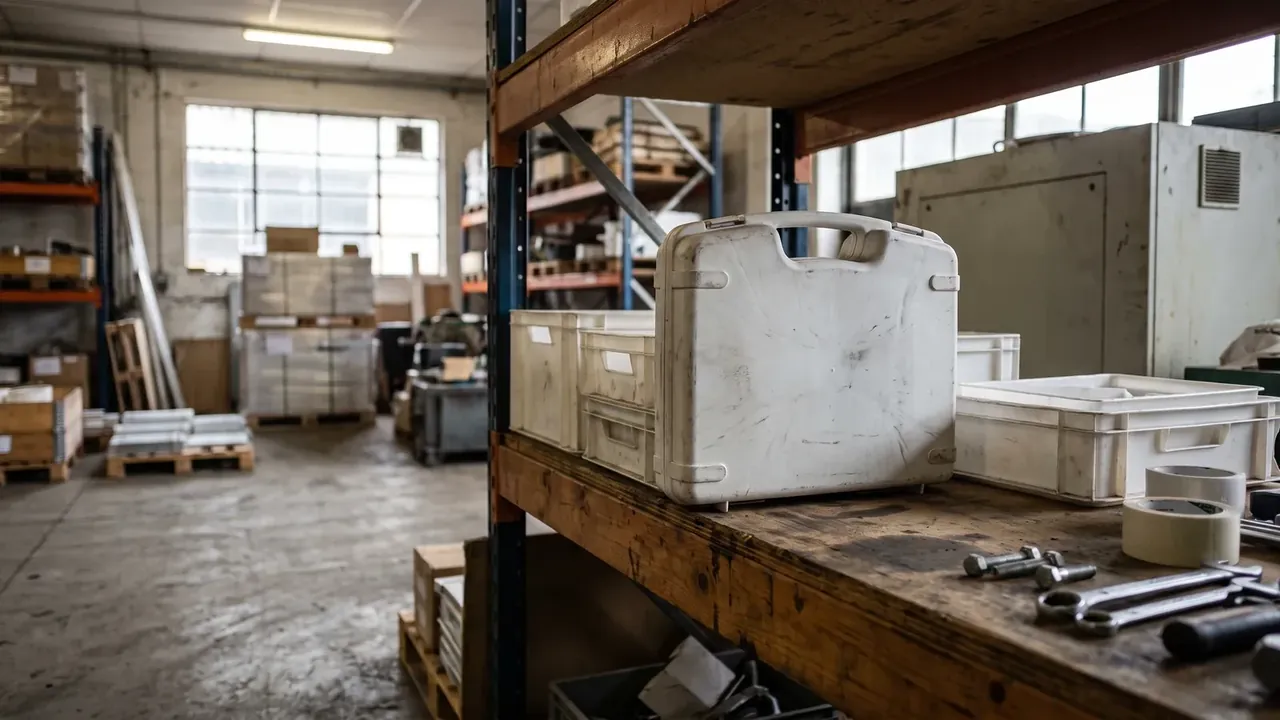
The Custom Construction Tool Case Factory reads radius with gauges from 0.5 mm to 2.5 mm in 0.2 mm steps until one stops seating. Three strikes at the same point sit at least 5 min apart so the lid recovers, and the largest value is kept. Centre and rim strip are logged as separate groups.
| Rib spacing tier | Cell width | Dent radius at impact |
|---|---|---|
| Dense | 48 mm | ≤1.1 mm |
| Standard | 62 mm | ≤1.4 mm |
| Open | 78 mm | 1.6–2.0 mm |
| Beyond | 90 mm | Cell centre sags |
Drops run in rounds of 12 kg from 1.2 m, with radius read after rounds 1, 6 and 12. Growth is steep for six rounds and flattens after twelve, where a further strike adds about 0.1 mm.
| Drop round | Cumulative strikes | Dent radius |
|---|---|---|
| First | 1 strike | ≤0.9 mm |
| Middle | 6 strikes | ≤1.2 mm |
| Final | 12 strikes | ≤1.4 mm |
3. Dust Lip Height
The Custom Construction Tool Case Factory runs a 2.2 mm lip down the inside of the rim, meeting the mouth before the sealing face so grit stays out of the groove. Too short and particles press into the groove; too tall and the lip must buckle before closure, which raises force instead of lowering it.
Compression is held at 0.5 mm, about a fifth of lip height, and comes from latch travel rather than extra lip. Change the lip and the mouth fit moves with it, which sends the insert back to the tool room.
Dust testing follows IP6X conditions in GB/T 4208: talc through a 75 μm sieve at 2 kg/m³, partial vacuum at or under 2 kPa, for 8 h. The lip and groove are then opened and checked for visible deposits. The water half of IP66 is sprayed separately, and the Custom Construction Tool Case Factory keeps the two results apart.
4. Closing Force After the Sand and Dust Test
Closing force is read at the middle of the rim with a push-pull gauge, travelling from open to latched, peak kept. A new case reads 55 N to 70 N; after 8 h of dust it may rise, but 85 N is the ceiling, because above that one hand cannot shut the lid and a gloved hand has no chance.
Grit between lip and groove dries the contact, and dust in the latch pivot stiffens rotation. The Custom Construction Tool Case Factory measures before and after wiping the lip, records the gap as the dust effect, and checks compression whenever that gap passes 10 N.
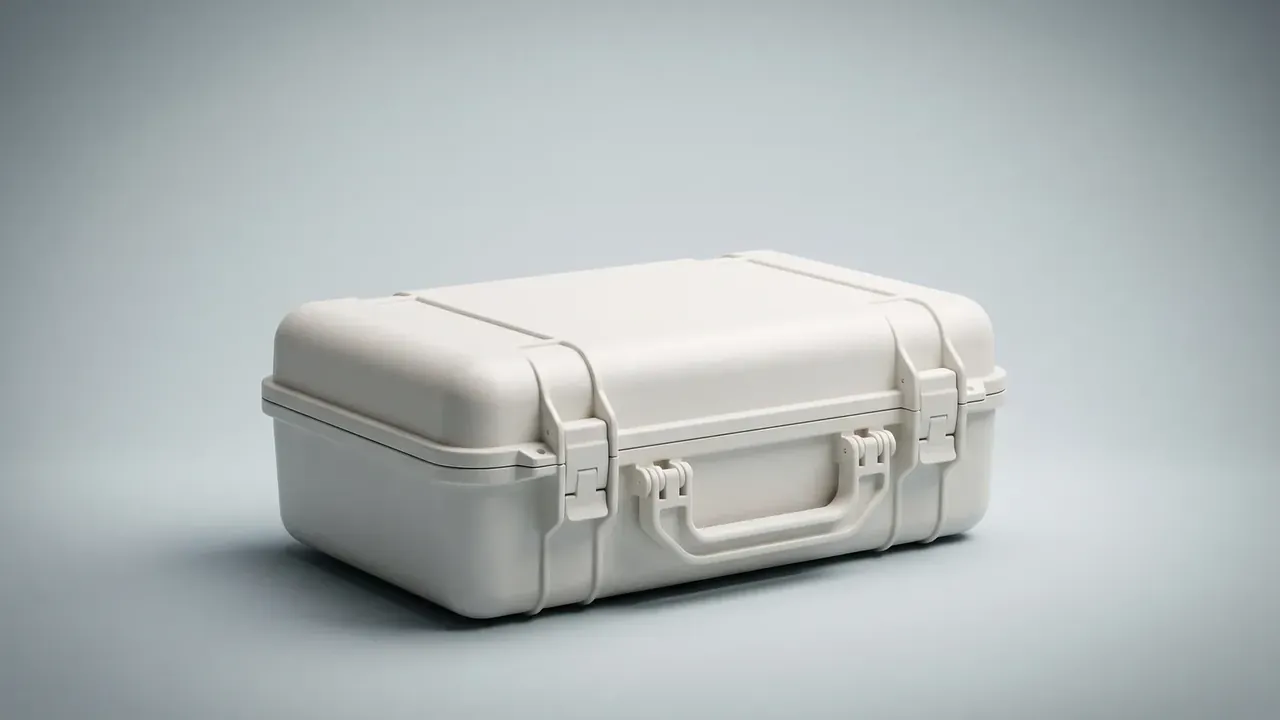
Four latches are set to 395 N each and rechecked after dust; one below 340 N is replaced. The 3,800-cycle rig runs to the end and closing force is read again, still at or under 85 N, pausing every 500 cycles for lip compression and latch travel.
5. Fixed Rib Spacing for Site Batches
The widest spacing that holds radius below 1.4 mm after the twelfth drop becomes the fixed value, and anything more open is left to light-duty samples. That makes the 62 mm tier the default for site batches and keeps the dense tier for lids with many openings.
Lifting holes are 26 mm across, one per corner, each proof-loaded to 180 kg without cracking at the bore. Lifting and dropping load the shell differently, so bore cracking and dent radius sit in separate columns.
| Dent reading | Rib spacing | Batch decision |
|---|---|---|
| ≤1.1 mm | 48 mm | Re-grade downward |
| 1.2 mm | 62 mm | Release |
| 1.4 mm | 62 mm | Boundary release |
| 1.6 mm | 78 mm | Return for review |
Each batch takes 5 cases for drops, 3 for dust and 2 for the rig, with no case moved between groups. The Custom Construction Tool Case Factory files spacing, radius and force in one column, so a drifted batch traces back to its insert change.
Conclusion
Three numbers govern the site case: 62 mm rib spacing holding a 1.4 mm dent radius, a 2.2 mm lip keeping grit out of the groove, and closing force under 85 N after 8 h of dust. A 12 kg drop from 1.2 m is judged at the twelfth round, while four latches at 395 N and a 3,800-cycle rig hold that line, and the Custom Construction Tool Case Factory signs the batch on those readings.
Related Reading
- Cavity Size to Usable Ratio
- Case and Carton: Where Each Fits
- Trolley Tool Case Procurement: Three Quote Stages
- Industrial Tool Case Factory Direct Supply
- Factory Maintenance Tool Case
Related Products
- 8 Series — Gun Cases; Military Equipment Cases; Camera Equipment Cases; Drone Cases; Watch Cases; Knife Cases; First Aid Cases; Electronics Equipment Cases
- WL8-2812 PP Gun Case — model WL8-2812
- All protective cases and toolboxes: 7 series, 158 models