

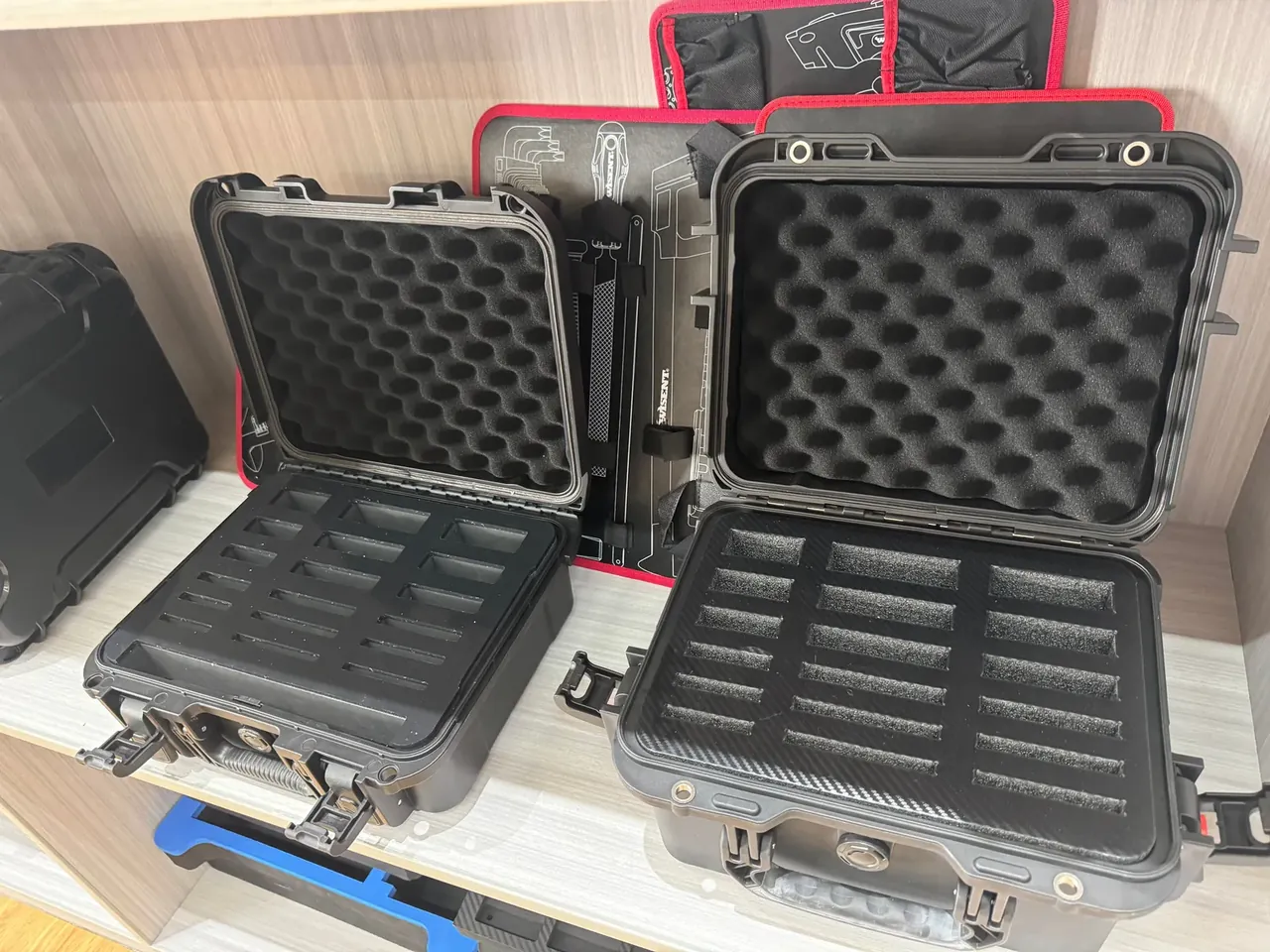
Quick answer: In Custom Foam for Military Cases, a 12 mm wall of 35 kg/m³ foam must shrink below 0.8 mm after 24 h at -25 °C and rebound above 90% on rewarming.
Table of contents
- Density Tiers in Custom Foam for Military Cases
- Cell Wall Thickness and Cutting Allowance
- Slot Wall Shrink After a Minus-Twenty-Five-Degree Freeze
- Foam Rebound Once the Case Rewarms
- Locking the Density Tier for a Custom Batch
- FAQ
1. Density Tiers in Custom Foam for Military Cases
How much foam is left once the cells are cut shows itself after one cold night; mismatch density and wall thickness and the slot walls give way first. Custom Foam for Military Cases starts from a 620×440×250 mm shell with a 550×375×185 mm cavity and a 4.6 mm wall, so the insert volume is fixed once the drawing is signed.
JUNZHIJIA trial-cuts one shell against 28, 35 and 42 kg/m³ foam, holding the cell wall at 12 mm. The light grade cuts easily but carries more voids and softens first in the cold; the heavy grade springs back well yet drags on the blade and chips at corners. 35 kg/m³ sits between them, the one tier where both readings still have room.
| Density tier | Foam density | Slot after 24 h |
|---|---|---|
| Low | 28 kg/m³ | 65.0 mm |
| Middle | 35 kg/m³ | 65.4 mm |
| High | 42 kg/m³ | 65.7 mm |
All three rows start at the same slot width; Custom Foam for Military Cases picks the one that holds its shape after 24 h without wasting stock.
2. Cell Wall Thickness and Cutting Allowance
The 12 mm cell wall in Custom Foam for Military Cases is derived from the 550×375×185 mm cavity, not rounded to a convenient figure: a thin wall bends first in the cold, a thick wall forces fewer cells. Cutting allowance stays at the floor of each cell, where the tool stops short, and that uncut skin works with the 4.6 mm shell wall to stop the insert sliding on the base.
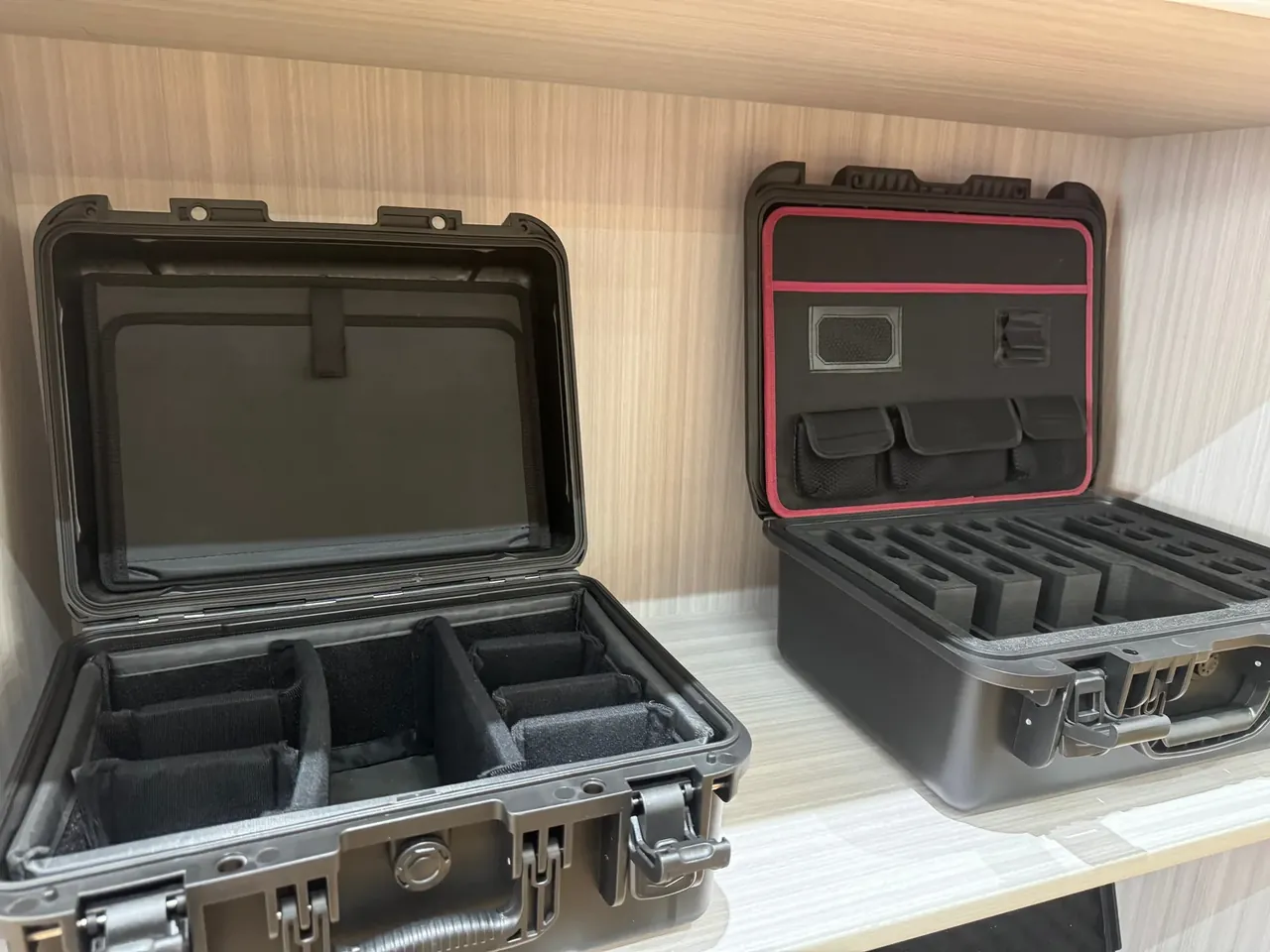
At this stage Custom Foam for Military Cases checks the cutting drawing and the lid liner apart: convoluted foam presses from the lid, the cells carry the load from the base, and the two never share one sheet. A rig logging 4200 open-close cycles checks the walls at intervals before the cold stage.
Four latches at 410 N each press through the lid, and the cell walls must not collapse under that load; two gasket rings at 21% compression seal the opening so dry cold air cannot creep in along the seam. These figures are booked apart from the liner so a leak deformation is not read as foam shrinkage.
3. Slot Wall Shrink After a Minus-Twenty-Five-Degree Freeze
For the cold stage the liner goes into -25 °C with its shell and sits 24 h, unopened and unmoved, before the walls are measured. Custom Foam for Military Cases tracks drift in slot width and depth: cell walls contract as temperature falls, and thinner, lighter walls cross the 0.8 mm line sooner. A gauge takes three readings per wall and the largest offset becomes that tier's shrink value.
| Freeze interval | Chamber | Slot widths (low / middle / high) |
|---|---|---|
| 0 h | Room | 66.0 / 66.0 / 66.0 mm |
| 12 h | -25 °C | 65.4 / 65.7 / 65.9 mm |
| 24 h | -25 °C | 65.0 / 65.4 / 65.7 mm |
At 12 h the three widths are still bunched; the second half of the soak pulls them apart, which is why Custom Foam for Military Cases keeps 24 h as the shortest window separating the readings.
4. Foam Rebound Once the Case Rewarms
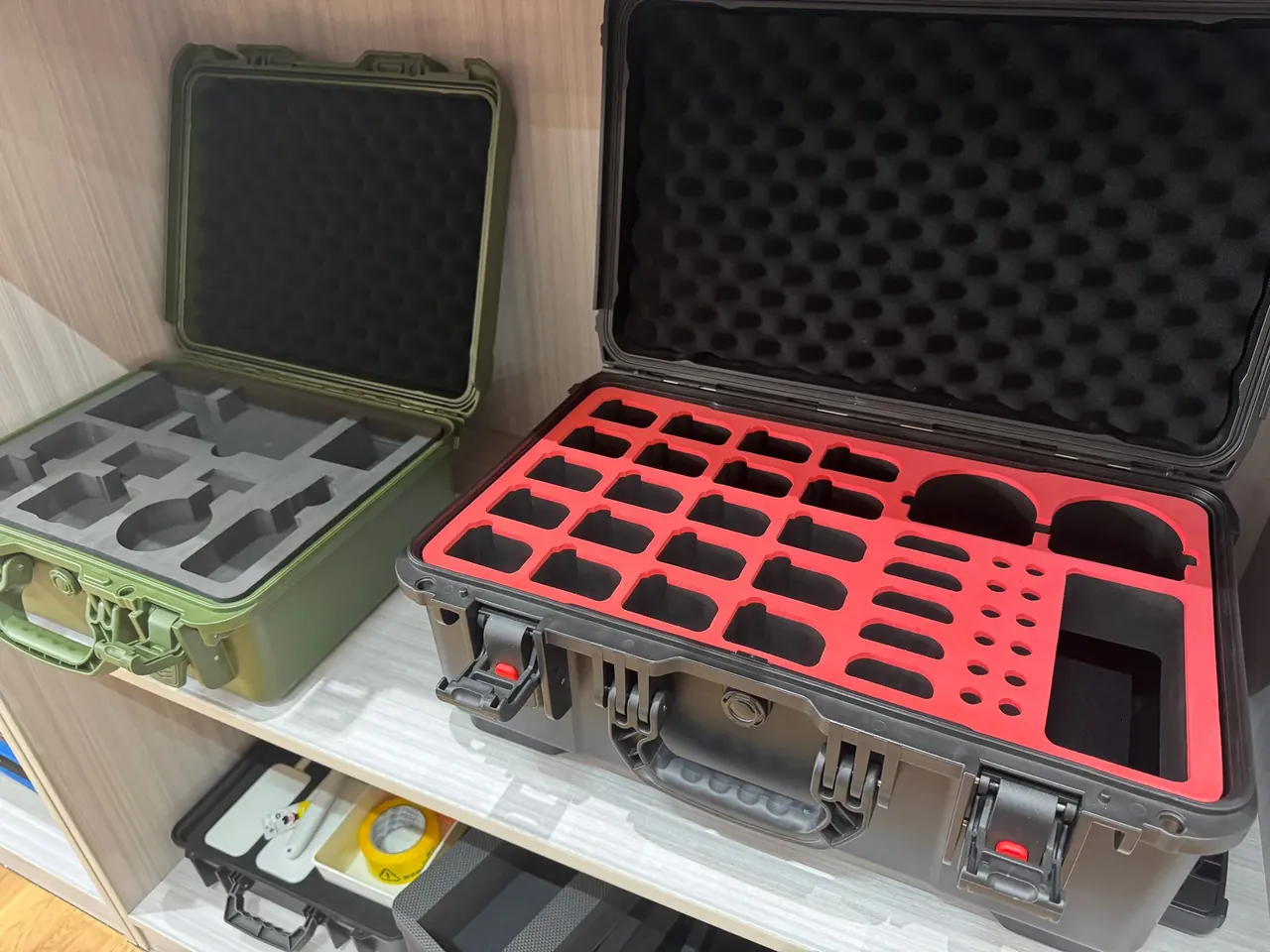
The liner is not judged the instant it leaves the chamber: the shell returns to room temperature first, then the slot is measured again. A rebound of at least 90% is the hard line for keeping a tier, since shrink that does not recover means the cell walls have taken a permanent set. Custom Foam for Military Cases pairs each rewarm reading with its cold reading, one pair per tier.
| Shrink reading | Tier | Rebound / disposition |
|---|---|---|
| 0.3 mm | High | 96% / keep |
| 0.6 mm | Middle | 93% / keep |
| 1.0 mm | Low | 84% / cushioning |
The low row at 84% leaves the batch; middle at 93% and high at 96% pass, leaving only which wastes less material.
5. Locking the Density Tier for a Custom Batch
The density tier is fixed at the lowest grade whose post-rewarm shrink still stays within 0.8 mm; anything lower is reassigned to room-temperature cushioning stock. That narrows the choice to the middle 35 kg/m³ grade: it just holds the line and costs less than the high grade, so drawing, cutting sheet and inspection sheet all lock to it. Custom Foam for Military Cases turns here from trial readings into a batch document, with the 6.7 kg empty shell and 15 kg loaded condition written in.
JUNZHIJIA records IP67 as a design target rather than a certificate held, rechecking the two gasket rings at 21% compression and the 410 N latches item by item, with no certification number or claimed test grade. The 4200 cycles, the 24 h soak and the 90% rebound belong to three separate rigs, each keeping its own log. Kexin New Materials (Guangdong) Co., Ltd. schedules production from this document; the batch is not revised once the tier is set.
Conclusion
The point of Custom Foam for Military Cases is not a foam of pleasing firmness, but lining up 35 kg/m³ density, a 12 mm cell wall, 0.8 mm shrink after 24 h at -25 °C and 90% rebound into one checkable set. A lighter grade lets walls shrink first, a heavier grade eats the cutting allowance. JUNZHIJIA fixes the tier from the rewarm reading of Custom Foam for Military Cases, keeping shell, seal and liner in separate accounts.
Related Reading
- EPE Foam vs EVA Foam in a Tool Box: What Is the Difference?
- Replacing and Re-Cutting Case Foam: When to Repair and When to Start Over
- What Factors Should a Custom Protective-Case Foam Insert Consider? A Complete Checklist Based on Equipment Shape, Weight, and Vulnerability
- Should a Protective Case Use Dividers or Foam Liner? Divider vs. Foam Comparison Table and Selection Advice
Related Products
- 8 Series — Gun Cases; Military Equipment Cases; Camera Equipment Cases; Drone Cases; Watch Cases; Knife Cases; First Aid Cases; Electronics Equipment Cases
- WL8-2812 PP Gun Case — model WL8-2812
- All protective cases and toolboxes: 7 series, 158 models