

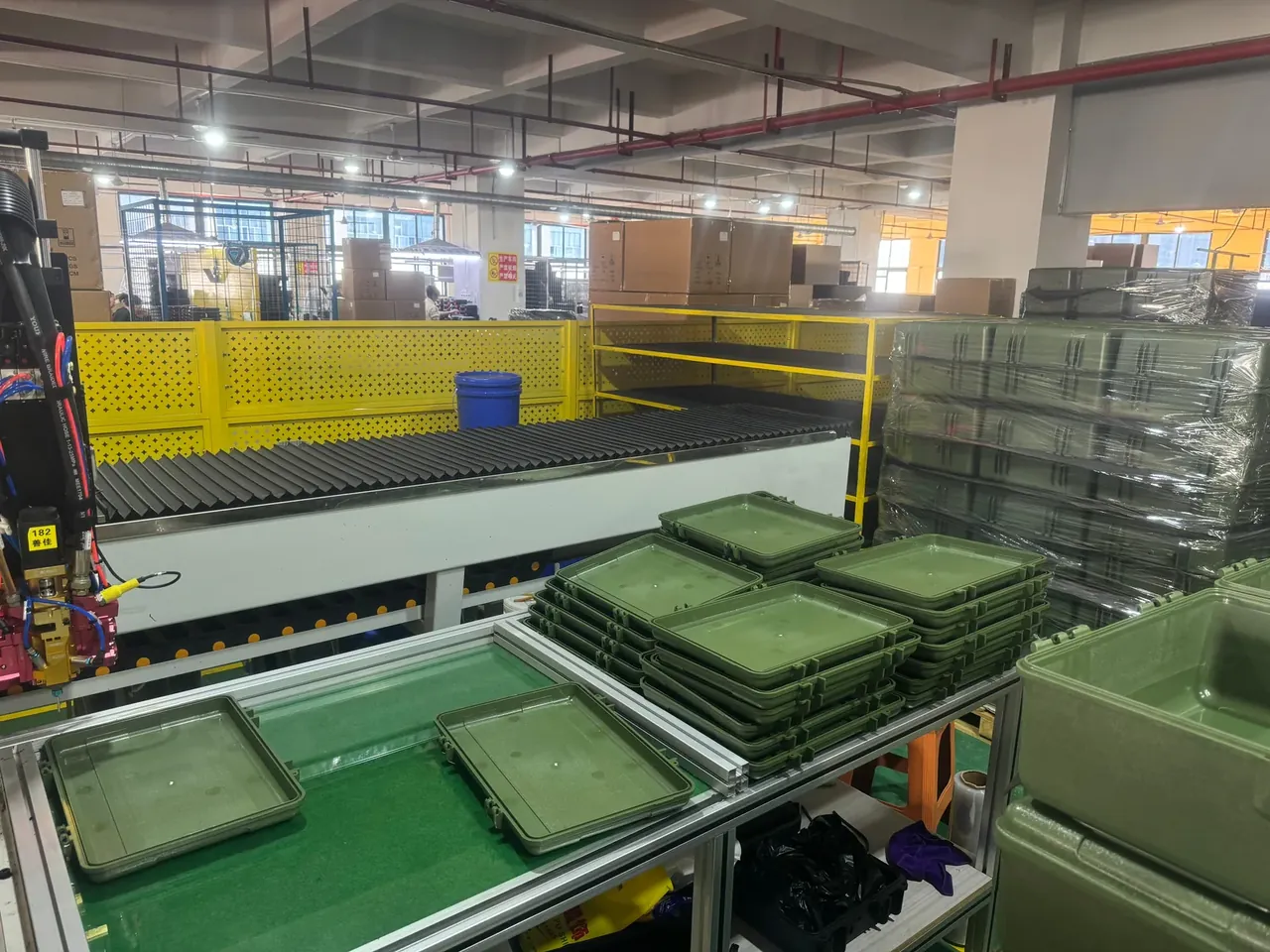
Quick answer: Custom Military Case Solutions fixes a 120 mm lid extension and 6.5 mm corner ribs, then reads lid dishing after four tiers stand for 12 h.
Table of contents
- Custom Military Case Solutions seam offset at the lid joint
- Thickness of the corner ribs
- Lid dishing after four-tier stacking
- Seam recovery after breaking down the stack
- Freezing the rib thickness per batch
- FAQ
1. Custom Military Case Solutions seam offset at the lid joint
A raised lid joins the shell at a seam, and offset plus corner rib thickness decide whether the lid springs back or keeps a dish under four tiers. A Custom Military Case Solutions shell is 780 by 520 by 340 mm outside, 700 by 450 by 260 mm inside, walls 5.0 mm, with a 120 mm extension. The drawing holds offset to 0.20 mm: a flat seam passes load down the walls evenly, while a step to one side throws the top three tiers onto that edge and lifts the dish reading.
One mould yields three rib grades, 5.5 mm, 6.5 mm and 7.5 mm, each stacked with a 120 mm extension and offset under 0.20 mm. The record opens with the rib grade; a changed extension or seam jig voids that group and restarts the 12 h press. A Custom Military Case Solutions lid is matched to its grade, tolerances filed apart.
2. Thickness of the corner ribs
The 6.5 mm corner rib sits where the lid face meets the wall at four corners. Under four tiers the lid feeds load there, and rib thickness decides whether the force runs down the walls or bows the panel. A thin rib lets the centre give first; a thick one stops the bow but clamps the seam so offset recovers slowly after unstacking.
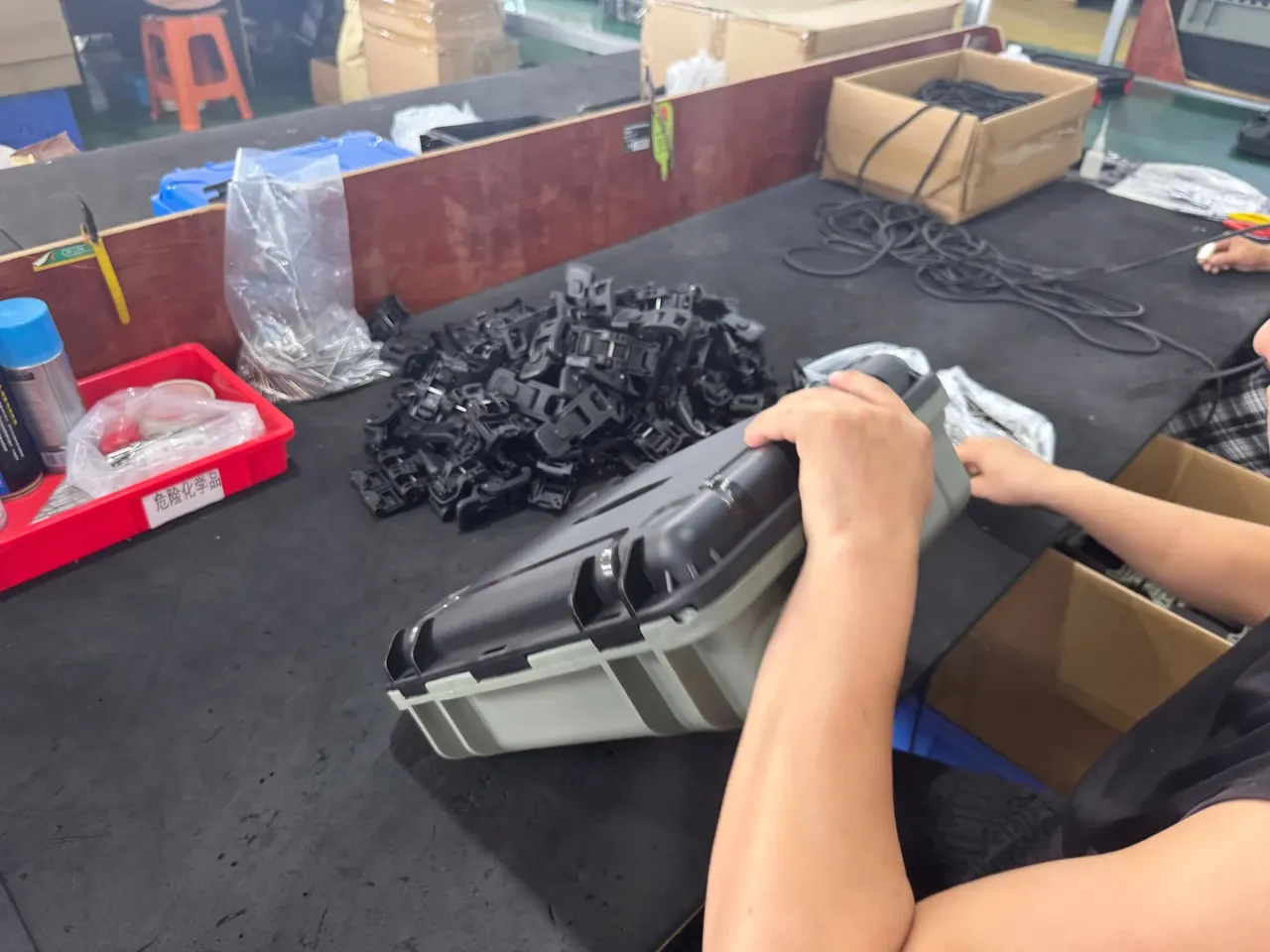
Four latches give 460 N each on two gaskets at 22% compression. The stack record of a Custom Military Case Solutions shell files those figures beside the rib grade, and latches are retightened after 3600 cycles; a slack one adds give during stacking and gets blamed on the ribs wrongly.
| Rib grade | Rib thickness | Seam offset |
|---|---|---|
| Thinner | 5.5 mm | 0.20 mm |
| Nominal | 6.5 mm | 0.12 mm |
| Thicker | 7.5 mm | 0.10 mm |
Across the rows, 7.5 mm pulls offset to 0.10 mm but is not the thinnest grade holding 0.70 mm at the twelfth hour; 5.5 mm reaches the 0.20 mm ceiling and fails first. A Custom Military Case Solutions batch keeps 6.5 mm as nominal, the thinnest grade that still works.
3. Lid dishing after four-tier stacking
Four aligned tiers stand for 12 h before the lid is read. Dishing is the sag of the lid centre, taken with a dial gauge along the normal to 0.01 mm and held to 0.70 mm. Judgment takes only the lowest lid at the twelfth hour, since the limit asks what stiffness the panel keeps after load. Custom Military Case Solutions draws 0.70 mm into the tolerance column, earlier segments kept as direction only.
| Stack interval | Lid dish | Seam reading |
|---|---|---|
| 4 h | 0.18 mm | 0.12 mm |
| 8 h | 0.45 mm | 0.15 mm |
| 12 h | 0.68 mm | 0.19 mm |
Dishing goes 0.18 mm at 4 h, 0.45 mm at 8 h and 0.68 mm at 12 h, the later hours adding more, so the panel creeps under the upper tiers. The seam reading climbs from 0.12 mm to 0.19 mm, leaving 0.01 mm under its ceiling. For Custom Military Case Solutions only the twelfth-hour row counts; 4 h and 8 h are filed without a grade.
4. Seam recovery after breaking down the stack
The tiers come off after 12 h and the lowest lid settles before the seam is read again. Recovery is the share of offset that springs back, with 90% as the floor. Dishing logs sag under load; recovery logs the step given back once unloaded. Each keeps its own release cell.
| Dish value | Seam after unstack | Recovery |
|---|---|---|
| 0.68 mm | 0.19 mm | 92% |
| 0.83 mm | 0.27 mm | 84% |
| 0.41 mm | 0.11 mm | 96% |
At 5.5 mm the dish crosses 0.70 mm at 0.83 mm, recovery falls to 84%, and the unstack seam at 0.27 mm breaks 0.20 mm, so all three cells fail; 7.5 mm keeps margin but sits a rib step above nominal, and the closing line wants the thinnest passing grade. Custom Military Case Solutions accepts only lids whose three cells match nominal, and one that skips settling earns no grade.
5. Freezing the rib thickness per batch
A custom batch closes on the twelfth-hour cell, not a segment-by-segment reread of the 4 h, 8 h and 12 h curve. Rib thickness settles at the thinnest grade still within 0.70 mm at that hour; anything thinner stays a sample record. A batch freezes 10.2 kg empty, 26 kg loaded, 3600 cycles and four latches at 460 N, and a changed extension or seam jig restarts the stack and recheck.
For acceptance each lid hands over four cells: rib grade, twelfth-hour dish, unstack seam and recovery share, and four cells in one grade admit it. A blank or crossed cell sends only that lid back. Moulding settings and stack readings for Custom Military Case Solutions sit in separate columns, IP67 is logged as a method reference only, and tolerances trace to the rig.
Conclusion
Seam offset, rib thickness, twelfth-hour dish and unstack recovery must line up in one nominal grade before a batch of Custom Military Case Solutions lids closes. At 6.5 mm the ribs hold the 12 h dish of four tiers to 0.68 mm, offset stays inside 0.20 mm, and recovery reaches 90% or better; a crossed figure sends just that lid back. JUNZHIJIA gathers the 3600-cycle stack rechecks by batch; tolerances trace back to Kexin New Materials (Guangdong) Co., Ltd.
Related Reading
- Choosing Pelican Alternative Cases: Spec Comparison and Pitfalls
- Replacing and Re-Cutting Case Foam: When to Repair and When to Start Over
- Case Structure Custom: Structural Customisation
- Tooling Ownership and IP Rights in Custom Case Projects
Related Products
- 8 Series — Gun Cases; Military Equipment Cases; Camera Equipment Cases; Drone Cases; Watch Cases; Knife Cases; First Aid Cases; Electronics Equipment Cases
- WL8-2812 PP Gun Case — model WL8-2812
- All protective cases and toolboxes: 7 series, 158 models