

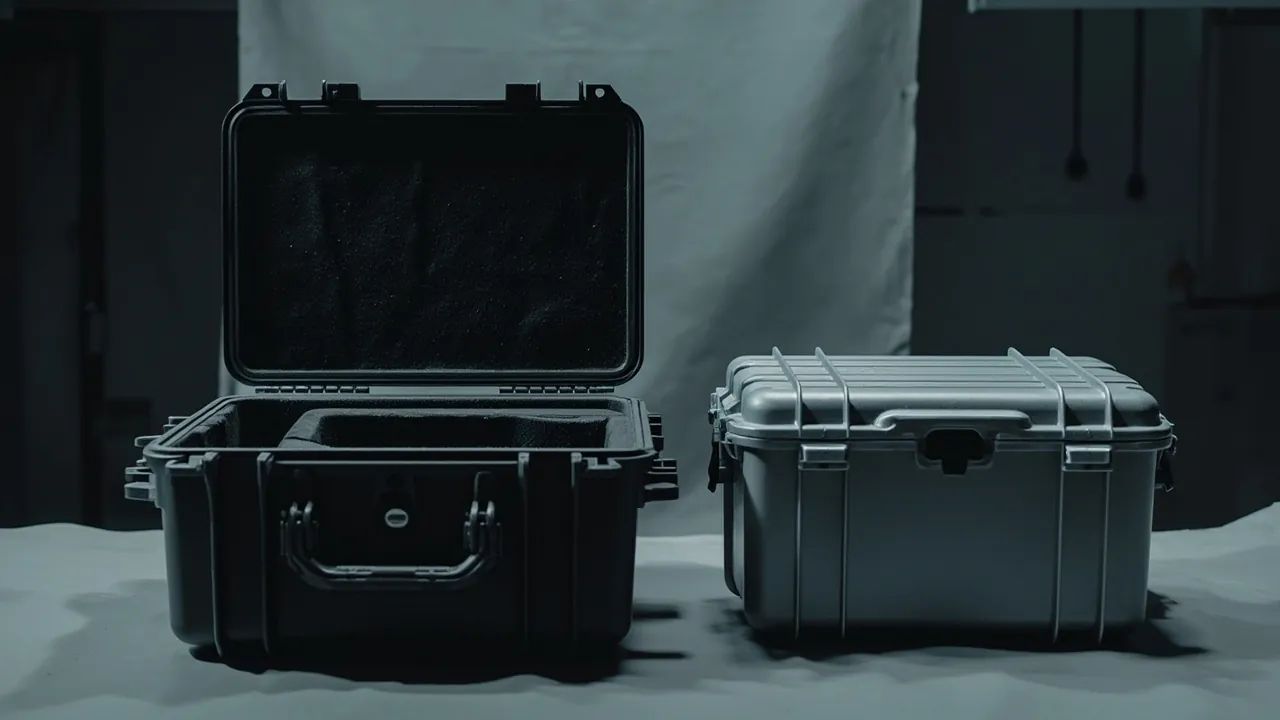
The short answer: choosing between custom and standard protective cases is not a values question with two camps, it is a layered decision problem. Start by letting a standard case cover the operating conditions, and only move to customization when the standard case genuinely fails on four hard boundaries: dimensions, insert, IP rating, and structure. For most B2B projects the best answer is neither full custom nor pure standard, but a hybrid: standard shell, custom insert, custom branding. That path drives tooling investment, minimum order quantity (MOQ), and development lead time down at the same time, while keeping the things that actually need to be custom: insert fit, brand identity, and product ownership.
This guide is written for procurement managers, mechanical engineers, and project managers. It turns the question of whether to customize into an executable decision tree: start from the operating conditions, work through whether a new mold is truly required, then decide how tooling cost should be amortized, how MOQ should be negotiated, how acceptance should be defined, and how IP and intellectual property clauses should be written. All tooling costs, lead times, and MOQ figures quoted here are industry typical values or rules of thumb; the binding basis for any real project is the drawing, the golden sample, and the signed contract. If you are sitting on a project where a standard case almost fits, this article will help you judge whether that "almost" is worth a new mold.
Table of Contents
- The Short Answer: Layered Decision-Making, Not a Value Judgment
- The Four Layers of Case Customization
- The Underrated Value of Standardization
- The Real Cost of Customization: Tooling, MOQ, Lead Time and Risk
- Decision Layer 1: Can a Standard Case Cover the Core Operating Conditions?
- Decision Layer 2: Can Dimensions and Inserts Be Solved with a Standard Case?
- Decision Layer 3: Must Sealing and IP Rating Be Redefined?
- Decision Layer 4: Volume and Tooling Amortization Break-Even
- Decision Layer 5: Certification, Branding and IP Ownership
- The Hybrid Strategy: Standard Shell Plus Custom Insert
- Sampling, Golden Samples and Acceptance Clauses
- How to Evaluate a Supplier's Customization Capability
- Frequently Asked Questions (FAQ)
- Conclusion and Further Reading
The Short Answer: Layered Decision-Making, Not a Value Judgment
Too many teams turn "custom or standard" into a vote. Sales wants custom because it sells better, procurement wants standard because it is easier to manage, and engineering wants custom because it fits better. The discussion rarely produces a decision, because everyone is using the same sentence to talk about different things. The right move is to accept that customization has layers, then judge each layer on its own merits.
Protective case customization can be divided into at least four layers, from light to heavy: appearance and marking customization (logo, color, model silkscreen), insert customization (foam cutouts, flocking, ESD material), partial structural customization (extra ports, modified handle, adjusted ribs), and full new tooling (a completely redesigned shell with new dimensions, seal groove, and latch layout). The first two layers barely touch the mold or the development cycle. The last two are where the real money and risk live. Replace "should we customize" with "how far should we customize," and the discussion immediately becomes actionable.
| Customization layer | Typical scope | New mold needed | Lead time (typical) | MOQ pressure | Risk level |
|---|---|---|---|---|---|
| --- | --- | --- | --- | --- | --- |
| Layer 1: Appearance and marking | Color change, silkscreen, laser marking, packaging | No (screen or stencil only) | 1-3 weeks | Low | Low |
| Layer 2: Insert | Foam cutouts, flocking, EVA/PE lamination | Usually no (cutting die only) | 2-5 weeks | Medium | Low to medium |
| Layer 3: Partial structure | Extra holes, new handle, local rib changes | Mold modification (may share a mold) | 4-8 weeks | Medium to high | Medium |
| Layer 4: Full new tooling | New dimensions, redesigned seal groove and latches | Full new mold | 8-16 weeks | High | Medium to high |
One sentence to hold onto: the deeper the layer, the more you should first ask "can a standard case be modified" rather than "can we open a mold." Most requirements that look like they demand tooling can in fact be satisfied within the first two layers.
The Four Layers of Case Customization
Only by spelling out the four layers can you avoid paying tooling money to solve a problem that a silkscreen would have solved.
Layer one, appearance and marking customization, is the most common and cheapest layer in commercial terms. Color changes, branding and model silkscreen, laser-marked serial numbers, custom cartons and manuals: the value here is brand recognition and channel control, and the impact on product performance is zero. One warning: a color change is not risk-free. Dark and light parts show sink marks differently on the same mold, and light parts are far more sensitive to flow marks and color deviation, so even a color change needs a signed golden sample.
Layer two, insert customization, is the best value for money. The outer shell stays unchanged, and only the internal foam is cut to the profile of the protected item, achieving fitting accuracy and handling convenience close to full customization. The key parameters are foam material (PE, EVA, EPE, PU, XPE, and so on), density, hardness, cutting tolerance, and flocking process. For precision instruments, optical equipment, and medical emergency kits, the insert is often the difference between a project succeeding and failing, yet the investment is far below that of tooling.
Layer three, partial structural customization, begins to touch the mold. Adding cable ports, air valves, pressure equalization valves, relocating a handle, or locally adjusting ribs can usually be done through mold modification or an insert, without cutting a new mold. The critical judgment is whether the change damages the seal face at the case rim or the primary load-bearing structure. If the change lands on the seal groove, the latch seats, or the four corners, it is no longer "partial" and must be re-evaluated as a sealing and strength change.
Layer four, full new tooling, is the last resort. It addresses cases where the standard family's size range and structural options simply cannot cover the requirement: unusually long and flat instruments, equipment that must mate with a non-standard interface, or projects bound to a strict military or industry dimension series. Full tooling means the complete chain from structural design, mold flow analysis, first shots, and mold correction to mass-production validation. The lead time and cost are not comparable to the earlier layers.
The Underrated Value of Standardization
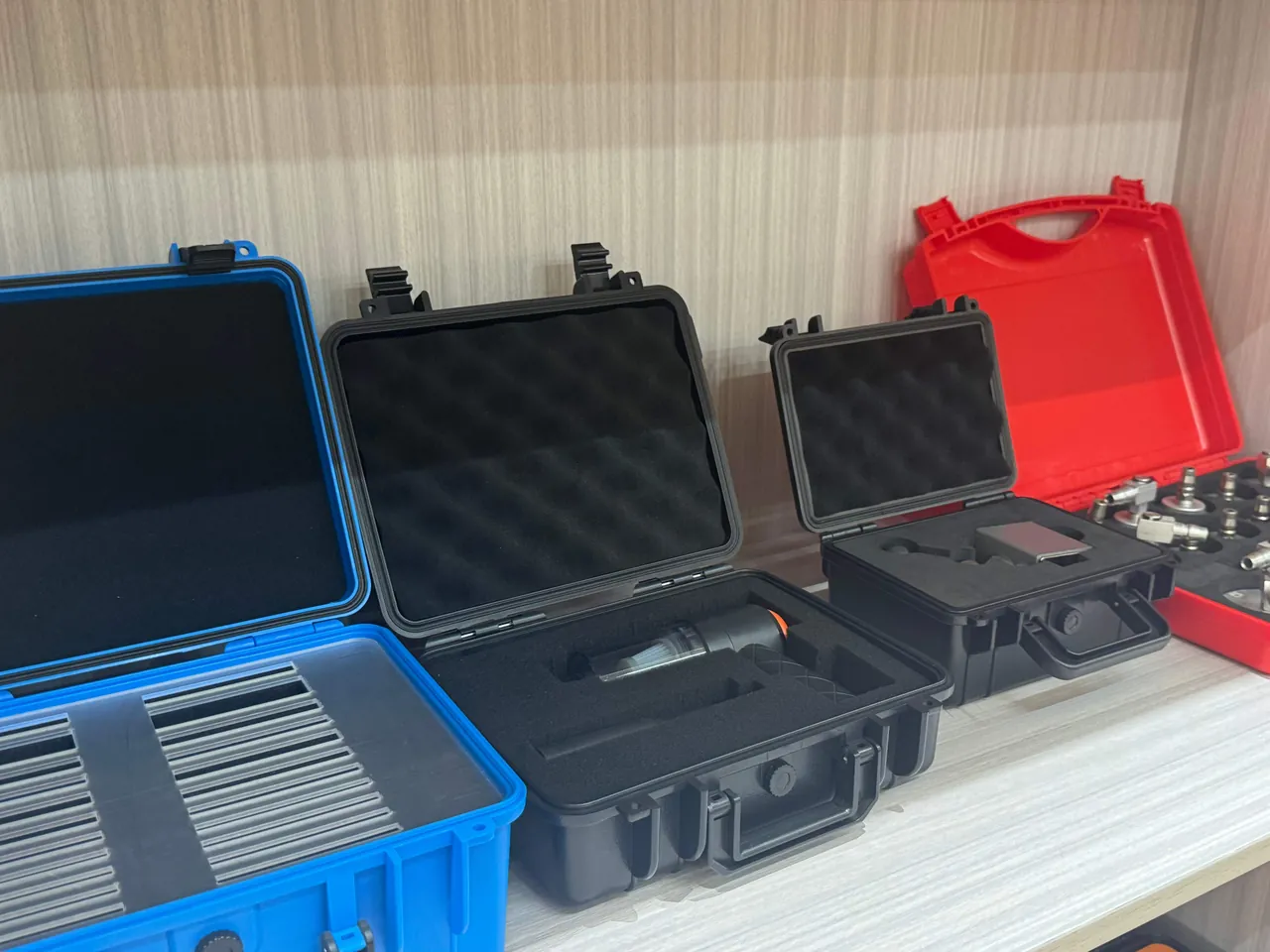
When discussing customization, procurement tends to see only the one disadvantage, "the standard size does not fit," and to overlook the four hidden advantages of standardization. These never appear on a quotation, but they generate value across the whole project life cycle.
First, delivery certainty. A standard case has a ready mold and stable capacity, so lead time is measured in weeks rather than months. A custom case must first take a slot in the mold schedule, then go through first shots and correction, and any correction round can multiply the lead time. For a project with a hard deadline, delivery certainty is itself a cost.
Second, predictable cost. The unit price of a standard case is stable at volume, and its step-down curve is clear. A custom case carries amortized tooling, sampling, and engineering costs in the first batch, so the unit price looks much higher. Many projects compare a custom unit price with a standard unit price and forget to amortize the one-time investment back.
Third, replaceability and expansion. A standard case is easiest to replace during replenishment, fleet expansion, or cross-region deployment: the same model is available on demand, and batch-to-batch variation is constrained by the standard and the golden sample. Once a custom case is discontinued or revised, replenishment becomes a negotiation.
Fourth, a mature quality baseline. A standard case has already been tested by the market, its common defects and failure modes are known, and the supplier's process parameters have settled. A custom case must climb the whole sample-validate-produce curve again, and early batches typically show a higher defect rate than a mature standard product.
Remember the trade-off in one line: standardization delivers certainty, customization delivers fit. The decision is really about which one the project needs more right now, and how much certainty you are willing to trade for fit.
The Real Cost of Customization: Tooling, MOQ, Lead Time and Risk
If you decide to move to layer four, full new tooling, then the cost must be calculated properly. Tooling cost is not a single line item for "the mold." It is a bundled investment.
The mold itself depends on case size, number of cavities, mold steel, and surface finish requirements. Large protective cases are expensive because of their volume, cooling difficulty, and the tonnage of the injection machine required. A multi-cavity mold lowers unit cost but raises total mold price, and is worth it only at a sufficiently large annual volume.
Development and sampling cost covers structural design, mold flow analysis, first shots, and correction iterations. In practice, a structurally complex protective case, with seal groove, latch seats, ribs, and inserts, often needs two to three sampling rounds before it reaches stable production, each with its own time and cost.
MOQ and first-order pressure are the most practical constraint on customization. Having invested in a mold and engineering resources, the supplier must require a minimum order quantity to recover it. If the buyer's first order falls far below MOQ, the supplier has only two options: raise the unit price or decline. So negotiate MOQ together with tooling cost at the quotation stage, rather than negotiating unit price first and then accepting whatever MOQ is imposed.
Mold revision risk is the most underrated item. If a dimensional deviation, an assembly interference, or insufficient gasket compression shows up during pilot production or the first field use, the mold must be revised. Revision can mean re-cutting a core, re-polishing, and re-sampling, with cost and schedule both out of control. The way to reduce this risk is to discuss the operating conditions, tolerances, and validation criteria thoroughly before design freeze, and to state in the contract who pays for mold revision and when.
| Investment item | Driving factors | Typical magnitude | Amortization method | Risk control |
|---|---|---|---|---|
| --- | --- | --- | --- | --- |
| Mold cost | Case size, cavity count, steel, surface finish | Low for small cases, high for large; multi-cavity raises total price sharply | Amortized over first order or first N orders | Define mold ownership and title |
| Engineering and sampling | Structural complexity, iteration rounds | Often several sampling rounds | Charged to first order | Full review before design freeze |
| First-order MOQ | Mold recovery pressure, material minimum | Inversely related to mold cost | One-time or annual commitment | Negotiate tiers and annual volume |
| Mold revision | Changed area, whether seal and load path are affected | Low for local edits, high for structural edits | Borne by the responsible party | Contractual revision responsibility |
| Certification and testing | IP, drop, transport, material tests | Charged per test | Charged to project | Reuse existing series reports where valid |
What this table really says is that customization cost is a package price, not a unit price. Comparing unit prices alone will always conclude that custom is much more expensive than standard. Divide the one-time investment by real usage, and the conclusion often changes.
Decision Layer 1: Can a Standard Case Cover the Core Operating Conditions?
The decision tree starts with operating conditions, because the first task of a protective case is to protect its contents. Layer one asks a single question: within the standard case family, is there a case that meets all four core conditions of IP rating, load, operating temperature, and transport?
The method is to tick off the standard case specification sheet item by item: IP rating (does the project need submersion, or only spray), static and stacking load, operating temperature range, drop height requirement, and whether a pressure equalization valve is needed for altitude and temperature swings. If all four are met, layer one passes and you move to layer two without considering tooling.
If one item fails, do not jump straight to tooling. Ask instead: is the failure a performance shortfall or a dimensional mismatch? A performance shortfall is usually a material and structure issue and may be solved by a higher-strength standard model. A dimensional mismatch is more likely to point toward customization. This distinction matters enormously, because it pulls a large set of requirements that "look like they must be custom" back into the standard selection space.
Two easily missed checkpoints belong to this layer. The first is certification reuse: if the project needs IP or drop test reports, a standard case usually has series reports that can be reused, whereas a custom case needs new testing, which lengthens the schedule considerably. The second is the delivery window: if the schedule is tight, a standard case is almost the only feasible option.
Decision Layer 2: Can Dimensions and Inserts Be Solved with a Standard Case?

Layer two deals with the dimension problem, but the method is not to open a mold immediately. It is to ask first whether a standard case plus a custom insert can solve it.
The approach is reverse matching: rather than requiring the internal dimension to equal the item dimension, allow the case to be slightly larger and use a custom foam insert to fill the surplus space and form a fitted pocket. In this way, the shell uses a standard mold and the insert is custom, gaining a fitted hold while skipping tooling. Insert design keys are: leave finger clearance for handling, provide sufficient cushion thickness at fragile points, and add pull tabs or lift edges for items accessed frequently.
Only three situations truly break layer two. First, the internal usable space is pinned by the item size, so the standard case either does not fit or is absurdly oversized, wasting foam thickness and adding volume and weight. Second, the external dimensions are constrained, for example when the case must slot into a standard rack, a vehicle bay, or an air-transport pallet. Third, the aspect ratio is unusual, so no standard case comes close. Only these three move you to layer three.
In practice, layer two absorbs roughly seventy percent of requirements that look like they need a mold. Ask "can foam fill the gap" before you ask "do we need tooling," and you will skip a great deal of unnecessary mold investment.
Decision Layer 3: Must Sealing and IP Rating Be Redefined?
Layer three deals with sealing and IP rating. The sealing performance of a protective case is determined by the seal groove geometry, the gasket cross-section and compression, and the closing force of the latches, all of which are tied directly to the mold. This is why sealing-related requirements are often a false-local customization, looking local but actually structural.
Consider a common misconception: some teams believe that drilling an extra hole in a standard case and fitting a connector produces a "waterproof case with an interface." The issue is that a standard case is designed as a full-perimeter face seal, and any new opening breaks the continuity of the seal path unless the opening itself has an independent sealing structure, such as a sealed cable gland, potting, or a threaded seal. Drilling a hole near the seal face effectively destroys the case's water resistance.
The layer-three judgment can therefore be standardized into three steps. First, define the IP rating the project actually needs and the test standard used to confirm it, since IP65 spray and IP67 short-term immersion are challenges of very different magnitude. Second, judge whether a new functional opening can be covered by the existing sealing structure. Third, if the seal groove or the latch closing structure must change, the item belongs directly in the layer-four tooling assessment, not in "partial modification."
| Requirement type | Breaks the seal path? | Available modification on a standard case | Correct layer |
|---|---|---|---|
| --- | --- | --- | --- |
| Silkscreen or color only | No | Directly on the standard case | Layer 1 |
| Internal fixing or shock absorption | No | Custom foam insert | Layer 2 |
| Non-sealed mounting points or strap | No | Local mold modification | Layer 3 |
| Adding a sealed connector or valve | Needs independent sealing | Choose parts with their own seal | Layer 3 to Layer 4 |
| Changing seal groove or latch closing structure | Yes | None | Layer 4 (new tooling) |
| Changing the rim profile or parting line | Yes | None | Layer 4 (new tooling) |
The value of this table is that it draws a red line for "partial customization": once a change lands on the seal path, it is no longer partial.
Decision Layer 4: Volume and Tooling Amortization Break-Even
By the time you reach this layer, the question is almost purely economic. The core formula is simple: a custom solution makes sense when the one-time investment can be amortized by sufficient volume within the product life cycle.
A simplified model helps. Let the standard unit price be P0, the custom unit price be P1 (usually a little higher, or comparable, because of lower scale), the one-time investment be M (mold, engineering, sampling, certification), the total project volume be Q, and the hidden benefit gained from customization be Δ (lower damage rate from better fit, less assembly labor, brand premium). The customization condition is approximately:
P1 + M/Q < P0 + Δ
Customization only pays when M/Q is small or Δ is large enough.
In practice, three thresholds give a quick read. First, can the annual volume amortize the mold within a reasonable period? Second, is the project one-off or a series? A series project reuses the same mold for years, so the amortization burden is far smaller. Third, can the same mold be shared across several models or customers, for example through a common mold base with interchangeable inserts. If two of the three fail, it is usually time to fall back to a standard case.
One important reminder: do not judge tooling by a single project's volume, but by the product life-cycle volume. A project whose first order is only a few hundred units, but which reorders steadily for three years, justifies tooling far more than a large one-off order that never repeats.
Decision Layer 5: Certification, Branding and IP Ownership
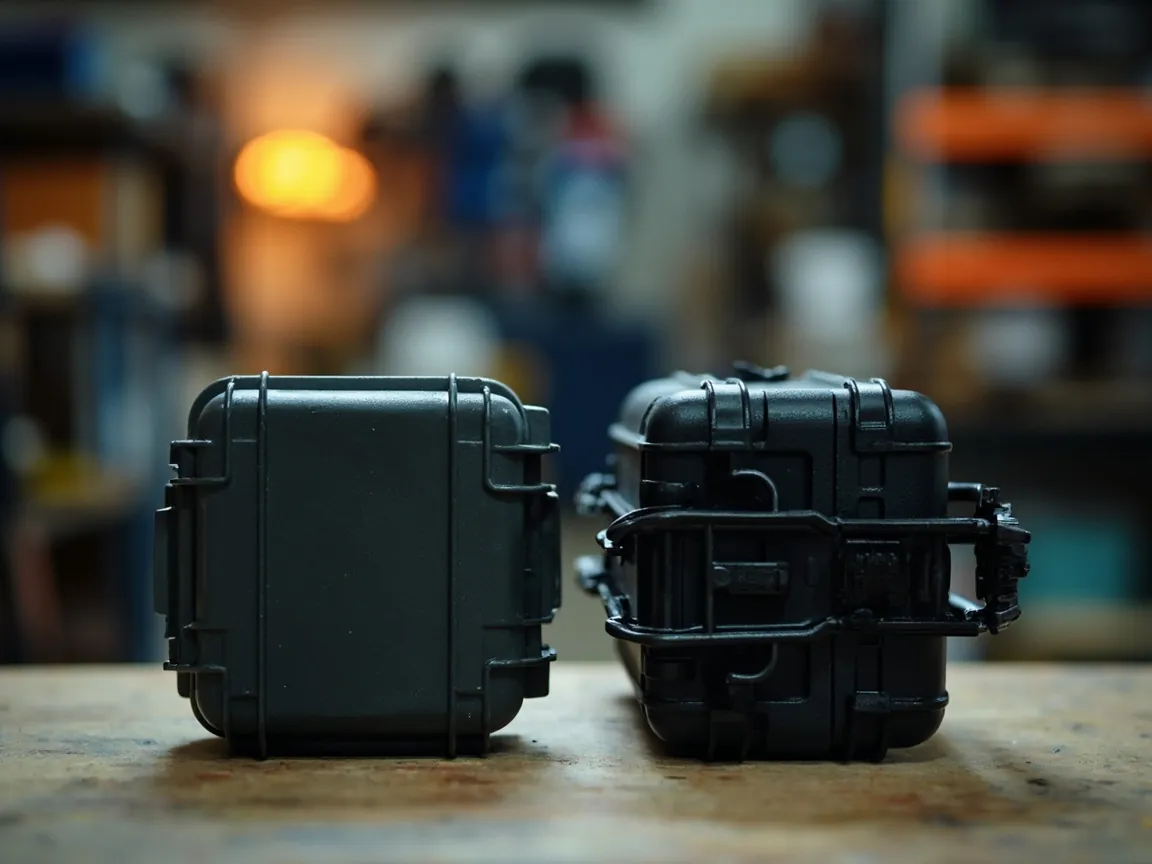
Layer five deals with the soft costs and ownership questions that are easy to ignore yet have the longest reach.
On certification, a custom case usually needs new testing for IP rating, drop, and transport, and both the cost and schedule must be folded into the project. If the customer or end user requires a third-party report, confirm the test house, the standard version (such as IEC 60529 or GB/T 4208), and the correspondence between the sample description and your model. Existing series reports for a standard case generally cannot be applied to a custom model.
On branding and marking, customization usually comes with ownership questions: whose logo is silkscreened, whose label is applied, who defines the nameplate and serial number. This looks like marketing, but it actually shapes channel control and after-sales responsibility.
On intellectual property, the ownership of the mold and the structural design must be written into the contract: who funds the mold, who holds title, how the mold is disposed of if the cooperation ends, whether the buyer can retrieve it, and whether the supplier may use the same structure for other customers. If these clauses are vague, disputes are almost certain later. In custom projects, buyers typically require mold title to rest with them, or require the supplier not to supply the dedicated structure to others, while suppliers may want to retain disposal rights until the mold is fully paid for.
For how to put these clauses into contract language, see contract and IP clauses for custom protective cases. For the composition and amortization of tooling cost, see how to estimate custom protective case mold cost.
The Hybrid Strategy: Standard Shell Plus Custom Insert
After walking through all five layers, a useful conclusion emerges: projects that genuinely need full new tooling are a minority, and a hybrid of standard shell, custom insert, and custom branding covers most requirements that look demanding.
The hybrid strategy works because it applies customization where the return is highest. The insert determines how the contents are held, cushioned, and handled, and it is the part users feel most. Appearance and marking determine brand and channel identity. The shell's dimensions, sealing, and structure, meanwhile, reuse the certainty of a mature mold. In other words, customize the fit and standardize the certainty.
A few points make the hybrid strategy work. First, when selecting the case, prefer standard models with a regular internal space, flat walls, and no complex internal bosses, which makes insert design and cutting easier. Second, leave tolerance in the insert: foam cutting tolerance, item tolerance, and case internal tolerance add up, so without margin you get an item that is too tight to remove or too loose to stay put. Third, if the project may later upgrade to full custom, still record the size range, interfaces, and marking specification during the standard phase, so the future tooling has solid design inputs.
The hybrid strategy also has a commercial benefit that is often overlooked: it lets the project reach market quickly on a standard product, and defers the tooling decision until sales are validated. This is effectively option-style risk management, postponing the mold decision to a point where information is better.
Sampling, Golden Samples and Acceptance Clauses
If customization is finally chosen, sampling, golden samples, and acceptance are the three gates that decide the project.
At the sampling stage, cover four categories of validation: dimensions and fit (key dimensions, lid closing gap, latch engagement), sealing (negative-pressure quick check or immersion test), structure (section a sample and measure wall thickness, inspect ribs and seal groove), and environment (condition at low temperature for the actual duty cycle, then drop). Sampling is the cheapest correction window; any structural problem not exposed here will be amplified many times in mass production.
At the golden sample stage, seal one "pass sample" and one "limit sample," signed by both parties, covering color, gloss, feel, assembly gap, and marking position. The golden sample is the only objective basis for resolving a "this batch differs from the last" dispute.
At the acceptance stage, agree in advance on the sampling standard and defect classification. In B2B procurement, a common approach is to invoke the counting sampling scheme of GB/T 2828.1, agree on the inspection level and acceptable quality limit (AQL), and define critical, major, and minor defects with their disposition (accept, sort, concession, reject). For how to run sampling and acceptance on custom parts, see how to accept custom protective cases by AQL. For the incoming batch inspection workflow, see how to sample inbound protective case batches.
JUNZHJIA is manufactured by KeXin New Materials (Guangdong) Co., Ltd., serving wholesale, distribution, OEM/ODM, and global supply, with a product line covering protective cases, toolboxes, military-spec storage boxes, and waterproof junction boxes. The company handles customization in layers, from standard case selection and insert customization to partial mold modification and full new tooling, and can configure material, sealing, latches, and insert to the project's duty cycle, supplying drawings, material statements, inspection records, and test documents so that quality standards, acceptance sampling, and mold ownership can all be written into the technical agreement.
How to Evaluate a Supplier's Customization Capability
The risk in a custom project often comes not from the product itself but from a supplier whose customization capability is insufficient. Evaluation can start from five angles.
First, engineering communication. A supplier with real customization capability can discuss seal groove geometry, compression design, sink mark control, gate location, and mold flow analysis with you. A supplier that can only relay "yes, we can do it" usually lacks structural engineering of its own.
Second, tooling resources and process stability. Understand the flow from mold design to first shots, whether injection equipment is stable, and whether process parameters are managed, including whether there is any notion of process capability such as Cpk on key dimensions. Process stability determines dimensional consistency between production batches.
Third, quality management system. Does the supplier have a quality management system such as ISO 9001, incoming, first-article, in-process, and outgoing inspection records, and the ability to support buyer sampling and quality traceability?
Fourth, change management. Custom projects inevitably involve changes to material, mold, gasket, or supplier. A reasonable supplier has a change notification and re-qualification process rather than swapping things quietly.
Fifth, spare parts and after-sales commitment. Whether the wear parts of a custom case (gasket, latches, handle, feet) can be supplied long term and mapped to a specific model determines the actual service life and economics of the fleet.
For building a supplier evaluation system, see how to build a protective case supplier evaluation system. For commercial baselines on custom MOQ, see minimum order quantity baselines for custom protective cases. For warranty and spare parts negotiation, see warranty and spare parts negotiation points for protective cases.
Frequently Asked Questions (FAQ)
Q: With a few hundred units only, is tooling absolutely out of the question? A: Not necessarily. What matters is the product life-cycle volume, not the first order. If those few hundred units are a one-off purchase with no repeat, the amortization burden is heavy and you should usually fall back to a standard case plus a custom insert. But if the product is part of a series, with a few hundred units now and steady reorders every year for several years, and the structure stays the same, the mold can be amortized over two to three years and tooling becomes far more reasonable. Also weigh the hidden benefit: if the standard case cannot hold or secure the item, and the resulting transport damage rate is high, that damage cost alone can justify tooling. A practical approach is a three-point calculation: one-time investment, estimated life-cycle volume, and the improvement in damage rate and assembly labor. Compare all three in one table instead of looking at first-order unit price alone.
Q: When does a standard case only appear usable but actually fail? A: There are four typical cases. First, the internal usable space is pinned by the item size, so the standard case either does not fit or is absurdly oversized, making the foam too thick and the volume and weight wasteful, which raises freight cost. Second, the external dimensions are constrained, for example when the case must slot into a rack, a vehicle bay, or a standard pallet, and no standard case comes close. Third, the aspect ratio is unusual, for example an instrument that is very long and flat, so the standard family's length-to-height-to-width ratio cannot approach it. Fourth, sealing or interface requirements exceed what a standard structure can do, for example when several sealed connectors must be integrated into the wall. Of these four, the first three may be solved by partial structural customization, while the fourth usually points straight to tooling. The way to judge is to draw the item dimensions, load directions, and mounting constraints on a simple layout, then compare them one by one against the internal dimensions of standard cases rather than relying on intuition.
Q: How should the mold cost of a custom case reasonably be amortized? A: Three models are common. The first is one-time amortization on the first order, where the buyer pays off the mold in the first order and then buys at a standard unit price, with mold title usually resting with the buyer. This suits long-term self-use projects. The second is spreading the mold cost across the first N orders, loading it into the unit price by agreed batches or quantities, which reduces first-order cash pressure but requires a clause on the balance if the project ends early. The third is waiving the mold fee in exchange for an annual volume commitment, where the buyer commits to a threshold annual volume and the supplier absorbs the tooling investment and recovers it through unit price. This suits cases where the supplier believes in a long partnership. None is universally better. The key is to write four things into the contract: mold title, disposal of the mold if the cooperation ends, responsibility if the committed volume is not met, and whether the structure may be supplied to others. Unclear mold ownership is the most common source of custom-project disputes.
Q: In a hybrid solution, what problems most often arise in the custom insert? A: The main one is tolerance stacking leading to an item that will not fit or will not stay put. Foam cutting has its own tolerance, the protected item has its own dimensional tolerance, and the case interior has its own injection tolerance. When the three stack up without margin, you get an item that is too tight to remove or too loose and rattling inside. The second common problem is insufficient cushion thickness: in order to fit the item into a standard case, designers often compress the foam thickness to a critical value, so on impact there is not enough travel and the item hits the wall directly. The third is overlooked handling experience, with no finger clearance or pull tab, so users struggle to load and unload and eventually stop using the insert. When customizing an insert, define three things: the fragile points of the item, the drop direction, and the handling frequency, then set cushion thickness and pocket shape accordingly, and do one physical assembly validation.
Q: Which customization-related clauses must be written into the contract? A: Cover at least six categories. First, drawings and technical specifications: dimensions, tolerances, material grade, gasket material, and the standard used to judge the IP rating. Second, mold clauses: mold cost, ownership, disposal if the cooperation ends, and whether the supplier may use the structure for other customers. Third, change clauses: material, mold, gasket, and supplier changes require advance written notice and may trigger re-qualification. Fourth, acceptance clauses: sampling standard (such as GB/T 2828.1), inspection level and AQL, defect classification, and disposition of nonconforming batches. Fifth, delivery and packaging clauses: lead time, packaging specification, stacking and transport protection requirements. Sixth, spare parts and after-sales clauses: whether wear parts can be purchased separately, how they map to models, and how long supply is guaranteed. Writing clauses in detail is not preparation for a lawsuit; it is a way to screen out suppliers that lack customization capability in the very first round.
Q: How can you tell whether a supplier's "customization capability" is real? A: Cross-check from five directions. First, see whether the supplier proactively proposes structural suggestions, such as how to design gasket compression or how to arrange ribs to avoid sink marks. A supplier with real engineering will discuss these. Second, see whether it is willing to provide sampling and first-article records, along with measured data on key dimensions. Third, see whether it has a mature quality management system and change management process. Fourth, look at its spare parts commitment for custom parts, whether it can supply gaskets, latches, and other wear parts long term and map them to a specific model. Fifth, look at its attitude toward small and medium batch customization, whether it is willing to optimize the solution together with the buyer rather than simply demanding a larger first order. If a supplier can only accept "you send the drawing and we quote," giving no input on structure or process, then the customization risk rests mainly with the buyer.
Q: If a standard case meets only part of the operating conditions, should you modify the standard case or open a new mold first? A: First try a limited modification of the standard case, then judge tooling. The order of judgment is: first check whether the change lands on the seal path. If it only involves non-sealed mounting points, a strap, marking, or handle position, the mold modification is cheap and the risk is manageable, so it is worth trying first. If it lands on the seal groove, the latch closing structure, or the rim parting line, it is effectively a redesign of the sealing system and should be assessed as tooling. Next, check whether the change affects the primary load-bearing structure, such as the four corners, the bottom grid ribs, or the hinge seats; if so, strength and drop validation must be redone. Finally, assess whether the existing test reports can still be reused; if not, the certification cost and schedule must be included. In practice, projects solved by non-sealed local mold modification tend to land faster and cheaper than projects that open a new mold.
Q: Once a custom case is made, how do you prevent "good first batch, drifting later batches"? A: The core is to fix the standard and to make sure the supplier can reproduce it. First, make golden samples: one pass sample and one limit sample, signed by both parties, as the baseline for appearance, feel, and assembly gap. Second, fix process parameters and mold state, and require advance notice and re-qualification when material, mold, or key processes change. Third, agree on batch and sampling rules, follow a sampling scheme such as GB/T 2828.1, and record key dimensions. Fourth, build a quality file, keeping measured data, defect distribution, and disposition for each batch so trends become visible. Fifth, agree on the long-term availability of spare parts and the mold to avoid being unable to replenish after a model change. In practice, batch drift usually follows a supplier's raw material switch, mold wear, or personnel turnover, so change management matters more than post-hoc inspection. For more on batch consistency and incoming inspection, see how to sample inbound protective case batches.
Conclusion and Further Reading
Back to the title question: how should you trade off customization and standardization in protective cases? The answer is a layered decision tree, not a stance. Let a standard case cover the operating conditions first; when dimensions do not fit, ask whether foam can fill the gap; only when sealing and IP rating must be redefined do you move the requirement into a tooling assessment; finally, judge economics by volume and tooling amortization, and write certification, branding, and IP clauses into the contract. After walking those five layers, most projects land in the sweet spot of standard shell, custom insert, and custom branding: both economical and well fitted.
Three actions you can take immediately: First, classify requirements into the four layers of appearance, insert, structure, and tooling, so you never pay tooling money to solve a silkscreen problem. Second, base the tooling decision on life-cycle volume rather than first-order volume, and compare the improvement in damage rate and labor hours. Third, whatever path you take, write golden samples, sampling standards, and mold ownership into the contract, so customization risk stays controllable and traceable.
JUNZHJIA is manufactured by KeXin New Materials (Guangdong) Co., Ltd., with a product line covering protective cases, toolboxes, military-spec storage boxes, and waterproof junction boxes, serving wholesale, distribution, OEM/ODM, and global supply. The company handles standard case selection, insert customization, partial mold modification, and full new tooling in layers, configures material, sealing, latches, and insert to the project's duty cycle, and supplies drawings, material statements, inspection records, and test documents to help buyers make a practical choice between custom and standard.
Further Reading