

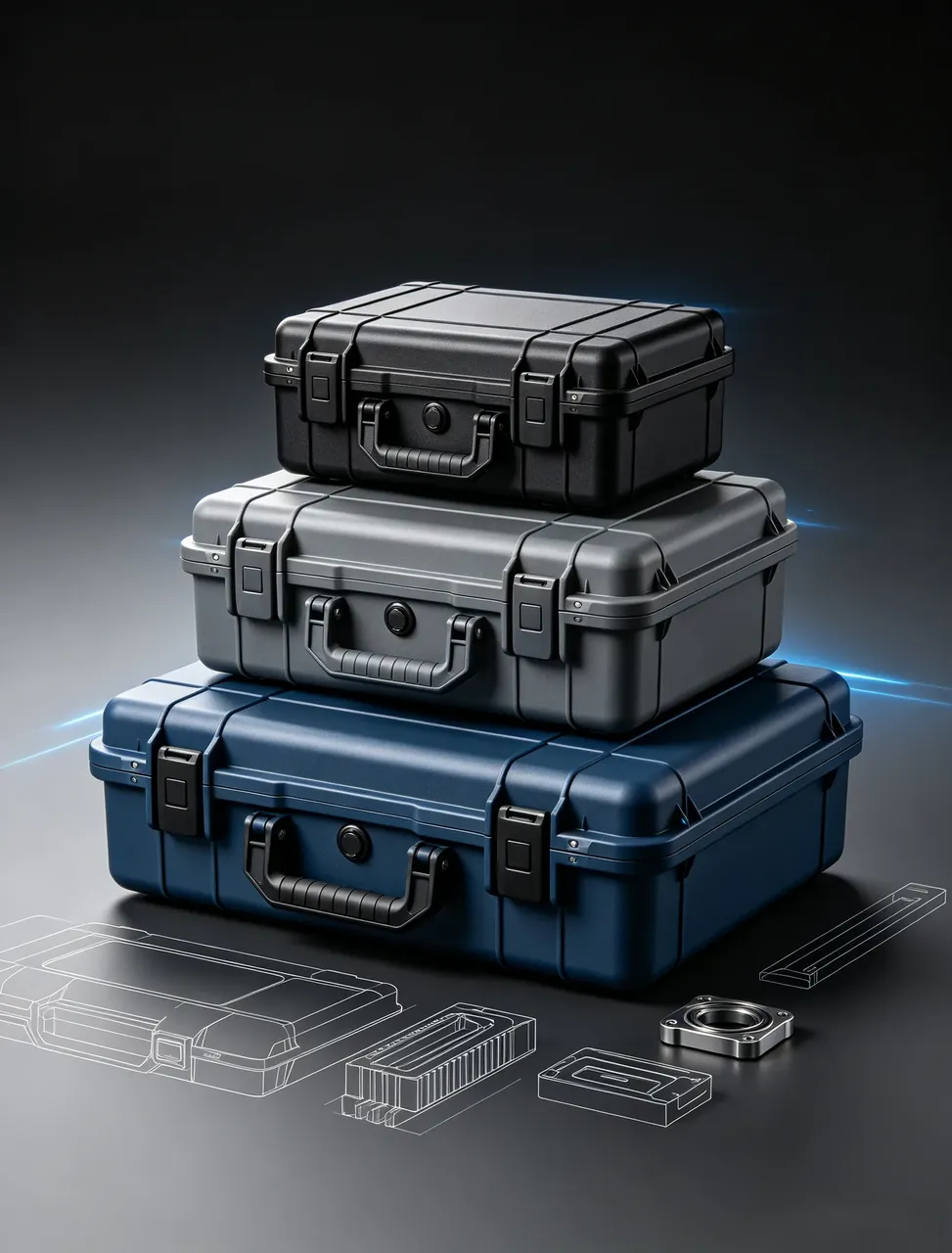
Quick answer: A data centre spares case holds two numbers: 10^6 to 10^9 ohm on the surface and ISO Class 8 inside, bridged by a conductive liner and 1 MΩ stud.
Table of contents
- Why Two Control Numbers
- The Resistance Window
- The Dust Side
- Liner and Stud, Not a Sealed Box
- Wiping and Desiccant
- FAQ
1. Why Two Control Numbers
A data centre spares case carries NICs, optical modules, fan trays and drive caddies. In the rack they sit on a grounded chassis; lift one out and the technician plus the case body become the only route for charge.
So the case answers two questions: how fast charge leaves, and how much dust follows the lid in. They pull against each other. Dust control wants a tighter gasket and fewer openings; static control needs a path from liner to stud, plus a little air exchange against negative pressure.
A fully sealed box scores well on dust and fails on static. Field use: 12 openings a shift, tens of seconds each, in aisles where fibre and floor-wax dust hangs. The 0.5 µm band is what lands on gold fingers.
2. The Resistance Window
Surface resistance on a data centre spares case belongs between 10^6 and 10^9 ohm. Below 10^6 ohm, charge leaves too fast: a device lifted out with pins on a conductive surface discharges in microseconds, current hits amps, and the gate oxide is punched through. That failure rarely shows at the bench; it returns as intermittent packet loss in service.
Above 10^9 ohm, charge will not leave. Foam, dividers and walls are insulators, charge creeps away, and a technician walking up becomes the path through the module. Below 30% RH the same motion generates several times the voltage.
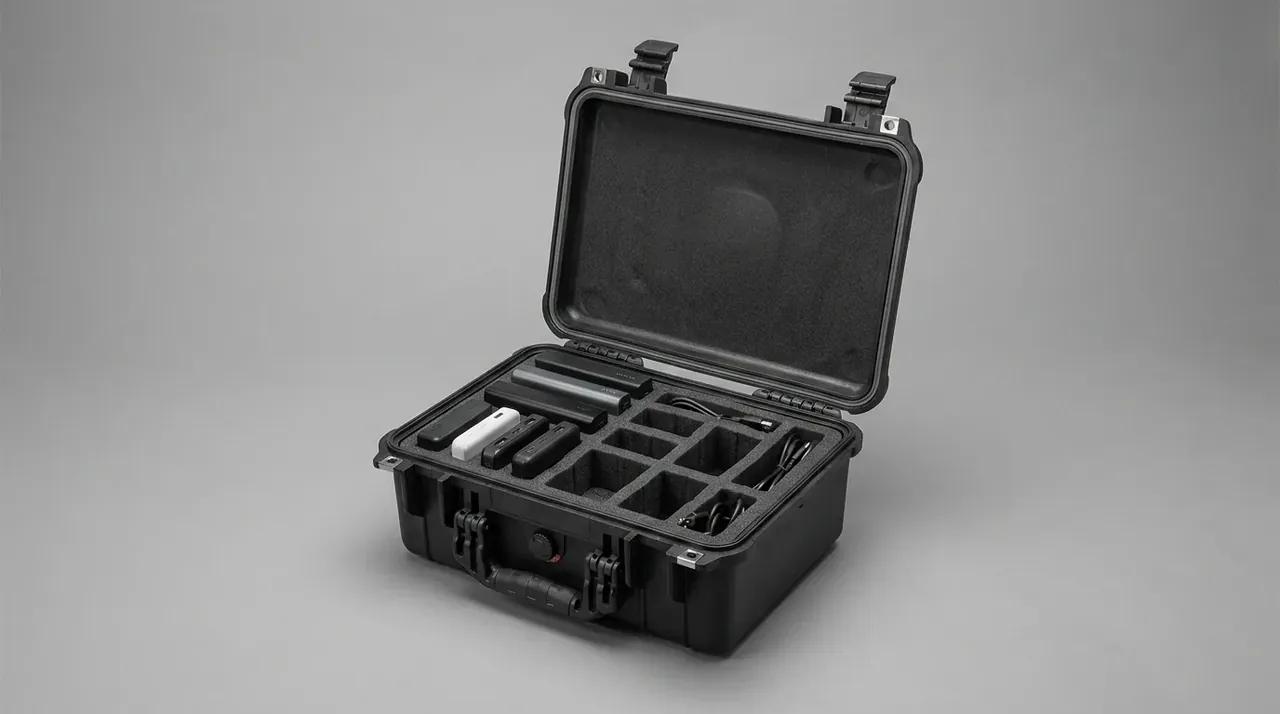
Inside a data centre spares case the 10^4 ohm foam is the collection layer, not a contradiction. It touches the module, takes charge off the surface and passes it through bonded copper foil to the stud, which carries a 1 MΩ resistor in series and lifts the path to the 10^6 ohm order. Collect low, release limited.
| Metric | Target | Test method |
|---|---|---|
| Surface resistance | 10^6–10^9 ohm | Parallel electrode, 500 V |
| Conductive foam | 10^4 ohm | Surface meter |
| Stud resistance | 1 MΩ | Megohmmeter across stud |
| Charge decay | < 2 s | Static meter, 1000 V |
Charge decay under 2 seconds is the acceptance value: apply 1000 V to the liner, remove it, time the fall to 10%. Slower usually means the foil-to-foam adhesive aged, not the foam.
3. The Dust Side
Interior cleanliness targets ISO Class 8: no more than 3,520,000 particles at 0.5 µm and above per cubic metre. That is looser than a rack intake, tighter than an office. A data centre spares case need not be a cleanroom, only avoid dragging coarse particles in while the lid is open.
Dust arrives two ways. Displacement at opening, where 30 litres of interior air mixes with aisle air and two or three tenths is exchanged. And the gap between wall and liner, where dust settles and is shaken loose at the next opening. Open less for the first; press a gasket onto the second. Humidity sits at 30–60% RH. Under 30% charge generation climbs; over 60% metal parts condense, and an optical end face is the last place for that. The band serves both numbers and sets the desiccant charge.
| Metric | Target | Test method |
|---|---|---|
| Cleanliness | ISO Class 8 | Counter, lid open and shut |
| Particle size | 0.5 µm | Lowest counter channel |
| Humidity | 30–60% RH | Logger, 7 days |
| Desiccant | 50 g per 30 days | Weigh, replace at 20% gain |
4. Liner and Stud, Not a Sealed Box
The shell is PP or ABS, an insulator around 10^14 ohm. Making the shell conductive is neither practical nor necessary; put conductivity in the liner, let the shell carry structure and sealing.
Foam is milled cell by cell with 3 mm ribs between cells, so the sheet is one electrical body, not a dozen islands. Copper foil bonded to the back runs to the stud; the body is stainless, holds a 1 MΩ resistor, and leaves a 6 mm face outside for a clip.
Skipping the sealed box is the trade this data centre spares case makes. A double-lip gasket compresses 30% at the rim and stops the bulk of dust; a breather valve cracking near 10 kPa takes the differential from transport and temperature swing. A dead-sealed case has its gasket drawn out of shape and dumps one violent exchange when opened.
Check stud continuity on the wiping cycle: probes across the body should read 1 MΩ ±5%. Tens of megohms means a resistor or joint has degraded while surface resistance still looks perfect.
5. Wiping and Desiccant
Wipe the data centre spares case liner weekly with a lint-free cloth and a neutral cleaner, then air it 10 minutes. Weekly rather than per shift, because foam does not load up visibly; what gets dirty is the cell floor and the rib corners.
A 50 g charge lasts about 30 days in a 30 litre case opened 12 times a shift. Silica gel equilibrates near 20% of its own weight at 40% RH, so 50 g takes on roughly 10 g before saturation, after which humidity tracks the aisle. Judge by weight, not colour.
| Metric | Target | Test method |
|---|---|---|
| Liner wiping | Weekly | Signed maintenance card |
| Desiccant change | 30 days | Weigh, replace at 20% gain |
| Stud continuity | 1 MΩ ±5% | Megohmmeter |
| Gasket compression | 30% | Feeler gauge |
The routine runs under 15 minutes a week, far cheaper than reworking a module wrongly judged good. A data centre spares case earns its keep on what comes out, not what goes in.
Conclusion
The difficulty is not any single number but holding two. Resistance inside 10^6–10^9 ohm lets charge leave without leaving violently; ISO Class 8 and 30–60% RH keep the interior clean after 12 openings. The fix is not to build the box shut: a liner through a 1 MΩ stud handles release, a double-lip gasket plus breather valve handles differential. Put both maintenance acts on the card and the case holds.
Related Reading
- Load paths and zoning in cooling spares cases
- Material and structure limits of antistatic cases
- Reading surface resistance and decay time
- How desiccant change intervals are set
Related Products
- 8 Series — Gun Cases; Military Equipment Cases; Camera Equipment Cases; Drone Cases; Watch Cases; Knife Cases; First Aid Cases; Electronics Equipment Cases
- WL8-2812 PP Gun Case — model WL8-2812
- All protective cases and toolboxes: 7 series, 158 models