

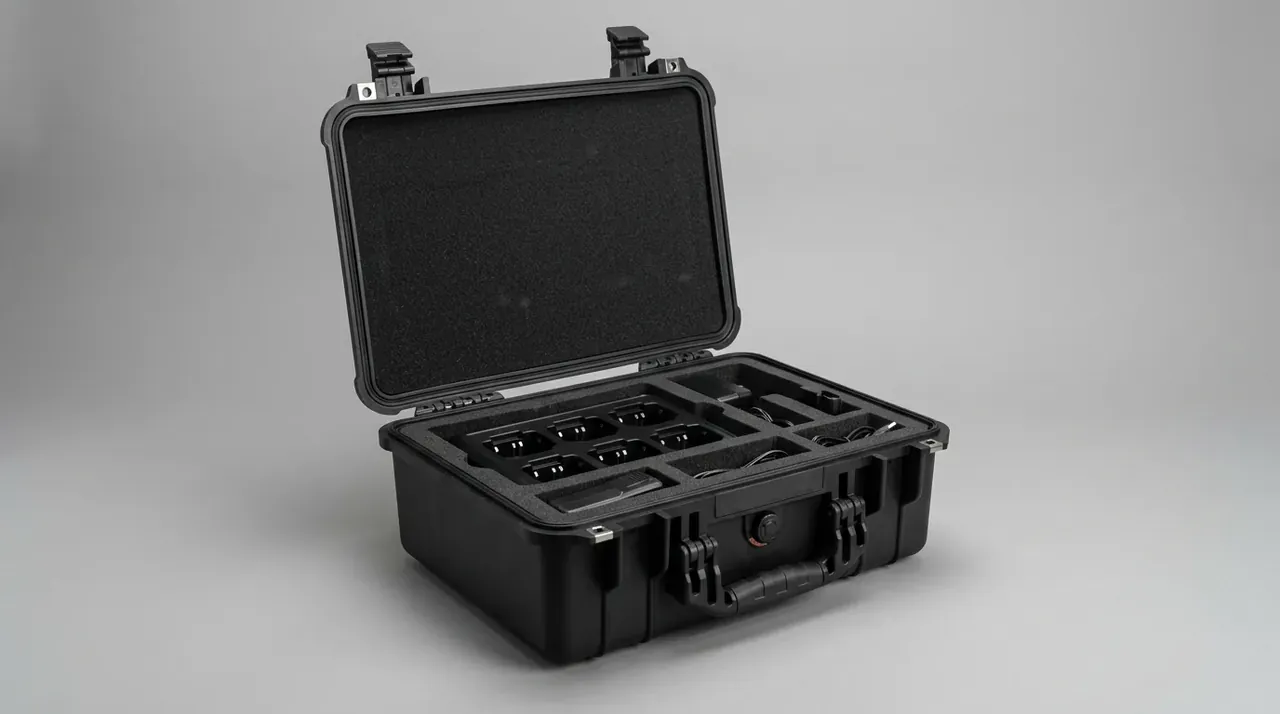
Quick answer: Case desiccant is dosed by weight, not colour: 30 g of silica gel per 10 L of net volume gives 90 days sealed, or 45 days with daily opening.
Table of contents
- How much desiccant: 30 g per 10 L
- The 20% saturation point and three colours
- Recharging at 120 ℃ for 2 h
- When 90 days drops to 45
- FAQ
1. How much desiccant: 30 g per 10 L
A 20 L case with two 15 g sachets shows fog on the lens after three months while both sachets are still blue. Colour is not the fault, the dose is: those two total 30 g, enough for 10 L, and the case needs twice as much.
Dose by net volume, not outside size. A 400 mm × 300 mm × 200 mm cavity is 24 L, and with foam taking 60% the net volume is 9.6 L, so 30 g of silica gel; the same case with a thin liner counts 22 L and needs 66 g.
| Net volume (L) | Silica gel (g) | Water at saturation (g) | 90 days at 25 ℃ | Humid climate |
|---|---|---|---|---|
| 5 | 15 | 3.0 | Sufficient | 45 days |
| 10 | 30 | 6.0 | Sufficient | 45 days |
| 20 | 60 | 12.0 | Sufficient | 30 days |
| 40 | 120 | 24.0 | Marginal | 30 days |
Ten litres of air at 30 ℃ and 80% RH holds only 0.24 g of water, while 30 g of gel can take 6 g, a factor of 25. Case desiccant never dries the air inside; it absorbs what leaks through the gasket.
Ingress runs 0.06–0.09 g per day with a gasket compressed to 30% and an 8 ℃ difference across the wall, so 6 g divided by 0.07 g gives 85 days. The 90 day figure is that quotient, not a round number picked by habit.
Run it the other way and 30 g in a 20 L case carries a 3 g payload, used up in about 40 days, after which RH climbs from 38% to 72% while the gel is still blue. Heat shortens it too: at 40 ℃ gel holds 14% instead of 20%, so 30 g carries 4.2 g and the interval falls to 60 days.
2. The 20% saturation point and three colours
Saturation sits at 20% of dry weight: 30 g takes 6 g and stops. Past that point the absorption rate falls to a fifth, so a spent sachet only takes up space and gives water back as the case cools.
The three colours map to three bands: blue below 15% RH, purple from 25% to 35%, pink above 45%. They describe the sachet surface, not the case, so a 30 g sachet in 20 L turns pink outside while the core stays blue.
Weighing is exact where colour is not: a new 30 g sachet reads 36 g at the change point, and that 5 g margin repeats to a gram. Orange-to-green sachets read the same way, and neither system returns fully to its first shade after recharging.
The target is 40% RH, because steel rusts near 60% and lens fungus starts near 65%. A 10 ℃ drop lifts RH about 7 points at constant moisture, so the margin covers the night, and a weekly peak above 50% three times running means the dose is short rather than the sachet spent. A logger clipped into the lid foam tracks it, provided the probe stays away from the wall, which runs 2–3 ℃ cooler and reads low.
3. Recharging at 120 ℃ for 2 h
Silica gel recharges at 120 ℃ for 2 h with beads no deeper than 20 mm and the oven exchanging air three times an hour. Recovery is 99% on the first cycle, 96% on the third and 92% on the fifth.
Stop at five. After that the pores begin to collapse, absorption falls from 0.07 to 0.05 g per day and the same 30 g covers 60 days, while 2 h at 140 ℃ fades the indicator and collapses 8% of the pore volume.
Cool below 40 ℃ before bagging, or trapped warm air condenses on the beads and the cycle is wasted. Confirm on the scale: 36 g before, 30.2 g after. Sun drying takes out only 40% of the water in 8 h and fades the indicator within 3 days, a closed oven drives the water back in and leaves 34 g, and a microwave cracks wet beads.
4. When 90 days drops to 45
Ninety days is the baseline, shortened by five conditions: opening more than once a day, ambient RH above 70%, a starting internal RH above 60%, a gasket compressed below 30% or nicked, and storage above 35 ℃ or a daily swing beyond 15 ℃.
One hit takes the interval to 60 days, two to 45, three or more to 30 with the dose raised by half. Each opening swaps about 30% of the air, lifting effective ingress from 0.07 to 0.3 g per day, so three openings equal four days of leakage.
A 500 mL bag at 0.7 kg per litre holds 350 g, enough for eleven 30 g sachets. Split it below 30% RH; in a 65% workshop each sachet starts 1.2 g heavier, spending 20% of its life before it reaches a case and turning 90 days into 72.
Sealing matters as much, because one bead in the zip strip leaks and a leaking sachet saturates within three days. Neglect compounds: rust by week 3, a gasket 8 Shore A harder by week 6, and fungus inside 14 days that never comes out. Write the dose, the last change and the next due date on the lid, and above 50 cases keep a batch sheet, since checking a sheet beats opening every case.
Conclusion
The interval is a division: total silica gel divided by daily ingress, capped by the 20% saturation limit. At 30 g per 10 L, 0.07 g per day and 6 g of capacity, the answer is 85 days, rounded to 90. Change any input and the divisor moves, which is why daily opening, ambient humidity, gasket condition and storage temperature each pull the number toward 45 days, and why case desiccant should be dosed by weight rather than by habit. Judge a sachet at 36 g on the scale, recharge at most five times, and write the next due date inside the lid.
| Situation on site | Interval | Dose change | Check |
|---|---|---|---|
| 25 ℃, one opening a day, sound gasket | 90 days | 30 g per 10 L | Weigh at change, 36 g |
| Ambient RH above 70% | 45 days | +50% | Read indicator every 15 days |
| Three openings a day or more | 45 days | +50% | Log openings monthly |
| Gasket compressed below 30% | 30 days | +100% | Fix the seal first |
| Overdue, fog inside | Now | Replace all | Recharge or scrap |
This article discusses container-side specifications and design implications only, and does not cover any handling, loading or use of the contents.
Related Reading
- Humidity control in camera gear cases
- How a moisture-proof case works
- Case configuration for Southeast Asian humidity
- Humidity inside unmanned substation cases
Related Products
- 8 Series — Gun Cases; Military Equipment Cases; Camera Equipment Cases; Drone Cases; Watch Cases; Knife Cases; First Aid Cases; Electronics Equipment Cases
- WL8-2812 PP Gun Case — model WL8-2812
- All protective cases and toolboxes: 7 series, 158 models