

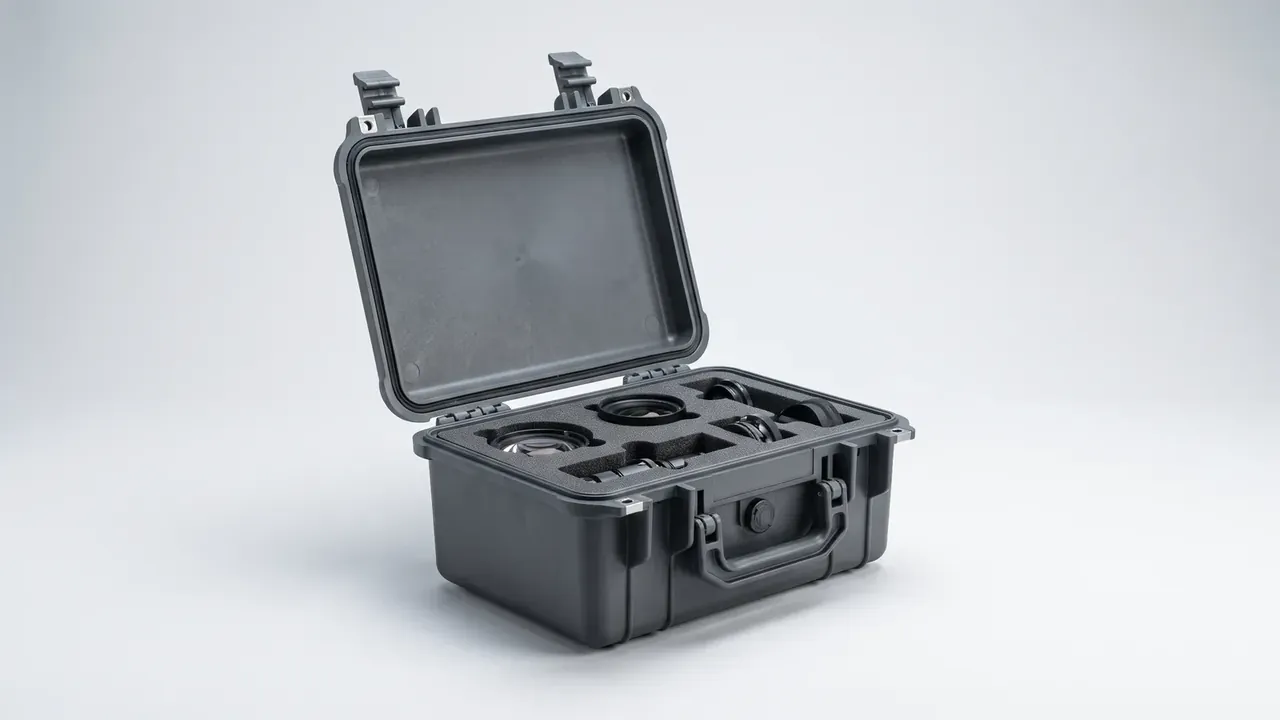
Quick answer: Divider Compartment Design for Industrial Cases starts with pick order: 6 to 12 cells at 120×90 mm, 2 mm clearance and 2.5 kg per cell.
Table of contents
- Order the cells by pick sequence, not by size
- Divider thickness and clearance per cell
- Where rigid dividers stop and soft ones start
- Load per cell and how force travels when stacked
- Six, nine and twelve cells: which one fits
- FAQ
1. Order the cells by pick sequence, not by size
What starts a redesign is a hand hunting the bottom of the box for a screw that belonged in the first cell. Divider Compartment Design for Industrial Cases opens with a stopwatch: note what leaves the case first and what never sits under a heavy part.
Bays drive the grid. A bench with 4 repair bays needs 4 bands of access: frequent parts near the hinge, spares at the far end, and 3 zones that are lid gestures, not slices.
| Cell | Contents | Unit weight | Picks per day |
|---|---|---|---|
| C1 | Hex key set | 0.4 kg | 45 |
| C2 | Torque wrench | 1.2 kg | 30 |
| C3 | Spare battery pack | 2.5 kg | 20 |
| C4 | Seal kit and small parts | 0.3 kg | 15 |
| C5 | Handheld meter | 0.9 kg | 6 |
| C6 | Spare cable | 0.7 kg | 4 |
Those rows total 120 picks a day, a cross-check rather than a quota. Size first and the heaviest part lands in the biggest cavity; a deep cell plus a frequent pick pushes one retrieval past 8 seconds, so Divider Compartment Design for Industrial Cases lets frequency set the cell.
2. Divider thickness and clearance per cell
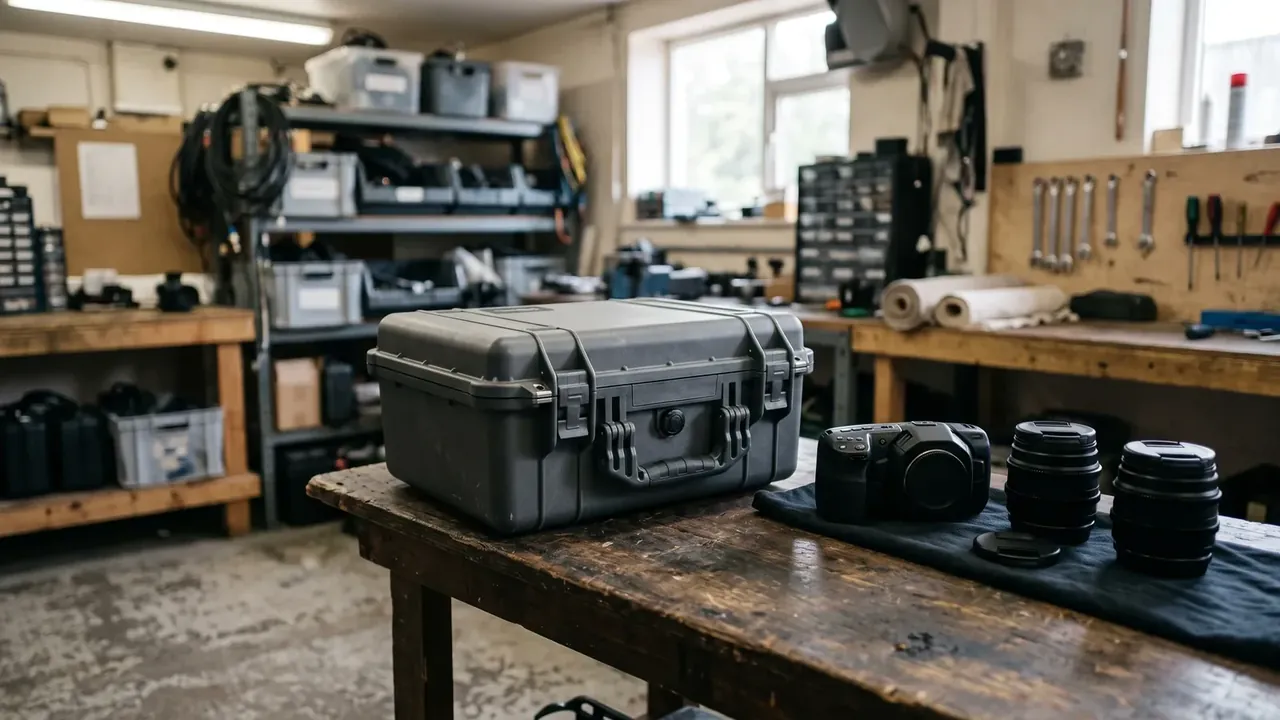
Settle thickness first, clearance second. A 3 mm rigid panel is the default: 2 mm flexes as it slides and 4 mm eats width until a 120×90 mm cell no longer holds. At 180 mm of internal height the panel runs to nine tenths of it.
Clearance of 2 mm is per side, from divider face to part face. Divider Compartment Design for Industrial Cases uses it to hold parts off the divider root and leave a fingertip gap: at 0.5 mm nothing comes out; past 4 mm the part knocks until the coating wears white.
| Divider type | Thickness | Compression | Parts it suits |
|---|---|---|---|
| PP hollow board | 3 mm | 0 mm | Square boxes, battery packs, wrenches |
| EVA sheet | 25 mm | 2 mm | Lenses, meters, odd shapes |
| PU foam | 30 mm | 3 mm | Long rods, cable bundles |
All three can share one case if the thickness step is on the drawing, the soft side taking 1 mm extra or its rebound pushing the rigid panel out of square.
3. Where rigid dividers stop and soft ones start
Rigid walls locate, soft walls cushion, and in Divider Compartment Design for Industrial Cases the split is decided part by part. Metal parts, flat battery packs and standard tools want a rigid wall on four sides so they move vertically but never sideways; lenses and parts with bosses want a soft wall held by compression.
Compression has a ceiling. A 25 mm EVA sheet pressed 2 mm still returns, being in the linear part of its curve; press it 5 mm and it yields, leaving a dent that lets the part rattle. PU at 30 mm is softer, so 3 mm is as far as it goes.
The rigid side fails at the root. A slotted joint needs a groove one tenth of the divider height or the panel rocks; a bonded joint needs an unbroken bead, since one gap lets parts into the next cell.
Cell count carries a cost too. Every divider adds wall area and removes usable volume, and 6 to 12 cells typically costs about 8 percent of it, so Divider Compartment Design for Industrial Cases adds cells only in the space left over.
4. Load per cell and how force travels when stacked

A 2.5 kg part per cell marks a boundary, not an average. Below it a divider restrains sideways only; above it the weight reaches the floor through a bearing strip, since a divider spanning free air is the weakest item in a stack.
Divider Compartment Design for Industrial Cases needs force to travel an unbroken route: part to divider, divider to strip, strip to floor. Break one leg and the load lands on a thin base wall; a strip three times the divider thickness spreads pressure enough to avoid the white mark that warns of a crack.
| Internal size | Cells | Cell size | Empty weight |
|---|---|---|---|
| 370×200×180 mm | 6 | 120×90 mm | 3.2 kg |
| 370×290×180 mm | 9 | 120×90 mm | 4.1 kg |
| 490×290×180 mm | 12 | 120×90 mm | 5.3 kg |
Holding the cell at 120×90 mm and adding rows takes the count from 6 to 12 while empty weight climbs from 3.2 kg to 5.3 kg. That mass is divider and wall material, not capacity; Divider Compartment Design for Industrial Cases still rates 2.5 kg for every cell.
In a stack the lowest case carries the column. Transport shock is estimated at three times static load, so a 2.5 kg part under vibration loads the divider root like 7.5 kg of dead weight, which is why that root gets thickened and filleted.
5. Six, nine and twelve cells: which one fits
Six cells suit a single-bay case that travels as a kit: few cells, large cavities, no pouches inside. The limit shows as variety grows, since two families in one cell disturb the order the layout was built around.
Nine cells is the compromise two-person cases settle on. Six serve frequent picks, three hold consumables, and one rigid panel keeps the halves apart. Cell size stays 120×90 mm and weight rises by under a kilogram.
Twelve cells suit consumable-heavy work where every part is light: one family per cell, numbers on the walls, stock read at a glance. Divider Compartment Design for Industrial Cases keeps twelve away from heavy parts, since small cells force a pinch grip.
Divider Compartment Design for Industrial Cases reverses the order: count families, count picks, weigh the heaviest part. Families set the floor, picks place the cells, weight decides whether a divider reaches the floor. When the three disagree, drop a cell and enlarge the rest.
The point of Divider Compartment Design for Industrial Cases is that the grid mirrors a work sequence rather than cutting the box into pieces. Cells that follow the hands feel obvious; cells that follow dimensions turn the case into a drawer. JUNZHIJIA asks for the pick sequence before any cell dimension is drawn.
Related Reading
- Divider or foam insert: which to choose
- Setting divider spacing so parts stay put
- Internal divider selection guide
- Usable volume: cavity, corners and the real ratio
Related Products
- 8 Series — Gun Cases; Military Equipment Cases; Camera Equipment Cases; Drone Cases; Watch Cases; Knife Cases; First Aid Cases; Electronics Equipment Cases
- WL8-2812 PP Gun Case — model WL8-2812
- All protective cases and toolboxes: 7 series, 158 models