

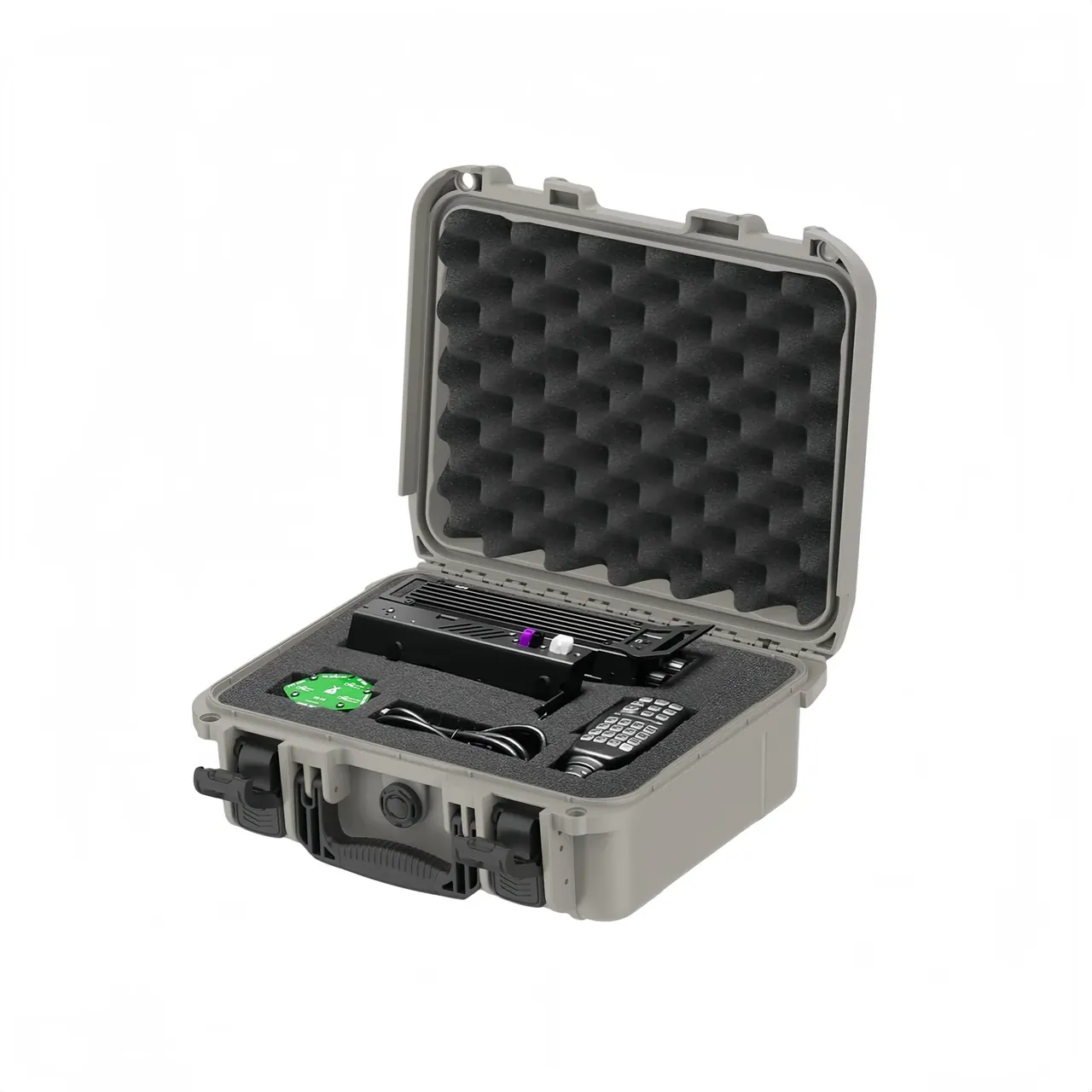
Quick answer: Double-Wall Blow Cases split a 1.2 m drop into three stages, so a 3 mm shell survives by deforming rather than passing the hit on.
Table of contents
- Double-Wall Blow Cases: How the Two Walls Absorb Energy
- The Foam Liner as a Second Stage
- How Floating and Welded Ribs Run
- Drop Height and Landing Attitude
- Proving the Cushion Works
- FAQ
1. Double-Wall Blow Cases: How the Two Walls Absorb Energy
A dropped case must put the energy somewhere; pick the wrong place and the tool pays. At contact, kinetic energy has three exits: plastic deformation of the shell, compression of the gap and liner, and whatever path runs straight through the wall into the tool.
In double-wall blow cases the section reads 3 mm outer wall, 6 mm gap, 3 mm inner wall. The outer skin crushes locally and turns a line contact into an area; ribs and trapped air in the gap compress, giving that crush 6 mm of stroke; only then does the inner skin take load, holding the interior shape so the tool does not deform with the shell.
Stroke beats thickness in double-wall blow cases. One 3 mm skin leaves 3 mm of crush space, two skins leave 9 mm, and peak acceleration differs by more than a factor of two on the same impact.
| Landing point | What deforms | Where the energy goes |
|---|---|---|
| Broad face | Panel dishes inward, slow recovery | Shell bending, gap squeezes 2–3 mm |
| Long edge | Edge line collapses, white crease | Local crush, one side of the gap works |
| Corner | Radius flattens | Highest concentration, needs build-up and foam |
Corners are the hard case, since three edges meet with nowhere to spread the load and local stress can run several times the face value. Thicker corner, R8 radius and an extra foam pad belong together; drop one and the other two cannot compensate.
2. The Foam Liner as a Second Stage
In double-wall blow cases the liner brings the remaining acceleration inside what the tool tolerates. A typical PE liner sits at 30 kg/m³, within the usual 25–35 kg/m³ band, and works at about 25% compression. Softer and the first drop bottoms it out, which is worse than no foam; harder and the stroke is never used.
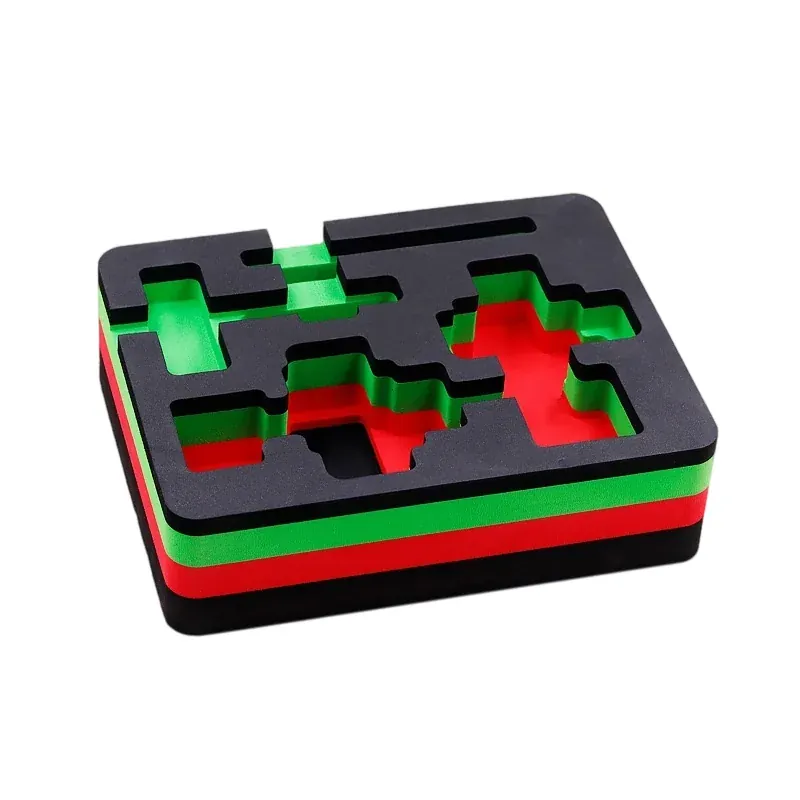
Density follows two facts: tool weight and landing attitude. A heavy tool landing on a corner wants the top of the band near 35 kg/m³ with compression held at 25%; a light tool landing on faces is fine at 25 kg/m³. Inside one case the base is denser than the lid, because lid foam only preloads and recovers.
EVA spans 25–45 kg/m³ and its compression set is read at 25% compression, 23 °C, 24 h, where it should stay under 5%. Past that the pad has taken a set and the next drop begins with less stroke than the first.
Thickness is not a case for more: extra foam lifts the tool, the lid cannot preload it, and it rattles in transit, collecting more small hits than any drop delivered. Most double-wall blow cases want light preload on closing: a finger feels resistance, the latches close without force.
3. How Floating and Welded Ribs Run
Ribs in double-wall blow cases come in two kinds. Welded ribs, or tack-offs, join both skins at the crown and resist bending and compression. Floating ribs rise from one skin only and leave the gap open, steering deformation and limiting crush depth. Both live in the same cavity, each doing one job.
Welded ribs follow the force path. A corner impact travels inward along the three edges that meet there, so ribs are laid along those edges at even spacing and gathered into a ring at the base. A rib crossing the path is a wall in the way of the load, and the wall breaks first.
Floating ribs decide where deformation happens. A shallow one at mid-panel, no deeper than twice the wall thickness, buckles first in a drop and spends the energy, leaving the flat inner skin undisturbed. Push it deeper and buckling turns to fracture.
The rule fits in a line: soft on the ground side, stiff behind the tool, with dense ribs behind the mounting face and sparse ribs outside.
4. Drop Height and Landing Attitude
Attitude decides failure earlier than height. A 1.2 m drop is the usual figure for hand-held power tools, matching a case slipping from a standing carry. The sequence runs 10 drops over 6 faces, 3 edges and 1 corner, faces first and corner last, since the corner is the point most weakened by everything before it.
Face impacts bend the whole panel; edge impacts run along the edge line and collapse the corners at either end; corner impacts concentrate the highest pressure. Three mechanisms, three reinforcements, and material in the wrong place leaves a 3 mm wall thickened to 4 mm still splitting at the corner.
| Sequence | Height | What to watch |
|---|---|---|
| 6 faces | 1.2 m | Spring-back, gap crush depth |
| 3 edges | 1.2 m | Length of white crease, corner radius |
| 1 corner | 1.2 m | Corner flattening, foam displacement |
More height is not more safety. A 1.2 m drop onto concrete and onto steel plate are different tests, so only a rigid anvil makes readings comparable. Below 0 °C the impact strength of PP and HDPE falls, so a cold drop needs conditioning at -10 °C for at least 4 h, enough to chill the wall through its thickness.
5. Proving the Cushion Works
Two numbers settle it: peak acceleration and residual set. An accelerometer at the tool position records three axes and must stay under 40 g; the liner is measured afterwards and must recover to within 1 mm.
| Check | Measured at | Criterion |
|---|---|---|
| Peak acceleration | Tool centre of mass, 3 axes | ≤40 g |
| Foam residual set | Corner and base pockets | ≤1 mm |
| Gap crush | Impact-side wall centre | Under 60% of gap depth |
| Wall cracks | Corner radius | No through crack |
Ruling for the report: after a 1.2 m drop on six faces, three edges and one corner, a liner holding more than 1 mm of residual set, or a peak above 40 g, sends the structure back for added ribs on the inside of the edge that landed.
The last step is a repeat run: with ribs added, the full sequence goes again, peak must fall and residual set must come back. Any double-wall blow cases signed off on a single run tend to fail in the second production batch, because foam density varies lot to lot.
Related Reading
- Blow-moulded cases: from parison to finished shell
- Designing a case foam liner without the usual mistakes
- EVA, EPE and PU foam compared for case liners
- Usable volume after cavity corners are counted
Related Products
- 8 Series — Gun Cases; Military Equipment Cases; Camera Equipment Cases; Drone Cases; Watch Cases; Knife Cases; First Aid Cases; Electronics Equipment Cases
- WL8-2812 PP Gun Case — model WL8-2812
- All protective cases and toolboxes: 7 series, 158 models