

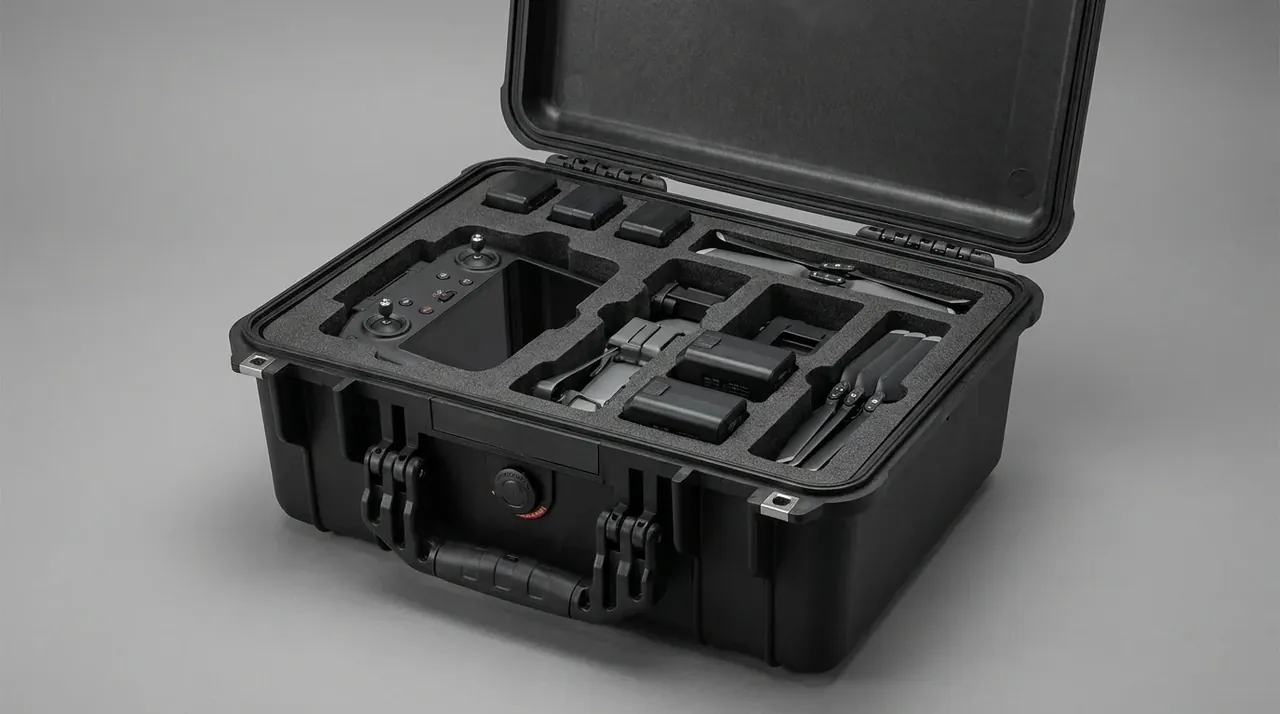
Quick answer: Three figures fix the shock protection of this drone aerial photography shockproof plastic case: 35 mm EVA, a 5.2 kg empty shell, a 1.2 m drop.
Table of contents
- Three transit stages that load the case
- Vehicle transit: how 10-55 Hz reaches the insert
- Carry transit: where 5.2 kg goes
- Setup position: lid angle and lid weight
- Twelve foam cavities that stay put
- FAQ
1. Three transit stages that load the case
The drone aerial photography shockproof plastic case meets three loads that pull the design in opposite directions: narrow-band vibration and road impacts on the road, a single-point hang from one hand on foot, the weight of its own lid at the setup position. No single wall thickness satisfies all three.
The shell is 500×400×230 mm and the cavity 445×345×190 mm, with a 3.5 mm wall, 5.2 kg empty weight and 9 kg of load. That leaves 27.5 mm per side and 20 mm in height, spent on wall, ribs and radii rather than foam. Protection reduces to transmission through the base, latch deformation and insert recovery.
2. Vehicle transit: how 10-55 Hz reaches the insert
For the drone aerial photography shockproof plastic case this is the most underestimated stage. Input energy clusters between 10 and 55 Hz, and a small shell with an insert usually has its first mode inside that band.
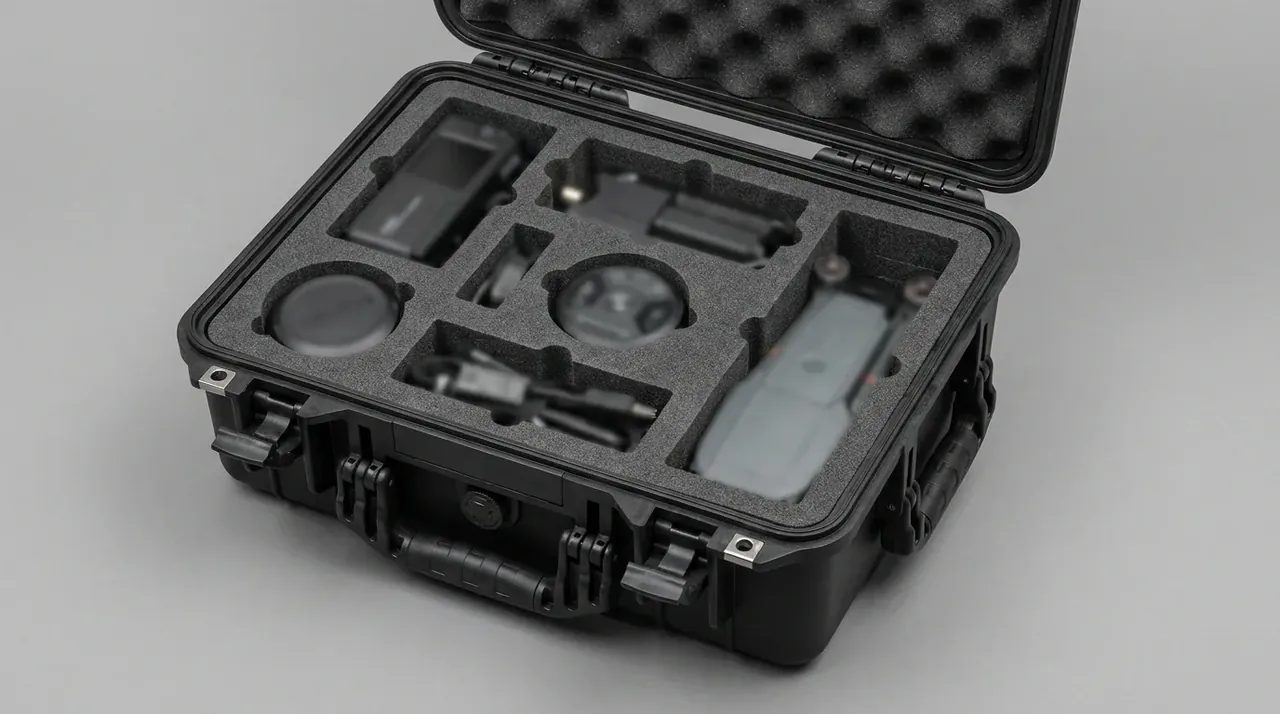
Vibration enters at the base ribs, crosses the side wall and only then reaches the insert. Ribbing spreads point contact into surface contact; EVA does the last stage. Swept at 9 kg, ribbed shells put the first mode above 62 Hz.
| Transit mode | Vibration and impact source | Insert response |
|---|---|---|
| Vehicle | 10–55 Hz narrow band, road impacts | 35 mm EVA all round, 5 mm pad under the base |
| On foot | Static hang, sway at step frequency | 20 mm lid foam pressed 2 mm |
| Setup | Lid opening, insert rebound | 15 mm egg-crate, R5 cavity chamfers |
Base ribbing cannot follow appearance. At 8 mm rib height and 40 mm pitch the base deflects about 1.4 mm under 100 kg; at 60 mm pitch deflection nearly doubles and the insert lifts off.
Stiffness alone does not settle this item.
3. Carry transit: where 5.2 kg goes
On foot the drone aerial photography shockproof plastic case is tested by hanging, not by vibration. The shell is 5.2 kg empty and 14.2 kg loaded, all of it landing on the handle mounts and the walls.
Moulding the mount into the shell, backing it with 6 radial ribs and wrapping the grip in 30 mm of TPE moves that load into the wall. Hung at 280 N for 1 h, root deflection stays under 0.6 mm.
The strap is a second load path for the drone aerial photography shockproof plastic case. Two points sit 15 mm above the centre line of the long side, each verified at 260 N, each a through hole with a metal bush so webbing cannot ream the plastic oval.
How closely the insert meets the wall decides whether impact reaches the shell. Cut 35 mm thick and 0.5 mm under the 445×345×190 mm cavity, the EVA shows no side gap and the top face is compressed 8%, about 2.8 mm. At 34 mm compression falls below 5% and the insert shifts 1 mm to 2 mm. On the same six-face 1.2 m drop, a sample at 8% read about 18% lower residual acceleration than one at 5%. Push compression to 12% and closing and release forces both climb. The 35 mm and the 8% are squeezed from both sides.
4. Setup position: lid angle and lid weight
At the setup position the lid of the drone aerial photography shockproof plastic case has to stay in the air. At 105° its centre of gravity passes 4 mm beyond the hinge axis and it holds; below 95° it falls back, above 115° it tips rearward.
The lid weighs 1.8 kg and carries 15 mm of egg-crate foam, so the crowns meet the cavity rim first as a soft stop.
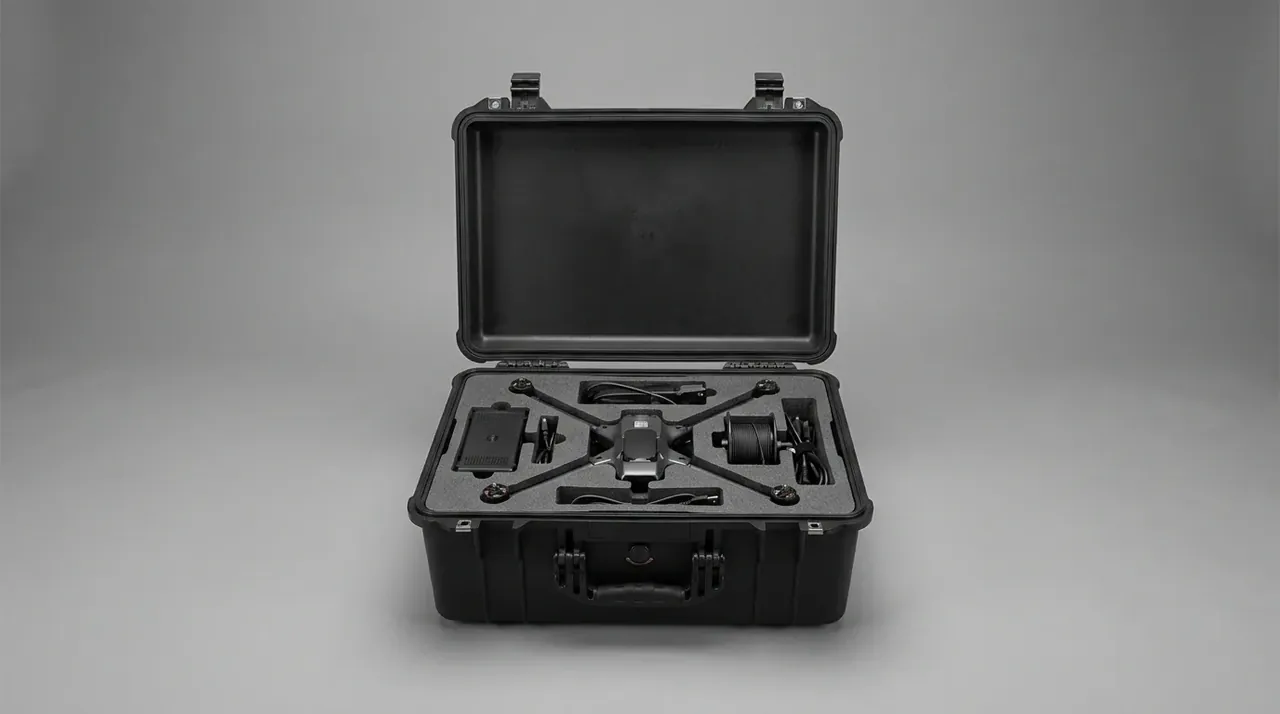
Recovery counts too: 35 mm EVA compressed 8% needs about 1.5 s to return to 98%, and closing early raises the starting point of the next compression.
| Opening stage | Constraint | Shell value |
|---|---|---|
| 0° to 45° | Lid lifts with one hand | Hinge damping 0.8 N·m |
| 45° to 105° | Lid holds, no fall-back | 2 stop blocks, centre offset 4 mm |
| 105° to closed | Foam crowns touch first | 15 mm lid foam, R5 chamfer |
5. Twelve foam cavities that stay put
The 12 cavities of the drone aerial photography shockproof plastic case are grouped by mass and footprint: heavy items along the base centre line, light ones in the corners, long ones running lengthwise. Each pair keeps a 12 mm EVA wall.
| Cavity group | Geometry | Retention and value |
|---|---|---|
| Main bay | 210×180×95 mm | 10 mm hard pad below, 1.5 mm clearance |
| Four round cavities | φ58 mm, 70 mm deep | R5 chamfer, φ8 mm vent |
| Three long cavities | 240×45×30 mm | 12 mm dividing wall |
| Four accessory cells | 80×80×45 mm | 20 mm foam above |
A cavity stays put only if the compression face is continuous once the lid shuts. Leave one top face untouched and that cavity becomes the only free travel in the case.
Inspection runs on three items: no latch release after one 1.2 m drop on each of six faces, with cavity shift under 2 mm; no water mark after IP67 at 1 m for 30 min; smooth opening after 4 h at −20 °C and 60 °C. Two latches rate 400 N each, combined retention above the peak impact force.
Conclusion
Protection here is not one layer of foam but four items working together: base ribs, wall thickness, insert compression and latch retention. Keep the first mode out of the 10–55 Hz band, hold the 35 mm EVA at 8%, hand the 1.2 m drop to two 400 N latches, and the shell side of the drone aerial photography shockproof plastic case is closed.
Related Reading
- What an IP67 rating really blocks on a drone case
- How to set cell spacing in a drone battery case
- Layout and access flow inside a drone accessory case
- Insert hardness and lens protection in camera cases
Related Products
- 8 Series — Gun Cases; Military Equipment Cases; Camera Equipment Cases; Drone Cases; Watch Cases; Knife Cases; First Aid Cases; Electronics Equipment Cases
- WL8-2812 PP Gun Case — model WL8-2812
- All protective cases and toolboxes: 7 series, 158 models