

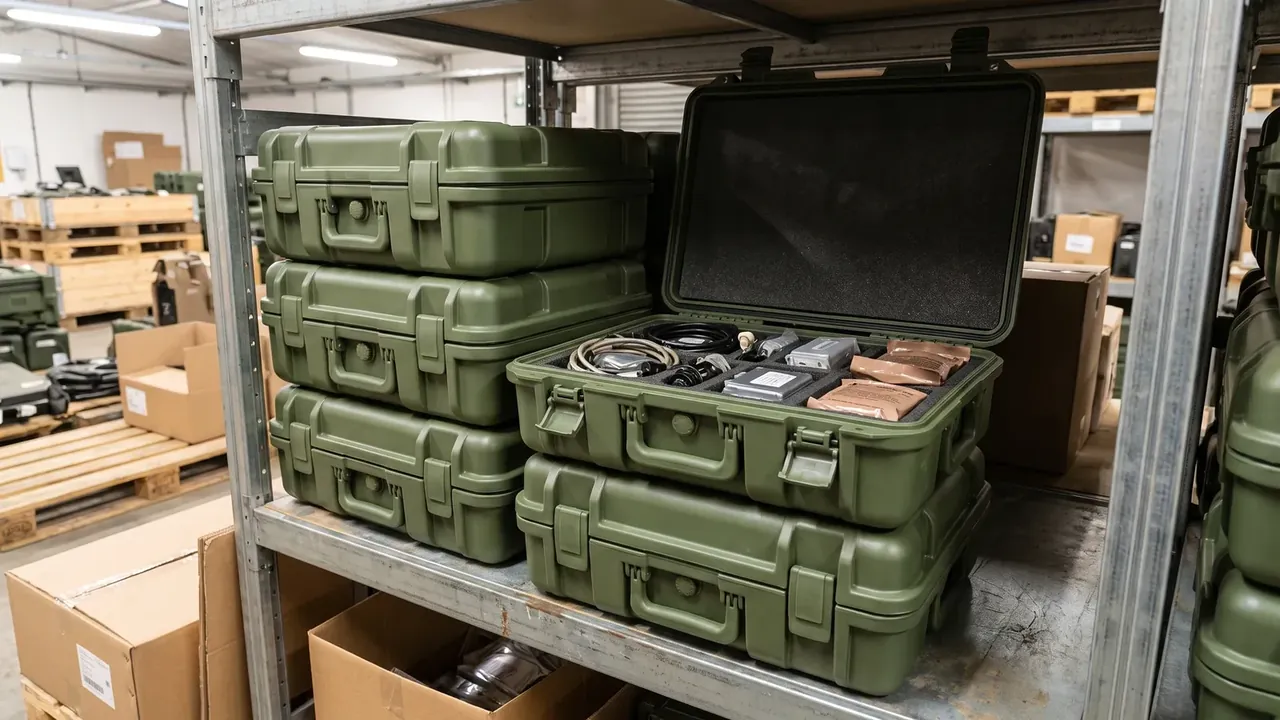
Quick answer: A drone battery explosion-proof fireproof case holds three lines at once: fire during runaway, 30% charge in transit, under 45 ℃ while charging.
Table of contents
- Why drone batteries need a fireproof case of their own
- What the shell has to withstand during thermal runaway
- Cell spacing and the insulation layer
- Charge level and terminal prep before transport
- Heat paths during on-site charging
- FAQ
1. Why drone batteries need a fireproof case of their own
Energy density went up in aerial batteries, and the margin for error in transport went down with it.
A quadcopter usually flies on 3S to 6S packs of 5000–10000 mAh, which works out at 77–150 Wh. A lead-acid block of the same volume holds a third of that and weighs twice as much, so aerial work has no fallback.
With that energy in a shell the size of a hand, failure moves quickly. One 18650 cell can go from first self-heating to venting in minutes, and what matters is not prevention but what survives alongside it.
The boundary of a drone battery explosion-proof fireproof case is narrow: keep one pack's runaway inside its cavity, stop it igniting the next, stop flame leaving the lid. Waterproof and shockproof cases work from outside in; this one works from inside out.
Rules have tightened too. Cells shipped alone have long been capped at 30% state of charge, and from 1 January 2026 the cap also covers batteries packed with the equipment they power.
2. What the shell has to withstand during thermal runaway
Runaway climbs through temperature bands, and each band asks something different of the shell.
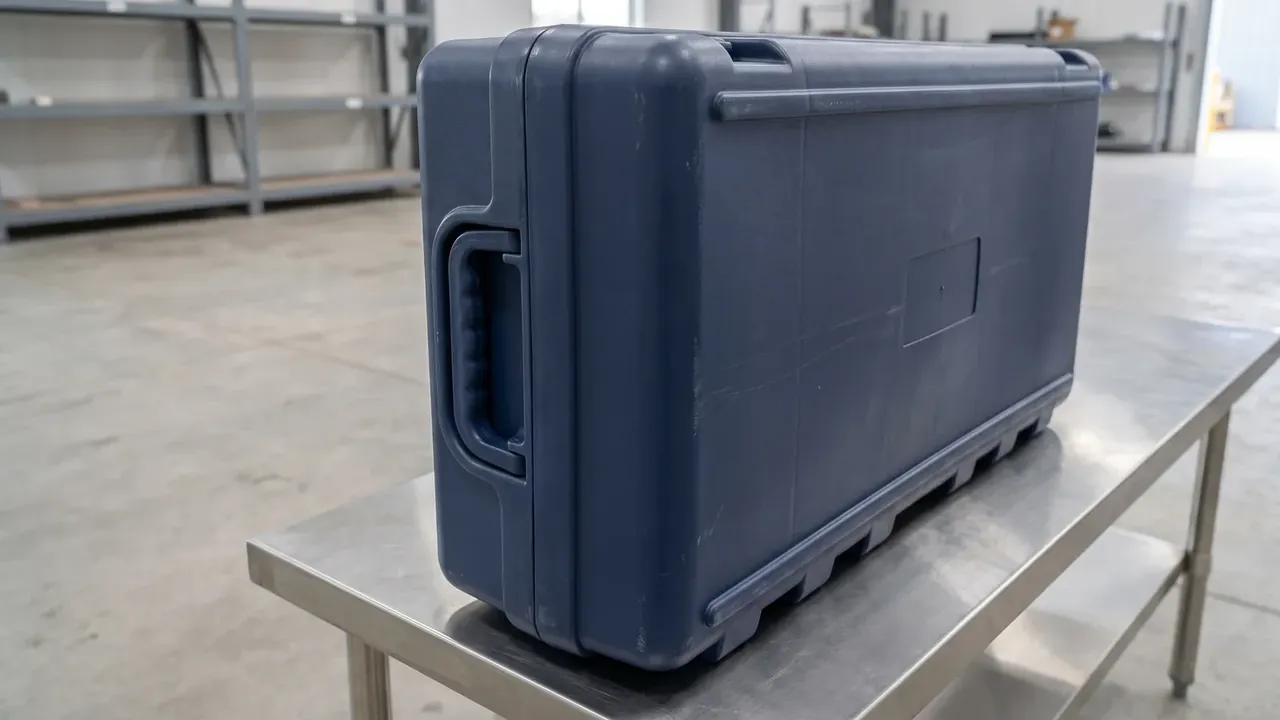
Calorimetry puts self-heating onset at roughly 70–120 ℃, the trigger at 180–250 ℃, and peak temperatures several hundred degrees higher. A drone battery explosion-proof fireproof case answers at three points on that curve.
Swelling comes first, so each cavity needs 2–3 mm of expansion allowance or the load transfers straight to the wall.
Venting comes second: in a few seconds the relief port discharges hot gas and electrolyte mist, so the lid needs a deflector that sends it to the cavity floor instead of through the gasket line.
Sustained burning comes third. Lithium cells carry their own oxidiser and burn in an oxygen-poor box, so the shell insulates rather than starves the fire.
| Runaway symptom | Time scale | What the shell must do |
|---|---|---|
| Cell swelling | 5–10 min after heating | 2–3 mm allowance per cavity |
| Relief venting | Seconds | Lid deflector, cavity floor catch |
| Open flame | 30 min or longer | Wall and intumescent layer intact |
| Heat into the next bay | Within 10 min | Cell gap of 10 mm or more |
The last row is the quiet one. A burnt-through wall is obvious; a neighbouring pack cooked to 150 ℃ is not, and it pushes the second cell to its trigger half an hour after landing, which is why the gap inside a drone battery explosion-proof fireproof case matters more than wall thickness.
3. Cell spacing and the insulation layer
Spacing inside a drone battery explosion-proof fireproof case is not empty air; it is a delay line that keeps the next bay below its trigger temperature.
The gap is set at 10 mm, a heat-flux figure rather than a habit. At venting, the side of a cell carries the highest flux, and 10 mm of air behind a 2 mm barrier holds the neighbouring surface rise under 60 ℃.
Mica is thin and takes heat, so it sits against the cell. Aerogel conducts less but loses performance once compressed, so it belongs where nothing presses. Stacking both is worse than one tight layer and an air gap.
The check is measurable: a gap under 10 mm disqualifies the insert for transport. Calipers go between adjacent cavity walls, measuring wall to wall, not centre to centre.
The insert has to keep up as well. EVA softens near 80 ℃, so the layer nearest the cells is flame-retardant EVA or carries a foil facing, or the barrier survives while the foam behind it collapses.
4. Charge level and terminal prep before transport
Most incidents involving a drone battery explosion-proof fireproof case are not a shell problem. They are a charge level and a terminal nobody dealt with.
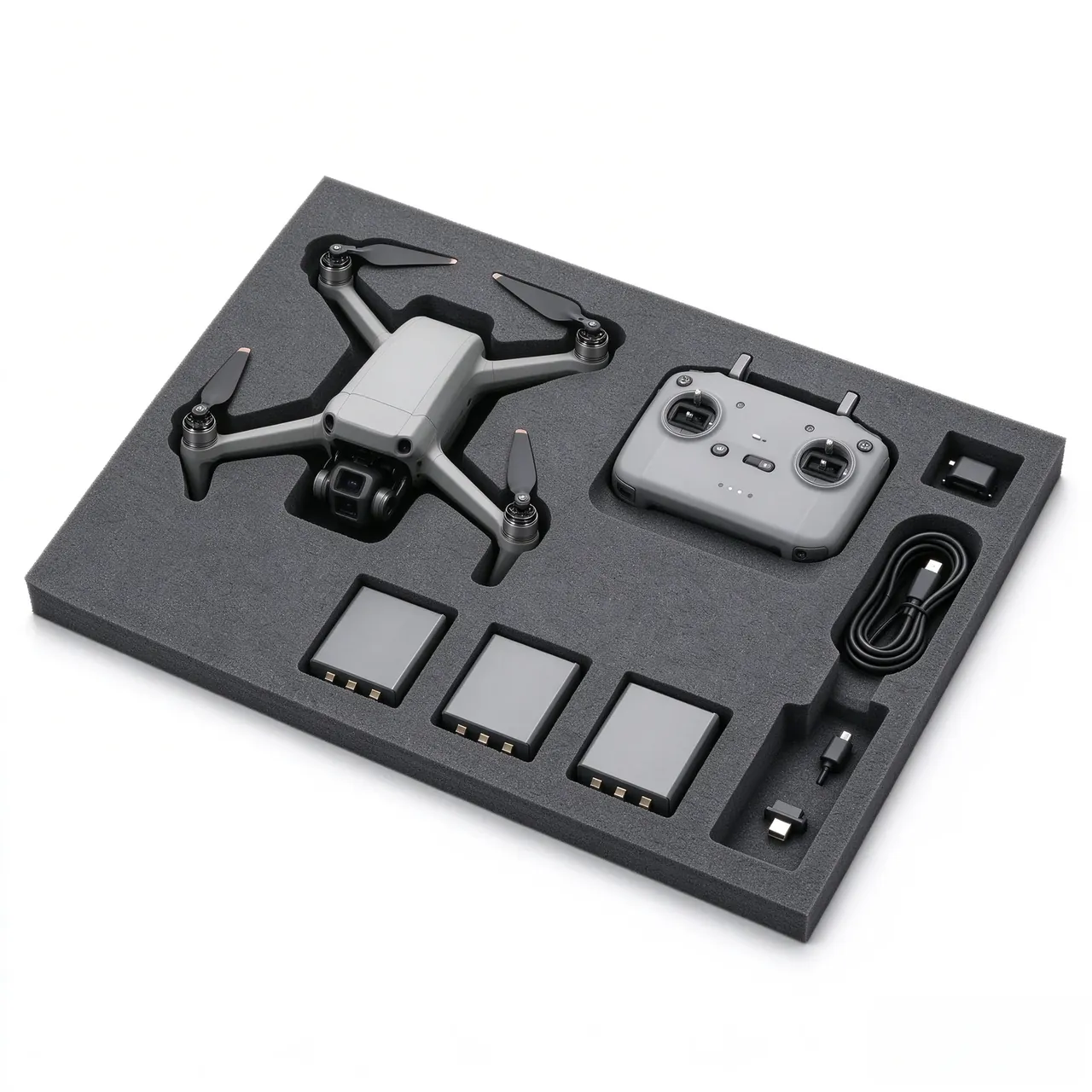
State of charge is the first gate. The 30% figure is not caution for its own sake: in cell testing a full sample starts self-heating about 30 ℃ lower than an empty one, so a full pack spends its margin before the trip starts.
Terminals are the second gate. A bare positive and negative short through a key or the metal shell of a spare pack, and a few seconds of short circuit lifts the cell past 200 ℃ locally.
Fixation is the third gate in a drone battery explosion-proof fireproof case. A pack that shifts wears its terminals and cracks the wrapper, and once cracked it should not fly again.
| Transport step | Action | Pass value |
|---|---|---|
| Discharge before leaving | Run down or charge to target | 30% of rated capacity or less |
| Terminal handling | Insulating tape or a cap | No metal bridge between poles |
| Loading | One pack per cavity | Gap of 10 mm or more |
| Boarding | Carry on, never check in | 100 Wh per pack or less |
| Winter transfer | Warm up before charging | Cell at 15 ℃ or above |
The fourth row is where the airline rule bites. Packs between 100 and 160 Wh need carrier approval, anything above 160 Wh stays off passenger aircraft, and no wall thickness changes that. Read the pack label before choosing a drone battery explosion-proof fireproof case.
5. Heat paths during on-site charging
Charging is where this case is most often misused, because the lid goes down and the heat has nowhere to go.
A 5000 mAh pack at 1.5–2.5 C draws 7.5–12.5 A, and at roughly 10% conversion loss it becomes an 8–15 W source. Four packs together put 30–60 W inside the shell.
A closed 0.6 m² case sheds 60 W only by lifting its surface 40 ℃ above ambient, which puts the interior near 70 ℃ on a 30 ℃ day. That curve rules out charging with the lid shut.
The workable routine is to charge with the lid open and folded back past 90°, leaving 100 mm of clear space above the cavities. A stick-on thermometer inside watches the air, stopping at 45 ℃ and resuming below 35 ℃.
Chargers stay outside. Two stacked chargers run at 60 ℃, and putting them in a battery bay fits an ignition source to a drone battery explosion-proof fireproof case.
Related Reading
- Packing list before a battery flies
- Sizing a safety case to the cell count
- Impact and insulation layers in battery cases
- Laying out battery bays and arms
JUNZHIJIA
Related Products
- 8 Series — Gun Cases; Military Equipment Cases; Camera Equipment Cases; Drone Cases; Watch Cases; Knife Cases; First Aid Cases; Electronics Equipment Cases
- WL8-2812 PP Gun Case — model WL8-2812
- All protective cases and toolboxes: 7 series, 158 models