

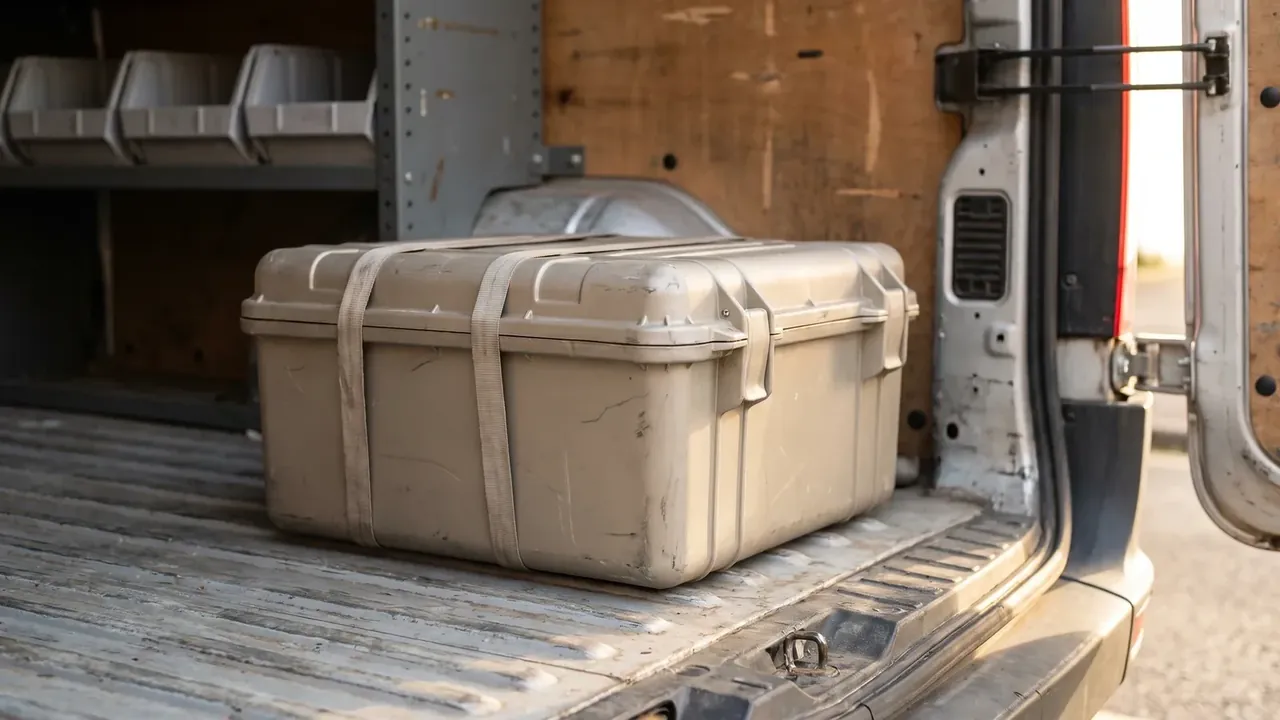
Quick answer: A Drone Battery Transport Case has to clear four checks: the Wh class, a state of charge under 30%, terminal insulation and a 3 m stack.
Table of contents
- Where the 100 Wh and 160 Wh lines fall
- How to bring charge below thirty percent
- Where poor terminal insulation starts to fail
- What the 3 m stack test asks of the case
- Which side the case should open on in the field
- FAQ
1. Where the 100 Wh and 160 Wh lines fall
The 100 Wh and 160 Wh thresholds measure rated energy, not capacity. Rated energy is nominal voltage times amp-hours, so a 6S pack marked 22.2 V and 10 Ah works out at 222 Wh and lands in the top band. Buyers often quote milliamp-hours only, and a bay layout built on mAh is rejected at the first acceptance check.
The bands are handled differently. Up to 100 Wh moves as ordinary cargo. Between 100 and 160 Wh needs airline approval, booked with a UN38.3 test summary attached. Above 160 Wh is refused on passenger aircraft. Most spare drone packs sit in the middle band, so a Drone Battery Transport Case must show rated energy pack by pack, labelled inside the bay.
| Rated energy | Air handling | What the case side does |
|---|---|---|
| Up to 100 Wh | Ordinary cargo under the packing instruction | Insulated, one pack per bay, label shows Wh |
| 100 to 160 Wh | Airline approval required | One pack per bay, label carries Wh and batch |
| Above 160 Wh | Banned on passenger aircraft | Single bay, extra warning mark outside |
The packing instruction has to match. Spare packs shipped with the aircraft fall under PI 966; packs installed in the aircraft fall under PI 967. From 1 January 2026, PI 966 Section II makes a state of charge at or below 30% mandatory above 2.7 Wh; a Drone Battery Transport Case for spare packs is therefore built for the mandatory band.
2. How to bring charge below thirty percent
Thirty percent means rated capacity, not the screen figure, which is calculated: a pack showing 30% may measure 26% or 34%. Discharge to 28–30% before dispatch, hold two points of margin, and log voltage, temperature and batch.
| Packing instruction | Situation | State of charge |
|---|---|---|
| PI 965 | Cells shipped alone | At or below 30%, long-standing rule |
| PI 966 Section I | Packs with equipment | At or below 30%, above needs state approval |
| PI 966 Section II | Packs with equipment, above 2.7 Wh | 30% or less, mandatory from 2026 |
| PI 967 | Packs inside equipment | 30% or 25% displayed recommended |
Discharging happens before packing; the case contributes marking and separation. Keep one batch per bay, because a mixed bay hides which pack is over the limit during a spot check, and label each bay with batch and measured charge.
Temperature moves the reading. Voltage sags in the cold, and the same pack reads several points apart at 5 °C and 25 °C. Let it rest two hours after discharge, then measure again. A Drone Battery Transport Case used outdoors in winter needs ambient temperature logged beside the voltage.
3. Where poor terminal insulation starts to fail
A short needs an exposed terminal, nearby metal and relative movement; a Drone Battery Transport Case controls the last two. Once a pack slides in its bay, the terminal rubs against a screw next door, and that is where the incident starts.
Insulation starts at the terminal root. Tape at least 25 mm wide, wrapped twice with no lifted edge, is the minimum; a factory cap that closes properly is better, with tape over it. Tape stored cold loses tack, so check it again before dispatch.
The case side of a Drone Battery Transport Case matters more than the material. One pack per bay, a solid partition rather than a slit, terminals facing one side, and a partition taller than the terminal so the lid foam presses the pack body, not the contacts. Clearance of 1–2 mm per side keeps removal easy without letting the pack slide, and uniform orientation turns a pack-by-pack check into one sweep of the eye.
4. What the 3 m stack test asks of the case
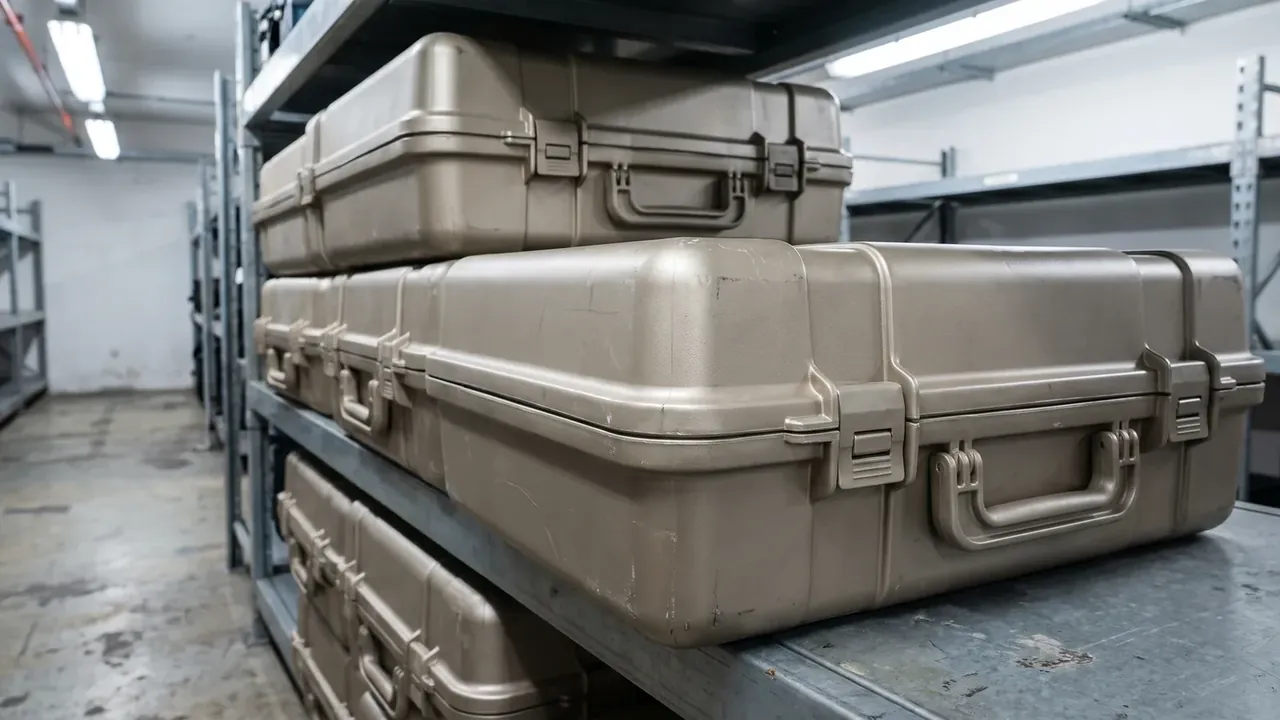
The 3 m stack requirement entered the packing instructions in 2025. A completed package must withstand a top load equal to identical packages stacked 3 m high, for 24 hours, without damaging the cells or reducing packaging effectiveness. It covers PI 966 Section II and PI 967 non-UN specification packaging, which is most Drone Battery Transport Case builds.
| Case height | Layers in 3 m | Packages loading the bottom one |
|---|---|---|
| 0.25 m | 12 layers | 11 packages |
| 0.30 m | 10 layers | 9 packages |
| 0.50 m | 6 layers | 5 packages |
The load reaches the case at three points. Lid ribs run along the load direction and line up with the base ribs, so force travels down the walls instead of the lid panel. Latches hold 200–400 N; one pushed open by a fraction of a millimetre has failed. A wall of 2.0–3.5 mm is the stiffness floor, and a thin wall creeps downward over 24 hours until the lid no longer closes flat.
Capability can be shown by test, assessment or experience; no third-party certificate is required. An assessment names the case model, insert and loading pattern, and is redone when any of them changes. A supplier who hands that over is worth more than one printing a military-grade line on a datasheet.
5. Which side the case should open on in the field
Which side a Drone Battery Transport Case opens on depends on where the aisle is. Face the opening toward the aisle so the lid does not block the walkway. If the case sits against a wall under other cases, put the bays nearest the opening, where a standing operator reaches them without unloading.
Lid or side door follows swap frequency. Ten swaps a day makes a side door worth it, since it removes the lift-and-close motion; one swap a week favours a plain lid with a simpler seal. Hinges are rated for 20,000 cycles, and latches at 200–400 N flip open with a gloved hand.
Once the opening side is fixed, bay order follows: the near side carries today's batch, the far side the spares, and nobody empties the whole case to find a pack. Strap a Drone Battery Transport Case down in a van and the opening direction can no longer change.
Compliance lives on paper, but on the case it comes down to three places: the partition, the insulation and the stack. The first decides whether a pack crosses into the next bay, the second whether a terminal meets metal, the third whether the bottom case still closes after 24 hours.
Related Reading
- Which parameters come first in battery case selection
- What IP67 covers on a battery transport case
- How usable volume and cavity corners are counted
- Hazmat transport cases under ADR and IMDG
Related Products
- 8 Series — Gun Cases; Military Equipment Cases; Camera Equipment Cases; Drone Cases; Watch Cases; Knife Cases; First Aid Cases; Electronics Equipment Cases
- WL8-2812 PP Gun Case — model WL8-2812
- All protective cases and toolboxes: 7 series, 158 models