

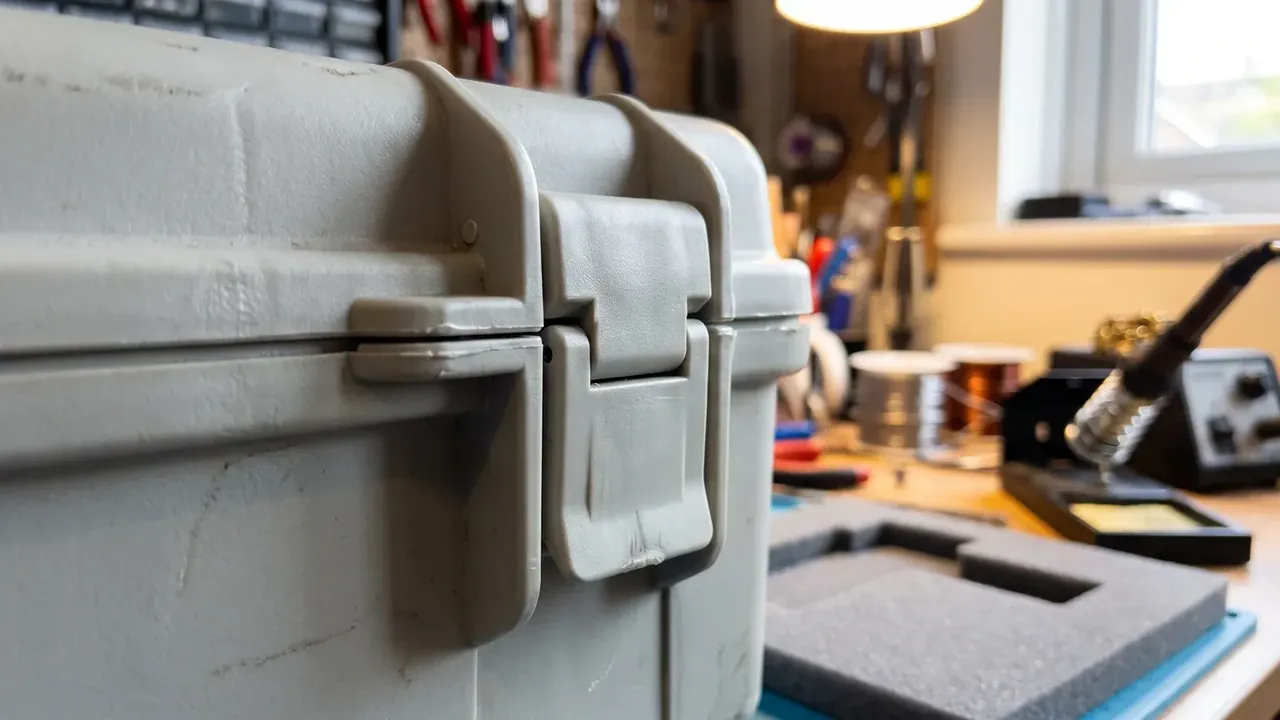
Quick answer:A drone camera transport case holds 40–50% RH, carries 5–10 g of desiccant per litre and keeps 25%–35% gasket compression from factory to field.
Table of contents
- The wipe before the lens goes in
- Desiccant grams follow case volume
- The condensation window from air conditioning to noon sun
- Upright or flat: how a lens takes load
- When to replace the gasket
- FAQ
1. The wipe before the lens goes in
A lens usually dies in a drone camera transport case from suffocation, not from a fall. Packing at the factory is the first of three humidity checkpoints and the only one that catches the problem at its source. A wipe that only removes visible dust leaves fingerprints and skin oil behind, and those are food for mould; the driest case only slows the growth.
The order is fixed: blow off loose dust, wipe once from centre outward with a lint-free cloth, finish with a dry pass. A cloth damp with cleaner dragged back and forth leaves streaks of oil. Let the solvent flash off before closing the lid, since trapping vapour inside adds humidity rather than removing it.
A drone camera transport case is packed at 15–25 ℃ and 40–50% RH, and that band is not arbitrary. Above 60% RH mould can germinate within 72 hours; below 30% RH the helicoid grease dries and rubber parts harden. Both ends damage gear, so the middle is the only window worth holding.
| Checkpoint | Relative humidity | What the case holds | Sign of failure |
|---|---|---|---|
| Factory packing | 40–50% RH | gasket seated, desiccant in place | spots on arrival |
| In transit | below 60% RH | gasket still springing back | water film inside |
| Field opening | back to 40–50% RH | reseal and swap desiccant | fog that will not clear |
2. Desiccant grams follow case volume
Desiccant is sized by internal volume, and 5–10 g/L is the usual band. A 30 L case takes 150–300 g; whether to sit at the top or the bottom of that range depends on how often the lid opens. Counting sachets instead of grams goes wrong quickly, since packs run from 5 g to 500 g.
Silica gel also stops working once saturated, and in a closed case it then releases moisture back into the air, turning from a buffer into a reservoir. Colour-change gel shifting from orange to dark green is the failure signal; bake it or replace it, and do not judge by feel.
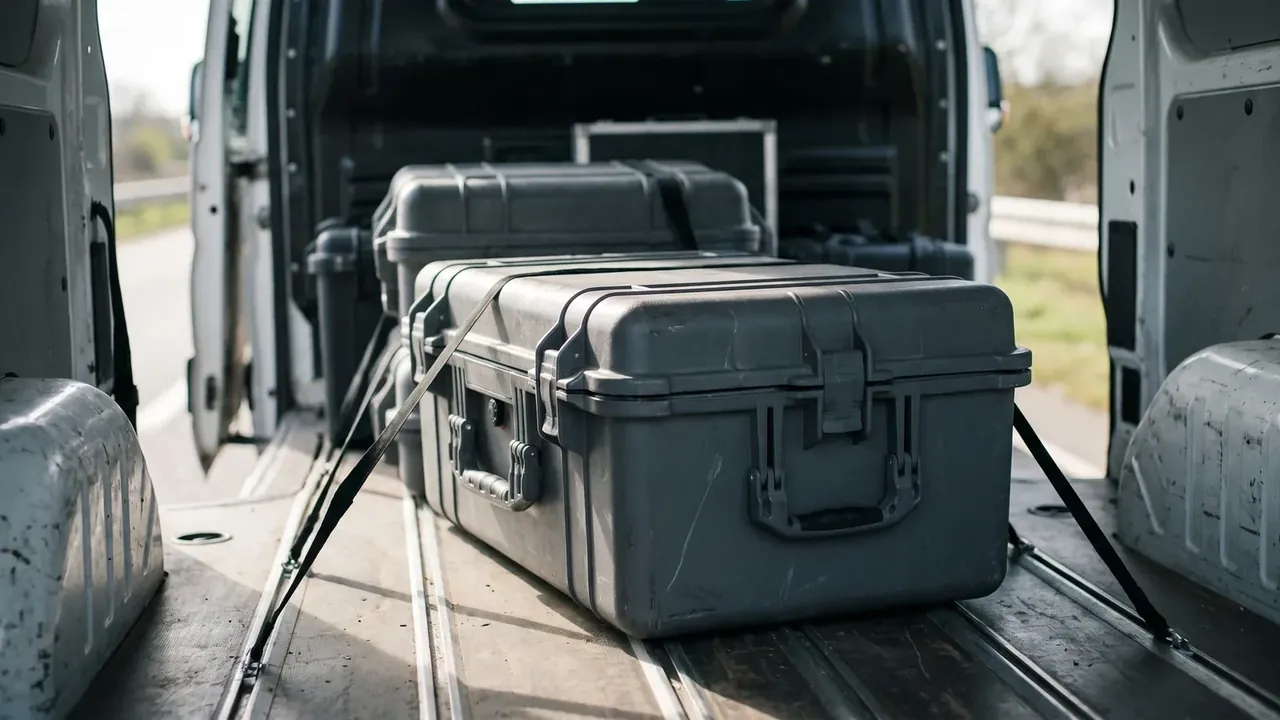
In transit the job of a drone camera transport case is modest and easy to miss: hold internal humidity inside the band for dozens of hours while the vehicle stacks, shakes and crosses day-night temperature swings. Once gasket compression drops, outside moisture walks in through the lid gap.
| Internal volume | Desiccant mass | Replacement interval | Indicator reading |
|---|---|---|---|
| 10 L | 50–100 g | after each field day | blue dot turns pink |
| 30 L | 150–300 g | every two weeks | 60% spot changes |
| 60 L | 300–600 g | monthly | whole card drifts pink |
Those intervals are conservative limits rather than predictions. A drone camera transport case opened eight times a day halves them; one that stays shut for a month can run to the top.
3. The condensation window from air conditioning to noon sun
A 22 ℃ room and a 35 ℃ street at 70% RH put a film of water on the glass in seconds. The mechanism is simple: the lens surface sits below the dew point of the surrounding air, so vapour condenses on it. The wider the gap and the wetter the air, the faster the window opens.
What a drone camera transport case can do is stretch the transition. Keep the lid closed while the case moves outdoors, park it in shade for 30 min, then open it once the temperature difference falls inside 5 K. Metal shells move heat quickly, plastic ones slowly, but both need the wait.
The reverse trip bites harder: a drone camera transport case baked in the sun, carried into an air-conditioned room, meets cold air the moment the lid lifts, and the vapour inside condenses on glass and sensor.
4. Upright or flat: how a lens takes load
Standing upright inside a drone camera transport case, a lens passes its weight down the optical axis into the mount. Lying flat, it presses on the barrel wall. At rest neither shows a difference; in a drop the upright lens drives its elements toward the mount while the flat one bends the barrel sideways, and a thin barrel tolerates less side load.
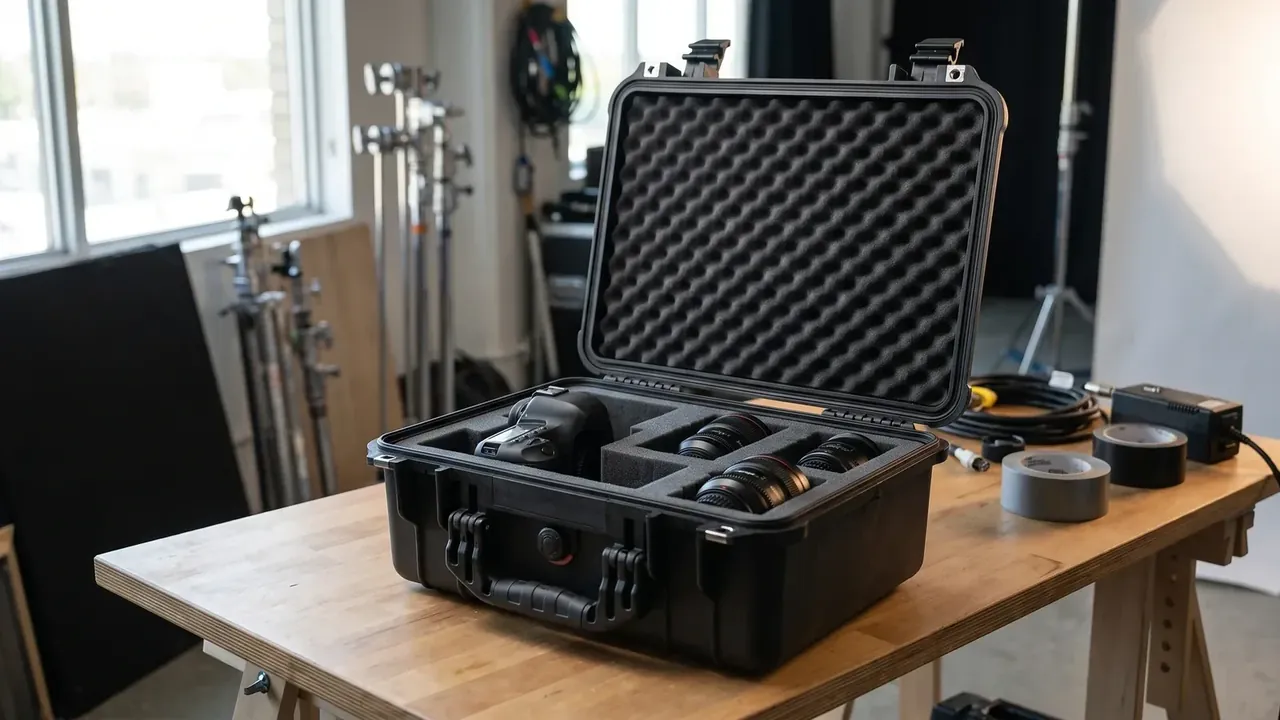
Pockets in a drone camera transport case are usually cut for upright seating: mount down, barrel held between two foam faces with 1–2 mm per side. Tighter than 1 mm and the lens has to be pried out, with fingers brushing the glass; looser than 2 mm and it travels inside the pocket, so the foam absorbs less of the impact.
Upright seating carries a second benefit. With the mount facing down, moisture in the barrel gaps does not pool on the front element, which saves a wipe on a damp morning.
| Seating | Load path | Inertia in a drop | Suits |
|---|---|---|---|
| Upright | mount and barrel flanks | along the axis into the mount | long primes |
| Flat | barrel wall | across the axis into the wall | short lenses, adapters |
| Angled | one corner of the mount | shear across the corner | hooded lenses |
5. When to replace the gasket
There is no calendar date for a gasket, only tests. Compression comes first: a free height squeezed to 25%–35% fills the lid gap, under 20% cannot bridge the microscopic roughness, and over 40% accelerates compression set until rebound falls away within months. Hardness is the second test, since a rise of more than 5 Shore A means the rubber has stiffened.
The third test is visual: whitening, fine cracks, a crease that will not spring back. Buy the original cross-section when replacing, because a thicker cord feels safer and actually lifts the lid, opening the gap it was meant to close.
Gasket life in a drone camera transport case tracks lid cycles more than years. Eight openings a day reaches nearly three thousand a year, while the same cord lasts far longer in storage. Judge by compression and hardness, not by the date on the label.
Moisture control comes down to gasket compression and desiccant mass, not wall thickness. The wall resists impact; the seal decides whether the air inside stays put. Reading them as separate specifications is what keeps thickness from being sold as a humidity feature.
Related Reading
- How a camera case lays out its interior
- Hard case or camera bag
- How much of a case volume is actually usable
- The test conditions behind an IP67 case rating
Related Products
- 8 Series — Gun Cases; Military Equipment Cases; Camera Equipment Cases; Drone Cases; Watch Cases; Knife Cases; First Aid Cases; Electronics Equipment Cases
- WL8-2812 PP Gun Case — model WL8-2812
- All protective cases and toolboxes: 7 series, 158 models