

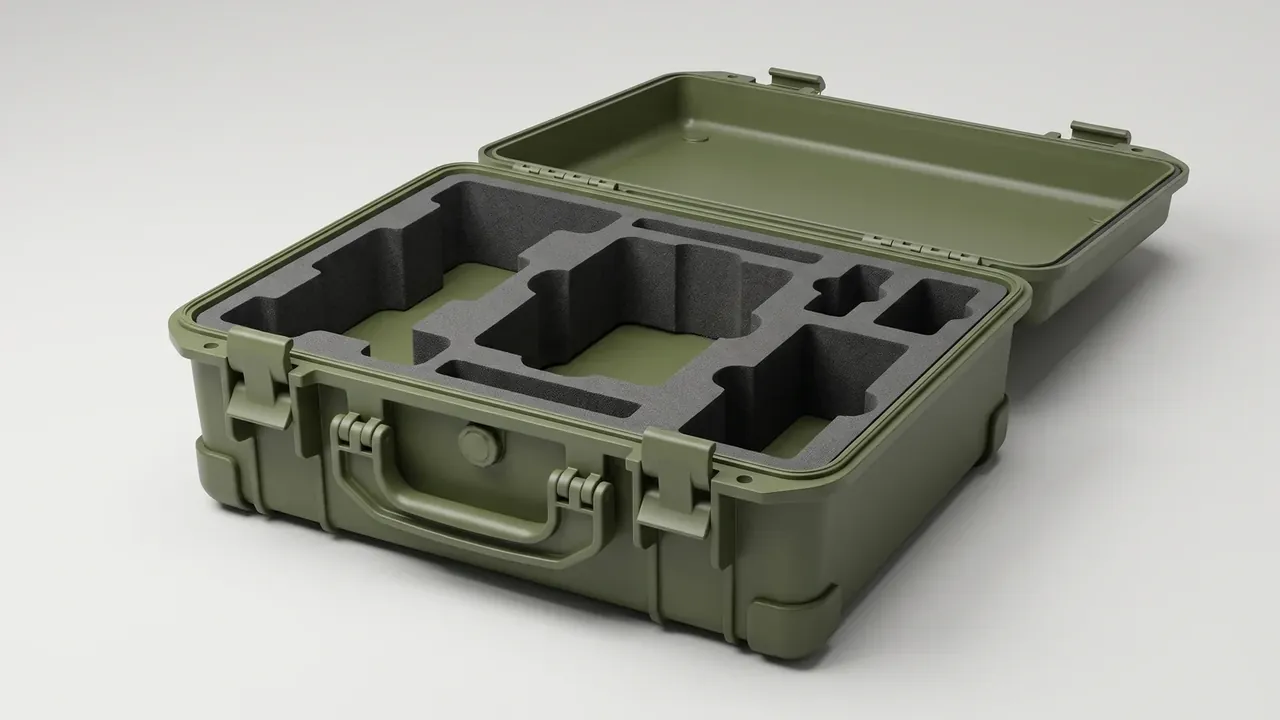
Quick answer: A drone case is decided by five factors: frame walls, gasket compression, latch force, foam cavities and validation, each tied to a number you can measure.
Table of contents
- How the Drone Case Frame and Wall Thickness Are Set
- Sealing Comes From a Silicone Gasket and Latches
- How Foam Cavities Are Cut for the Airframe
- Moulding Machine and Process Parameters
- Drop and Ageing Validation
- FAQ
1. How the Drone Case Frame and Wall Thickness Are Set
The first layer is a frame: base, side walls, lid and four ribs working as one load path, so corner impact travels into the ribs. Thicker walls sink; heavier cases fly worse.
A case for a folding quadcopter measures 560 × 420 × 230 mm outside, 500 × 360 × 190 mm inside, and weighs 3.6 kg, with 3.2 mm sides, a 4.0 mm base, a 2.6 mm lid and 2.2 mm ribs.
| Part | Wall | Duty |
|---|---|---|
| Base | 4.0 mm | Payload, drop reaction |
| Side | 3.2 mm | Lateral squeeze |
| Lid | 2.6 mm | Gasket compression |
| Ribs | 2.2 mm | Impact spread |
Ribs above 70% of the wall sink on the visible face; below 50% they snap in a drop. That ratio is the most overlooked line in the structure.
2. Sealing Comes From a Silicone Gasket and Latches
Sealing is not a thick gasket crushed hard. The lid edge carries a 6 mm groove with a 50 Shore A silicone cord; closing compresses it 25% and produces a continuous spring load. Uneven pressure lets water in at the loosest stretch.
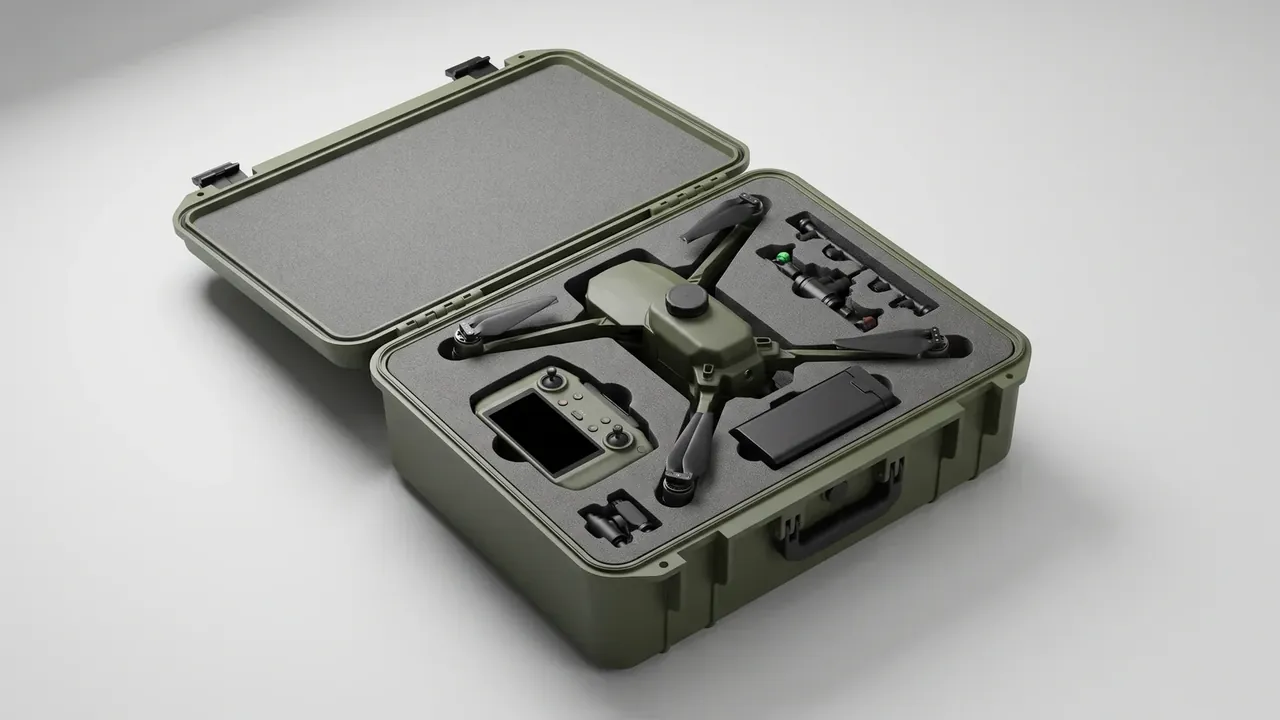
Two front latches and one side catch hold that compression at 40–60 N: softer and the lid leaks, harder and one hand cannot open it. Bodies are PA66 with 30% glass fibre, pivots rated for 3,000 cycles.
The equalisation valve is routinely forgotten: sea level to 2,000 m creates about 0.2 bar, enough to lock the lid. Its membrane still holds IP67 at 1 m for 30 minutes.
3. How Foam Cavities Are Cut for the Airframe
Cavities decide where each item lives. Start with attitude: folded props, arms toward the lid, centre of gravity 10 mm behind centre so the case does not tip.
Foam is EVA at 45 kg/m³, 35 Shore C — lower density collapses at the wall, higher resists cutting and scrapes the airframe. A 20 mm locating layer sits over a 120 mm cradle layer, interlocked so the block cannot shift in a drop.
CNC leaves 0.3 mm for springback; press the cavity wall and it should rebound without a fingerprint. Controller, batteries and spare props get separate cavities with 8 mm walls.
4. Moulding Machine and Process Parameters
A 1.8 kg body with a large projected area points to a 650-tonne press, one cavity, a 95-second cycle. Under-tonnage means flash around the parting line, and the gasket groove fails first.
Material is PP with 15% glass fibre, dried at 80°C for two hours to hold moisture below 0.1%, melt at 230°C, mould at 45°C, injection at 85 MPa, holding 12 seconds. Shorter holding sinks the base corners; longer leaves stress marks at the ribs.
The lid needs its own cooling circuit: a 3°C mould difference warps it 0.5 mm, enough to break gasket contact. Check the diagonal on a gauge; over 1.2 mm on 560 mm sends the batch back.
5. Drop and Ageing Validation
Calculations do not settle structure; tests do, in three stages: ambient drop, cold drop, salt spray.
Ambient drop runs 1.2 m onto six faces at three points, 18 drops, with 4.5 kg inside; the lid then opens for inspection with no cracks, no latch release, no cavity collapse. Cold drop freezes the case at -20°C for four hours and finishes within three minutes of removal, where PP turns brittle and corners fail first.
| Test | Condition | Pass criteria |
|---|---|---|
| Ambient drop | 1.2 m, six faces | No crack, no release |
| Cold drop | -20°C, 4 h | Same as ambient |
| Immersion | 1 m, 30 min | Dry interior |
| Salt spray | 48 h neutral | No white rust |
Salt spray is treated as a formality: a zinc-plated hinge pin rusts white within 48 hours, while a 304 pin costs under two CNY more and removes a class of returns.
Conclusion
A drone case is judged on a few numbers: 3.2 mm sides, a 4.0 mm base, 25% gasket compression, ±0.3 mm foam tolerance, 1.2 m across six faces. Process order matters just as much, frame before seal and cavities before machine settings. Put those numbers on the drawing and the inspection sheet, and the drone case is finished.
This article discusses only the container (case body) side of specifications and design intent, and does not cover any handling, loading or use of the contents.
Related Reading
- Drone case selection guide
- Drone case problems and solutions
- How internal dividers are built
- Injection machine choice for case bodies
Related Products
- 8 Series — Gun Cases; Military Equipment Cases; Camera Equipment Cases; Drone Cases; Watch Cases; Knife Cases; First Aid Cases; Electronics Equipment Cases
- WL8-2812 PP Gun Case — model WL8-2812
- All protective cases and toolboxes: 7 series, 158 models