

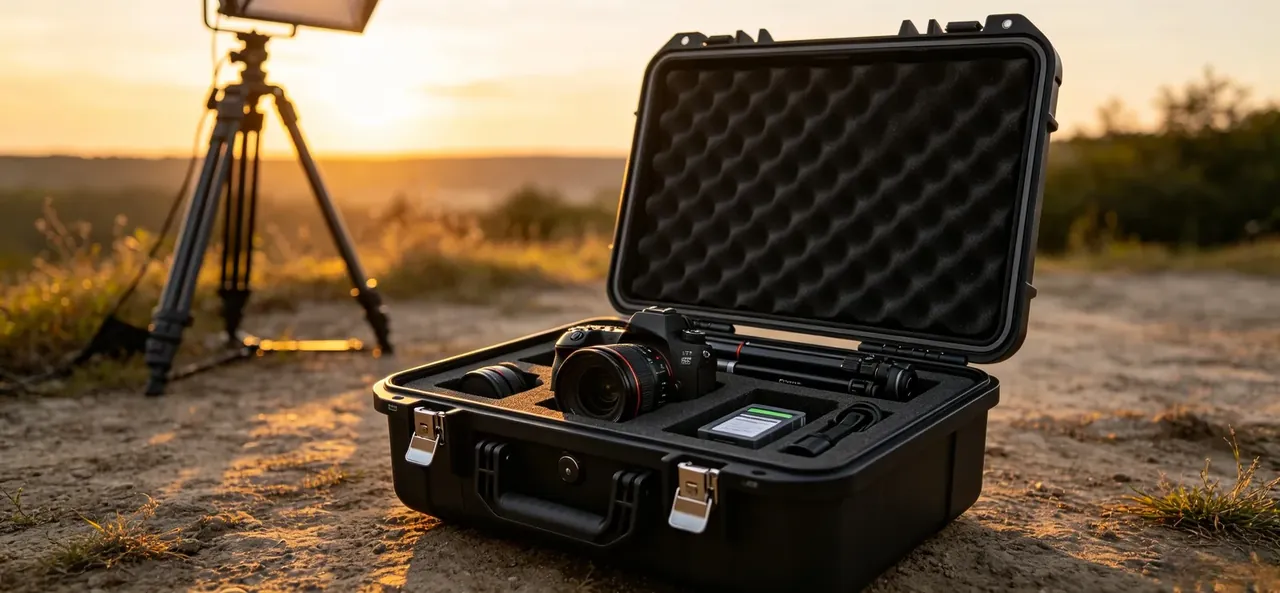
Quick answer: The Drone Equipment Storage Case splits into four zones in unloading order, with ±0.5 mm cavities, 1–2 mm clearance per side and 60–120 kg/m³ foam.
Table of contents
- Why the body zone must sit one step deeper than the blade zone
- How blade cavity orientation decides ten-year set
- How many millimetres the controller zone really needs
- Should the battery partition be bonded shut
- Number labels and retrieval order
- FAQ
1. Why the body zone must sit one step deeper than the blade zone
Fitting an aircraft into a case is easy; getting every part out within three minutes of landing is not. The order is set when the lid opens: airframe, blades, batteries, controller, shallowest near the lid and heaviest at the bottom.
Depth comes from clearance, not habit. A mid-size camera drone needs 40–70 mm around the airframe, above 80 mm where a gimbal sits; blades need thickness plus 1–2 mm per side. That gap is one lamination layer, and a Drone Equipment Storage Case insert uses 3: three under the airframe, two under the blades.
| Zone | Depth basis | Vertical allowance | Main load point |
|---|---|---|---|
| Airframe | Body thickness plus cushion | 40–70 mm | Arm roots and lower shell |
| Blades | Blade thickness plus relief | 1–2 mm per side | Blade grips and roots |
| Controller | Body thickness plus lid compression | 0.5–1 mm per side | Back panel and corners |
| Battery | Cell thickness plus terminal height | 1–2 mm per side | Base and terminal side |
Depth is not bulk. The 2.0–3.5 mm wall governs shell stiffness; the cavity wall carries the airframe. A low wall holds the body on one side only, compressing it by another layer at every drop. EVA runs 60–120 kg/m³, upper end at the airframe in a Drone Equipment Storage Case, lower end at the blades.
2. How blade cavity orientation decides ten-year set
Blades are the only long, thin parts in a Drone Equipment Storage Case, and they must lie flat. Choose the wrong opening direction and nothing shows for two years; by year five the blade carries a fixed curve and the aircraft vibrates.
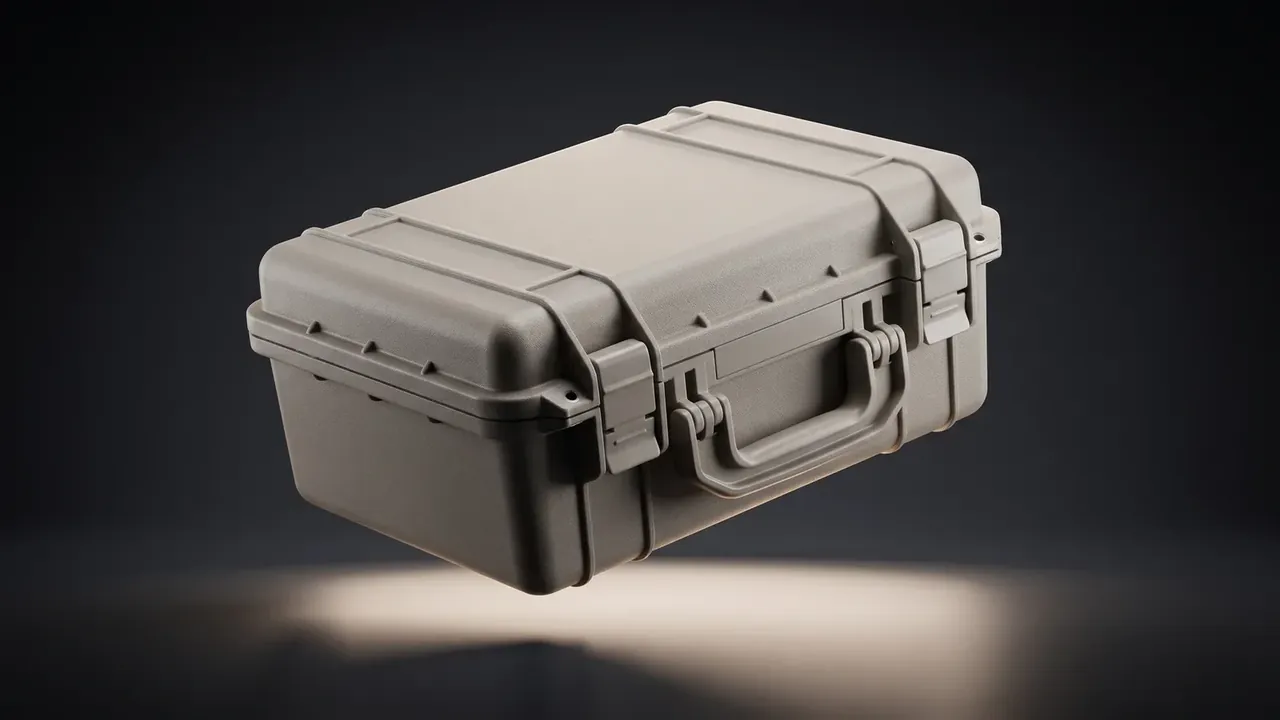
Open the cavity along the blade length so fingers reach in from both sides at mid-span. The load lands on the grip, not the blade face. Cut across the blade and the thumb rests on mid-span at every retrieval; a few hundred cycles a year and the curve never comes back.
Counter-rotating blades need separate slots. Stack a pair and the upper blade loads the lower for months, curving it against the rotation direction; a balance check finds it at once. A Drone Equipment Storage Case wall cut for 60 kg/m³ foam holds its section; thinner walls slump.
Compression set is held at 5% or less at 25% compression, 23 °C, 24 hours; a passing number does not mean the wall never moves. The 3-layer build puts load on the base, cavities in the middle and clamping at the top.
3. How many millimetres the controller zone really needs
The controller zone is the one most often over-cut. Leaving 5 mm looks safe, but the unit rattles and its screen side strikes the wall on every drop; leaving 0.2 mm means it cannot come out. Rigid parts sit at 0.5–1.0 mm per side, held by foam rebound. In a fleet-issued Drone Equipment Storage Case, width wastes volume here, not depth.
| Contact pair | Clearance per side | Retrieval feel | Drop risk |
|---|---|---|---|
| Airframe and arms | 1–2 mm | Lifted with both hands under the base | Low wall pinches the arms |
| Controller | 0.5–1 mm | Held in one hand | Excess gap hits the screen edge |
| Battery | 1–2 mm | Lifted by the terminal side | Looseness loads the terminals |
| Blades | 1–2 mm | Gripped at the root and slid out | Cross-cut opening presses the face |
Tolerance and clearance are different numbers. Die-cut tolerance is ±0.5 mm, or ±0.2 mm for high-precision work, and it describes the spread between two inserts cut from one program; clearance is the gap between wall and device. Tolerance stacks onto clearance, so the tightest unit in a batch may end at 0.3 mm. Design against the upper limit.
Depth here need not match the airframe zone: the controller lies flat under lid foam, so depth covers unit thickness plus compression only.
4. Should the battery partition be bonded shut
A partition between the battery zone and the airframe zone can be bonded or left free in a Drone Equipment Storage Case. Bonding stops packs from sliding across, but it makes cleaning and replacement impossible.
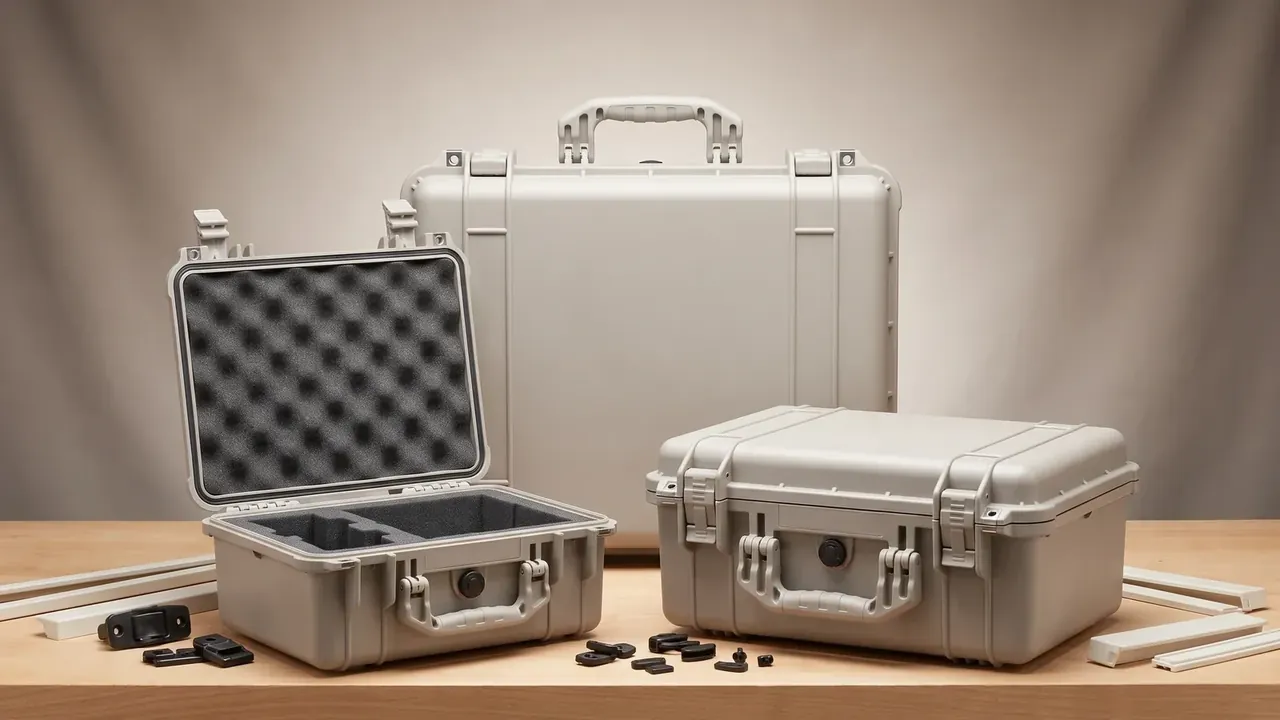
The free version is a single EVA sheet held 1–2 mm off the wall and pressed down by the lid insert. If a pack swells, the partition gives outward instead of pushing the load into the arm roots beside it.
Height matters more than thickness. Cut the partition flush with the cavity floor and keep its top below the insert surface. Anything above that surface bends when the lid closes, and a partition that has bent once will not stand straight again.
None of this is a sealing decision. Water enters through the lid gasket, and treating the partition as a second seal only traps dirt.
5. Number labels and retrieval order
Where the label goes decides whether the case can still be packed in order three years from now. Put it on the cavity wall, not the top face, which fingers brush and the lid rubs on every closure.
Numbers should match positions: airframe 1, blades 2, batteries 3, controller 4, each label equal to its step. A new operator reads the number instead of memorising the layout, which matters in a case shared by shift crews.
| Step | Label position | Renewal | Cost of a wrong label |
|---|---|---|---|
| 1 Airframe | Wall on the handle side | Every two years | Airframe and blades swap places |
| 2 Blades | Slot wall on the opening side | Every two years | Counter-rotating pairs mix |
| 3 Batteries | Inside face of the partition | Every year | Charge batches no longer match |
| 4 Controller | Wall on the hinge side | Every three years | Controller rests on the packs |
Replace a label and its position moves with it. Old adhesive collects dust on the EVA, the dust works into the cavity floor, and a dark ring is worn into the foam within a season.
Once retrieval order is fixed, the depth split has no room left to change; touching one zone drags the lamination count and the die file with it. Settling depth, clearance and numbering at the sample stage costs less than three rounds of rework. The value of a Drone Equipment Storage Case is not in how hard the shell is, but in never having to think when the lid opens.
Related Reading
- Why usable volume is always smaller than nominal
- What IP67 actually covers on a drone case
- How foam lining layers and bonding are set
- Carton or hard case for e-commerce shipments
Related Products
- 8 Series — Gun Cases; Military Equipment Cases; Camera Equipment Cases; Drone Cases; Watch Cases; Knife Cases; First Aid Cases; Electronics Equipment Cases
- WL8-2812 PP Gun Case — model WL8-2812
- All protective cases and toolboxes: 7 series, 158 models