

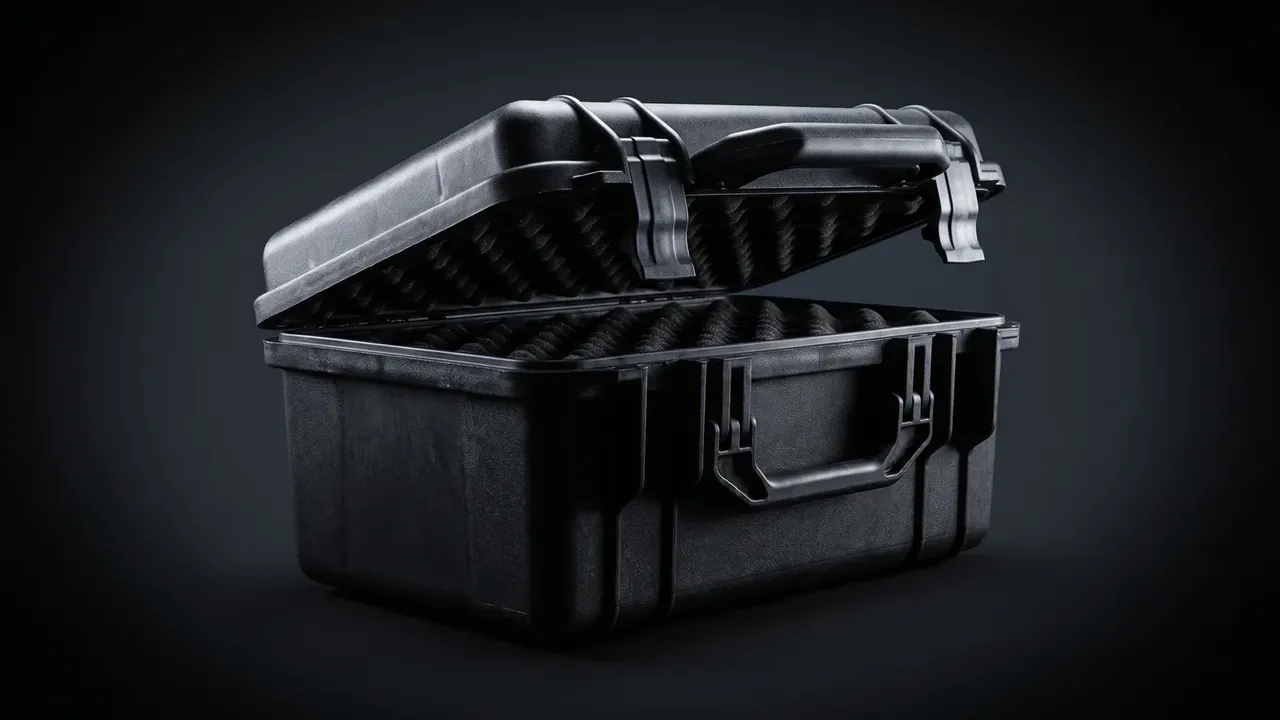
Quick answer:A drone field operation case is tested from first light to pack-up by dew, noon sun, dust and rain, so the seal groove matters more than the lid.
Table of contents
- Dew is harder to keep out than rain
- How far the inside climbs above the air at noon
- What eight hours of dust leaves in the seal groove
- Should a wet case be latched at pack-up
- Which two corners take the straps in a van
- FAQ
1. Dew is harder to keep out than rain
At 05:40 the drone field operation case has spent the night in a van, and the shell sits 2–3 K below the morning air. Lift the lid and warm, damp air rolls onto cold walls, and water beads inside within a minute.
Dew is vapour, not liquid. The IP67 test floods the case at 1 m for 30 min and looks for water pushed in from outside; it says nothing about vapour that walks in through an open lid. A gasket stops rain and still lets air through.
One criterion decides condensation: a surface colder than the dew point of the air around it. Air at 18 ℃ and 90% RH has a dew point near 16 ℃, so a shell at 14 ℃ is already wet, and morning shells sit in exactly that band.
The fix sits in timing. Set the drone field operation case in shade for 10–15 min before the first opening; on a rushed morning that step disappears first.
2. How far the inside climbs above the air at noon
Between 12:00 and 14:00 at 35 ℃ ambient, a black lid skin reads around 70 ℃ and the air inside a drone field operation case passes 50 ℃, roughly 15 K over ambient. A white lid runs 20 K cooler on the surface and pulls the interior down with it.
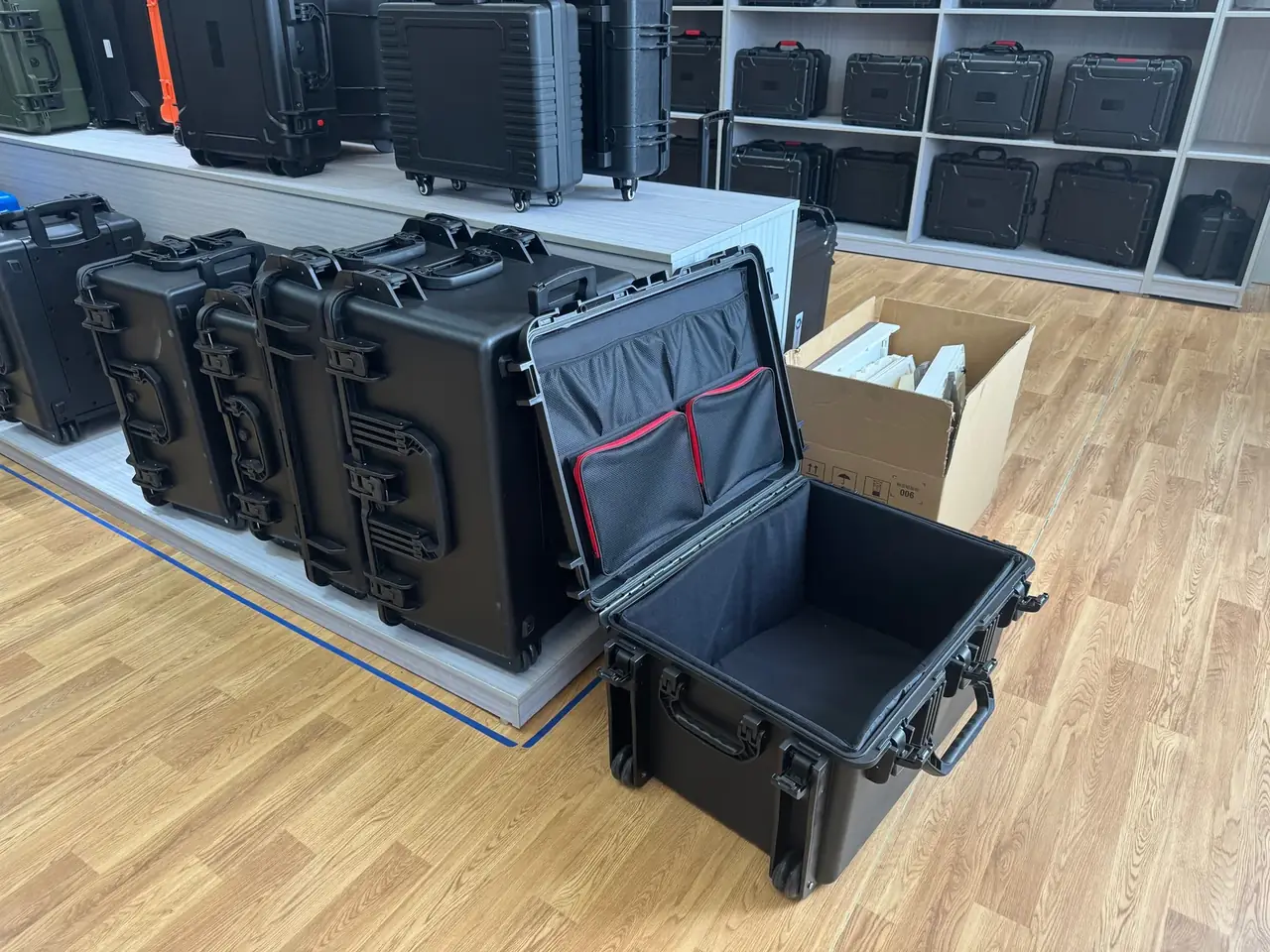
The 5 K figure is a different measurement: the spread between the top and bottom of one drone field operation case, not the gap to ambient. An empty case in four hours of sun shows 8–12 K from lid to floor; add partitions and the cells stop mixing, so the spread grows.
The storage band of −20 to 60 ℃ protects the polymer and the gasket. A van with the windows up reaches 65–70 ℃ at noon, which the shell survives and the batteries do not. Sit the case at mid-height, clear of the glass, and the interior drops 5–8 K.
Three moves hold the noon hours: a pale shell, shade while parked, and 50 mm of air against the nearest surface. Skip one and the other two lose half their effect.
3. What eight hours of dust leaves in the seal groove
Work starts at 07:00 and the first shift ends at 15:00, with the drone field operation case opened a dozen times at a landing zone that has no surface other than gravel and dry grass. The IP6X test uses talcum under 75 μm at 2 kg/m³ for 8 h with an internal delta of 2 kPa; a landing zone delivers a wider size range plus fibres.
After eight hours the groove holds three layers. Loose dust sits on top and brushes away; compacted fines sit at the bottom, pressed there by every latch cycle; an oily film of sweat and sunscreen binds the third layer.
Gasket compression is set at 25%–35%. A particle of 0.2–0.5 mm in the groove drops local compression below 20%, and that spot becomes the leak path. When a drone field operation case takes water in the rain, the cause is usually grit in the groove rather than an aged gasket.
| Residue | Where it sits | Removal | Cost of skipping |
|---|---|---|---|
| Loose dust | Groove lip | Soft brush | Pressed to the bottom on closing |
| Compacted fines | Corners of the channel | Damp cloth, one direction | Gasket bridges the grit |
| Oily film | Beside the latches | Mild detergent | Rubber turns tacky |
| Grass fibre | Hinge end | Tweezers | Lid will not seat fully |
Never clear the groove with compressed air. The jet drives fines to the bottom, so the groove looks clean while the gasket is being held off its seat. Brush, wipe, then check the corners, about 40 s per case.
4. Should a wet case be latched at pack-up
At 19:30 the shell is wet with rain, the inside is wet with dew, and the easy move is to snap the latches and throw the drone field operation case in the back. The bill arrives at 06:00 as a smell and a film of water on the wall.
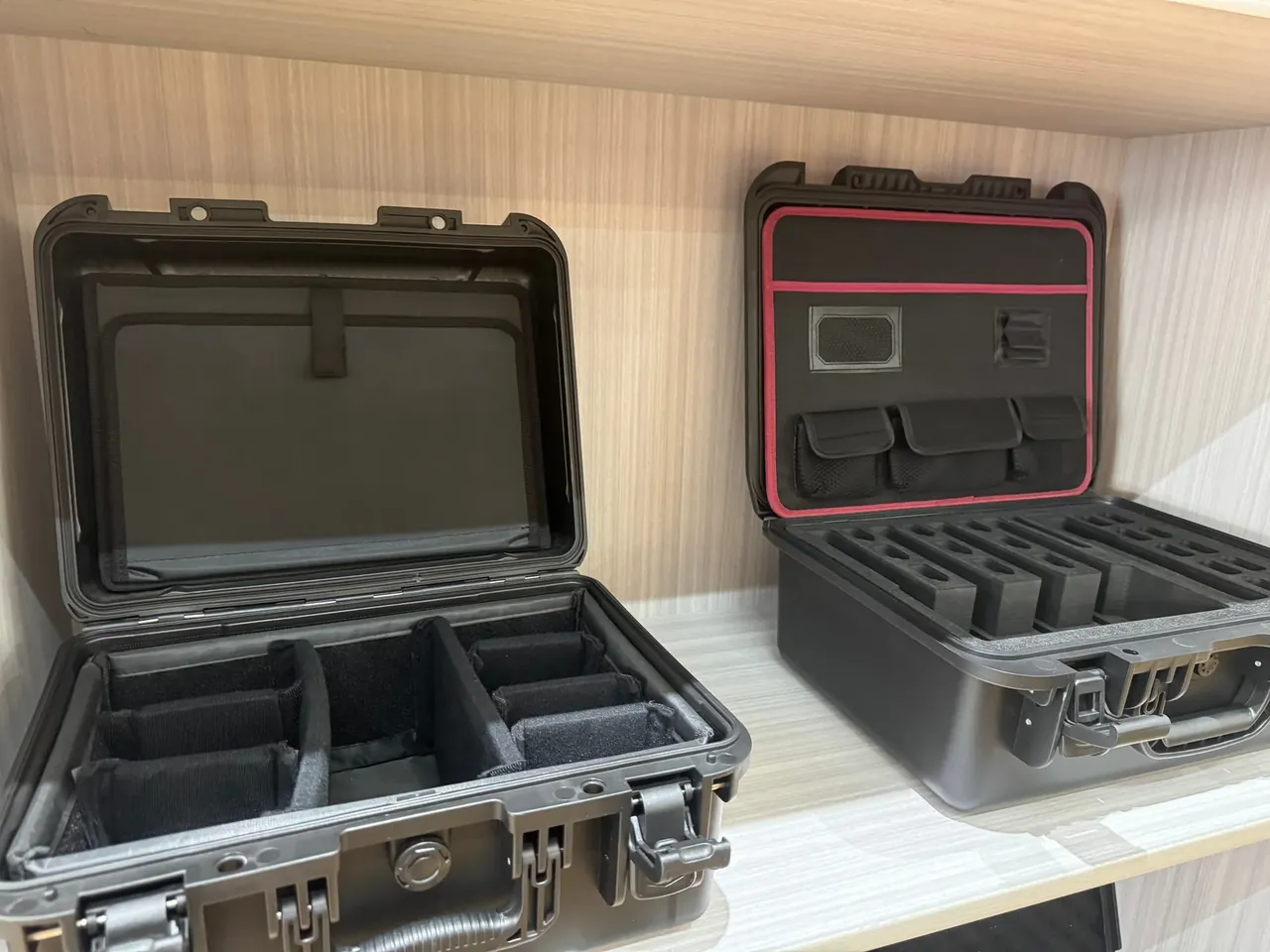
Latching traps a box of damp air. Overnight that air cools with the surroundings and sheds its vapour onto the coldest surface, usually metal parts and the wall. A tighter seal makes the cycle more complete, not less.
| State at pack-up | Action | Time | Why |
|---|---|---|---|
| Wet outside, dry inside | Wipe the shell | 3 min | No water has entered |
| Dew on the inner wall | Open lid, ventilate | 30 min | Vapour needs a way out |
| Standing water inside | Empty, dry, leave open | 2 h | Foam dries slowly |
| Rained on and already latched | Reopen next morning | Overnight | The cycle has started |
Half an hour with the lid open is not lost time. Park the drone field operation case in a dry room, lift the foam edge, and let it breathe. If time is short, dry the groove at least, since it holds water longer than the cavity.
5. Which two corners take the straps in a van
A drone field operation case takes its hardest load under braking and cornering. Braking throws the mass forward onto the strap line; a turn pushes the case into the van wall and turns the contact point into a pivot.
Strap the two lower corners nearest the cab, run the webbing around the lower body, and keep the angle to the floor under 45°. Two diagonal points restrain all three axes, so the case cannot spin around a single anchor.
Do not strap the handle. It is rated for a two-person lift, a vertical load; a strap pulls horizontally and follows a different path through the shell. Walls run 2.0–3.5 mm and latches hold 200–400 N, and those numbers describe the body.
Stack no more than two high with the heavy case at the bottom, and hold the upper case against a wall or a bulkhead rather than relying on friction between lids. Over 200 km of mountain road, the top case is the one that shifts first.
Related Reading
- How a field survey case is kitted out
- What IP67 actually floods
- IP67 against IP68
- How much case volume is really usable
Related Products
- 8 Series — Gun Cases; Military Equipment Cases; Camera Equipment Cases; Drone Cases; Watch Cases; Knife Cases; First Aid Cases; Electronics Equipment Cases
- WL8-2812 PP Gun Case — model WL8-2812
- All protective cases and toolboxes: 7 series, 158 models