

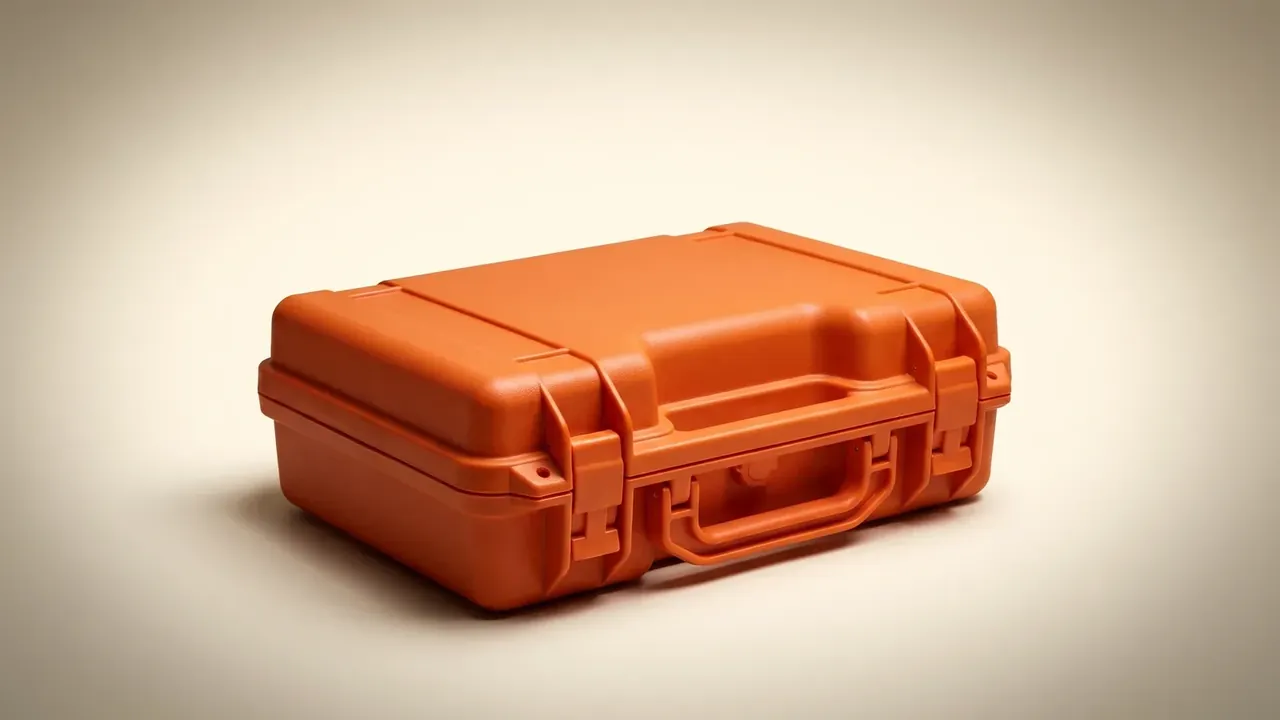
Quick answer:A Drone Ground Control Station Case carries laptop, video link, power and tripod as one system: 15 mm of airflow, 4x cable radius, 18 kg total.
Table of contents
- What the First Five Minutes Actually Do
- Laptop Inside the Case or Outside
- How Much Air a Video Link Needs
- Cable Exit: Side or Rear
- Can One Person Move the Whole System
- FAQ
1. What the First Five Minutes Actually Do
A Drone Ground Control Station Case is judged in the first five minutes, not in its spec sheet. The first thirty seconds go to opening the lid, pulling the tripod and standing the lid at 110°. A hinge that will not hold costs a hand, and every step after it slows.
The next ninety seconds go to antennas and satellites. Antennas come out of the lid recess, screw onto the tripod, tilt to the right elevation, and the receiver starts hunting. If the antennas share a recess with the power brick, pulling one drags the other out and costs forty seconds.
Minutes three to five are power, video link, compass calibration and a first image. The laptop moves to the lid, the link module powers up, the network cable goes in, the software starts. Whether it appears on time depends on whether anyone bent down to hunt for a port.
| Clock | Task | Usual snag | Target |
|---|---|---|---|
| 0:00–0:30 | Open, tripod out, lid up | Hinge will not hold | 30 s |
| 0:30–2:00 | Antennas up, wait for fix | Cable tangled with power | 90 s |
| 2:00–3:30 | Power, link, software | Ports at the bottom | 90 s |
| 3:30–5:00 | Calibrate, first image | Screen glare | 90 s |
2. Laptop Inside the Case or Outside
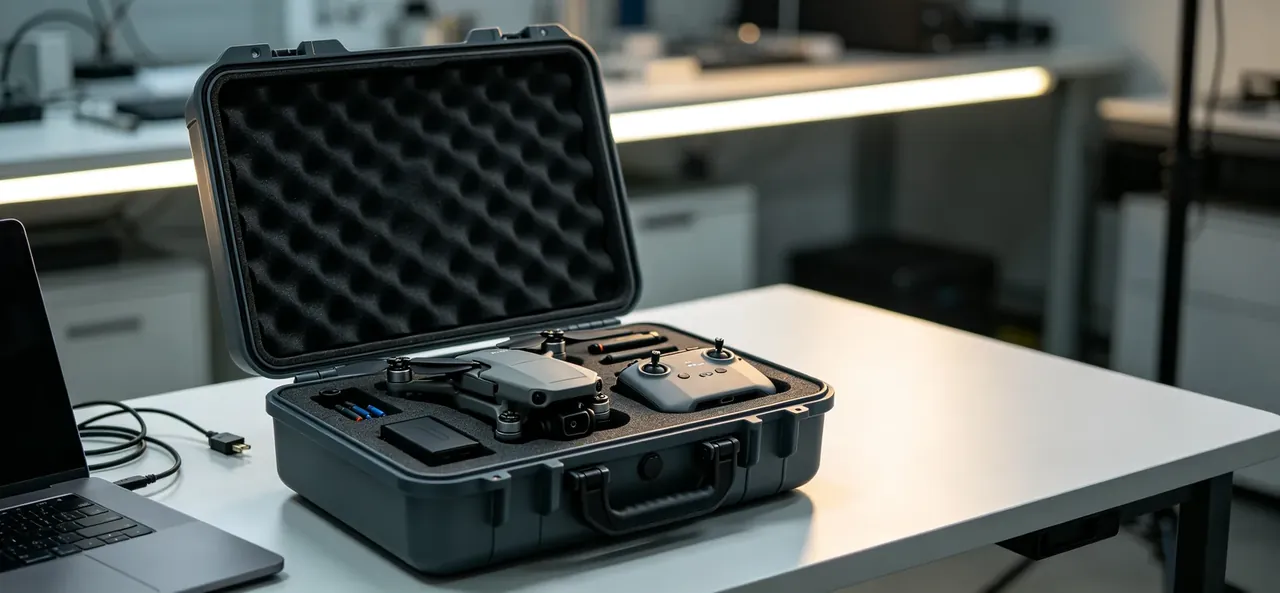
A Drone Ground Control Station Case that keeps the laptop inside gains shock and dust protection, and the closed shell ships as is. The cost is glare, keyboard height and heat trapped by foam. At 200 mm deep, the keyboard sits 250 mm off the ground, too low to stand at.
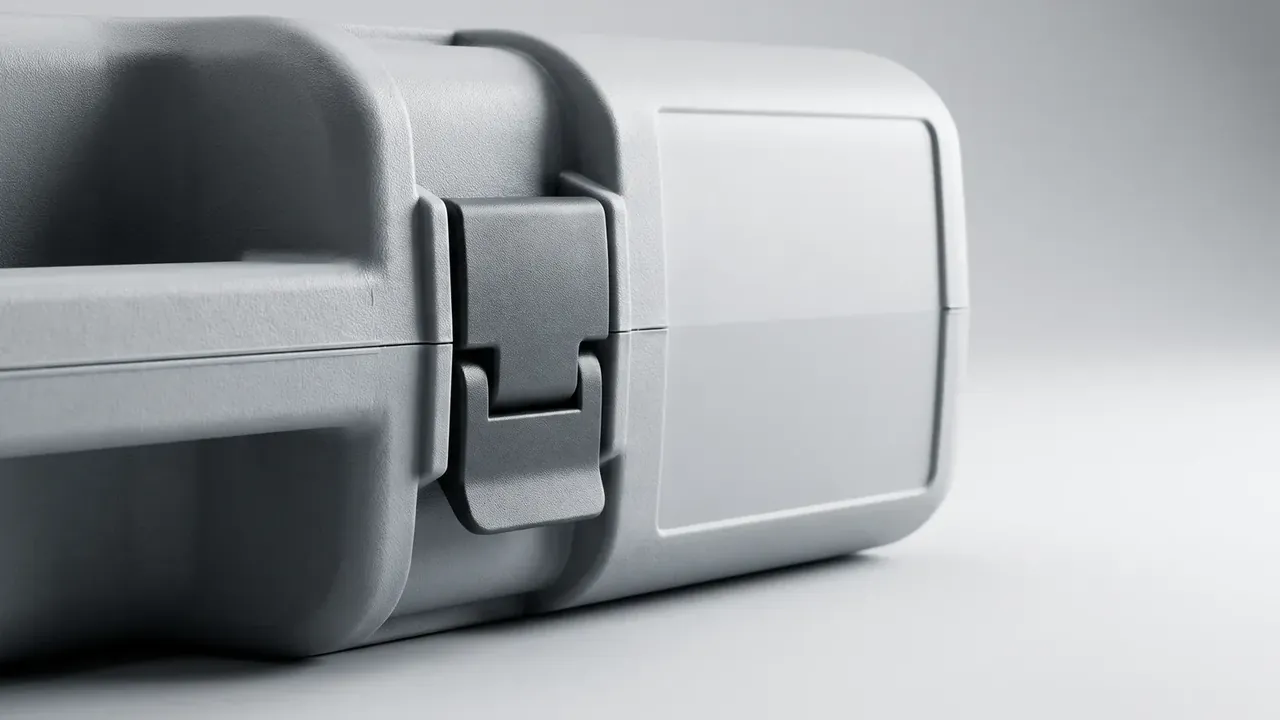
Keeping it outside means finding a table. The usual answer is a flat, hard panel bonded into the lid, so the case body becomes the desk and the laptop rests 100 mm higher, near eye level. That route needs a locking hinge and a 2 mm PP plate under the lid foam.
A third option is a pull-out tray inside the body: the tray slides out and tilts up, screen facing the operator. Rails add 20–30 mm to the body height and about 1 kg to the total. None of the three wins outright. A Drone Ground Control Station Case for long shifts wants the lid panel; one for quick visits wants the tray.
| Placement | Time to image | Weak point | Working style |
|---|---|---|---|
| Fixed inside | Fastest | Glare, high keyboard | Short watches |
| Lid as desk | Medium | Hinge must lock | Long screen time |
| Pull-out tray | Slowest | 1 kg and one more move | Fixed sites |
3. How Much Air a Video Link Needs
Inside a Drone Ground Control Station Case, a video link draws 10–20 W and sheds it by convection, so it wants 15 mm above and 10 mm around. Fill that gap with foam and the heat circulates between module and foam; in summer the inside of the case runs 15 ℃ above ambient. A module rated to −20~55 ℃ loses most of its top end inside a sealed box.
There are two ways to move heat out: bolt the metal housing to the wall, or cut vents. The first is limited by a 2.0–3.5 mm PP or ABS wall, which carries only part of the load. The second ends IP67 the moment the drill goes in.
The compromise part is a pressure-equalisation vent. It passes vapour, not liquid water, and its real job is to balance the pressure swing from closing the lid, so the gasket is not sucked into the groove. A Drone Ground Control Station Case with vents still has no convection inside; the gap above the module is not optional.
4. Cable Exit: Side or Rear
A side exit is within reach and direct, but the connector takes the load when the case lies on its side in a vehicle. A rear exit keeps cables away from the screen and the operator's feet, at the cost of 300–500 mm extra length.
Wherever it sits, the exit has to respect a bend radius of 4x the cable diameter. An 8 mm network cable needs 32 mm, so the inside of the exit gets an R5 fillet and the foam is cut into a flare, letting the cable leave in a smooth arc. Bend it tighter and the shield cracks, producing faults that take days to trace.
Waterproof glands are the other trap. Drill a hole, fit a plain gland, and IP67 is gone. A Drone Ground Control Station Case needs a gland with its own seal, torqued to the maker's figure; overtightening flattens the seal. Closing the lid onto a cable is the commonest failure, so the foam must leave a finger's width of slack.
| Cable | Min radius | Exit position | Sleeve |
|---|---|---|---|
| Network, 8 mm | 32 mm | Rear, low | Flare plus R5 fillet |
| Power, 6 mm | 24 mm | Side, rear | Abrasion sleeve |
| Video feed, 5 mm | 20 mm | Rear, centre | Own channel |
| USB, 4 mm | 16 mm | Side, front | 100 mm slack |
5. Can One Person Move the Whole System
A total of 18 kg is the practical ceiling for one person carrying a case a short distance; above that it is two people or wheels. Laptop, link, power and tripod weigh 12–15 kg together, leaving 3–6 kg for the shell.
The handle belongs directly over the centre of gravity. Move it 30 mm off and a Drone Ground Control Station Case hangs crooked, forcing a hand change every ten steps. Past 500 mm on the long side, twin centre handles let two people lift one side each. Hanging the tripod outside saves about 2 kg inside, but the bracket has to survive a hard stop.
Hinges rated at 20,000 cycles and latches at 200–400 N describe durability, not handling. Fit power, cooling and carrying into one shell and the dimensions have no slack left: add to one and the other two give way.
Related Reading
- How IP67 is proven on a drone case
- Six measurable numbers in an EVA insert spec
- Hard case or carton for e-commerce shipping
- Gasket and O-ring materials compared
This article covers the case side of the specification only.
Related Products
- 8 Series — Gun Cases; Military Equipment Cases; Camera Equipment Cases; Drone Cases; Watch Cases; Knife Cases; First Aid Cases; Electronics Equipment Cases
- WL8-2812 PP Gun Case — model WL8-2812
- All protective cases and toolboxes: 7 series, 158 models