

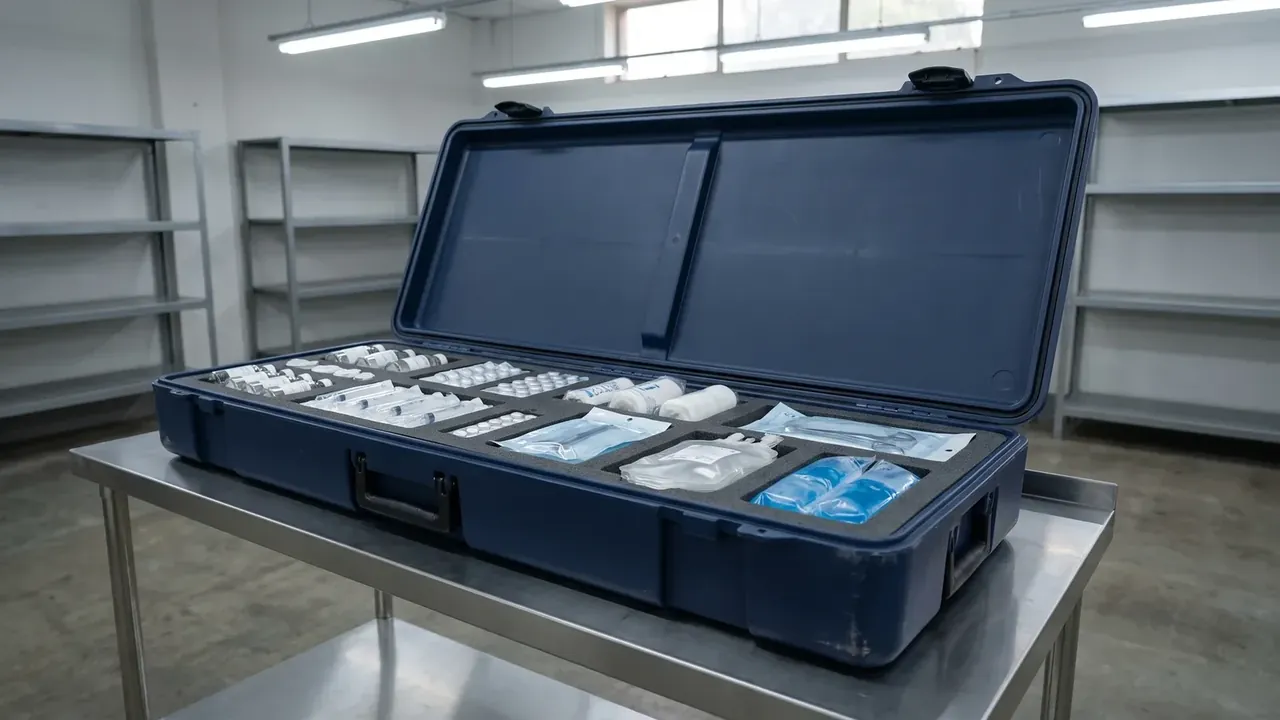
Quick answer: DSLR camera & lens trolley protective case, 550 × 400 × 250 mm, 6.2 kg empty: the 50 mm above the 200 mm boarding line is all wheel set and lid crown.
Table of contents
- Where the 50 mm goes on a 550 × 400 × 250 mm shell
- Deriving four compartments from a 500 × 350 × 190 mm cavity
- 15 mm dividers and a 0.5 mm seat clearance
- Wheels, handle and a 12° ramp
- Boarding, checking in and the 14 kg load ceiling
- FAQ
1. Where the 50 mm goes on a 550 × 400 × 250 mm shell
A DSLR camera & lens trolley protective case measures 550 × 400 × 250 mm with wheels on, floor to lid top. Cabin allowances sit at 55 × 40 × 20 cm, so length and width have zero margin. Boarding is blocked by the 250 mm height, 50 mm above 200 mm.
That 50 mm splits in two: a 65 mm wheel recessed 20 mm leaves 45 mm exposed, and the lid crowns 5 mm from rim to centre. Pulling the wheels is not enough: 250 less 45 is 205 mm, still 5 mm over, so the crown must flatten, though a flat lid then domes at the centre in a 1.0 m corner drop. A 4 mm rib inside the lid stays invisible to a tape measure: the foam needs relief pockets, or net height falls from 180 mm to 176 mm and a long lens will not stand.
2. Deriving four compartments from a 500 × 350 × 190 mm cavity
Planning runs inward. The cavity of this DSLR camera & lens trolley protective case is 500 × 350 × 190 mm; 15 mm lining per wall removes 30 mm per axis, leaving 470 × 320 mm to draw on. The base pad takes 10 mm, so net height is 180 mm.
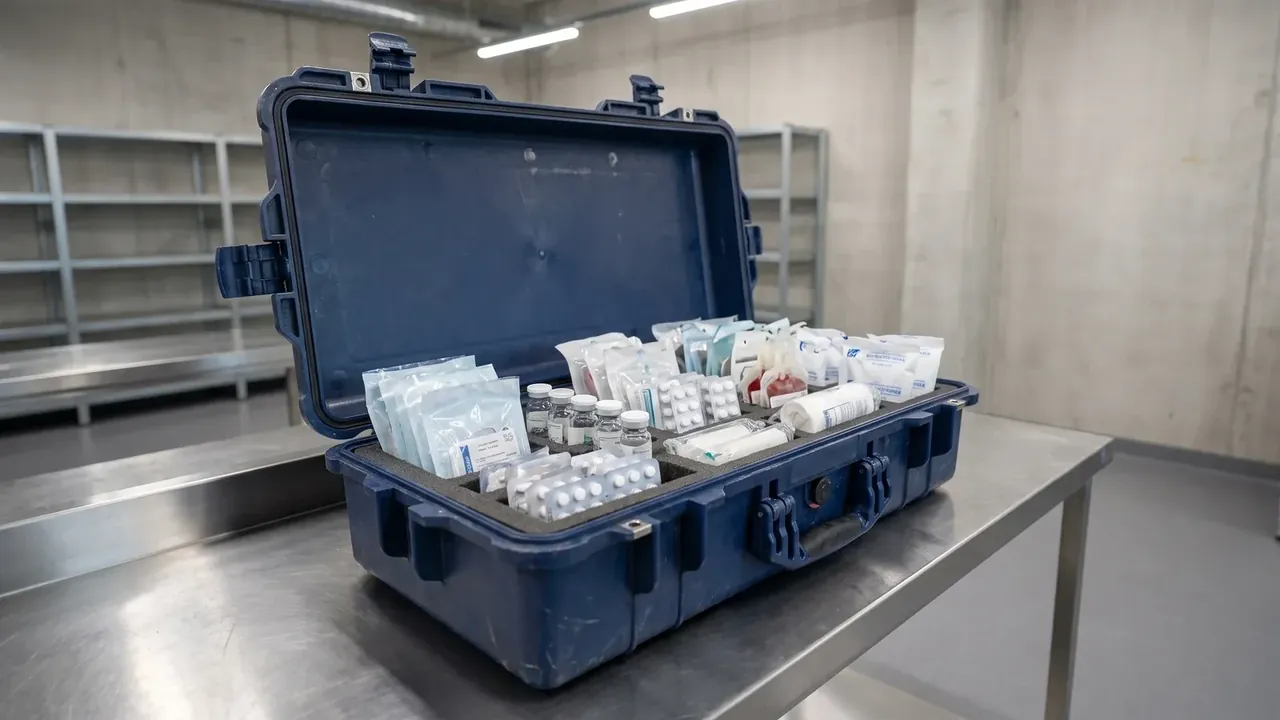
The camera bay, 165 × 150 × 110 mm, fits a gripped body of 150 × 140 × 95 mm with a 15 mm right-hand projection, leaving 3–4 mm per side. Three lens bays run φ95 × 180 mm: a 24–70 mm f/2.8 with hood reversed is about 90 mm across, so φ95 leaves 5 mm.
Along the 320 mm depth, 3 × 95 mm gives 285 mm and two 15 mm dividers reach 315 mm. One 10 mm divider separates camera bay from lens row at 165 + 10 + 95 mm, or 270 mm; the other 200 mm is hand clearance.
| Compartment | Net size mm | Divider |
|---|---|---|
| Camera bay | 165×150×110 | 15 mm EVA |
| Lens bay, each | φ95×180 | 15 mm EVA |
| Lid layer | 470×320×25 | 20 mm EVA |
The lid layer of this DSLR camera & lens trolley protective case is the fourth load face: 25 mm of pad on top plate and lens rims, holding end float under 1 mm.
3. 15 mm dividers and a 0.5 mm seat clearance
Dividers in a DSLR camera & lens trolley protective case are 15 mm EVA at 45 kg/m³, which rebounds predictably at 10% compression; at 20% the foam takes a set and bay corners collapse. Two bays share one divider rather than two 10 mm sheets, whose void shifts in transit.
Seat clearance is 0.5 mm per side. Under 0.3 mm a gripped body enters at an angle and frays the cut edge; over 1.2 mm it slides 2–3 mm and the lens mount takes shear instead of preload. On 30 kg/m³ foam the same bay needs 0.3 mm.
| Mating face | Value | How it is checked |
|---|---|---|
| Camera bay to body | 0.5 mm per side | 0.5 mm feeler enters, 1 mm does not |
| Lens bay to barrel | 0.5 mm per side | same |
| Lid pad to bay top | 3 mm compression | recovers within 2 s |
Below 40 kg/m³ the tool tears the bore, a φ95 mm pocket measures 94.2 mm, and lenses drop in loose. In a DSLR camera & lens trolley protective case, dividers wear 0.2–0.3 mm a year and are then replaced.
4. Wheels, handle and a 12° ramp
On a DSLR camera & lens trolley protective case, a 65 mm wheel and 340 mm wheelbase decide tipping. Centre of gravity near 250 mm against a 170 mm half-wheelbase gives about 34°, so a 12° ramp plus 5° of sway keeps half the margin; at 280 mm it tips at 30°.
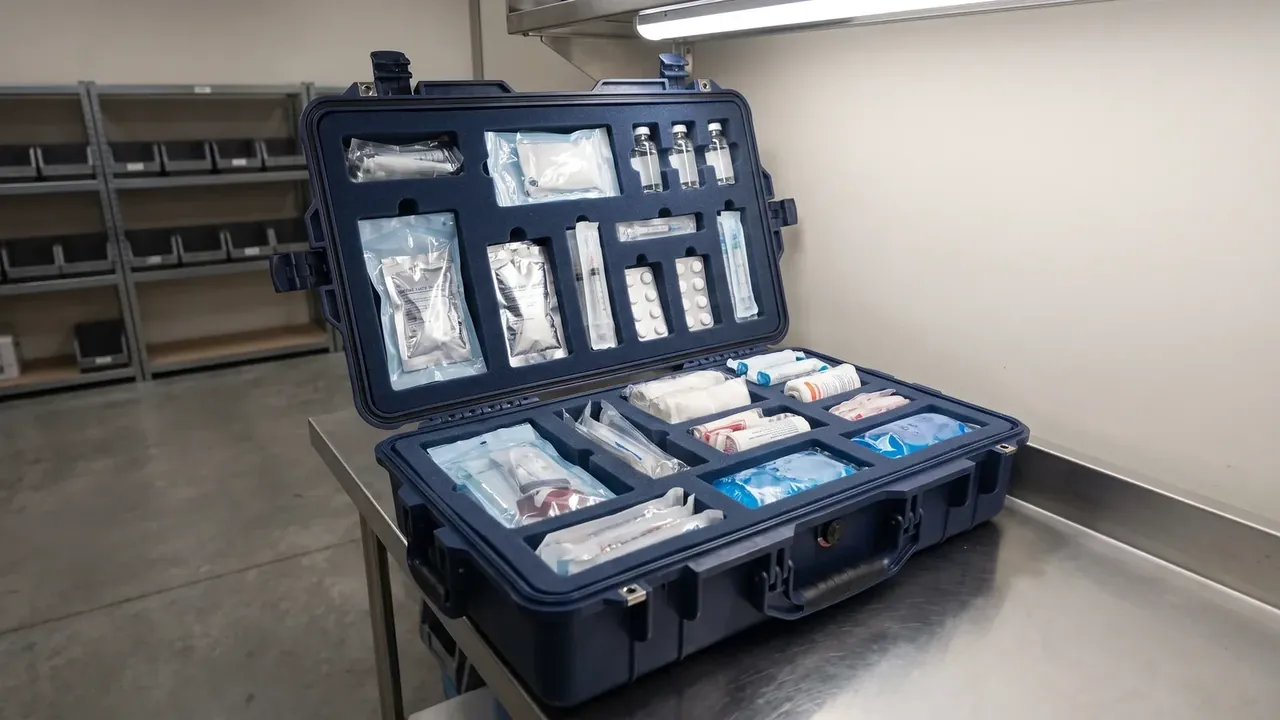
The handle runs three stages to 1 050 mm. A pushing wrist sits at 900–950 mm, so full extension suits about 175 cm; at 185 cm two stages track better.
A 65 mm wheel must be lifted over a threshold rather than pushed through it. Housings on the DSLR camera & lens trolley protective case sit on four M5 screws into an 8 mm base thickened to 12 mm locally, with 3 mm counterbores.
5. Boarding, checking in and the 14 kg load ceiling
A packed DSLR camera & lens trolley protective case answers to 55 × 40 × 20 cm, roughly 10 kg, and a one-person lift. Empty is 6.2 kg and the ceiling 14 kg, so a full case reaches 20.2 kg and often goes to the hold. Two TSA locks match two latches: an inspection opens one and the bays stay put.
The 1.0 m drop follows belt and hold-door heights: corner bumpers spread the hit into 15 mm walls, and bays in this DSLR camera & lens trolley protective case hold on 0.5 mm clearance, moving under 2 mm.
| Stage | Limit | Design here |
|---|---|---|
| Gate gauge | 55 × 40 × 20 cm | 550 × 400 × 250 mm, 50 mm over |
| Cabin carry | 20 kg in one hand | 6.2 kg empty, 14 kg load |
| Belt drop | 1.0 m on a corner | corner bumpers, 15 mm wall |
Above 14 kg the second-stage collar fails before the wheels: the tube wall is 1.2 mm and the pin carries axial load only.
Conclusion
Every trade in this DSLR camera & lens trolley protective case returns to 250 mm outside and 190 mm inside: one decides boarding, the other whether four bays hold a gripped body and three long lenses. Get the 470 × 320 mm face, the 15 mm dividers and 0.5 mm clearance right, and both a 1.0 m drop and a 12° ramp stay survivable.
Related Reading
- How a camera case is laid out inside
- Matching wheels to a trolley handle
- Four factors in custom foam
- Choosing a protective case with wheels
Related Products
- 8 Series — Gun Cases; Military Equipment Cases; Camera Equipment Cases; Drone Cases; Watch Cases; Knife Cases; First Aid Cases; Electronics Equipment Cases
- WL8-2812 PP Gun Case — model WL8-2812
- All protective cases and toolboxes: 7 series, 158 models