

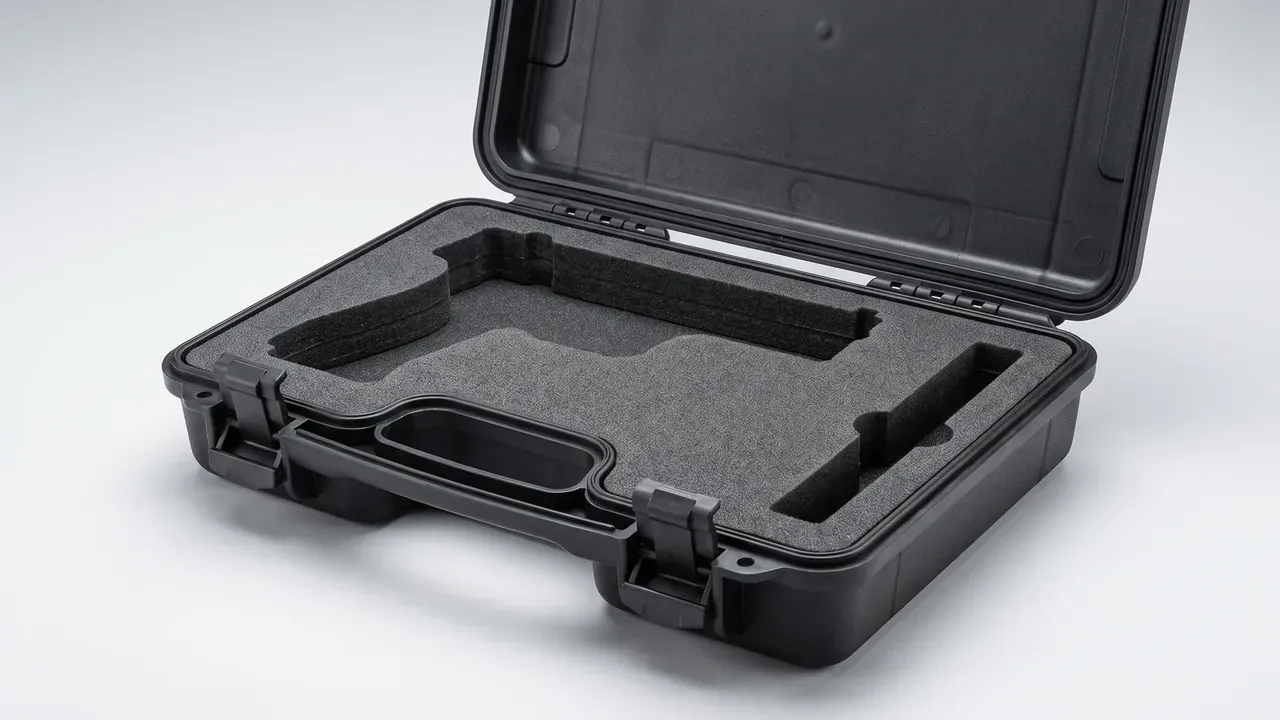
Quick answer: The Dustproof Outdoor Equipment Case answers the fine end of dust, about 75 µm and below, which rides airflow into seals, latch bores and the breather.
Table of contents
- Dust particle size and entry paths
- Running an IP6X dust chamber test
- Filter structure inside the breather valve
- Blowing dust out of latches and hinges
- Opening a case in blowing sand
- FAQ
1. Dust particle size and entry paths
Seventy-five micrometres marks the split for a Dustproof Outdoor Equipment Case. Coarse grit falls under gravity and wipes off the body; fine dust travels with moving air, finds a gap and stays there, packed behind the gasket until the next closing pushes it into a channel.
Three paths carry dust into a Dustproof Outdoor Equipment Case, all driven by the same differential: an under-compressed seal face, the hollow behind a latch bore, and the breather filter. None leak at rest. Let internal temperature drop or a gust hit the outside, and the pressure difference starts pushing.
That difference is small: 2 kPa across the wall, about 20 mbar, is enough to drive fines past a seal that is not fully loaded, so tightness is judged under load rather than by how narrow a gap looks in a photograph.
Size also decides where a particle stops. Hard quartz grains land on the seal face and are pressed into the rubber at closing, leaving pits that leak next time; organic dust is light and hygroscopic, caking on the gasket back and eating into compression.
| Size band | Typical source | Where it enters | What stops it |
|---|---|---|---|
| Above 75 µm | Road grit, loading dust | Lid rim and body face | Outward-turned lip |
| 10–75 µm | Cement powder, dry soil | Behind the gasket | One step more compression |
| Below 10 µm | Smoke, airborne fines | Breather valve | 0.2 µm membrane |
| Fibrous debris | Woven sacks, carton edges | Latch bore | Blind bore with a shield |
2. Running an IP6X dust chamber test
Talcum powder is the medium for a Dustproof Outdoor Equipment Case test, held at 2 kg/m³ and sieved past 75 µm. The sample goes in as it would be used, glands and caps fitted, then air is drawn out until the differential reaches 2 kPa and held for 8 h.
The vacuum is not there to pull dust in; it reproduces breathing. Temperature swings, altitude changes and opening the lid all make a body breathe, and the test stretches that into eight hours of steady depression, exposing anything relying on staying tight by habit.
Condition before the run belongs in the record: gasket age, closes on the latches, whether the membrane is original. Those make one body read differently between rounds, so writing them down is what makes two reports comparable.
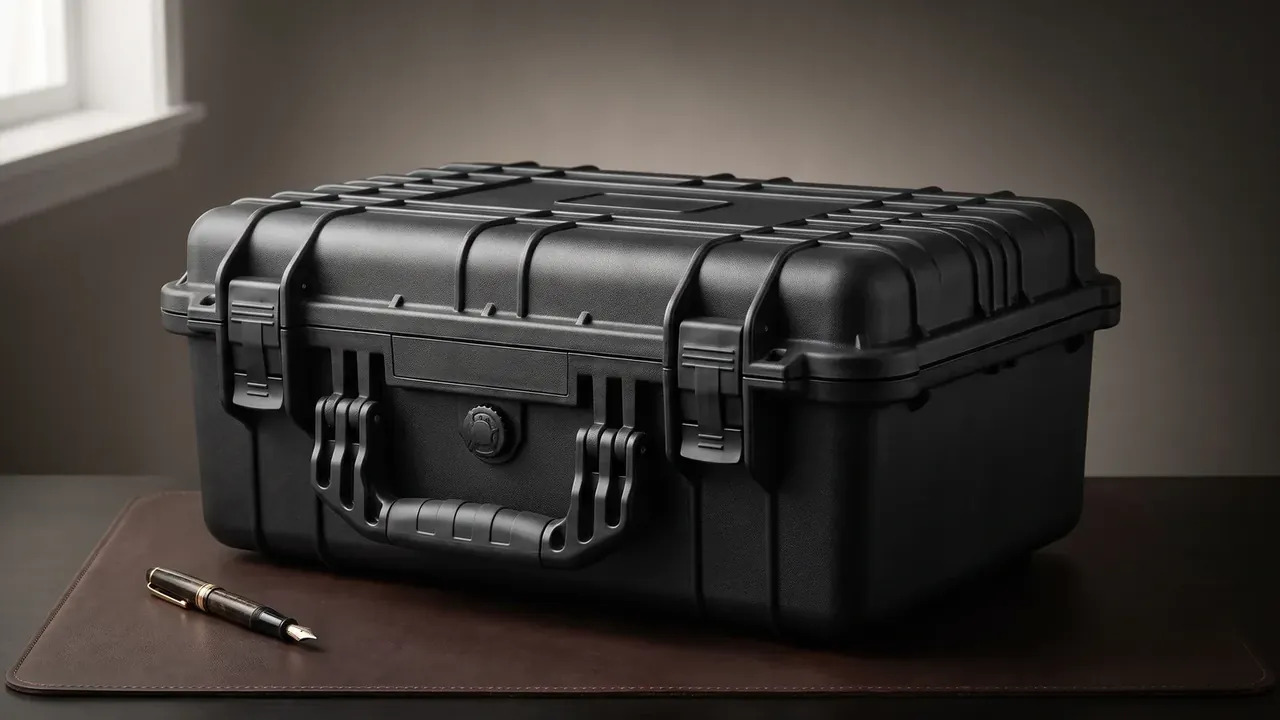
Verdict comes at the moment of opening: in a clean room, under normal light, a visible layer on the inner wall or cavity floor fails the run; isolated particles may be retested, a settled sheet may not.
Dust rule: visible dust inside a Dustproof Outdoor Equipment Case after the chamber run, or a blocked breather valve, fails the dust structure of that case. The rule covers two failures at once, ingress and suffocation, and the second is the one usually missed: once the membrane clogs, a body can only breathe through its seal.
3. Filter structure inside the breather valve
The breather on a Dustproof Outdoor Equipment Case is a pressure port with a membrane. Temperature or barometric change creates a differential, the valve lifts around 20 mbar, and air passes through a 0.2 µm membrane that holds fine particles outside.
That membrane is a consumable: a finer pore blocks more and clogs sooner, so in sand country its life is counted in cleaning intervals — blow it out every 50 h, from the inside outward, never outside in, which drives grains into the pores.
Opening pressure on a Dustproof Outdoor Equipment Case has to match body stiffness. Set it high and the body deforms first under thermal load, pulling the gasket open; set it low and the valve chatters on rough ground until the lip wears.
Mounting decides whether the port gets buried. Standing the case upright with the valve facing down and clear of the floor keeps falling dust off the membrane; pointing the port into the wind turns the filter into a bag.
| Differential | Valve state | Filter behaviour | Action |
|---|---|---|---|
| Under 10 mbar | Closed | No flow | Nothing to do |
| Around 20 mbar | Cracking open | Slow exchange | Clean on schedule |
| Above 40 mbar | Wide open | Dust-laden flow | Check the seal face |
| Not falling back | Stuck | Pores packed | Replace and retest |
4. Blowing dust out of latches and hinges
Latches and hinges are the only moving parts of a Dustproof Outdoor Equipment Case, which makes them first to seize. Dust in a bore plays no part in sealing, yet it stops a latch closing fully.
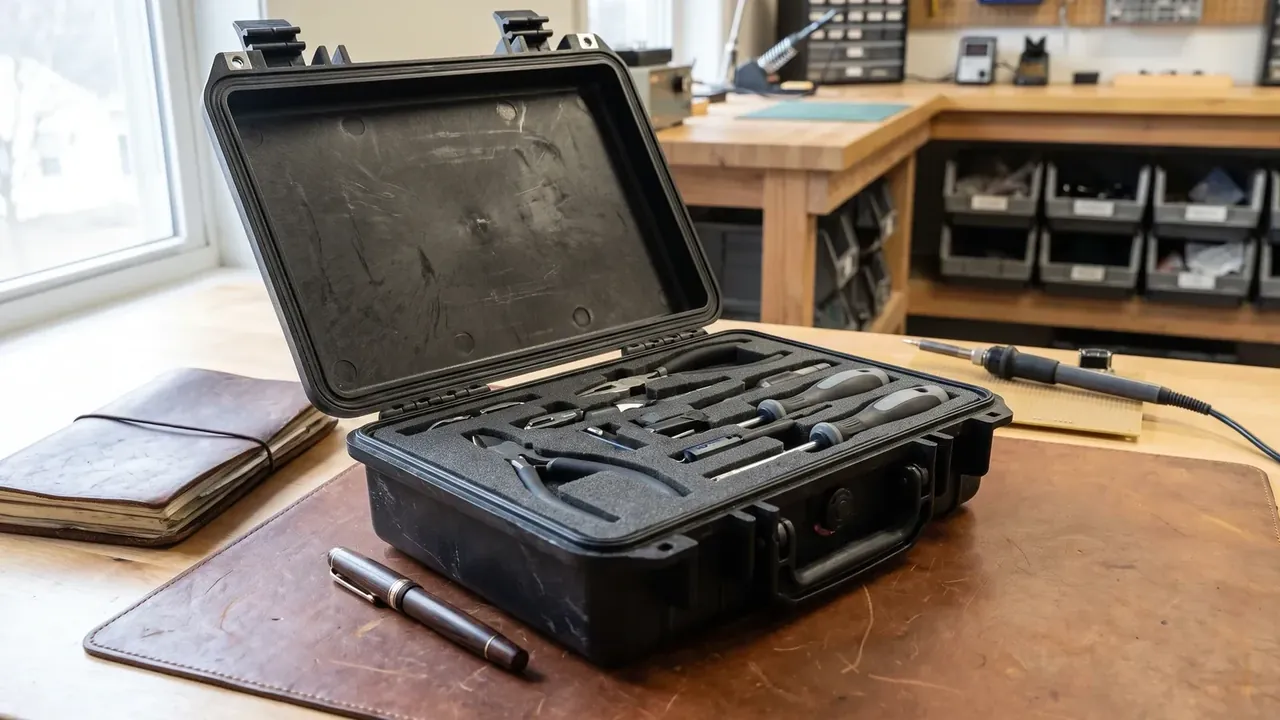
Cleaning runs on a 50 h interval, and the figure is not arbitrary: two openings a day, a pinch of dust each time, and by 50 h the bore load has just begun to affect spring return, after which the lever feels stiff.
The blow goes from the axis outward. Pushing air inward drives grains past the shoulder into the bottom of a blind bore, tighter with every pass; blowing outward walks them back along the path they came in, leaving the running fit clean.
A holding force of 200–400 N describes a clean Dustproof Outdoor Equipment Case latch. Once dust collects, the number rises, and an operator reading that as a better seal is reading friction instead; a lever that suddenly feels stiff is a signal to clean early.
5. Opening a case in blowing sand
On a Dustproof Outdoor Equipment Case the lid coming up is the weakest moment in the barrier. Once the cavity opens, the slight depression inside collapses and dusty air sweeps along the rim, dropping more onto equipment faces than ever seeps through a gasket.
Stand upwind of the Dustproof Outdoor Equipment Case and lift the lid downwind, so air streams across the back of the lid instead of into the cavity. Where wind cannot be chosen, blow the body off before opening rather than after.
Opening angle matters too. Past 90 degrees the lid foam faces down and fallout lands on its back rather than in the cavity; a narrow gap with a hand pushed through only traps dust on the rim, where closing drags it onto the seal.
In sand, opening time follows an action list: decide what comes out, reach in once, close, then write it down.
Related Reading
- Sandstorm-proof sealed equipment box
- IP68 waterproof dustproof small hard box
- Dustproof hard case for landscape photographers
- Choosing 5, 10 or 15 mm foam
JUNZHIJIA
Related Products
- 8 Series — Gun Cases; Military Equipment Cases; Camera Equipment Cases; Drone Cases; Watch Cases; Knife Cases; First Aid Cases; Electronics Equipment Cases
- WL8-2812 PP Gun Case — model WL8-2812
- All protective cases and toolboxes: 7 series, 158 models