

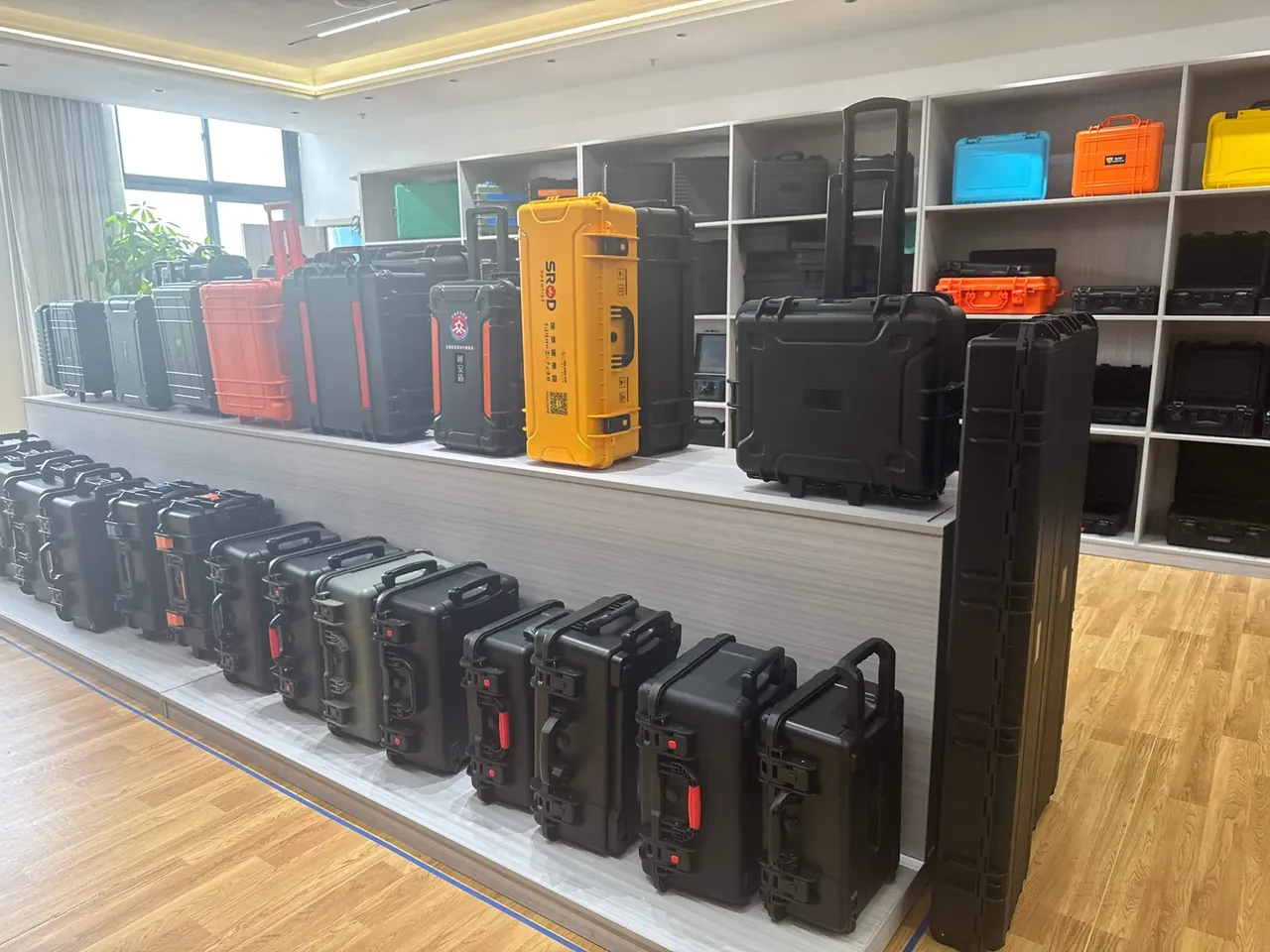
Quick answer: The outdoor sandstorm-proof sealed equipment box works on a flat rabbet, 22%–28% lip compression and a valve that rebounds after 2 kPa of vacuum.
Table of contents
- Sealing face setup on the outdoor sandstorm-proof sealed equipment box
- Fine sand grain size against the sealing lip
- How the breather valve opens under pressure differential
- Latch preload and mid-span compensation on the long edge
- Resetting checks after the dust test
- FAQ
1. Sealing face setup on the outdoor sandstorm-proof sealed equipment box
After the wind drops, the ring people wipe is the wrong one. What wears sits inside: a rabbet on the lid drops into a step on the body, trapping a 3.2 mm lip between two flats. The rabbet stops coarse grains, the lip closes the last microns.
A 4.0 mm wall is the usual figure for this class of outdoor sandstorm-proof sealed equipment box. At 3.0 mm the part warps as it cools and the rabbet turns into a wave the lip cannot reach. Above 5.0 mm the thick section cools last and sink marks land on the sealing face. Resin moves dimensions too: ABS shrinks 0.4%–0.7% and PP 1.0%–2.5%, so a 600 mm edge shifts 6 mm per point.
| Item | Value | Failure mode |
|---|---|---|
| Rabbet width | 6.0 mm | Lip has nowhere to sit |
| Flatness | ≤0.25 mm | Dust line starts mid-edge |
| Compression | 22%–28% | Under 20% it stops rebounding |
The -30 to 60 ℃ window follows the resin. ABS deflects at 80–100 ℃ under 1.82 MPa, PP at 50–65 ℃, so 60 ℃ leaves PP little margin. A closed vehicle reaches 55 ℃, and a latched case bows along the long edge, drifting flatness about 0.1 mm.
2. Fine sand grain size against the sealing lip
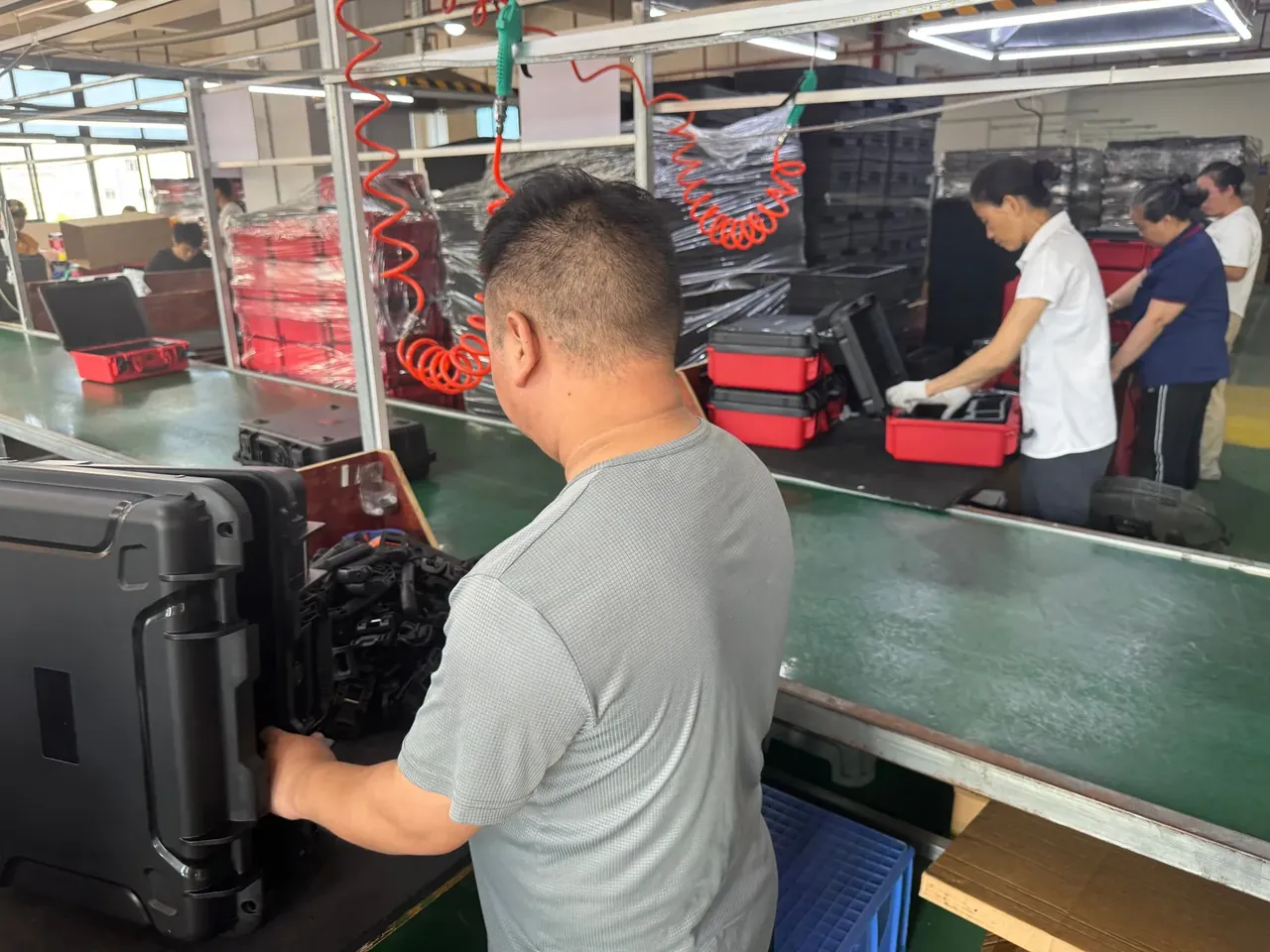
The standard dust test pushes talcum powder through a 75 μm sieve at 2 kg/m³, holds 2 kPa of vacuum inside and runs 8 h. Together they ask one question: does the lip stay seated while air is pulled from behind it? A real storm spreads wider, 0.075–0.15 mm grains both float and cut, and once settled they act like lapping paste.
Quantity matters less than size on an outdoor sandstorm-proof sealed equipment box. Anything over 0.5 mm the rabbet stops; the 0.075–0.15 mm band lodges in the contact strip and lifts rubber by tens of microns. The 3.2 mm lip is sized around that band: thinner and a grain punches through, thicker and force never reaches the tip.
| Grain band | Effect on lip | Countermeasure |
|---|---|---|
| Under 0.075 mm | Seeps through grooves | Compression holds it |
| 0.075–0.15 mm | Lifts a channel | Rabbet at 6.0 mm |
| 0.15–0.5 mm | Piles outside | 1.5 mm purge groove |
Compression stays between 22% and 28%. Under 20% the lip cannot follow a waved surface; above 30% the rubber sits in high strain, and set to ASTM D395 Method B (175 ℃, 22 h, 25% deflection) rises fast. Shore A 55–65 balances followability against embedding in this outdoor sandstorm-proof sealed equipment box.
3. How the breather valve opens under pressure differential
Tighter sealing sharpens the pressure problem. Carry an outdoor sandstorm-proof sealed equipment box from a 20 ℃ pass to a 45 ℃ vehicle and the air inside expands about 8%; on 60 L that is 4.8 L with nowhere to go. It pushes on the lip or lifts the lid a millimetre at the latch.
The valve cracks at 20 kPa differential, an actuation threshold rather than a shell rating. A 0.5 mm silicone diaphragm with a cross slit opens past that point and seals flat on return. The threshold sits above the 2–5 kPa swings of transit and below the point where the lip is pushed aside.
The seat is where dust enters an outdoor sandstorm-proof sealed equipment box. During an IP6X run the interior holds 2 kPa below ambient in a 2 kg/m³ cloud, and airflow aims at every path. A diaphragm that lifts at its rim passes powder for 8 h unnoticed, so seat flatness is held to 0.1 mm.
4. Latch preload and mid-span compensation on the long edge
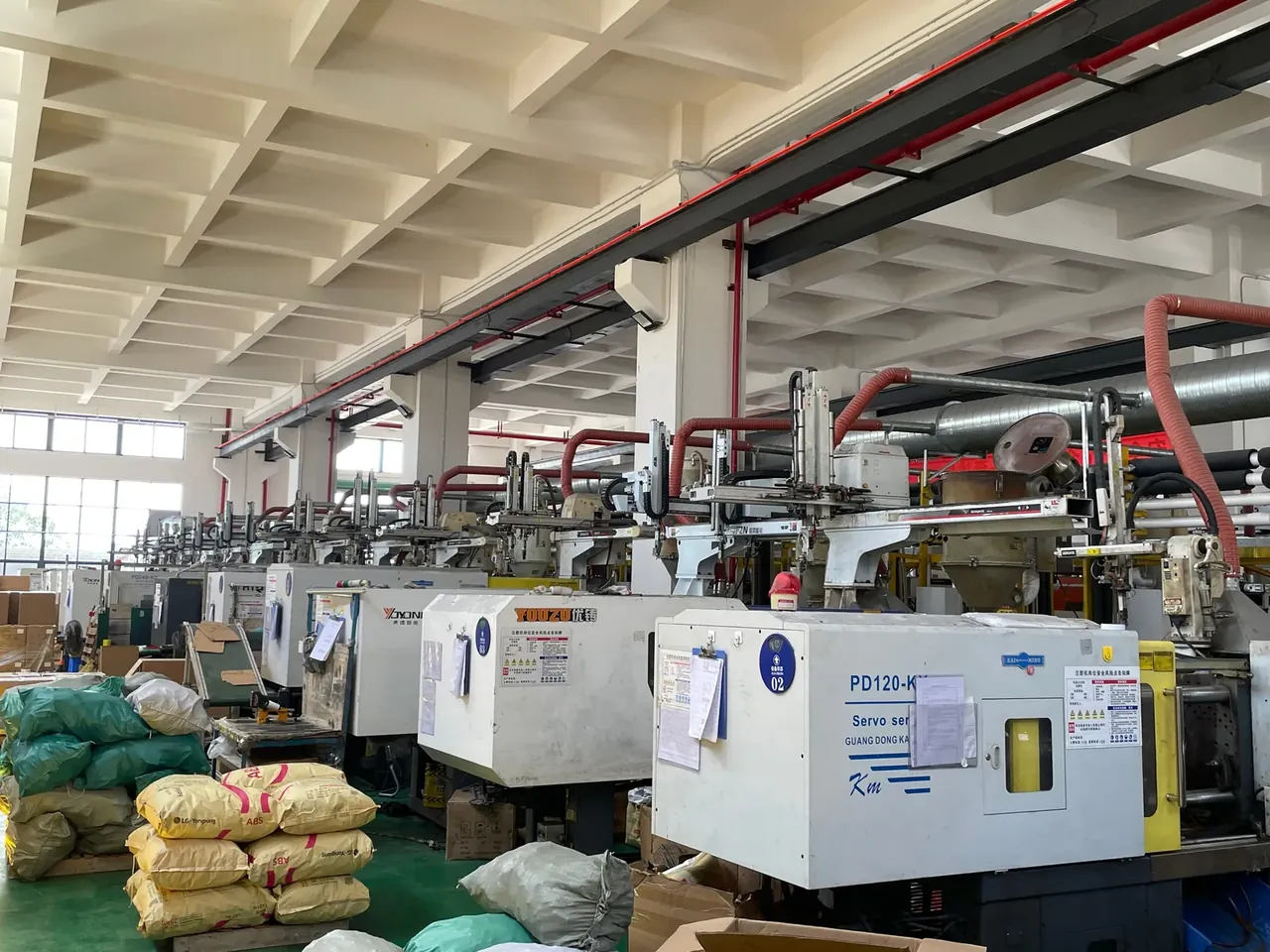
Two latches at 280 N each give 560 N across a 620 mm edge, under 1 N/mm of line load. Force lands at the ends, the middle relies on wall stiffness, and the mid-span leaks first. Three fixes exist: move each latch 60 mm inward, add two 2 mm ribs in the lid skirt, or build a 0.3 mm crown into the rabbet.
| Long edge | Latches | Residual gap | Verdict |
|---|---|---|---|
| 420 mm | 280 N × 2 | 0.12 mm | Acceptable |
| 620 mm | 280 N × 2 | 0.35 mm | Third latch needed |
| 620 mm | 280 N × 3 | 0.18 mm | Acceptable |
Preload has to be read with temperature on an outdoor sandstorm-proof sealed equipment box. ABS loses modulus at 60 ℃ and a latched lid creeps; 24 h costs about 0.05 mm. A 1.5 m drop closes the loop: open the case and look for fresh rub marks. Marks clustered mid-span mean short compensation, and tightening harder fixes nothing.
5. Resetting checks after the dust test
Passing the chamber is not the verdict for an outdoor sandstorm-proof sealed equipment box; the reset check is. Open the lid and read three places: a bright line on the contact strip, a flat crush band on the lip tip, a diaphragm flush on its seat. A broken line means flatness is out, a band deeper than 0.3 mm means too much compression.
Finish within 30 min of the test. Silicone recovers gradually, and a lip measured next morning has climbed back most of the way. Close the case and press the four corners; a faint suction sound means the lip still works.
If flatness, compression or rebound crosses its limit, the batch returns. The three do not cover for each other. A 0.1 mm flatness error can be masked by extra compression, but set accelerates and the case leaks again in two months. A mid-size tool runs 25–35 days to build and moulded parts usually start at 500–1000 pieces, both fair questions when quoting any outdoor sandstorm-proof sealed equipment box.
Conclusion
A sandstorm reduces sealing to three numbers: rabbet flatness, lip compression, diaphragm rebound. Each needs margin, and protection exists only when all three hold. Measure the rabbet first, size latch count from edge length, then confirm the valve threshold sits above transit swings. Reverse that order and the rest is patching an outdoor sandstorm-proof sealed equipment box that was never going to hold.
Related Reading
- Usable volume against cavity corners in a case
- Plastic case versus wooden crate in transport
- UV-resistant weatherproof plastic case materials
- Waterproof equipment case grades and test conditions
- Latch design for high-altitude cold environments
Related Products
- 8 Series — Gun Cases; Military Equipment Cases; Camera Equipment Cases; Drone Cases; Watch Cases; Knife Cases; First Aid Cases; Electronics Equipment Cases
- WL8-2812 PP Gun Case — model WL8-2812
- All protective cases and toolboxes: 7 series, 158 models