

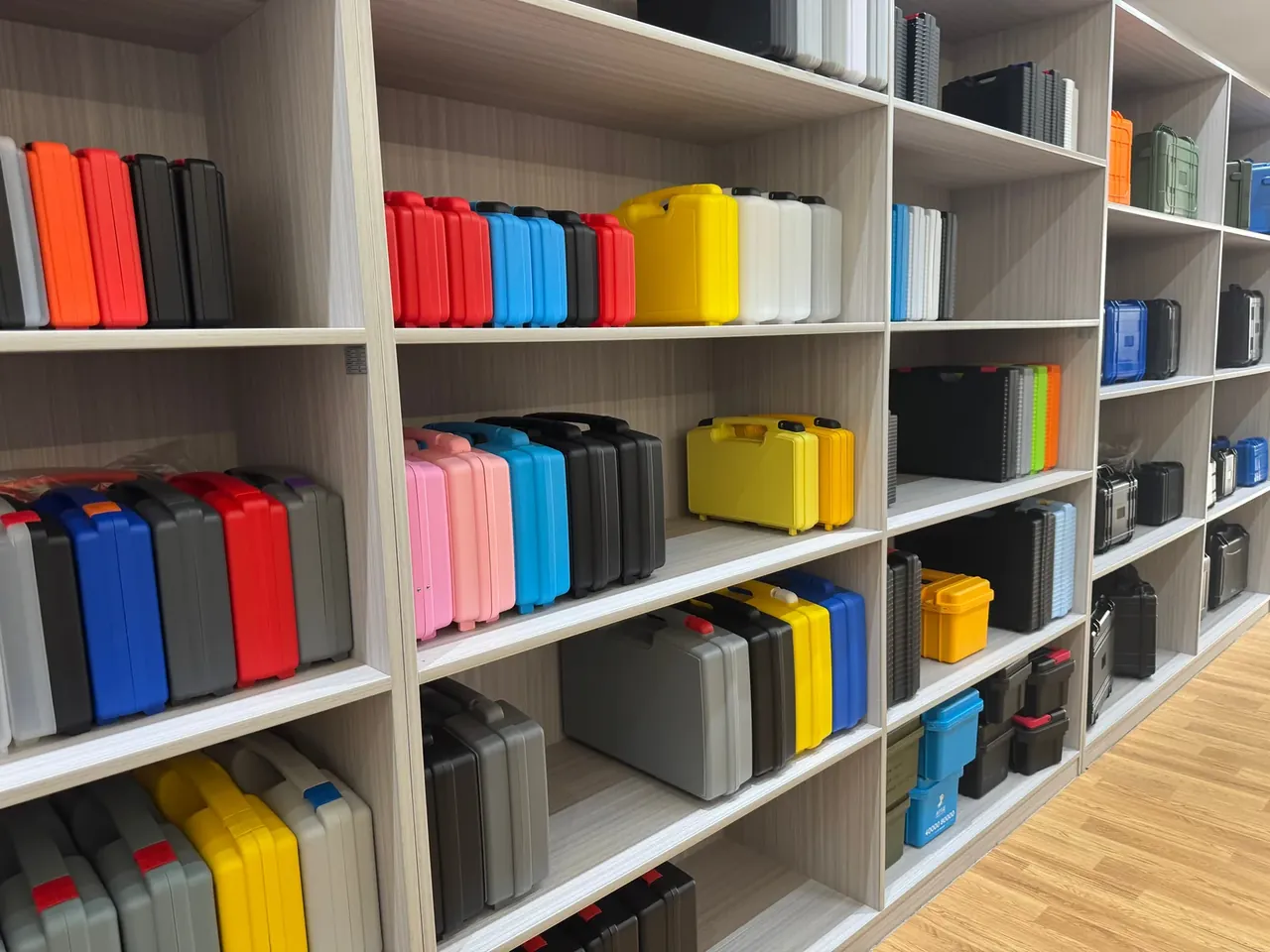
Quick answer:Empty shell storage tops out at five high: by the sixth layer the bottom case bulges at the latch, 1.2 mm of set that no pallet can undo.
Table of contents
- Stack height limit for empty shell storage
- Where the bottom case deforms above five
- Pallet and floor support
- Storage duration and creep
- Judging deformation and isolating stock
- FAQ
1. Stack height limit for empty shell storage
Five high is where an empty shell begins to show. The limit is load, not habit: at 2.6 kg a shell, the bottom unit carries 10.4 kg of dead weight, and 13 kg at the corner that takes the offset.
An empty shell is not a packed case: a loaded case passes load down its walls, an empty one has air in the middle, so force runs through four vertical edges and the floor ribs, past the latch seat. The shell that shrugs off 40 kg when full bows at 13 kg when empty.
Six is the knee. One more layer lifts the bottom unit from 13 kg to 15.6 kg, only 2.5 kg, but the wall is past yield and will not spring back when the stack comes down. Below five the set reverses; above five it does not.
| Layers | Load on one bottom shell | 30-day set | Practice |
|---|---|---|---|
| 3 | About 7.8 kg | Under 0.3 mm | Fine for long storage |
| 5 | About 13 kg | 0.6–1.2 mm | Turn over within 30 days |
| 6 | About 15.6 kg | Above 1.5 mm | Avoid |
| 8 | About 20.8 kg | Latch fails | Prohibited |
Shell size moves the number: a 120 mm shell reaches 600 mm at five and can go to seven on one pallet, while a 300 mm shell is 1.5 m at five. Empty shell storage takes the lower limit.
2. Where the bottom case deforms above five
Set picks the thinnest section first: the wall under the latch seat, 2.0 mm against 2.5 mm on the side. Seven days into a five-high empty shell storage stack it bulges, and at 1.2 mm the latch stops closing.
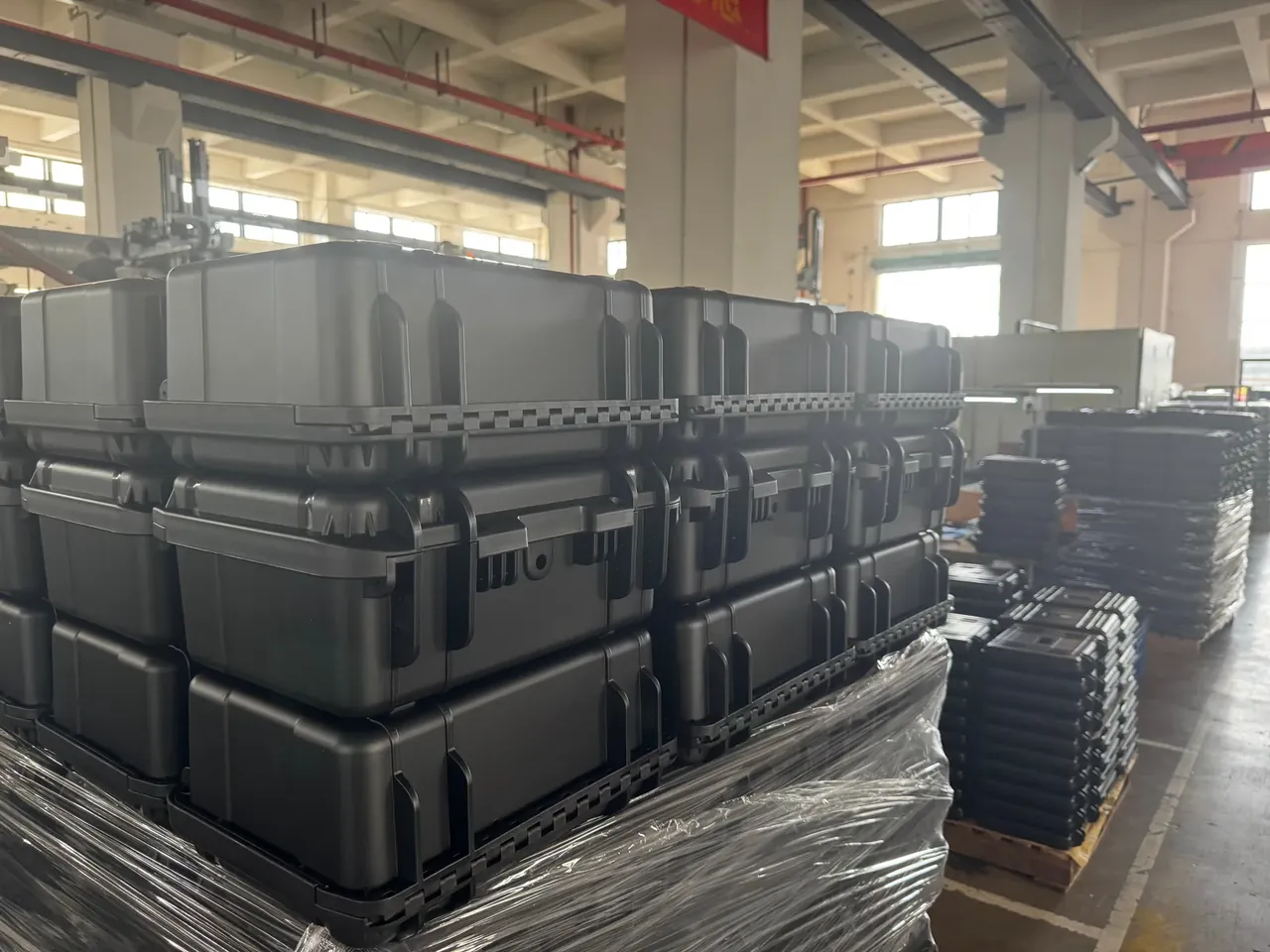
Corner posts come second. Double-walled and normally the strongest part, they line up in a stack, each upper corner pressing on the one below across a 20×20 mm face. At five high the plastic whitens, and white means yield.
Third is the middle of the long bottom edge. With bearers too far apart the floor spans air, the edge sags, and 0.8 mm of sag makes the case rock. This tracks bearer spacing, not layer count.
Warm air multiplies all three. Polypropylene holds its elasticity at 23 ℃ and softens by 35 ℃, where the same load doubles the set. West-facing bays hit 45 ℃ in the afternoon and raise most of the complaints, so shade beats another sheet.
3. Pallet and floor support
The pallet is the first floor of empty shell storage: 1200×1000 mm holds four shells a layer, twenty at five high, about 52 kg. Stiffness beats strength, and a nine-leg pallet spreads its points better than three bearers, so the floor spans less.
| Support | Contact area | Load spread | Common problem |
|---|---|---|---|
| Nine-leg plastic pallet | About 65% | Close points, small span | Low unit capacity, heavy loads sag it |
| Three-bearer timber pallet | About 45% | Three lines only | Long edge sags 0.8 mm |
| Perimeter-base pallet | About 75% | Even, most stable | Heavy, awkward to move |
| Direct on floor | 100% | Floor flatness decides all | Damp rises, bottom moulds |
The floor counts too. Slabs are held to 3 mm in 2 m; past that a pallet sits like a see-saw, turning an even load into two points. Settlement near a doorway, 5 mm low, is the usual culprit.
Moisture is the quiet variable: a shell washed and not dried sits at 0.8% surface moisture, so empty shell storage wants 0.2% or less before stacking, with 5 mm plastic sheets replacing paper.
4. Storage duration and creep
Half the set in empty shell storage comes from load and half from time. Under constant load the plastic creeps: the first 48 h deliver about 60%, the rest spreads over weeks. The first week is the dangerous one, and a three-month stack will not recover.
Thirty days is the working scale. At five high the latch bulge settles near 1.2 mm by day 30, then slows without stopping. Inside 30 days the shell can still be pressed back; past 60 days the stack is fit only for downgrade.
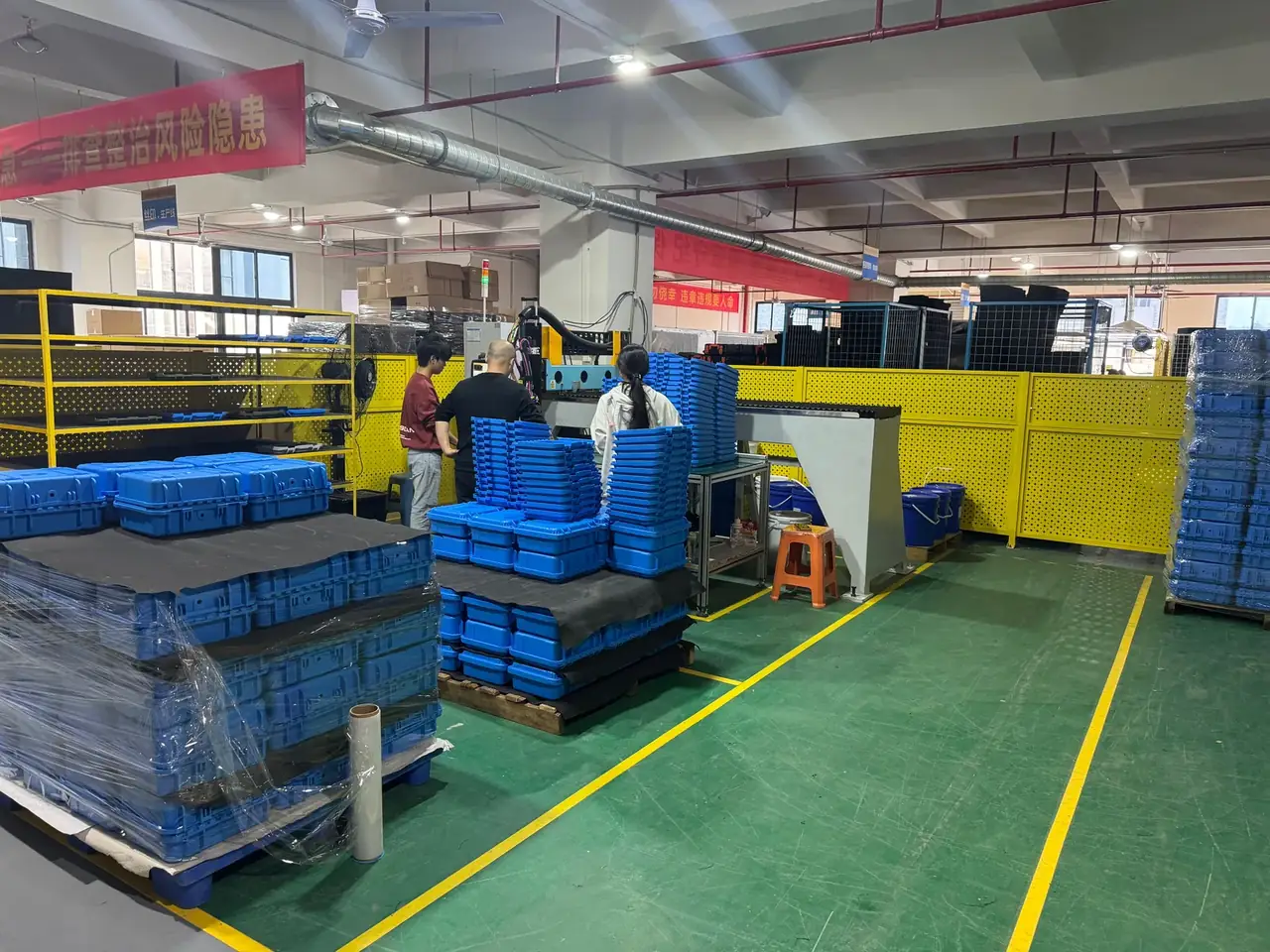
Heat and time compound. The set that takes 30 days at 23 ℃ arrives in about 18 days at 35 ℃, so holding a bay under 30 ℃ buys a third more safe time, cheaper than dropping a layer.
Timber pallets left in a damp bay climb from 12% to 18% moisture, lose a fifth of their stiffness and warp, so bays turn over quarterly.
5. Judging deformation and isolating stock
Judge with one gauge and one number: a straight edge along the long side, a feeler in the gap, 1.2 mm out of tolerance. Close the case and push the lid, and over 1 mm of movement means the latch has given up.
| Check | Gauge | Limit | Action |
|---|---|---|---|
| Long-edge straightness | 500 mm rule plus feeler | 1.2 mm | Isolate and re-check |
| Latch closure | Eye and a push on the lid | 1 mm of movement | Downgrade or re-form |
| Corner whitening | Eye | 10 mm white line | Scrap |
| Floor impression | Steel rule | 0.8 mm deep | Isolate and re-check |
Isolate in groups: adjacent shells share a load path, so when one bulges the two beside it are usually at the limit. Three shells is the usual block, tagged with batch, layer and date.
Disposition has three grades: a bulge under 1.2 mm with a working latch is pressed flat 24 h and re-checked; past 1.5 mm, or with whitened corners, the shell goes to liner duty; a failed latch is scrapped. Re-check after 7 days in empty shell storage.
All of it returns to layer count. Judging and isolating are repairs; counting load before the first shell goes up is what saves money, and the sixth layer is not worth a trial.
Related Reading
- Storage conditions for empty shells
- Floor marking rules for a warehouse
- Corner loading in a stack
- Stacking ammo boxes to full height
Related Products
- 8 Series — Gun Cases; Military Equipment Cases; Camera Equipment Cases; Drone Cases; Watch Cases; Knife Cases; First Aid Cases; Electronics Equipment Cases
- WL8-2812 PP Gun Case — model WL8-2812
- All protective cases and toolboxes: 7 series, 158 models