

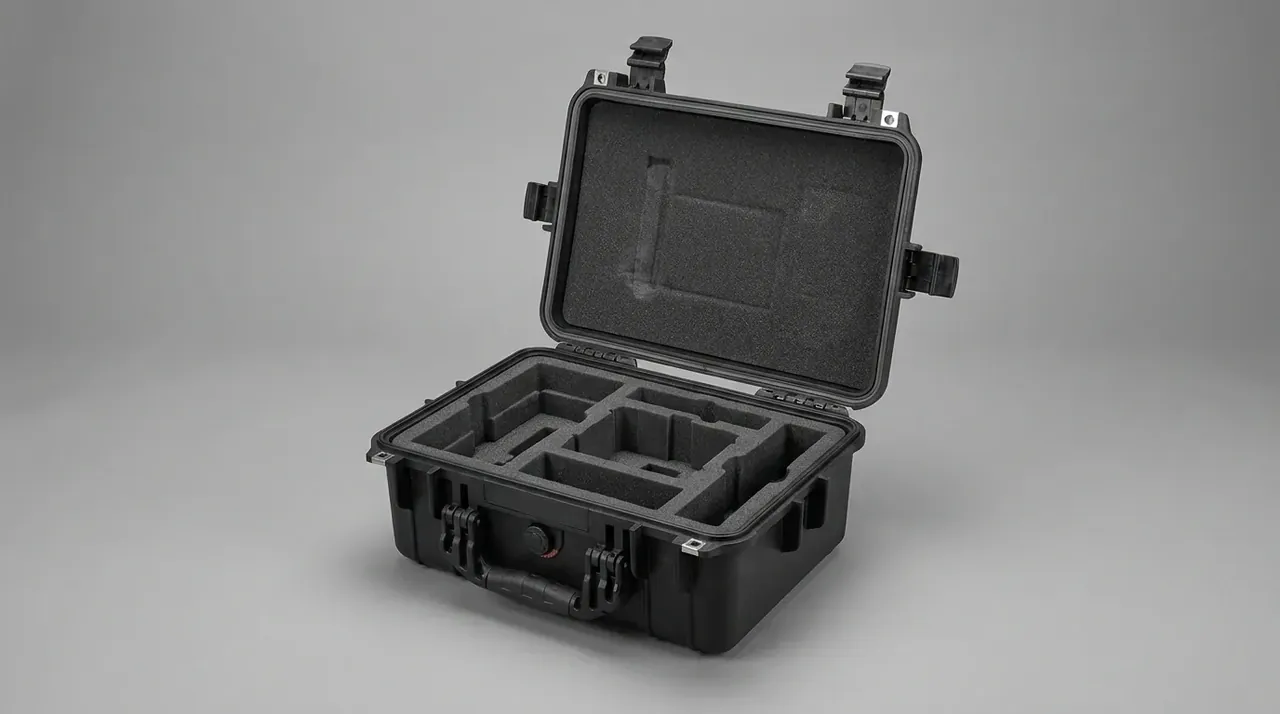
Quick answer: An en 45545 case is judged R22 for exposed parts over 0.25 m² and R23 inside; typical limits run 28%/32% oxygen index and 300/150 smoke, graded by HL.
Table of contents
- Two Questions Decide the Requirement Set
- Oxygen Index and the Four-Point Gap
- Smoke Density, Peak Heat Release and Toxicity
- Hazard Level Picks How Many Sets You Run
- Specimens, Area and Thickness
- FAQ
1. Two Questions Decide the Requirement Set
A cover panel with 0.42 m² of exposed face and the divider behind it come from one moulding family, but not from one requirement set. Under EN 45545-2 the panel is normally R22 and the divider R23. R22 addresses equipment and cases mounted outside the vehicle or on exposed faces; R23 addresses in-vehicle equipment and internal parts. Final classification follows the vehicle hazard level and the mounting position.
R22 usually covers shells, covers and door skins; R23 covers brackets, dividers, liner panels and latch seats. They are not a high and low pair: R23 is typically stricter on index, R22 looser on smoke, and a mixed report fails review.
For an early call, one number helps: 0.25 m² of exposed area. Above it a part is usually read as external and taken to R22; below it, even an outside part is read as internal. A review that fixes the outline but not the area is one meeting away from a wrong set.
| Requirement set and item | Where it applies | Typical requirement | Specimens |
|---|---|---|---|
| R22 oxygen index | Parts on or outside the vehicle body | ≥28%, rising at HL3 | 3 |
| R22 smoke density | Parts on or outside the vehicle body | Ds max 300, tighter at HL3 | 3 |
| R23 oxygen index | In-vehicle equipment, internal parts | ≥32% | 3 |
| R23 smoke density | In-vehicle equipment, internal parts | Ds max 150 | 3 |
| Vertical burn, both sets | All parts | V-0 | 3 |
2. Oxygen Index and the Four-Point Gap
Air sits at 21% oxygen. A typical 28% index leaves seven points of margin before a flame sustains itself; 32% leaves eleven. Those four points cannot be bought with wall thickness, and which of the two applies depends on hazard level and position.
A halogen-free package at around 8% lifts a base resin from 24% to roughly 28%; more of the same additive stops working, and at 12% loading the index may reach 31% while tensile strength falls 8%–12%.
Preparation moves the number as much as the additive. The same compound pressed into a plaque and cut from a production wall can differ by 1–2 points, because fibre orientation and skin thickness differ. Cut specimens from a flat section of the actual en 45545 case, or the data will look good and fail on the assembly. Judgement runs on 3 specimens, 3 readings each, the lowest no more than 1 point under the threshold.
3. Smoke Density, Peak Heat Release and Toxicity
Smoke is judged on the maximum, not the average. Three specimens give three curves, the highest point across them becomes Ds max, and it is compared against the typical 300 for R22 or 150 for R23. One specimen over the line fails the set.
Heat release is read as a 90 s peak, because what escapes in the first 90 s decides whether people can leave. Specimens are tested flat at 3 mm; at 2 mm the peak reads 10%–15% low.
Toxicity is a separate index, typically CIT ≤0.9: smoke density is about seeing the exit, toxicity about walking to it, and a part can pass one while failing the other. Conditioning is the step most often skipped too, since specimens rested 48 h at 23 ℃ and 50% RH read 20–40 lower on smoke than ones taken straight from the floor.
4. Hazard Level Picks How Many Sets You Run
Hazard level belongs to the vehicle duty cycle, not to the case, but it decides how many sets the case has to cover and how tight each one runs.
Rough mapping: metro and short commuter stock at HL1, mainline coaches and underground at HL2, sleeping cars and long tunnel sections at HL3. Sell one design to two operators and you run the stricter set, or keep two report packs.
| Hazard level | Vehicle example | Sets run | Typical oxygen index | Typical smoke |
|---|---|---|---|---|
| HL1 | Metro, short commuter | R22 mainly | ≥28% | Ds max ≤300 |
| HL2 | Mainline coach, underground | R22 and R23 | 28% / 32% | ≤300 / ≤150 |
| HL3 | Sleeping car, long tunnel | Both, stricter side | ≥32% | ≤150 |
All figures are typical requirements; a signed vehicle specification may add or relax one step and governs.
Higher levels add specimens and report pages, not necessarily a new shell; at HL3 the liner usually moves to a flame-retardant grade, adding 15%–20% to cost.
5. Specimens, Area and Thickness
Exposed area is projected area including folds and ribs, excluding shielded faces. A 600 mm × 400 mm cover projects 0.24 m², which looks under the line until the 40 mm return flange is counted, and then it clears 0.25 m² and moves to R22.
Cut specimens at least 50 mm from the gate and 30 mm from a weld line. Weld lines read 1–2 points low on oxygen index, so a specimen taken there reads low or scatters.
| Specimen | Thickness | Exposed area | Requirement set |
|---|---|---|---|
| Lid outer panel | 3 mm | 0.42 m² | R22 |
| Side wall panel | 3 mm | 0.36 m² | R22 |
| Internal divider | 3 mm | 0.18 m² | R23 |
| Latch and hinge seat | 3 mm | 0.05 m² | R23 |
All specimens are 3 mm so data stays comparable. A 4 mm production wall reads slightly higher on index and lower on smoke, but the report still carries 3 mm unless the buyer agrees to a supplementary run at actual thickness.
Conclusion
The logic for an en 45545 case compresses to one line: position first, then 0.25 m², then R22 at a typical 28% and 300 against R23 at 32% and 150, with HL3 on the strict side. Hazard level decides whether one set or two is run, and getting it wrong costs more than a pre-test.
This article covers case-side specifications only and does not address any handling, loading or use of the contents.
Related Reading
- How UL94 V-0 vertical burn is judged
- Reading flammability ratings on cases
- Configuring a rail maintenance tool case
- Label compliance for export packaging
Related Products
- 8 Series — Gun Cases; Military Equipment Cases; Camera Equipment Cases; Drone Cases; Watch Cases; Knife Cases; First Aid Cases; Electronics Equipment Cases
- WL8-2812 PP Gun Case — model WL8-2812
- All protective cases and toolboxes: 7 series, 158 models