

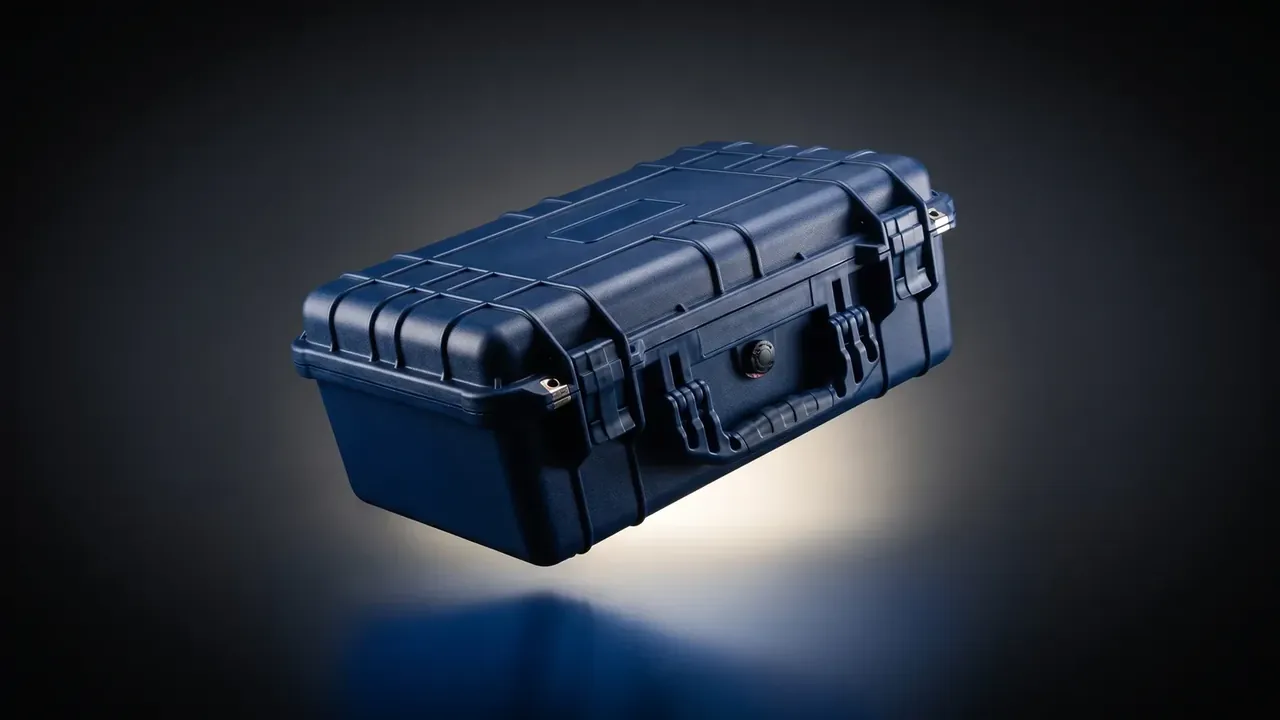
Quick answer: Environmental Monitoring Instrument Case fails first at 3 mm lid ribs, chalked after 1000 h of UV with ΔE past 3 and impact retention under 80%.
Table of contents
- Where the Environmental Monitoring Instrument Case fails first
- UV ageing: lid ribs chalk before the flats
- A one-kilogram hammer at minus 25
- Breathing: day-night swings pump moisture in
- Compression set in the gasket
- FAQ
1. Where the Environmental Monitoring Instrument Case fails first
After three years on an outdoor station, the repair log fills with chalked lid faces, latches that will not bite and water marks inside, while cracked walls stay rare. The Environmental Monitoring Instrument Case takes a compound load: the lid runs above 60 ℃ by day and drops to 5 ℃ at night, one 25 K swing a day and more than 300 a year, with 5% salt fog and 90% relative humidity added on the coast.
| Failure | First seen | Main cause | Visible sign |
|---|---|---|---|
| Chalked lid face | 12 to 18 months | UV and oxygen ageing | Roughness climbs to 2.5 μm |
| Latch stiff in cold | First cold snap | Shrinkage mismatch, brittleness | Engagement short by 0.4 mm |
| Water marks inside | Wet season | Moisture drawn in by breathing | Desiccant spent in 2 weeks |
| Gasket no longer loaded | 24 to 36 months | Compression set | Lid gap at 0.6 mm |
Ordered by time, the work sets itself: water first, cold next, material last. A single temperature range on a spec sheet hides those boundaries.
2. UV ageing: lid ribs chalk before the flats
UV is read on a bench. A QUV chamber with UVA-340 lamps runs 8 h of light at 60 ℃ and 4 h of condensation at 50 ℃ per cycle, and at 1000 h two numbers matter: colour shift ΔE no more than 3 and notched impact retention no less than 80%. Below that line the shell starts shedding powder from the rib tops in its second summer.
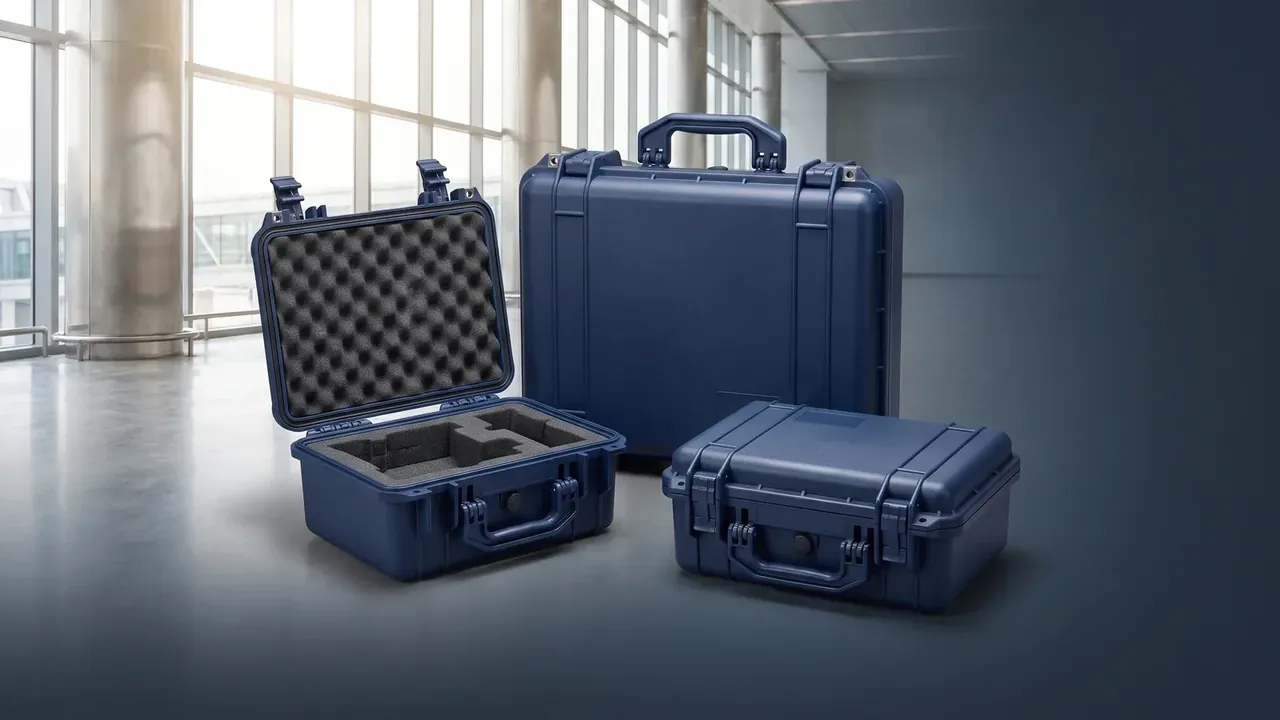
The compound carries the rest: 2.0% to 2.5% carbon black blocks UV and 0.3% hindered amine light stabiliser scavenges radicals. Bare PP chalks at 300 h under the same lamps, and only the pair pushes it past 1000 h. Lid ribs of the Environmental Monitoring Instrument Case fail early because a 3 mm rib top cools faster in the tool, crystallises differently from the flat, and degrades sooner out of the same melt.
Rib tops take a 0.5 mm radius and a 0.1 mm grain hides the first bloom, but the bench still judges ΔE at 1000 h.
3. A one-kilogram hammer at minus 25
Cold is decided in the material. PP turns brittle around -20 ℃, with homopolymer grades higher up, while ABS looks good at room temperature and loses more than PP by -25 ℃. A shell and latch in one grade shrink together but also go brittle together, so a cold snap takes both at once.
The bench holds the case at -25 ℃ for 4 h, then drops a 1 kg hammer from 1 m onto a corner; no crack at the dent passes. Engagement depth is measured separately: 2.5 mm as designed becomes 2.1 mm at -25 ℃ through differential shrinkage, which the hand reads as a latch that needs a hard push.
| Temperature | Material state | Hammer result | Verdict |
|---|---|---|---|
| 20 ℃ | Ductile | Dent 1.2 mm, no crack | Pass |
| 0 ℃ | Transition | Dent 1.0 mm, no crack | Pass |
| -25 ℃ | Brittle edge | Dent 0.4 mm, hairline at corner | Change grade |
Over 400 mm per side, PP at 1.5×10⁻⁴/K loses 2.7 mm across a 45 K drop; a lid in the same grade shrinks with the body and keeps the bite, but an ABS lid moves about 1 mm differently and the latch must absorb that travel elastically.
Three routes exist: a fillet at the latch root, a copolymer grade, or a taller latch bridge. The Environmental Monitoring Instrument Case takes the third, spending 1 mm of lid height to hold 2.3 mm of engagement and under 150 N at -25 ℃.
4. Breathing: day-night swings pump moisture in
Seal a cavity and temperature becomes pressure. A 20 L cavity climbing from 15 ℃ to 40 ℃ reaches roughly 8.8 kPa of differential by ideal gas estimate; the gasket stops liquid water but not that head, so air leaks out past the lip and returns with moisture when the case cools, twice a day.
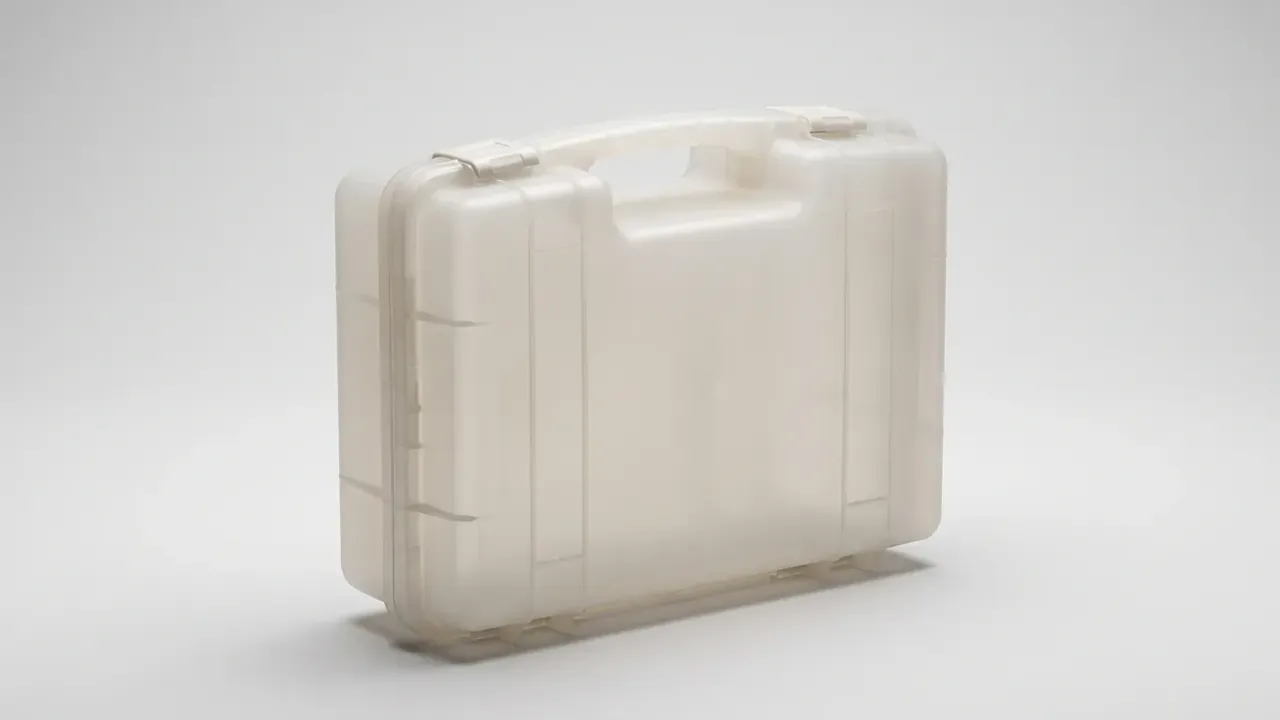
A relief valve handles that head. It cracks between 3 kPa and 5 kPa, staying shut below and venting above to trim 8.8 kPa toward the threshold, and reseats under 1 kPa as it falls. The Environmental Monitoring Instrument Case puts the valve high on the side wall, 60 mm above the floor, so condensate cannot seal the port.
Humidity gets its own budget. A 20 L cavity takes 30 g of silica gel, which holds 20% of its weight and is spent in two weeks in the wet season. Dew point matters too: 25 ℃ at 60% relative humidity condenses at 16.7 ℃, so a station at 5 ℃ collects water on the floor.
5. Compression set in the gasket
A gasket does not stay effective once fitted; compression set climbs year by year. Silicone held at 70 ℃ for 70 h must set less than 25%, yet the same batch reaches 40% after three outdoor years, and the lid gap grows from 0.2 mm to 0.6 mm until immersion finds that seam first.
Groove and cord are paired first. A 3.0 mm groove with a 3.6 mm cord lands at 20% to 25% compression; under 15% the seal is not loaded, over 30% the cord root rolls. The Environmental Monitoring Instrument Case cuts a 0.2 mm vent into the groove floor so trapped air has somewhere to go and the cord beds flat.
| Service age | Compression | Recovery | Lid gap | Verdict |
|---|---|---|---|---|
| Delivery | 22% | 98% | 0.2 mm | Pass |
| 18 months | 21% | 88% | 0.4 mm | Watch |
| 36 months | 18% | 60% | 0.6 mm | Replace cord |
Inspection runs twice a year, with immersion to IPX7 at 1 m for 30 min and a look at the cavity wall within 15 min of lift-out. Cord replacement follows the gap, not the calendar: stock spares at 0.5 mm, replace at 0.6 mm.
Conclusion
Whether an Environmental Monitoring Instrument Case holds three years outdoors comes down to the longest of four terms: ΔE at 1000 h, a corner drop at -25 ℃, a valve that trims 8.8 kPa, and a 0.6 mm lid gap at 36 months. Each stands alone, and the first to break drags the rest.
This article covers the case-side specification and its design implications only. It does not address any handling, loading or use of the items inside.
Related Reading
- Plastic case versus carton for e-commerce shipping
- Foam lining for a shockproof environmental monitoring meter case
- How cavity volume and corner usability are measured
- The airtight path of a pressurised latch case
Related Products
- 8 Series — Gun Cases; Military Equipment Cases; Camera Equipment Cases; Drone Cases; Watch Cases; Knife Cases; First Aid Cases; Electronics Equipment Cases
- WL8-2812 PP Gun Case — model WL8-2812
- All protective cases and toolboxes: 7 series, 158 models