

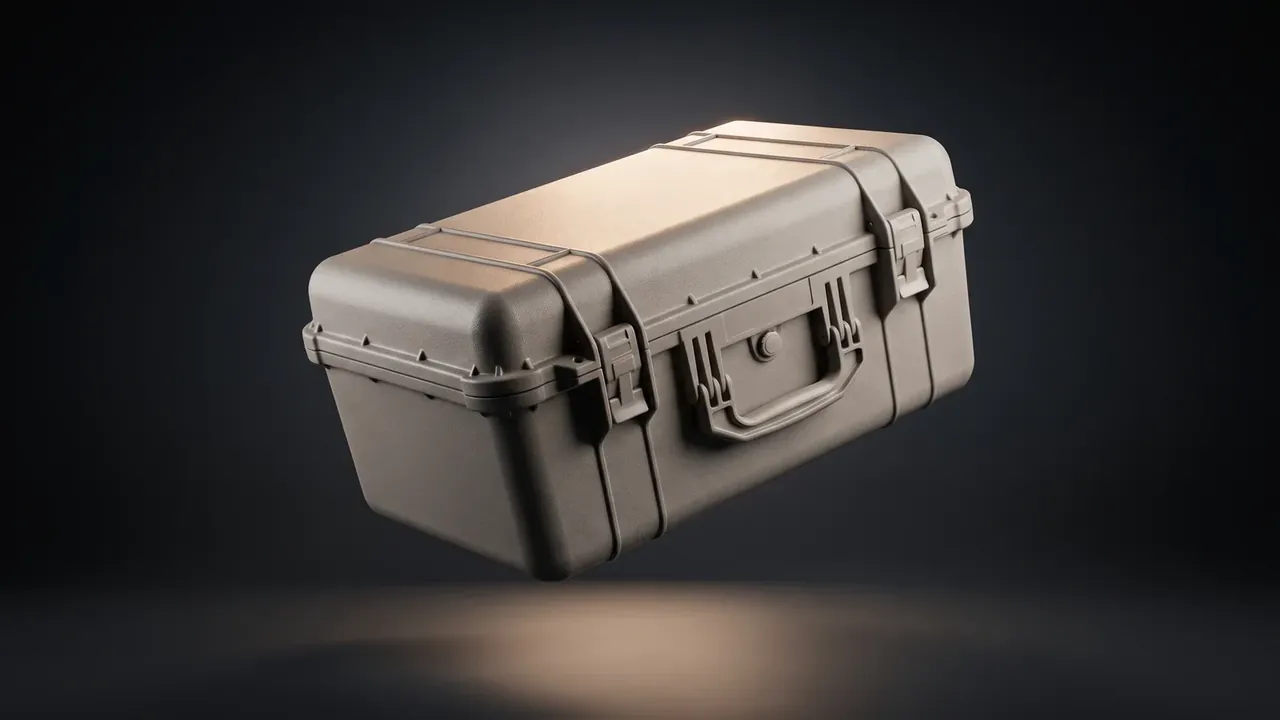
Quick answer: Five measurable details decide an explosive storage case: a 3.2 mm wall with ribs at 85 mm pitch, a seal groove sharing the rim with a ground post, a retardant load capped by drop results, and four end-of-line readings.
Table of contents
- How Wall Thickness and Ribs Are Set
- Seal Groove and Ground Post on One Rim
- How Much Flame Retardant Before Drop Strength Falls
- Latch Lock Boss and Foam Compartments
- Four Readings Before the Case Ships
- FAQ
1. How Wall Thickness and Ribs Are Set
An explosive storage case is carried by one person or a small team, so volume sits between 8 and 20 litres and the body is single-shot polypropylene moulded. With no rotomoulded wall for stacking load, every throw in a vehicle lands on 3 mm of plastic.
The wall is 3.2 mm, the base 4.0 mm, tolerance ±0.3 mm, because bottom corners take the first hit. Ribs run at 85 mm pitch, 6 mm high, R1.5 root, filling evenly on an 800-tonne press at 40 degrees Celsius; closer ribs sink, wider ones bulge. The lid carries two recesses as stack stops, two cases maximum, not a flat load platform.
| Feature | Dimension | What it controls |
|---|---|---|
| Body wall | 3.2 mm, ±0.3 | Crush resistance, boss strength |
| Base | 4.0 mm | First contact on a drop |
| Rib pitch and height | 85 mm and 6 mm | Side wall bulge |
| Lid depth and corner | 45 mm and R20 | Opening clearance, corner cracks |
2. Seal Groove and Ground Post on One Rim
The rim of an explosive storage case is fifteen millimetres wide: the seal groove takes half, the ground post needs a footprint.
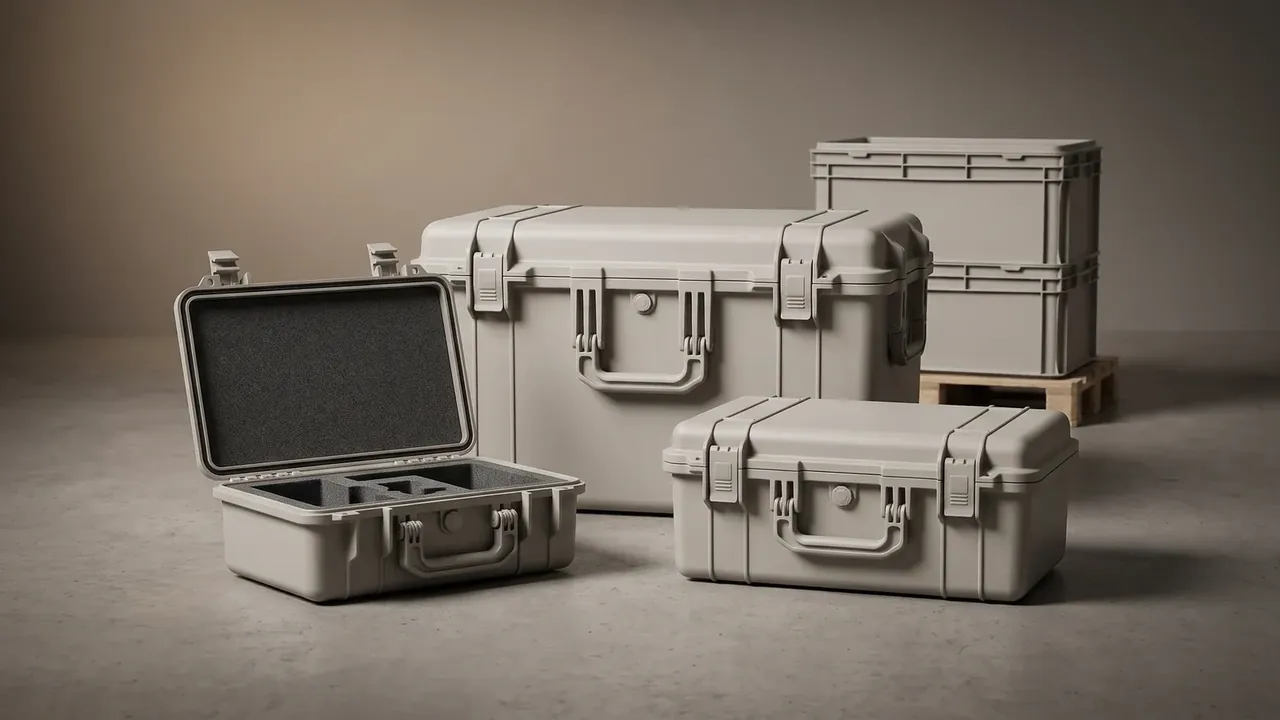
The seal is 5 mm EPDM cord in a 6.2 mm groove, compressed 22 percent, floor flat to 0.3 mm. Below 18 percent it leaks; above 28 percent the lid must be forced and latches wear first.
Static control runs on material and grounding. The shell is dissipative grade at 10 to the 6th to 10 to the 9th ohm; an M6 nickel-plated brass post sits in the boss inside the handle mount, only a nut showing outside. Grind the paint off before measuring and hold 10 ohm or less. The case is opened by hand, so discharge starts at the handle; handle mount and ground post must form one path.
3. How Much Flame Retardant Before Drop Strength Falls
Retardancy and toughness pull against each other on a thin wall: the same 6 percent masterbatch costs a 3.2 mm wall more impact than an 8 mm box wall, since a thin section is mostly oriented skin.
Three numbers fix the claim: glow-wire ignition at 750 degrees Celsius or higher, UL94 V-0 on a 1.6 mm bar, afterflame of 8 seconds or less. The masterbatch works from 5 to 6 percent, and notched impact falls from 11 to 8 kilojoules per square metre; 0.4 mm more base and 0.8 mm at rib roots recovers about 9.5. Past 9 percent, corners crack on a cold drop test.
4. Latch Lock Boss and Foam Compartments
Closure is two latches plus one central lock hole. Latches are rated 380 N pull, the hole is 7 mm through, and the boss needs 3 mm of wall or one pry opens the shell.
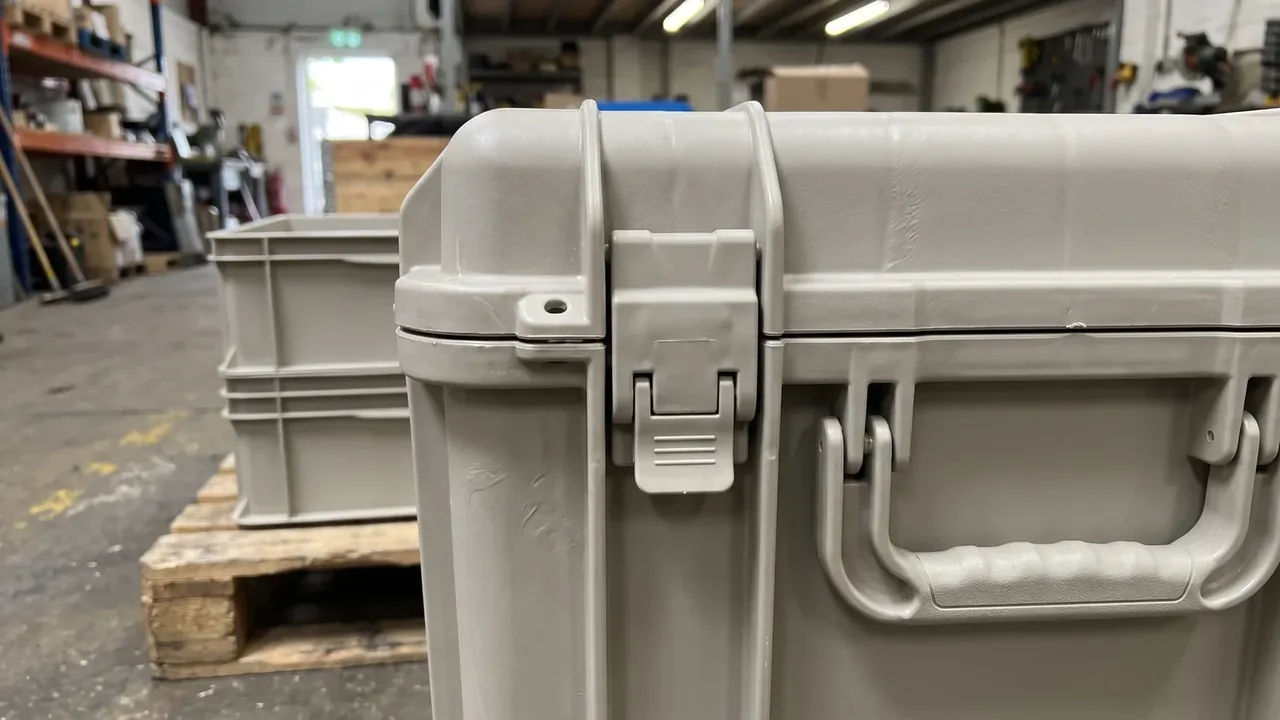
The liner is EPE at 25 kilograms per cubic metre in six compartments, 8 mm walls, under 1 mm clearance, top 3 mm below the seal groove. Flush or proud, and the lid presses foam before seal, killing air tightness. The real argument is opening force: thicker liner, forced lid, preload, fatigued boss. Trim foam rather than uprating the latch.
5. Four Readings Before the Case Ships
Four readings tell whether a batch is stable: air tightness, opening force, drop, surface resistance.
Air tightness is charged to minus 20 kilopascals for 60 seconds, decay 0.5 or less; IP67 takes one metre of water for 30 minutes.
| Reading | Limit | Instrument |
|---|---|---|
| Air tightness | Minus 20 kPa held 60 s, decay 0.5 kPa | Leak tester |
| Opening force | 60 N or less per latch | Push-pull gauge |
| Drop | 1.2 m, six faces, rated ballast | Drop rig |
| Surface resistance | 10 to the 6th to 10 to the 9th ohm | Resistance meter |
Three units per batch go through the drop; hardware takes 24 hour neutral salt spray. A drift means checking the mould and resin lot first.
Conclusion
Wall and ribs decide the drop, groove and post must agree on fifteen millimetres of rim, retardant load is set backwards from drop results, clearances set the feel, and four readings tie the rest together. In an acceptance sheet, those five are what a well-built explosive storage case sells.
This article discusses only the container (case body) side of specifications and design intent, and does not cover any handling, loading or use of the contents.
Related Reading
- Applications for explosive storage cases
- Inspection and maintenance of explosive storage cases
- Reading explosive storage case specifications
- Structure and craft of explosive storage boxes
Related Products
- 8 Series — Gun Cases; Military Equipment Cases; Camera Equipment Cases; Drone Cases; Watch Cases; Knife Cases; First Aid Cases; Electronics Equipment Cases
- WL8-2812 PP Gun Case — model WL8-2812
- All protective cases and toolboxes: 7 series, 158 models