

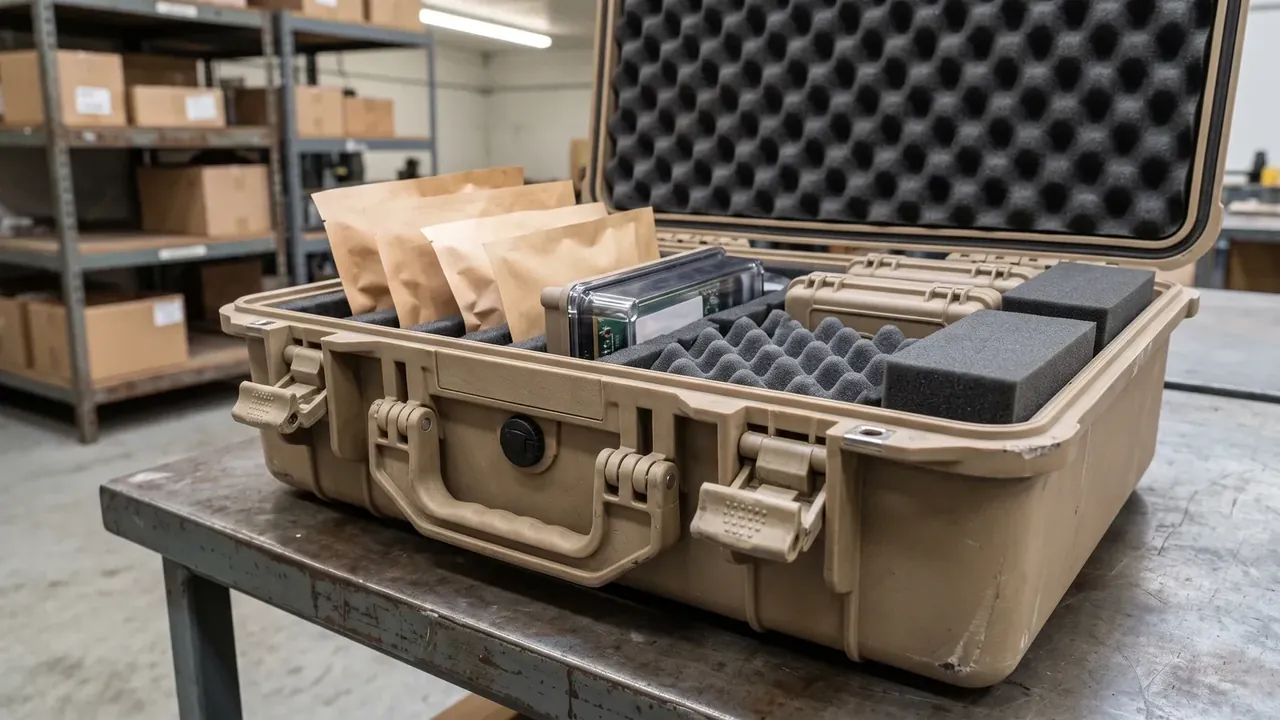
Quick answer: A film crew lighting equipment heavy duty transit case starts at 32 kg: 14 kg shell plus 18 kg load, and 1 kg over means stripping it at check-in.
Table of contents
- The 32 kg Line Comes Before Any Wall Thickness
- What 8 mm of Rotomoulded Wall Does in a 1.8 m Corner Drop
- After 200 Trips a Year, What Loosens First
- The 25 kPa Valve Against a 90 K Swing
- FAQ
1. The 32 kg Line Comes Before Any Wall Thickness
A lighting department weighs the case before it packs anything. A film crew lighting equipment heavy duty transit case measures 800 × 600 × 450 mm outside, weighs 14 kg empty and carries 18 kg, for 32 kg loaded against a 32 kg single-piece limit.
There is no margin in that figure. One extra kilogram means the desk opens a film crew lighting equipment heavy duty transit case and pulls something out, which then travels as carry-on, where the allowance usually belongs to batteries.
Lightness has a price. Dropping the shell from 14 kg to 12 kg turns an 8 mm wall into 6 mm, and a 1.8 m corner drop starts a crack; going to 16 kg leaves 16 kg of payload, two battery cases short.
| Leg of the trip | Constraint | Design here |
|---|---|---|
| Check-in | 32 kg per piece | 14 kg empty plus 18 kg load |
| Ramp handling | 6 handlings a day | Four-way fork entry, 8 mm base |
| Hold stacking | 4 high | Lid carries 96 kg |
| Winter apron | −30 ℃ to 60 ℃ | 8 mm rotomoulded wall |
| Cruise altitude | Cabin pressure drop | Valve opens at 25 kPa |
| Annual use | 200 trips a year | 4 wheels, φ100 mm |
2. What 8 mm of Rotomoulded Wall Does in a 1.8 m Corner Drop
In a film crew lighting equipment heavy duty transit case the wall is never uniform. Material flows slowly into the corner, so a nominal 8 mm becomes 10 mm at the radius, exactly where a drop lands.
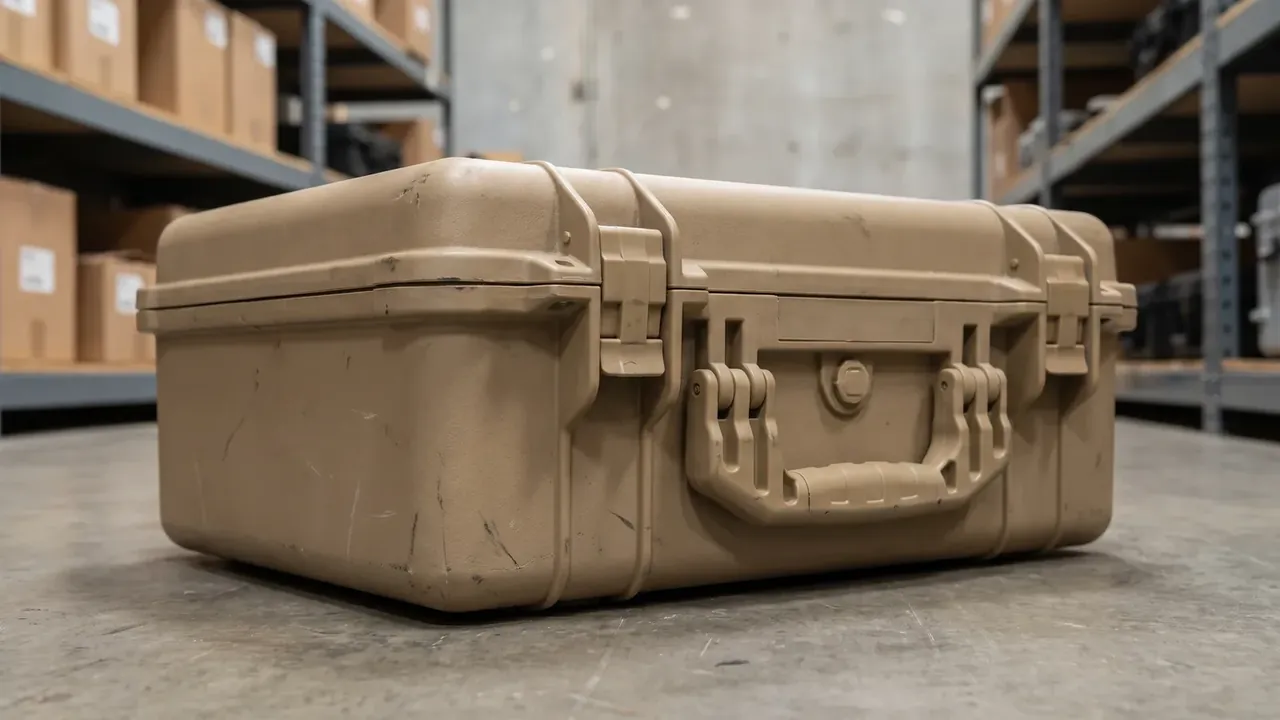
A 1.8 m corner drop arrives at 5.9 m/s. At 32 kg the shell carries about 560 J, and the corner radius absorbs most of it before the load reaches the wall, where 8 mm and four ribs spread the rest.
Stacking is another load case. The bottom lid takes three cases, 96 kg, over 600 × 450 mm at about 3.6 kPa. The pressure is modest; what hurts is uneven contact, which concentrates load on one edge and leaves a dip.
| Zone | Structure | Under drop and stack |
|---|---|---|
| Corner | 10 mm at the radius | Lands first, absorbs most energy |
| Side wall | 8 mm, four ribs | Slight bulge, springs back |
| Lid | Double wall, grid ribs | 3 mm dip under 96 kg |
| Base | 8 mm, four-way slots | Fork tines do not crush the edge |
| Wheel mounts | 4 × φ100 mm | Bolts loosen before wheels crack |
Low temperature is the hidden test. At −30 ℃ impact strength falls to about 60% of room temperature, and 8 mm still has margin at the corner; at 5 mm a 1.8 m drop can crack the latch seat.
3. After 200 Trips a Year, What Loosens First
A film crew lighting equipment heavy duty transit case turns over 200 times a year at 6 handlings a day; wheels and straps wear first.
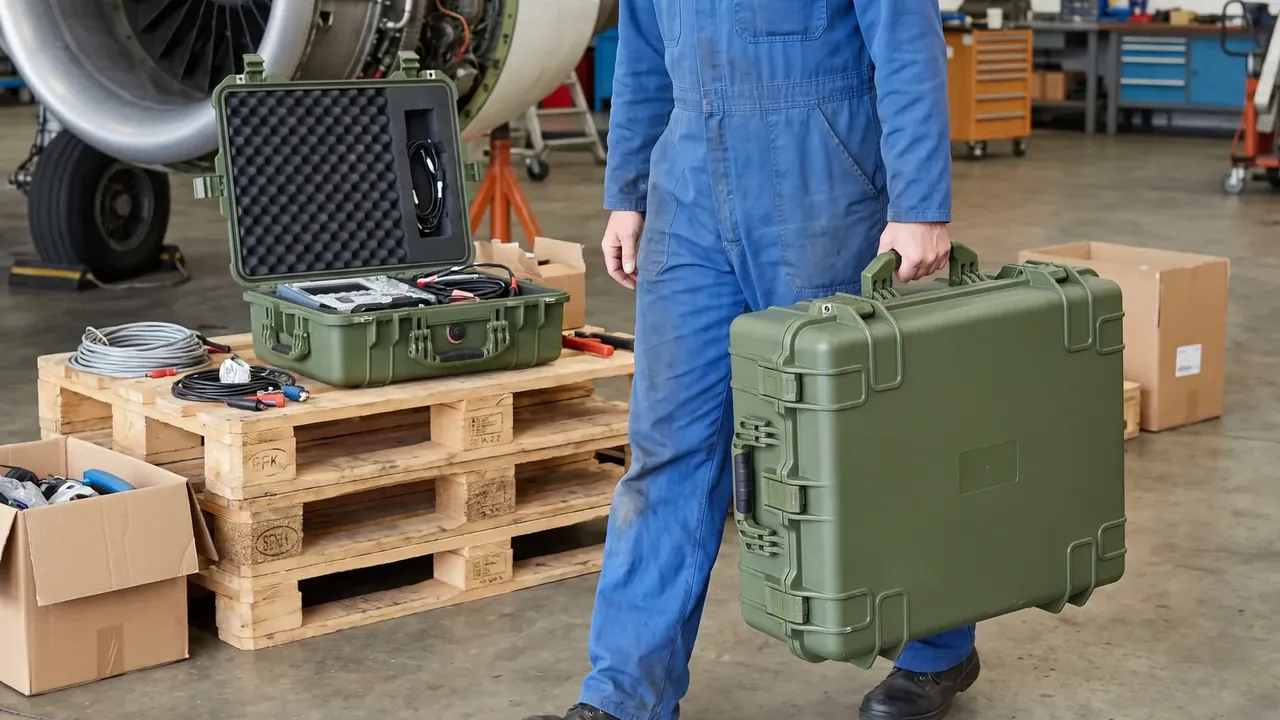
Four φ100 mm wheels on a film crew lighting equipment heavy duty transit case share 32 kg, 8 kg each at rest. Apron joints run about 20 mm, which a 100 mm wheel crosses, but the wheel-mount bolts want re-torquing every 50 trips.
Two 50 mm straps handle in-vehicle fixing. After 200 tensioning cycles the webbing fuzzes by about 1 mm, which changes nothing until more than five filaments break.
4. The 25 kPa Valve Against a 90 K Swing
Sixty degrees on the apron, minus thirty in the hold a few hours later: a 90 K swing. What happens inside a sealed shell can be worked out in one line.
Take the case sealed at 101 kPa and 333 K, then cooled to 243 K. Internal pressure falls to 74 kPa, so outside pressure runs 27 kPa higher, past the 25 kPa opening threshold, and the valve admits air on the way down.
| Temperature case | Pressure difference | Valve action |
|---|---|---|
| 60 ℃ sealed, cooled to −30 ℃ | 27 kPa outside | Opens, admits air |
| −30 ℃ sealed, warmed to 60 ℃ | 37 kPa inside | Opens, vents |
| 20 ℃ on the floor | Under 5 kPa | Stays shut |
| Sun on the apron, 70 ℃ skin | 12 kPa inside | Stays shut, cap flexes |
The reverse direction is the larger one, because gas sealed cold expands by a bigger ratio when it warms. That is why the valve has to work both ways; a one-way valve pushes the lid 2 mm open on the warm leg.
Port down and a dust cap on top, so rain runs off the shell instead of into the valve body. On a film crew lighting equipment heavy duty transit case that detail matters more than the opening pressure.
Conclusion
A film crew lighting equipment heavy duty transit case is designed backwards from the 32 kg limit: 14 kg empty plus 18 kg loaded, so every kilogram one side takes comes off the other. An 8 mm rotomoulded wall spreads a 1.8 m corner drop through a 10 mm radius and four ribs, and carries 96 kg on the lid when stacked four high. A 25 kPa two-way valve answers the 27 kPa and 37 kPa differences a 90 K swing produces, with the port facing down so water stays out. At 200 trips a year the wheel bolts and strap webbing are the first two things to check.
Related Reading
- How a touring lighting case is built
- Where the pressure relief valve sits
- What to check before an air freight booking
- Flight case versus plastic case damping
Related Products
- 8 Series — Gun Cases; Military Equipment Cases; Camera Equipment Cases; Drone Cases; Watch Cases; Knife Cases; First Aid Cases; Electronics Equipment Cases
- WL8-2812 PP Gun Case — model WL8-2812
- All protective cases and toolboxes: 7 series, 158 models