

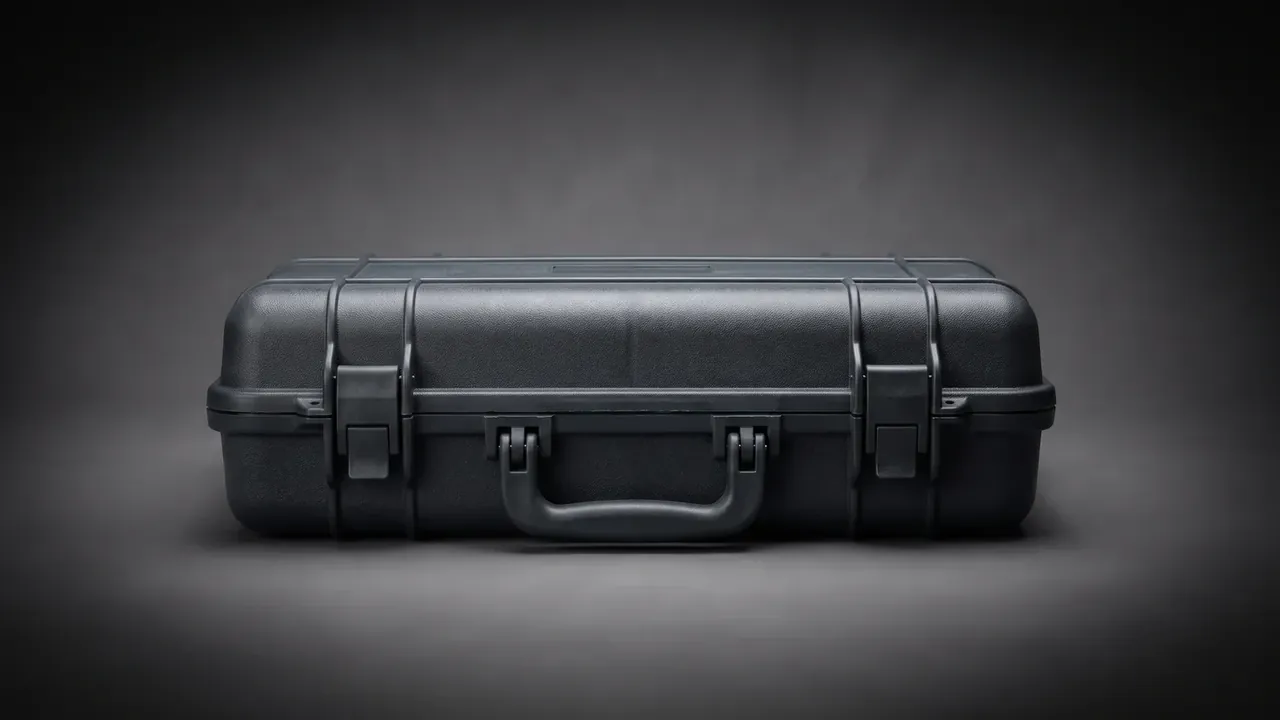
Quick answer: On a rain rig a film equipment case needs three things: an IP67 seal at 1 m for 30 minutes, a lid drained before it opens, and a 4-high stack on 38 mm webbing. Keep internal humidity under 40%.
Table of contents
- Waterproofing rules on a rain rig
- Draining the lid and holding humidity
- Compartments for bodies, lenses and batteries
- Long cases, tripods and stacking for the move
- Temperature swing and condensation indoors
- FAQ
1. Waterproofing rules on a rain rig
Rain on a film set comes from towers set between 15 mm/h and 25 mm/h, one covering a 12 m frame, two facing each other laying a 2 mm film on the ground. At that rate water does not run off; it gathers along the moulded rib and pools on the latch side. The waterproofing of a film equipment case is therefore less about the rating than about how long water sits on the lid.
IP67 gives 1 m of still water for 30 minutes, about 9.8 kPa. Raindrops are far below that. What puts water inside is the open: pooled water on the lid runs back along the rim and drips into the gasket channel. Nine in ten wet interiors happen at that instant.
| Part | Value | Acceptance |
|---|---|---|
| Enclosure | IP67, 1 m / 30 min | No standing water inside |
| Gasket | Silicone A55, 5 mm cord | 20% to 30% compression |
| Lid gap | Closed | ≤0.4 mm |
| Latches | 4, 150 N each | ≤15% loss after 500 cycles |
2. Draining the lid and holding humidity
A film equipment case is opened in a fixed order: tilt it 30 degrees so lid water runs off, wipe the rim, then release the latches. Support the base while tilting, not the handle; pulling the handle opens the lid gap by 0.3 mm, which is exactly where water enters.
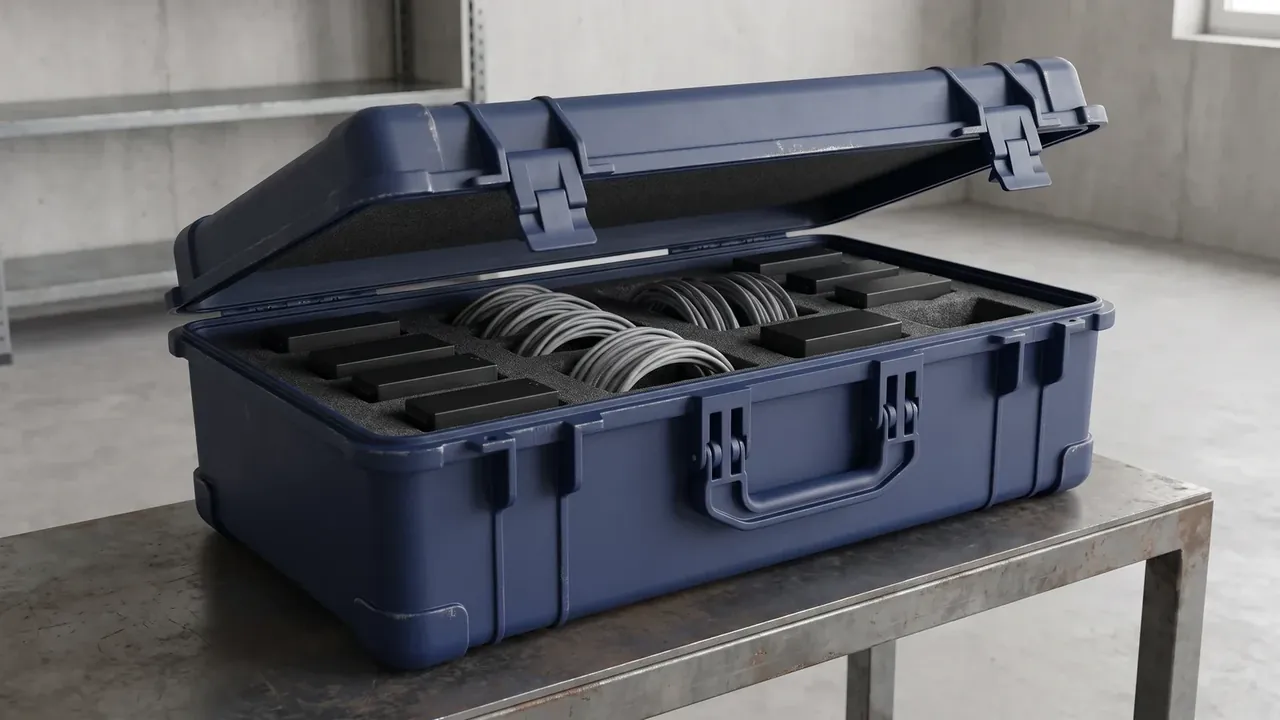
The lid lining is the second reservoir. Between the moulded ribs it holds 150 to 200 mL, which runs down the inside face once the lid is up. Choose a film equipment case lid with a one-way drain slope falling away from the latches.
Humidity takes two small items: a 50 g silica pack and a three-dot card that changes at 30%, 40% and 50%. Above 40% the pack is spent. A wet summer saturates one in two days, a dry winter in two weeks, so read the card.
3. Compartments for bodies, lenses and batteries
In a film equipment case, compartments follow the sequence of use, not size. Bodies sit nearest the front, lenses in the middle, batteries and cards on the hinge side, so the first place a hand lands is the body. That order cuts the reach from about 40 seconds to 15.
| Bay | Cavity size | Positions |
|---|---|---|
| Bodies | 340 × 260 × 180 mm | 2 |
| Lenses | 100 mm diameter, 120 mm deep | 4 |
| Batteries and cards | 90 × 70 × 55 mm | 6 |
| Monitor and cables | 260 × 180 × 90 mm | 1 zone |
Foam is 30 kg/m³ closed-cell PE under a 2 mm EVA facing. Closed-cell PE takes up no water, so rain creeping past the rim wipes off instead of soaking in as open-cell sponge does, and the EVA facing stops the lens mount leaving crumbs.
Battery bays need their own divider. A lithium pack left 6 hours above 45 °C swells, and a swollen pack pushed into its cutout lifts the lid foam and holds a latch open by a hair. Give that bay 5 mm of extra clearance.
4. Long cases, tripods and stacking for the move
Long items are the hardest part of a company move. A carbon tripod folds to 1350 mm and a light stand to 1100 mm, so a long case needs 1650 mm inside. Two transverse ribs at 400 mm centres keep the shell from sagging 8 mm mid-span, which is enough to open the lid gap along the bend.
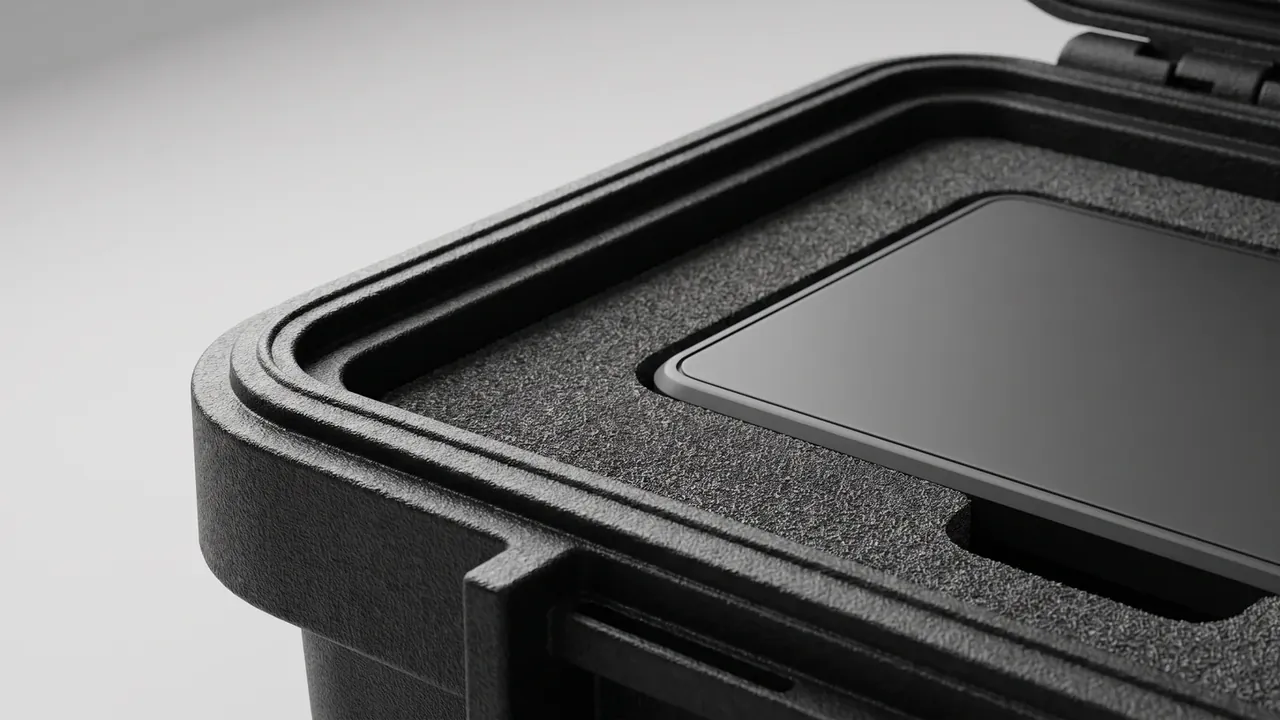
A long case seals differently. Past 1.5 m the lid deflects enough to unload the gasket at mid-span, so the channel carries two lips that compress independently: lose 0.2 mm in the middle and the second lip still holds. Latches go to 4 units, spaced no more than 550 mm apart.
Loading a film equipment case runs 4 high, long cases at the bottom. Use 38 mm polyester webbing rated at 800 kg, two straps across and one along, with 5 mm rubber corner pads. Without pads a strap under braking marks the corner, and such a mark cracks within a year.
5. Temperature swing and condensation indoors
A wet exterior sits at 6 °C to 10 °C, and a studio at 24 °C with 60% RH puts the dew point near 15.8 °C. Once the shell falls below that, moisture condenses straight onto the case: a layer harder to deal with than rain, because it lands on a case you thought was dry.
Let the shell warm slowly. Park it in a lobby for 40 minutes until the surface passes 18 °C before opening. Open early and cold air inside meets warm damp air outside, and fog forms on the rear element where no cloth reaches.
Thicker walls buy time. A 3.2 mm PP shell climbs from 8 °C to 18 °C in about 35 minutes, some 15 minutes longer than a 1.5 mm wall, and those minutes are the buffer. A pack inside absorbs part of the rush of damp air at the open.
Metal parts suffer first. Latch springs and hinge pins pit within 24 hours if left wet, and pitting 0.1 mm deep changes the feel of a latch. Wipe the hardware at wrap and add a thin oil film.
Conclusion
Reliability of a film equipment case in rain comes down to three figures for the handover sheet: IP67 at 1 m for 30 minutes, 35% to 40% internal RH, and a 4-high stack on 38 mm webbing. The rating sets the floor, the drain order decides the day, and 40 minutes of warming decides whether a lens works.
This article discusses only the container (case body) side of specifications and design intent, and does not cover any handling, loading or use of the contents.
Related Reading
- Compartment layout and protection for camera cases
- Sizing and sealing a camera case
- Cutting pick and pluck foam without waste
- How waterproofing is built into outdoor cases
Related Products
- 8 Series — Gun Cases; Military Equipment Cases; Camera Equipment Cases; Drone Cases; Watch Cases; Knife Cases; First Aid Cases; Electronics Equipment Cases
- WL8-2812 PP Gun Case — model WL8-2812
- All protective cases and toolboxes: 7 series, 158 models