

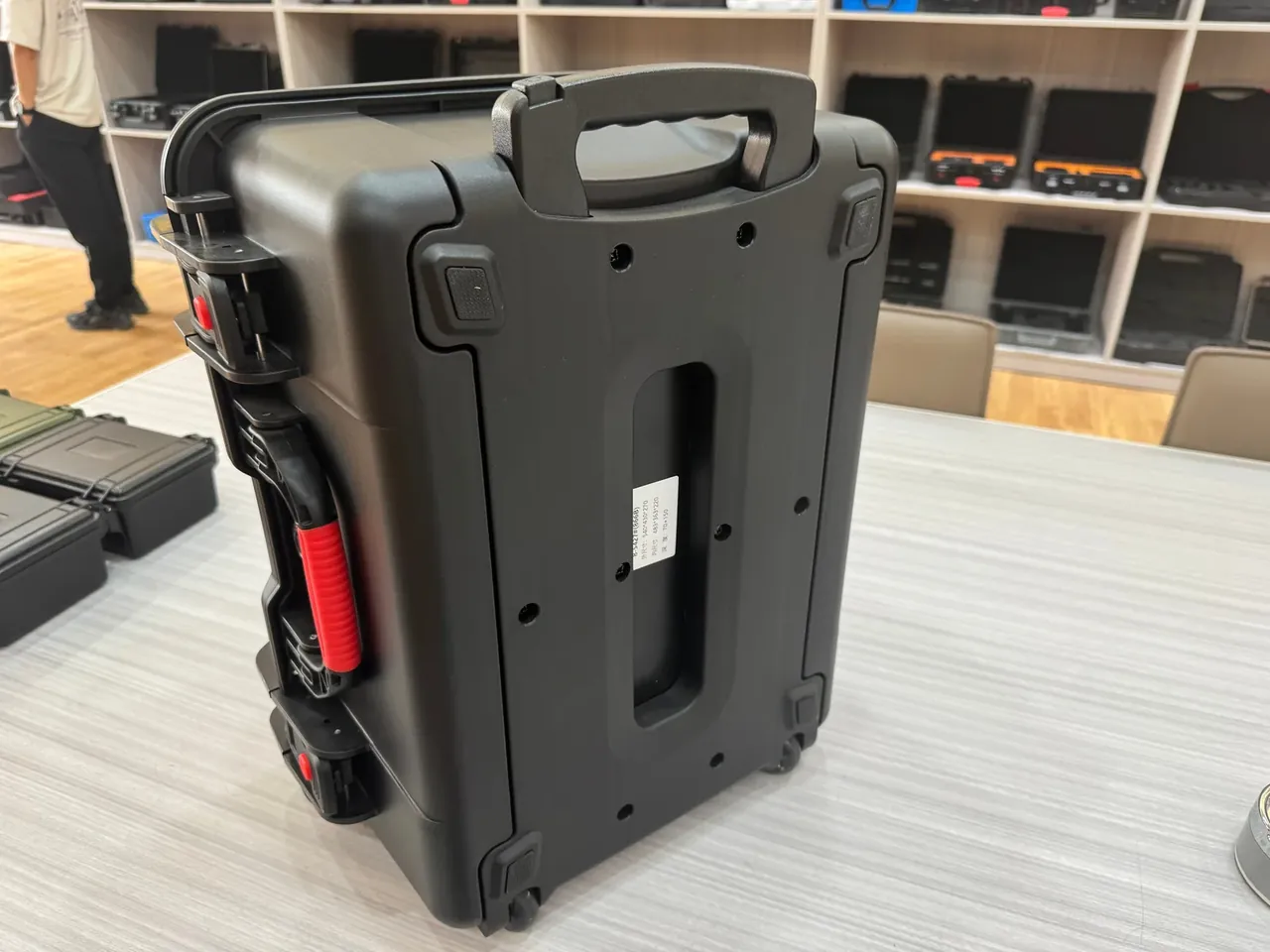
Quick answer:A film video light & battery protective trolley box has to carry 45 kg, survive a 1.5 m drop and roll 5 km: a 4 mm rotomoulded wall, 620×420×300 mm interior, a three-section handle with 340 mm of travel and two 100 mm wheels, at 9.5 kg empty. When the lights load one end, offset the wheels 20 mm toward that end.
Table of contents
- The transport chain
- Rotomoulded versus injection moulded shells
- Handle, wheels and floor loads
- Sealing, pressure and tamper tags
- Inner depth for the largest fixture
- FAQ
1. The transport chain
One location day means six handlings: equipment van, lift, set floor, holding area, return van, rental house. The adversary of a film video light & battery protective trolley box is not a single impact but the repeated scuffing and corner knocks across those six moves.
The load is predictable: a 300 W panel with yoke about 6 kg, four V-mount batteries 3.2 kg, cables and a softbox 5 kg, and clamps push the total to 30–45 kg. Past 45 kg one person cannot push it up a ramp.
Ground decides wheel diameter. Locations mean gravel, grass, thresholds and temporary decking. A 75 mm wheel jams on a 10 mm gap; 100 mm rolls over it. Bigger wheels pull easier but lift the box higher, which raises the centre of gravity when loading a van.
2. Rotomoulded versus injection moulded shells
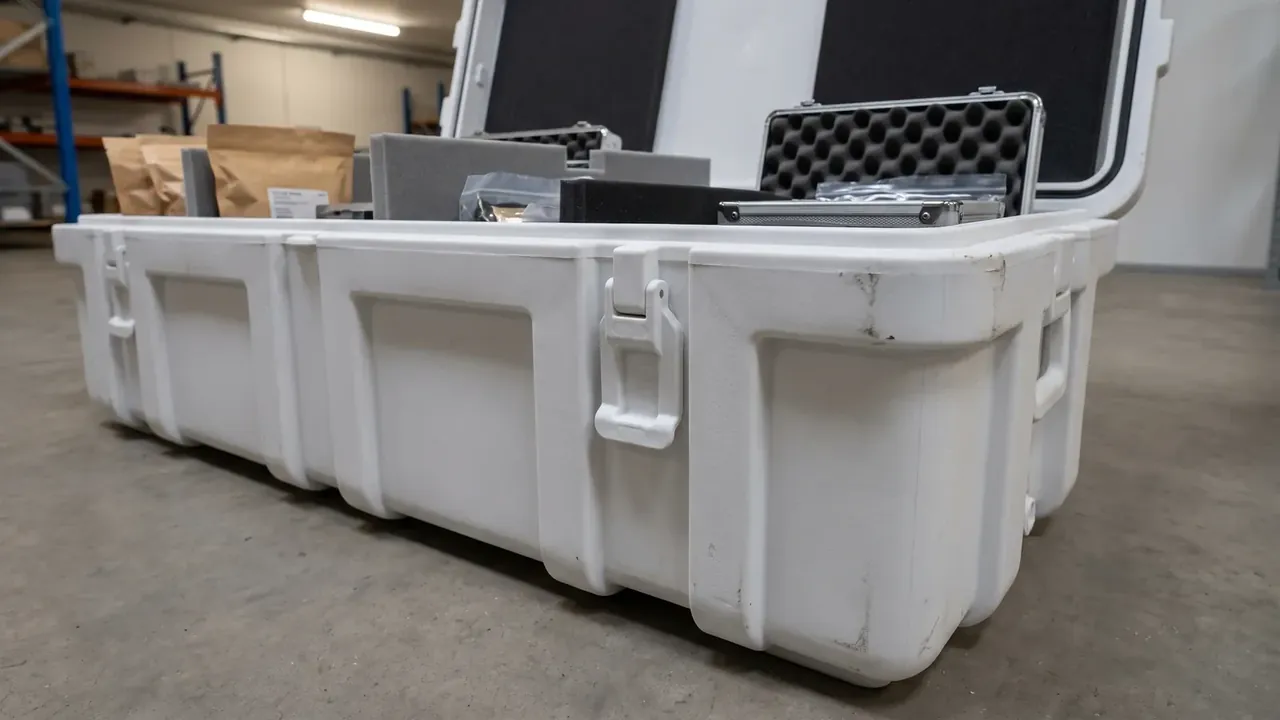
At this size there are two routes: rotomoulded PE, or injection moulded PP and ABS. Rotomoulding brings cheap tooling, 4 mm walls and deep ribs, which suits anything over 600 mm. Injection moulding brings tight dimensions at roughly ten times the tooling cost.
| Item | Rotomoulded PE | Injection PP |
|---|---|---|
| Typical wall | 4–6 mm | 2.5–3.5 mm |
| Shells over 600 mm | Well suited | High tooling cost |
| Dimensional accuracy | ±2 mm | ±0.5 mm |
| Unit cost, small batch | Low | High |
Wall thickness is what rotomoulding buys. A 4 mm PE wall still has ductility at -25℃, so a 1.5 m drop dents a corner instead of splitting it, while a 3 mm injection PP shell tends to stress-whiten at the rib roots under the same hit. Light cases get stood on edge against walls all day, corner first, so this matters more than any other property.
The weakness is precision. Two shells from one mould can differ by 2 mm across the outside, which is why stacking relies on a recess in the base to guide the box above. If the box must drop into a van rack without play, allow 3 mm of assembly clearance and do not draw it to injection tolerances.
3. Handle, wheels and floor loads
The handle is a load path, not a tube. Three aluminium sections at 1.2 mm wall with 340 mm of travel is the common build, and play should stay under 5 mm or the box weaves as you push. Below 1.0 mm wall, 40 kg over 2 km bends the middle section for good.
Wheel position matters more than wheel choice. When lights sit at one end, move the wheels 20 mm toward it and the box stops crabbing. Bolt the housings through a 5 mm steel plate with four M6 bolts; self-tapping screws loosen after 300 km of road vibration.
The floor takes the peak load. Two lengthwise ribs plus a turned-up perimeter send the landing impact into the side walls, and the walls pass it to the handle mounts. A flat floor with no ribs sags 3–5 mm in the middle when a 45 kg box is set down, and it does not come back.
| Load | Wheel diameter | Handle and push distance |
|---|---|---|
| ≤20 kg | 75 mm | Two section, under 500 m |
| 20–35 kg | 100 mm | Three section, under 2 km |
| 35–45 kg | 100 mm twin | Three section plus brace, under 5 km |
| >45 kg | 125 mm pneumatic | Three section plus brace, two people or a cart |
A 55D PU tread loses about 0.6 mm at the rim over 5 km of concrete, and a 75 mm wheel turns 33% more often over the same route, runs hotter and growls after two years. Wheel sets cost far less than shells, so make them replaceable.
4. Sealing, pressure and tamper tags
A light case needs rain and dust protection, not dive rating. A double-step mouth with a 6 mm solid silicone cord at 30% compression reaches IP65; past 45% the lid stands proud and leaks worse than a loose one.
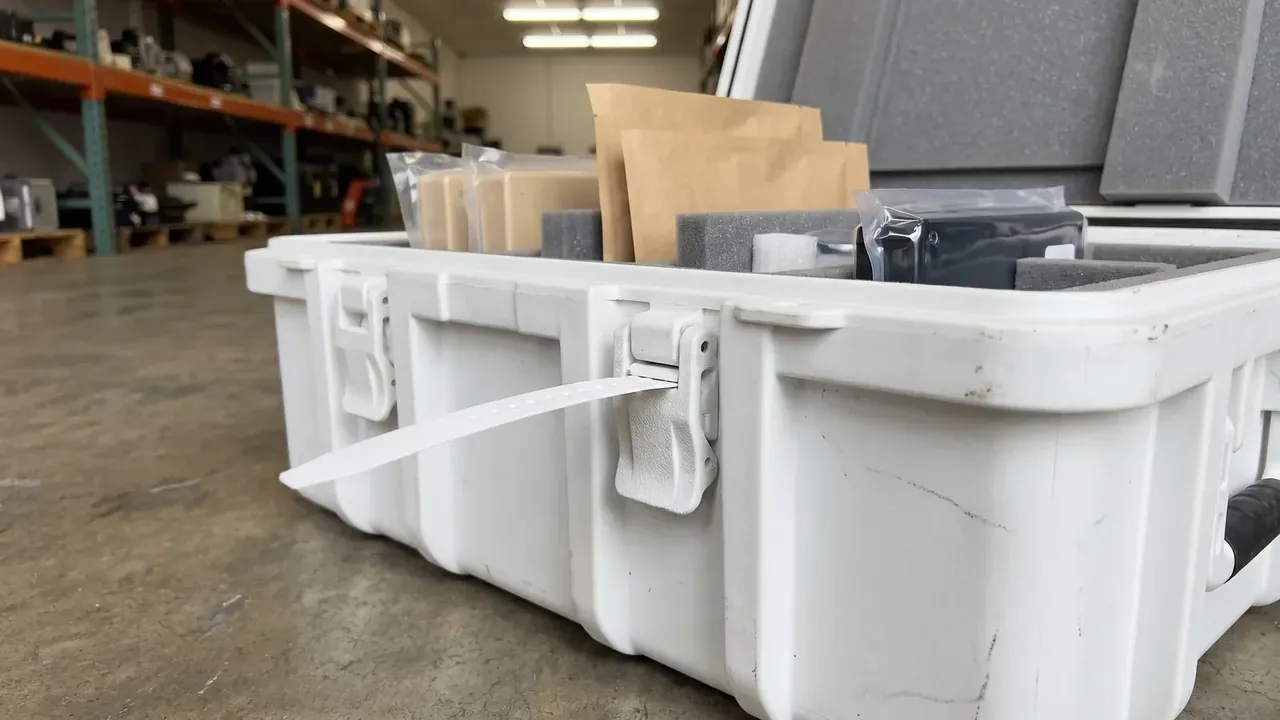
The tamper hole is the practical detail. Drill 4 mm through the latch, thread a numbered tie, and both loading and receiving sides log the number, so anyone can see whether the box was opened. Keep it outboard of the tongue pivot so the latch still flexes and does not cut a glove.
Pressure only matters in the air: a cargo hold equals roughly 2,400 m of altitude, up to 30 kPa across the wall. The better the seal, the harder the lid opens on landing, so an 8 kPa relief valve equalises it without spoiling rain protection.
Heat cycles kill the gasket slowly. Two hundred rounds between 55℃ and 20℃ leave about 12% compression set, so sealing drops from 30% to 26%, still working but no longer safe. A new cord every two years costs a fraction of a factory return.
5. Inner depth for the largest fixture
Size the interior from the biggest item, not the average. A folded 60 cm softbox is 90 mm thick, a panel on its U-bracket stands 320 mm, a packed stand is 780 mm long, so all three together need 800×420×330 mm inside.
Depth is the dimension people get wrong. A panel standing upright needs 330 mm clear, which pushes outside height to 400 mm and may not clear a lift door. Give the stands their own layer behind a movable divider, drop clear depth to 300 mm and height to 370 mm, and both lift and hatchback accept it.
The insert need not cover everything. Rotomoulded walls are not flat, so fully bonded foam blisters. Build it in blocks: 40 mm EVA cut for the panel, 25 mm EVA plus a divider for batteries, 100 mm open for cable, so a change of fixture means changing one block.
Keep the battery block off the wall. A rotomoulded wall in direct sun reaches 60℃, and a battery against it is being warmed all afternoon. A 15 mm EVA barrier holds the battery zone 8–10℃ cooler than the wall, which costs almost nothing in weight and decides cycle life.
Conclusion
Five numbers settle a film video light & battery protective trolley box: a 620×420×300 mm footprint, a 4 mm wall, 100 mm wheels offset 20 mm, a 4 mm tamper hole and an 8 kPa valve. Fix those, renew the gasket every two years, and one box outlasts three or four productions.
This article discusses container-side specifications and design implications only, and does not cover any handling, loading or use of the contents.
Related Reading
- Case requirements for checked baggage
- What air freight declaration needs
- What case feet actually do
- Matching inner height to foam thickness
Related Products
- 8 Series — Gun Cases; Military Equipment Cases; Camera Equipment Cases; Drone Cases; Watch Cases; Knife Cases; First Aid Cases; Electronics Equipment Cases
- WL8-2812 PP Gun Case — model WL8-2812
- All protective cases and toolboxes: 7 series, 158 models