

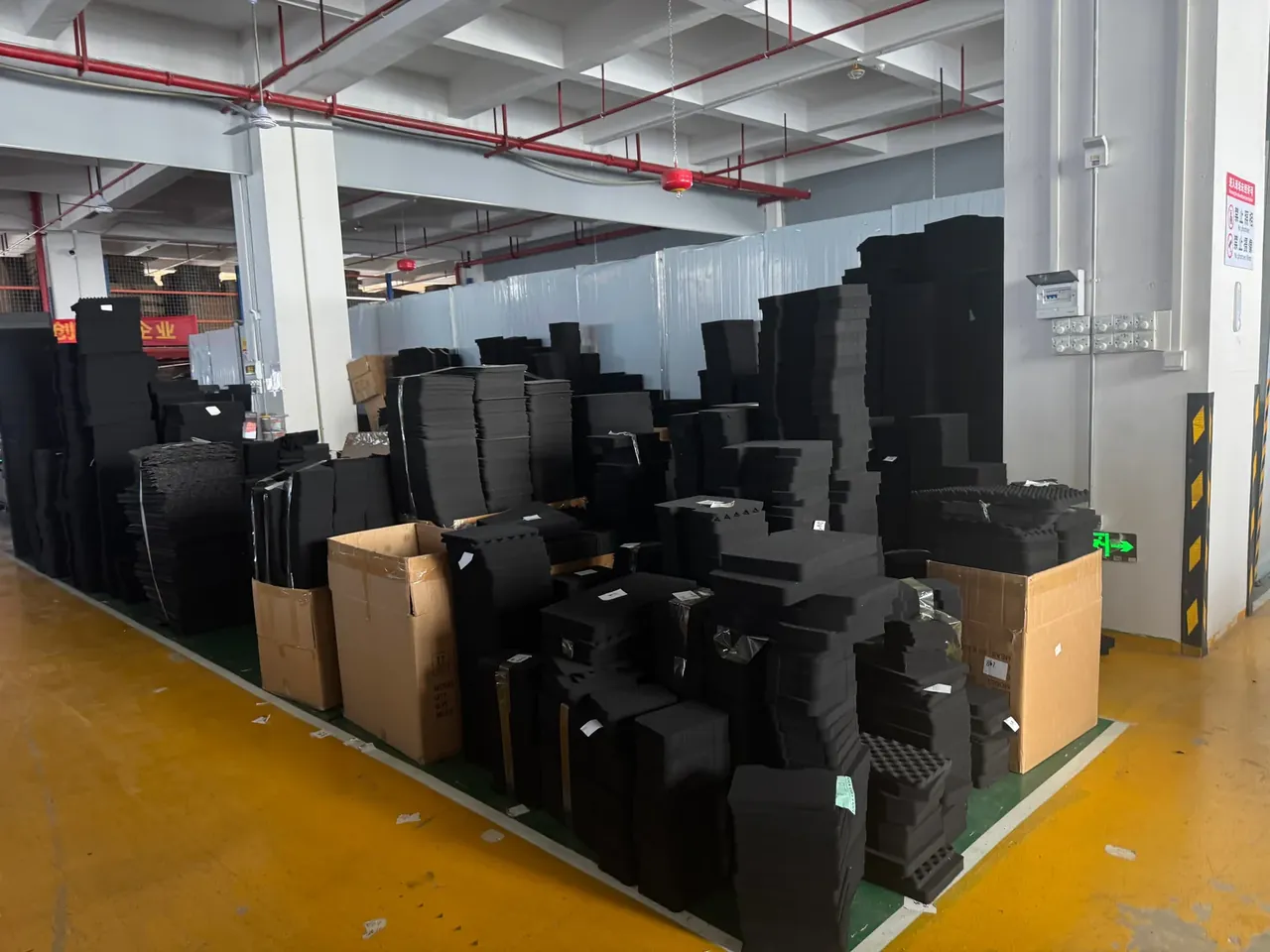
Quick answer: A cut insert may sit in staging 48 h at most; past that, foam recovery shifts the pocket by 0.3 mm. Finished insert staging is ruled less by floor space than by three numbers: carton layers, label lines and standing angle.
Table of contents
- Why Staging Stops at 48 Hours
- Five Carton Layers and 0.3 mm of Set
- A Three-Line Label: Batch, Pocket, Date
- Six Upright Layers on 12 mm Board
- 2.4 m Pick Aisle and Seven-Day FIFO
- FAQ
1. Why Staging Stops at 48 Hours
Recovery starts the moment the wire leaves the block. The first 24 hours carry most of it; by hour 48 pocket dimensions have stopped moving. The 48-hour ceiling trades floor space for dimensional drift.
At 23 C and 50 percent RH, EVA at 45 kg/m3 returns about 0.2 mm within 48 hours and adds 0.1 mm by day three. That 0.3 mm is invisible on a bench but shows up inside a case as a loose pocket.
For that reason finished insert staging is a timed buffer, not a second warehouse: capacity is two days of line consumption, and anything beyond is refused at the gate.
Counters working finished insert staging check the racks at the start and end of each shift. A batch that passes its window takes a yellow tag and a pocket measurement before release.
2. Five Carton Layers and 0.3 mm of Set
A carton is the cheapest outer pack in finished insert staging and the easiest way to crush what sits inside it. Twelve inserts at 9.6 kg means the bottom carton carries 38.4 kg once the stack reaches five high.
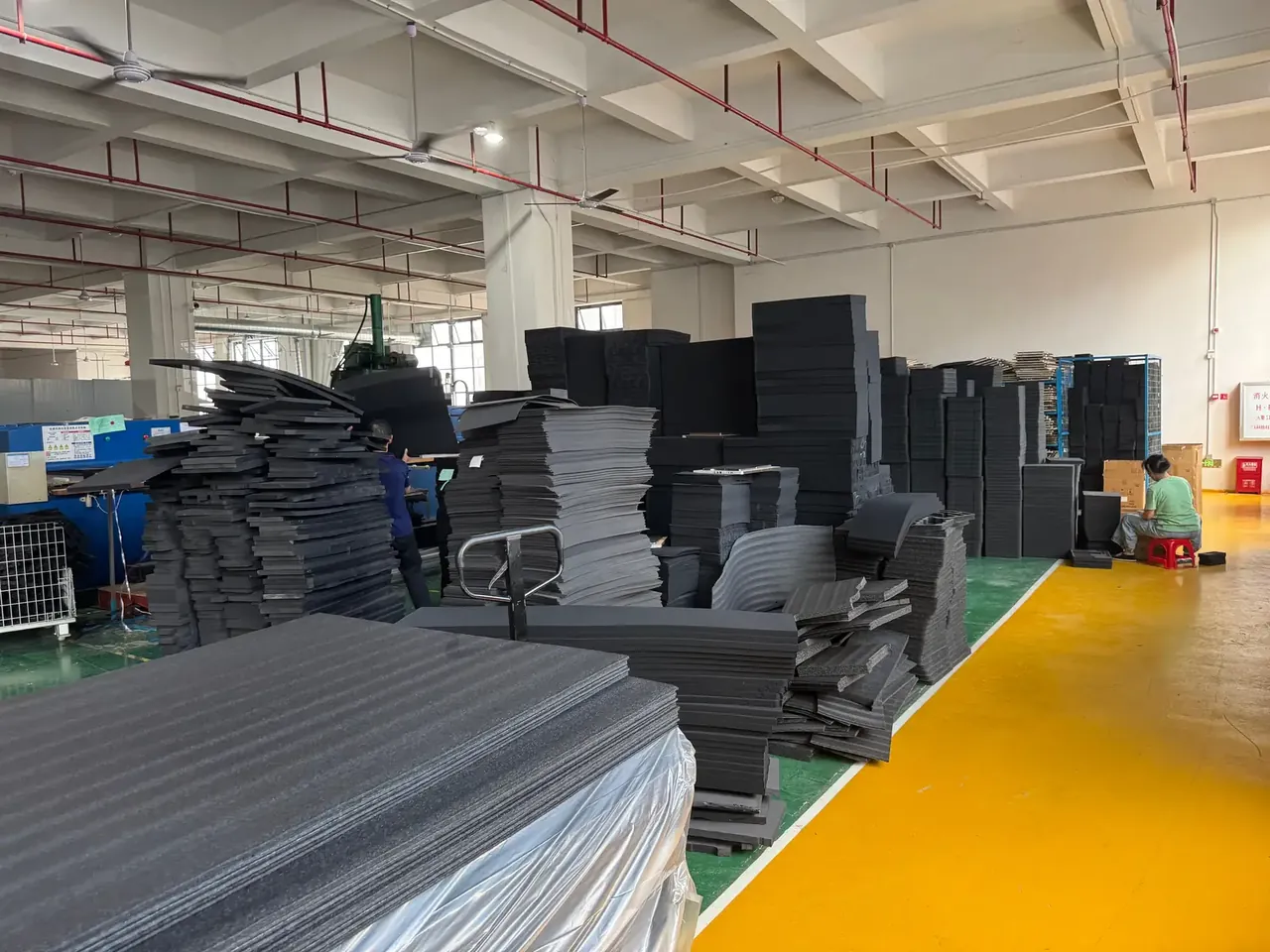
Set shows up in the pocket rather than on the carton. Forty-eight hours under load pulls the cavity walls inward, and the sheet never springs back fully; a square cut turns into a soft radius that operators pat flat before fitting.
Layer count follows dwell time, not habit. The table below maps the two.
| Carton layers | Load on bottom carton | Pocket shift after 48 h | Advised dwell |
|---|---|---|---|
| 6 | 48.0 kg | 0.4 mm | not advised |
| 5 | 38.4 kg | 0.3 mm | up to 24 h |
| 4 | 28.8 kg | 0.2 mm | up to 48 h |
| 3 | 19.2 kg | 0.1 mm | overnight or weekend |
A sixth layer is not impossible to build; it simply commits the bay to a 0.4 mm pocket shift. Fixing that at the line costs more than the two square metres it saves, so the ceiling belongs in the work instruction.
3. A Three-Line Label: Batch, Pocket, Date
The step most often skipped in finished insert staging is the label. Skip it once, and finding a single pocket later means breaking the stack down and rebuilding it, which eats twenty minutes.
Each line has one job. Line one carries the batch, eight digits: production date plus press number. Line two carries the pocket code, P01 through P24, matching the drawing.
Line three carries the date, four digits for month and day plus two for the hour, for example 1128 and 14. All three lines stay under 20 characters at 6 mm cap height, readable from a metre away.
| Line | Content | Characters | Cap height | Check |
|---|---|---|---|---|
| 1 | Batch number | 8 | 6 mm | against the work order |
| 2 | Pocket code | 3 | 6 mm | against the drawing |
| 3 | Date and hour | 6 | 5 mm | against system time |
| Footer | 2D code | 12 mm square | not applicable | scan on receipt |
Placement matters: top right of the short side, 30 mm from the edge and 50 mm clear of tape. A crooked label makes the scanner take three tries and the bay backs up.
4. Six Upright Layers on 12 mm Board
Laying sheets flat puts the weight of the whole insert on the bottom cavity wall. On a 600 by 400 mm tray, one sheet at 1.8 kg means six flat layers press 9 kg onto the base, and the pocket edge collapses first. This is the most common error in finished insert staging.
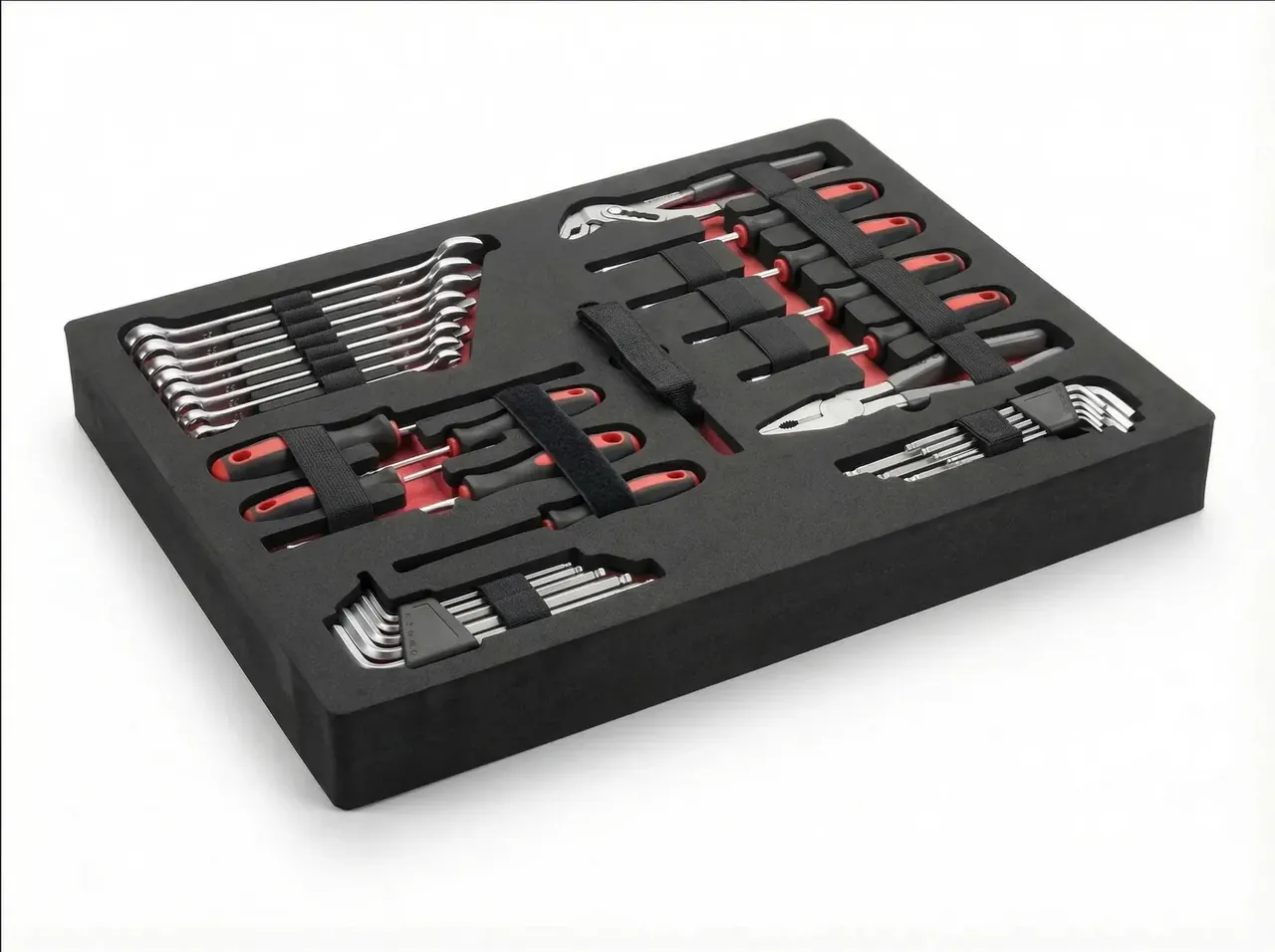
Standing changes the load path: a sheet on edge carries its weight on the bottom rim and leaves the pocket untouched. Six layers is the ceiling; by the seventh the rim bulges and catches fingers.
A 12 mm board keeps the rim off the floor. It is pressed from EVA offcuts at 55 kg/m3, slightly harder than the insert, and stops compressing at 0.2 mm. Lean is held at 8 degrees by a 20 mm stop bar; boards are swapped every three months, sooner once a corner crushes, because a soft board lets the stack slide to 12 degrees.
| Standing layers | Board | Stop bar | Dent depth | Pick method |
|---|---|---|---|---|
| 7 | 12 mm | 20 mm | 0.4 mm | not advised |
| 6 | 12 mm | 20 mm | 0.2 mm | two hands |
| 5 | 10 mm | 18 mm | 0.2 mm | one hand |
| 4 | 8 mm | 15 mm | 0.1 mm | one hand |
5. 2.4 m Pick Aisle and Seven-Day FIFO
Aisle width sets pick speed in finished insert staging. The trolley is 1.1 m wide and turns broadside at the rack, so 2.4 m is the width that allows one clean turn.
Both sides keep 300 mm for door swing and sheet draw, the two places finished insert staging loses width first. Below that, cartons get nudged into the aisle and the clear width falls to 1.5 m within a week.
First in, first out runs on a seven-day cycle. Each batch carries a receipt time; on day seven an untouched batch jumps to the head of the pick list, and any override needs a written reason.
Ageing past seven days is not scrapping, it is re-measurement: pocket size and surface dent. Pass both and the clock restarts; fail either and the batch drops to spares.
The seven-day cycle does not fight the 48-hour ceiling: one governs a batch on the rack, the other release from the store. Read together, 48 hours, five layers, three label lines, six upright layers and seven-day FIFO turn finished insert staging from a corner of stacked cartons into a process that can be counted and audited.
Related Reading
- Pallet modules and rack heights
- Standing foam sheets and dent control
- Cartons and cases in packing
- Label area and nameplate space
JUNZHIJIA
Related Products
- 8 Series — Gun Cases; Military Equipment Cases; Camera Equipment Cases; Drone Cases; Watch Cases; Knife Cases; First Aid Cases; Electronics Equipment Cases
- WL8-2812 PP Gun Case — model WL8-2812
- All protective cases and toolboxes: 7 series, 158 models