

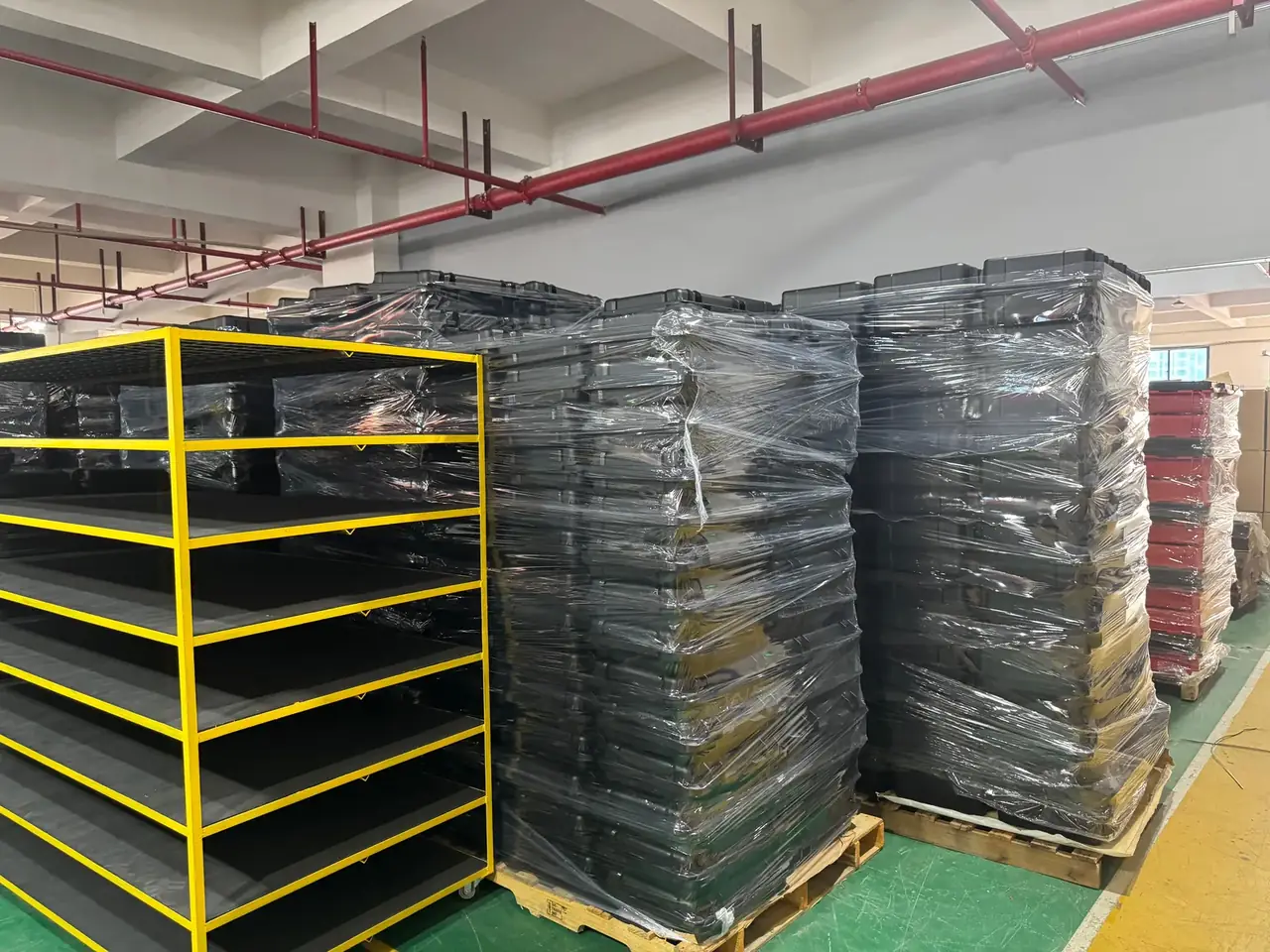
Quick answer: A Finished-Goods Warehouse runs on 1200 x 1000 mm pallets, 96 slot lines, 1800 mm beams and 0.8 mm of base dent before quarantine.
Table of contents
- Slot Lines and Pallet Edges in a Finished-Goods Warehouse
- Rack Clearance Set from Case Height in a Finished-Goods Warehouse
- Base Denting Causes and Batch Quarantine in a Finished-Goods Warehouse
- Stack Layers and Bottom-Load Checks in a Finished-Goods Warehouse
- Labels and Count Verification Across a Finished-Goods Warehouse
- FAQ
1. Slot Lines and Pallet Edges in a Finished-Goods Warehouse
Before a pallet goes up, the aisle is already decided. Storage runs by slot, not by case: floor area, corner position and fork entry are fixed by paint.
The pallet is the GB/T 2934 unit, 1200 x 1000 mm, four-way entry, 150 mm tall. In a 1300 mm deep slot it leaves 100 mm at the long edge; 96 slots run 12 bays by 8 rows, every edge on one line.
| Slot line | What the floor shows | Action this shift |
|---|---|---|
| Slot line flush | Edge on the paint, four fork faces clear | Load it |
| Slot line set back | Pulled in past 40 mm, forks under the beam | Drag out, reset |
| Slot line overrun | Edge past the paint, fork face blocked | Pull back, repaint |
Drift spreads fast. One overrun gets ignored, the next copies it, and within a week the row has no usable line. Wrap follows the same rule: 23 μm film at 250% pre-stretch, inside the pallet edge.
2. Rack Clearance Set from Case Height in a Finished-Goods Warehouse
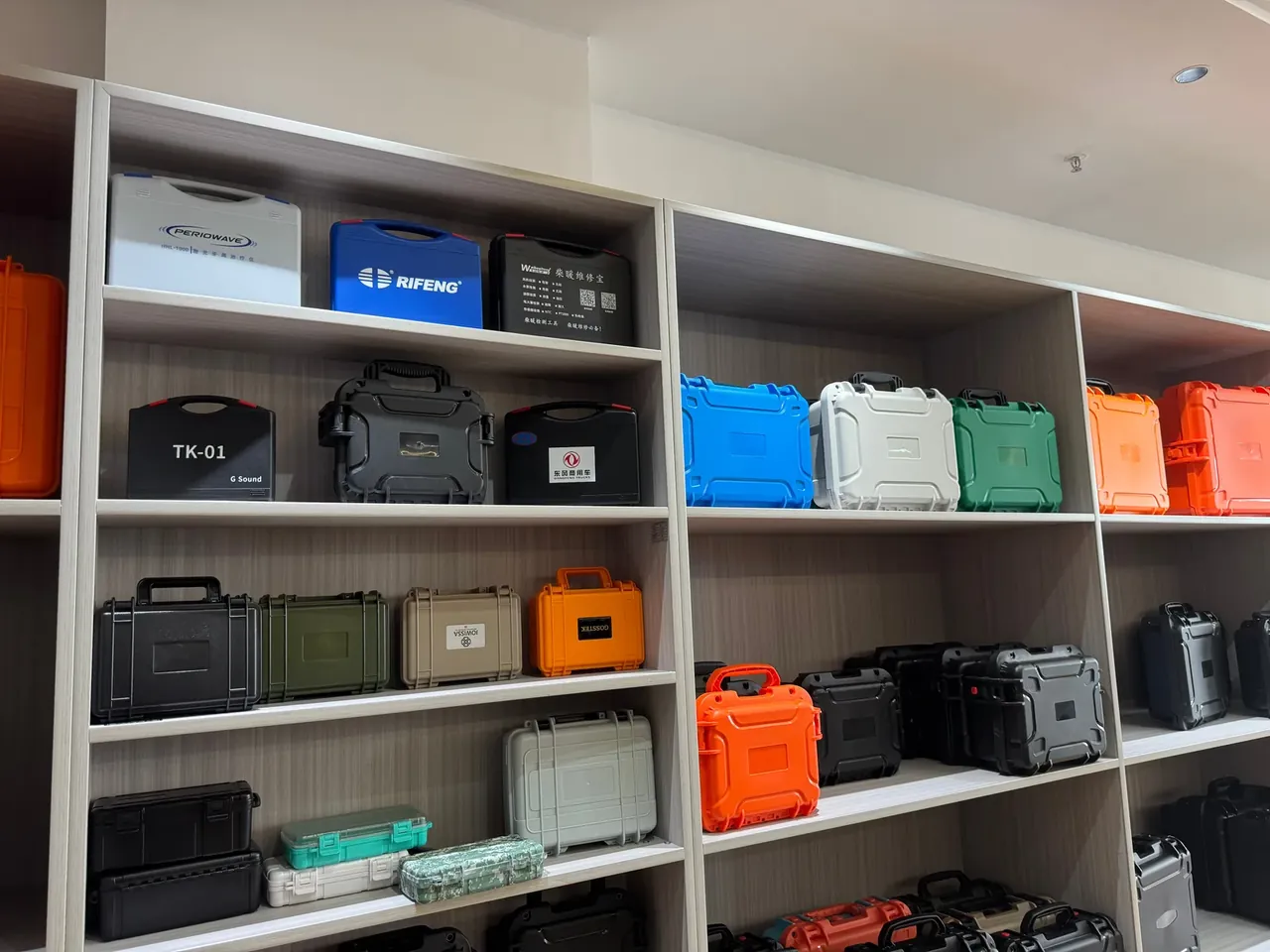
Clearance is not the upright height but the gap a case travels through. This Finished-Goods Warehouse sets 1800 mm between beams with 120 mm of pick clearance.
Uprights are punched every 50 mm or 75 mm, so beam height only lands on a hole. The 1800 mm step is worked back from the tallest case: 1650 mm with the pallet, plus room for forks to lift and lower. Practice allows 75 to 100 mm above the load, reach trucks 100 mm.
| Beam setting | Case envelope it serves | Result at the face |
|---|---|---|
| 1500 mm step | Up to 1380 mm with pallet | One more column, hand loading |
| 1800 mm step | Up to 1650 mm with pallet | Truck picks out, 120 mm gap |
| 2100 mm step | Up to 1950 mm with pallet | Dead air, reach truck needed |
Mixing two settings in one row hands the height to the shorter case. Set for the tall one, a short case leaves 300 mm of air, and the driver loses sight of the lid and cracks it.
3. Base Denting Causes and Batch Quarantine in a Finished-Goods Warehouse
A base dent is not impact damage, it is load held long enough to matter. In a Finished-Goods Warehouse the bottom layer carries three layers for months, and once the aisle reaches 30 ℃ the creep rate climbs; the base edge sinks for good.
Cases stacked six high at 30 ℃ for three months lose 3 to 8 mm of stack height. This warehouse stops at 4 layers, so denting gathers at the bottom corners, the base edge and over a deck board, read to 0.1 mm. The rejection line is absolute: a base dent deeper than 0.8 mm moves to quarantine and misses that shift's dispatch. The base wall is 3.0 mm, leaving 2.2 mm to carry bending load.
| Dent hold | Verdict | Where it goes |
|---|---|---|
| Dent hold under 0.3 mm | Recovered on re-check | Back to the slot |
| Dent hold 0.3 to 0.8 mm | Faint edge mark remains | Down to sample stock |
| Dent hold beyond 0.8 mm | Base margin gone | Run held, checked at 72 h |
Cases go into quarantine by pallet and molding run, the run is held whole, nothing re-checked before 72 h. Recovery lags: a dent read within 24 h measures 0.2 to 0.3 mm deeper than settled, so the reading at 72 h decides who returns.
4. Stack Layers and Bottom-Load Checks in a Finished-Goods Warehouse
Four layers is the working stack; going higher is not forbidden, the bottom case simply yields first. The check is plain arithmetic: what one pallet weighs and how many points carry it.
A 4-layer pallet at 3.2 kg of case weight is checked at 480 kg on the slot beam, across four stringers onto four supports at 120 kg each. GB/T 2934 rates a timber pallet at 750 kg on the rack, leaving 270 kg for placement error and impact.
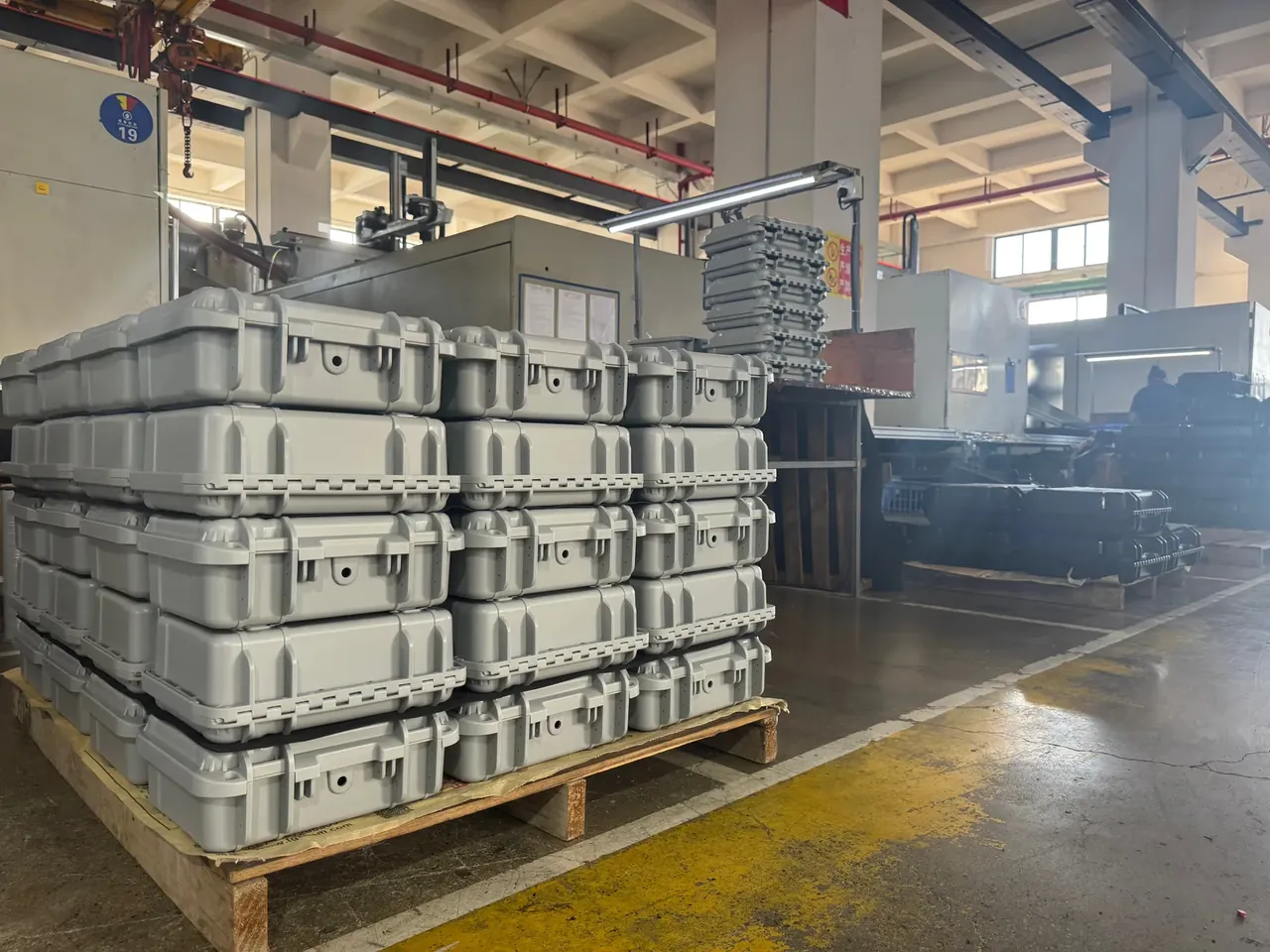
Contact area matters as much as mass. Corners sit on deck boards with gaps, and any gap wider than 30 mm leaves base unsupported, where creep bulges first; wide-gap pallets go back to the yard.
Layers offset by a third of the case length send weight down the ribs, not into the lid centre. A squared stack behaves like four columns under four thin plates. Tall, narrow cases get their own limit: a wall midpoint reading over 6 mm drops that row to 3 layers.
5. Labels and Count Verification Across a Finished-Goods Warehouse
Labels are for the re-check, not for people walking past. All 96 slots in a Finished-Goods Warehouse carry a zone-row-level-position code on a 100 x 75 mm plate at eye height, with the beam setting.
Inbound checks pallet edge and code together. A right code with a pallet off the line goes back into the aisle; a right pallet on the wrong code means an outbound was never signed off.
Counting covers 8 slots per shift, all 96 in a week: count pallets, confirm the code, check the base. A one-pallet variance freezes the zone for a recount that starts with paperwork, then the aisle ends.
Conclusion
A Finished-Goods Warehouse is held by three numbers and one deadline: 1200 x 1000 mm pallets in 96 slots, 1800 mm beams with 120 mm clearance, 480 kg under a 4-layer stack, and a 0.8 mm dent that routes a run to 72 h of quarantine.
Related Reading
- case footprint versus pallet module
- stacking layers and pallet planning
- usable volume ratio inside a case
- how reinforcement ribs are laid out
Related Products
- 8 Series — Gun Cases; Military Equipment Cases; Camera Equipment Cases; Drone Cases; Watch Cases; Knife Cases; First Aid Cases; Electronics Equipment Cases
- WL8-2812 PP Gun Case — model WL8-2812
- All protective cases and toolboxes: 7 series, 158 models