

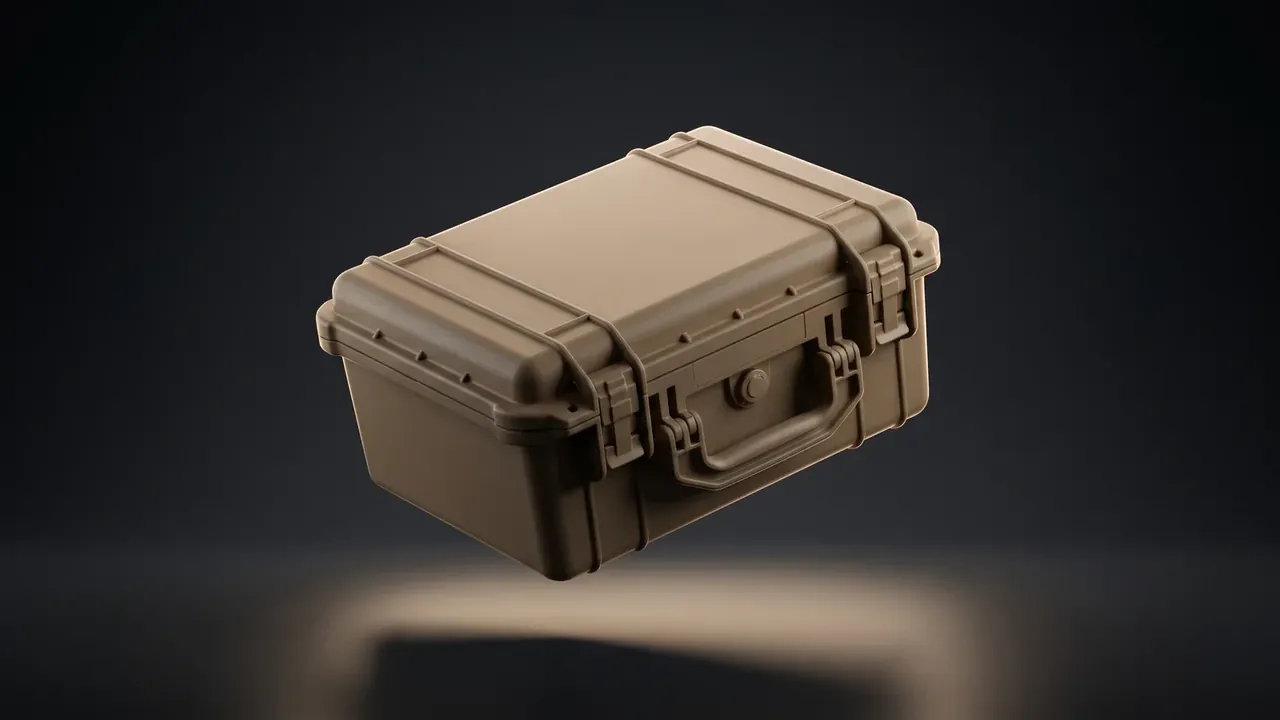
Quick answer: A firearm storage case specification has four blocks — interior clearance, wall and rib pitch, stack load, sealing with temperature — and each needs a target, a tolerance and a method before the drawing reads the same to the toolmaker, the gauge room and the buyer.
Table of contents
- What a Firearm Storage Case Specification Must Fix First
- Sizing the Interior and the Tolerance Chain
- Wall Thickness and Rib Pitch
- Stack Load and Case Deflection
- Sealing Class and Temperature Range
- FAQ
1. What a Firearm Storage Case Specification Must Fix First
The brief is one sentence: one long gun, two magazines, moved by vehicle, stacked three high, overnight at minus thirty. It yields three numbers: clearance, stack height, ambient temperature.
The first page holds numbers only.
| Parameter | Callout | Measurement | Drift |
|---|---|---|---|
| Interior length | 1180 mm, plus or minus 0.8 | Calipers, 3 points per end | Shrinkage low |
| Sidewall | 3.2 mm nominal, 2.8 mm minimum | Ultrasonic, four points | Thin near gate |
| Rib pitch | 120 mm | Tape along the long side | Hidden by foam |
| Stack load | 5 high, 24 hours, set under 2 mm | Lid centre after load | Top units ignored |
A longer interior raises sidewall bending with the square of the span, so wall grows and rib pitch shrinks. On any firearm storage case, lock the interior first, then wall and rib pitch, then a stack test.
2. Sizing the Interior and the Tolerance Chain
Size the interior from the contents, not the outside: a rifle 1100 mm long with 30 mm buffer each end gives a 1180 mm cavity at 10 per cent foam compression.
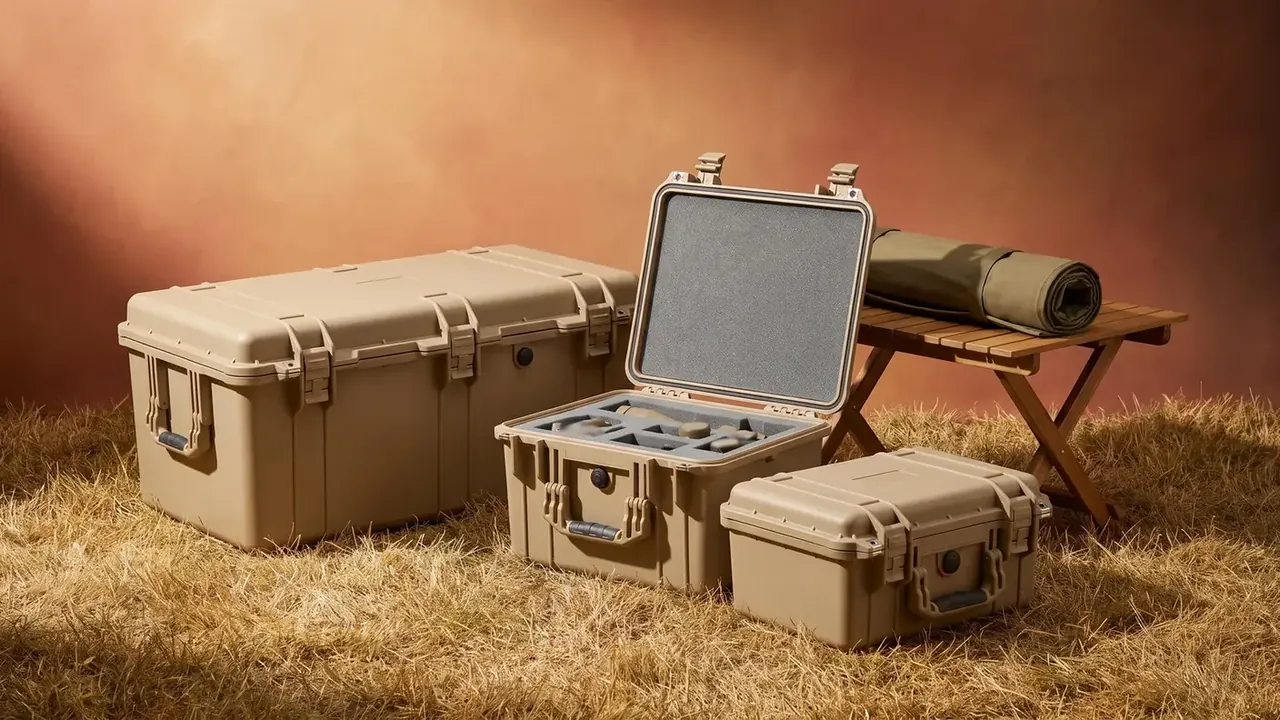
On that cavity, shrinkage 0.6 per cent, forming tolerance plus or minus 0.5 mm, foam plus or minus 1.5 mm and a 0.3 mm rebate stack to 4.1 mm worst case. At 0.5 per cent instead of 0.65 the cavity is 1.8 mm short, enough to jam a rifle butt.
Add the chain worst case, not by root sum square. Keep the rebate at 0.4 to 0.6 mm or the gasket stops compressing.
3. Wall Thickness and Rib Pitch
Thicker is not safer. A firearm storage case in this class starts at 3.2 mm; at 4.0 mm cooling climbs 55 per cent and sink follows; below 2.6 mm corners crack. Rib pitch follows span: no rib under 120 mm, then one at 2.5 times the wall.
| Interior length (mm) | Sidewall (mm) | Rib pitch (mm) | Rib height (mm) | Base |
|---|---|---|---|---|
| Up to 900 | 3.0 | 140 | 7.5 | Grid |
| 901 to 1200 | 3.2 | 120 | 8.0 | Grid, gussets |
| 1201 to 1500 | 3.5 | 110 | 9.0 | Double grid |
Thickness is read by ultrasonic gauge, one point per side, against 88 per cent of nominal. Rib pitch is checked in the mould.
4. Stack Load and Case Deflection
Stack load needs three numbers: payload, tiers, permitted set. Thirty-eight kilograms, five tiers, twenty-four hours, set under 2 mm survives a warehouse; stackable alone shifts the risk.
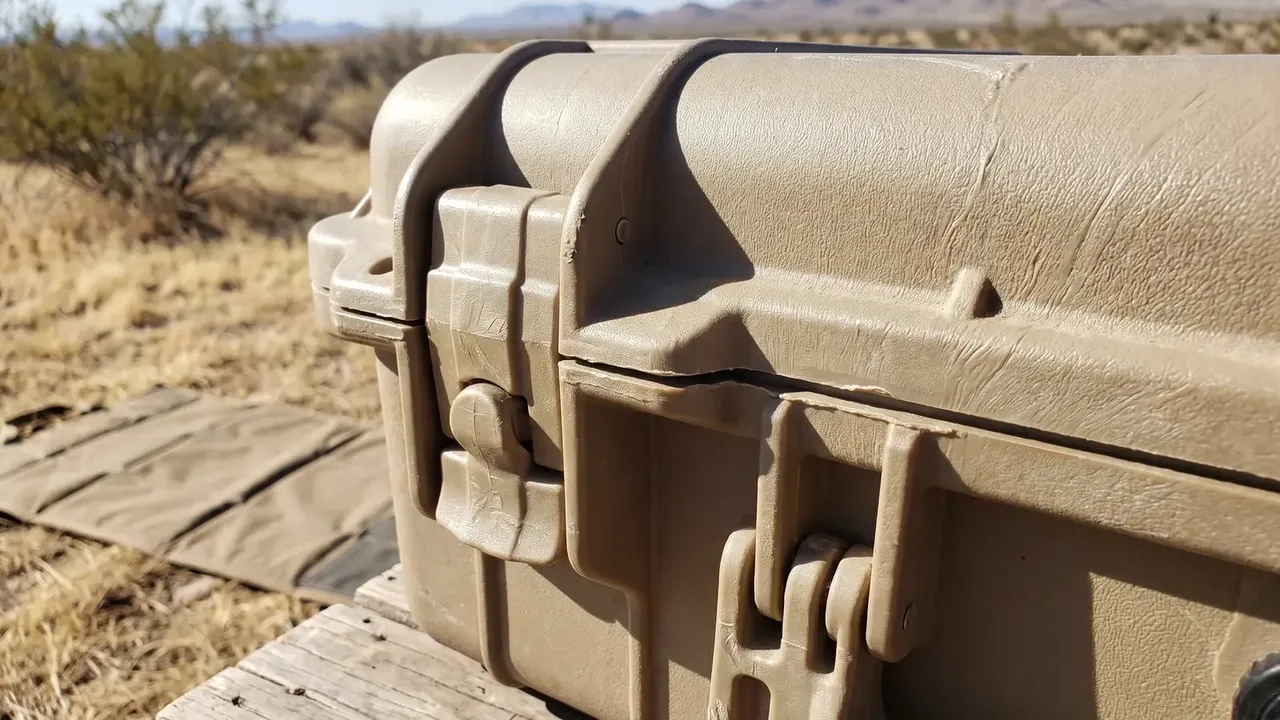
The bottom lid carries 152 kg over 1180 by 420 mm, about 3 kPa. Modest, yet a flat panel sags past 3 mm a day; one cross rib brings it under 1.5 mm. Read lid centre, sidewall and base corners.
5. Sealing Class and Temperature Range
Two digits are not a specification. IP67 is 1 m of water for 30 minutes; IP65 is 12.5 litres per minute of jet for 3 minutes. Gasket set sits at 25 to 30 per cent: below 20 it leaks, above 35 closing force passes 180 N.
Every firearm storage case drawing should split the range. Storage runs minus 30 to plus 60 Celsius for 48 hours; transport adds 70 Celsius for 4 hours and a 1.2 m drop at minus 30.
| Item | Callout | Condition | Verdict |
|---|---|---|---|
| Ingress | IP67 | 1 m, 30 minutes | No water inside |
| Heat ageing | 60 Celsius, 48 hours | Read after 2 hours | Within 0.3 per cent |
| Cold drop | Minus 30, 4 hours, then 1.2 m | Six faces | No crack, latches shut |
Conclusion
A specification translates field facts into toleranced numbers, and a repeatable method keeps them honest. Derive the interior from the contents, tie wall and rib pitch to span, state payload and set, pair every sealing figure with its test condition. Then the firearm storage case specification holds one set of numbers for toolmaker and dock.
This article discusses only the container (case body) side of specifications and design intent, and does not cover any handling, loading or use of the contents.
Related Reading
- How a firearm storage case is built
- Where firearm storage cases are used
- Materials for firearm protective cases
- Writing a custom foam insert specification
Related Products
- 8 Series — Gun Cases; Military Equipment Cases; Camera Equipment Cases; Drone Cases; Watch Cases; Knife Cases; First Aid Cases; Electronics Equipment Cases
- WL8-2812 PP Gun Case — model WL8-2812
- All protective cases and toolboxes: 7 series, 158 models