

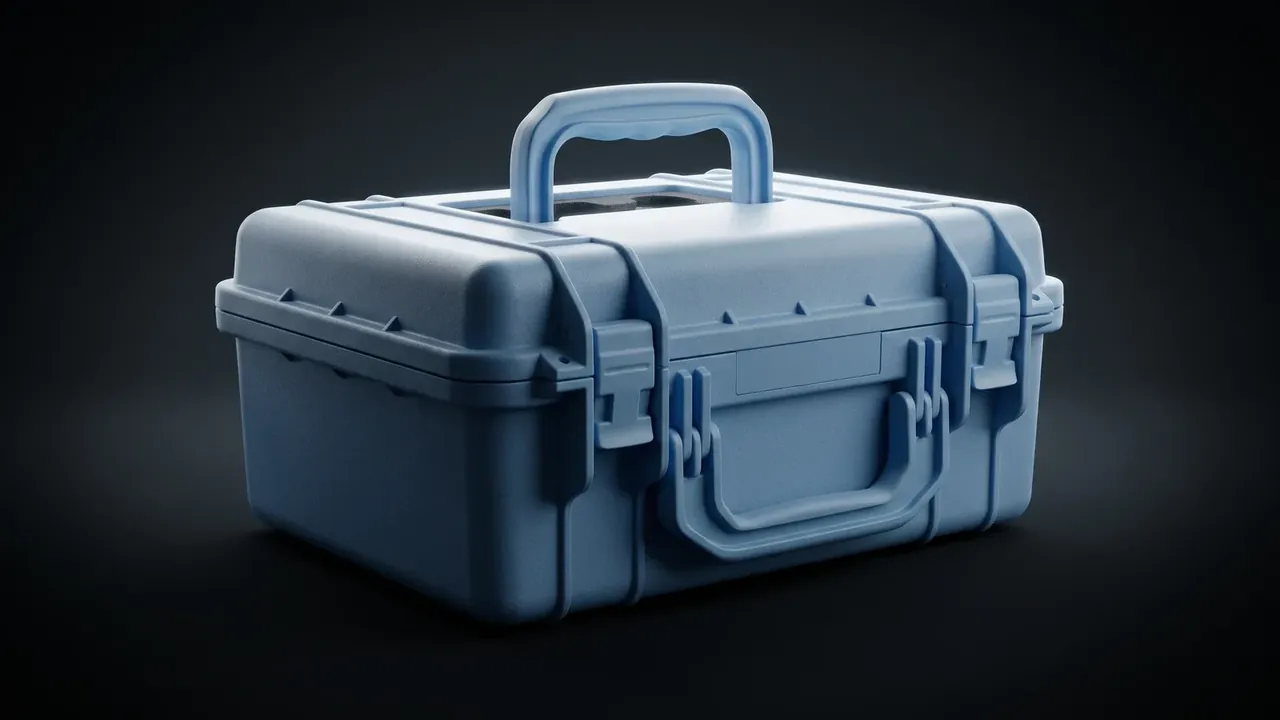
Quick answer: Write a firearm transport case specification from the inside out: cavity from the load envelope and foam, then wall and rib pitch, then static load, stack height, vibration spectrum and IP rating. Every line must be measurable.
Table of contents
- Turning Requirements into Drawing Parameters
- Internal Size and Tolerance
- Wall Thickness and Rib Pitch
- Static Load, Stacking and Vibration
- IP Rating and Temperature Range
- FAQ
1. Turning Requirements into Drawing Parameters
Briefs fail at the first line, where needs arrive as adjectives: strong, light, waterproof. A toolmaker can only guess. A firearm transport case brief turns each adjective into a number before the mould is quoted.
| Requirement | Parameter | Value | Verified by |
|---|---|---|---|
| No rattle | Cavity, tolerance | 900 x 340 x 190 mm, plus 2 minus 0 | Calipers, 4 points |
| One person carries it | Loaded mass, handle | 18 kg, 250 kg handle | Ten minute pull |
| Stacks in transit | Layers, static load | 4 layers, 72 kg on base | 24 hour load, set |
External size comes last: cavity plus wall, rib height, latch protrusion. Reverse it and foam gets shaved to recover millimetres.
2. Internal Size and Tolerance
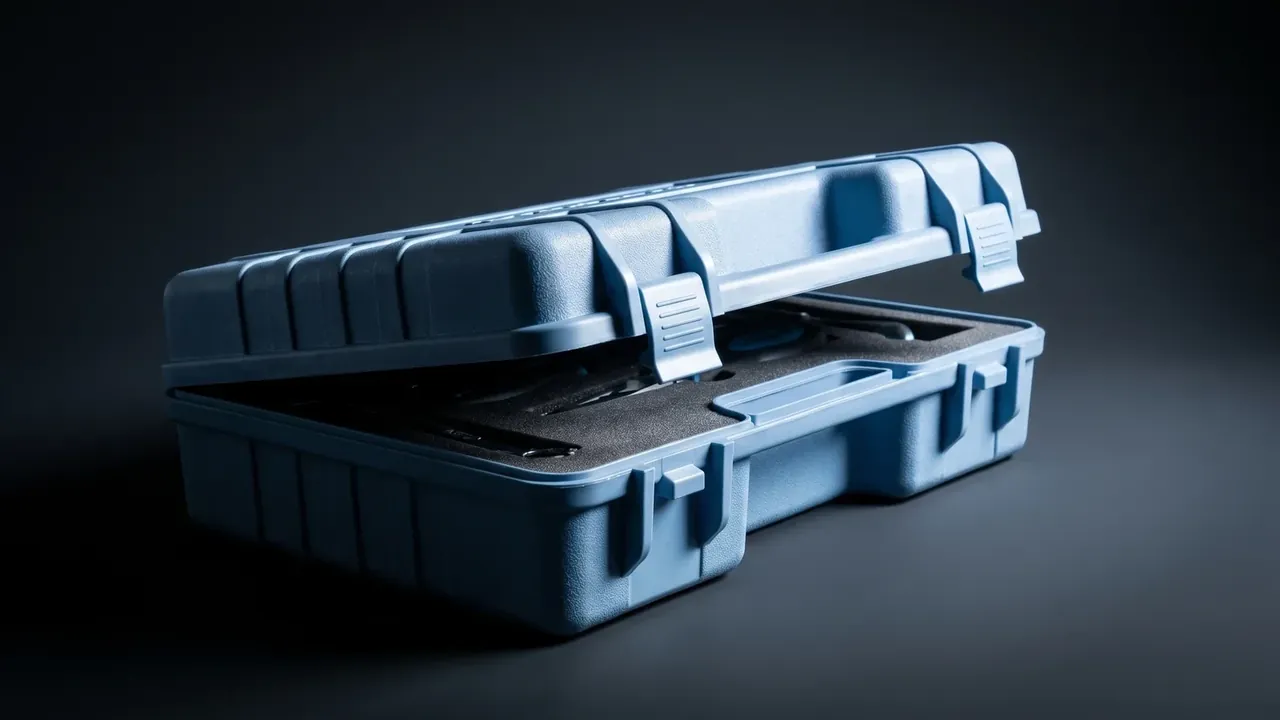
The cavity of a firearm transport case equals the load envelope, foam both sides and lift clearance: at 20 mm per side, a 900 x 340 x 190 mm envelope needs about 946 x 386 x 213 mm.
| Parameter | Value | Note |
|---|---|---|
| Cavity length, width | Plus 2, minus 0 mm | Bias small |
| Gasket compression | 2 mm | Part of the stack |
| Draft angle | 1.5 degrees | 2 in deep cavities |
| Internal corner | R8 | Costs corner width |
Write plus 2 minus 0, never plus or minus 1: a cavity errs small and a symmetric band fails one way.
Draft eats the nominal figure: over 190 mm, 1.5 degrees draws in 5 mm per side, and R8 corners take a dozen more of usable width.
3. Wall Thickness and Rib Pitch
Thicker is not stronger. Three millimetres is the working wall for a firearm transport case: 2.5 mm whitens at the corners in a 1.2 m drop, while 4.0 mm invites sink marks on flat faces.
| Feature | Thickness | Spacing |
|---|---|---|
| Main wall | 3.0 mm | Not applicable |
| Rib | 1.8 mm, 0.6 x wall | 120 mm pitch, 8 mm high |
| Bosses | 4.5 mm | Hinge and latch pads |
A 120 mm pitch with 8 mm ribs keeps the side wall from bulging under load. Polypropylene shrinks 1.5 to 2.0 percent, so the tool is cut oversize: over 900 mm the spread is nearly 13 mm, and 0.2 percent between lots costs 1.8 mm, half the band.
4. Static Load, Stacking and Vibration
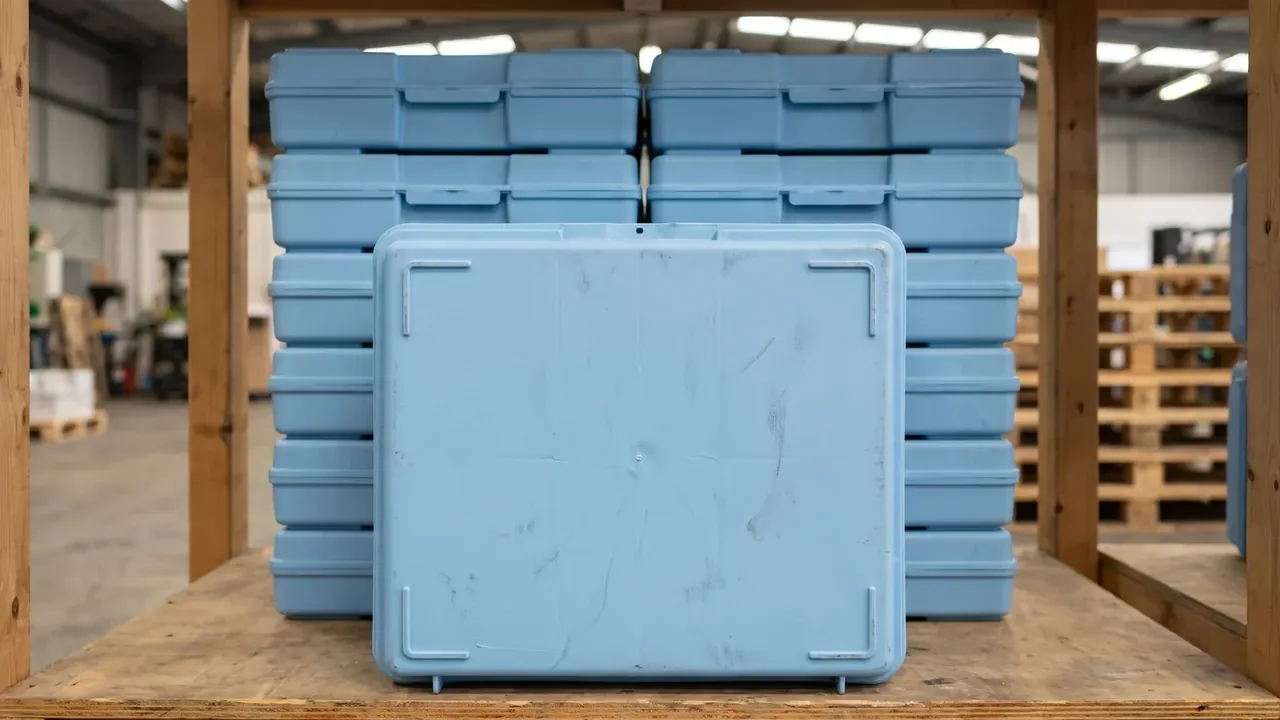
Load is written twice. Static load on a firearm transport case means 150 kg on the lid for 24 hours, set under 2 mm after release. Stacking follows real layers: 18 kg per case over four puts 54 kg on the base, and a factor of two makes the validation 108 kg.
| Test | Parameter | Pass criterion |
|---|---|---|
| Static load | 150 kg on lid, 24 hours | Set under 2 mm |
| Stacking | 4 layers, 108 kg | No permanent bulge |
| Random vibration | 5 to 500 Hz, 1.0 grms, 30 min per axis | Latches stay closed |
Vibration for a firearm transport case follows the route: road freight takes 5 to 500 Hz at 1.0 grms, air freight adds 0.5 inch double amplitude below 100 Hz. State the stack height the store uses, or mould the limit on the lid.
5. IP Rating and Temperature Range
An IP rating needs a test state. IP67 is dust tight plus 1 m for 30 minutes, yet the same firearm transport case passes empty and fails loaded, or passes with every latch home and leaks with one resting on its keeper.
Temperature takes two ends and one action: minus 30 to plus 60 Celsius for storage, a cold drop after four hours at minus 25, and 48 hours at 60 Celsius under 0.3 percent growth.
Keep ingress and compliance apart: IP67 says water stays out, not that a carrier accepts the shipment.
Conclusion
A specification is a set of numbers a third party can measure: cavity plus 2 minus 0, a 3.0 mm wall on a 120 mm pitch, 150 kg over four layers, a 5 to 500 Hz spectrum, IP67 with its test state written down. Hold those numbers and the drawing holds, which is how a firearm transport case specification survives inspection and repeat orders.
This article discusses only the container (case body) side of specifications and design intent, and does not cover any handling, loading or use of the contents.
Related Reading
- Why loads shift inside a case in transit
- Transport compliance and marking rules for firearm cases
- Specifying a foam insert: thickness, density and cutouts
- Size ranges and selection limits for protective cases
Related Products
- 8 Series — Gun Cases; Military Equipment Cases; Camera Equipment Cases; Drone Cases; Watch Cases; Knife Cases; First Aid Cases; Electronics Equipment Cases
- WL8-2812 PP Gun Case — model WL8-2812
- All protective cases and toolboxes: 7 series, 158 models