

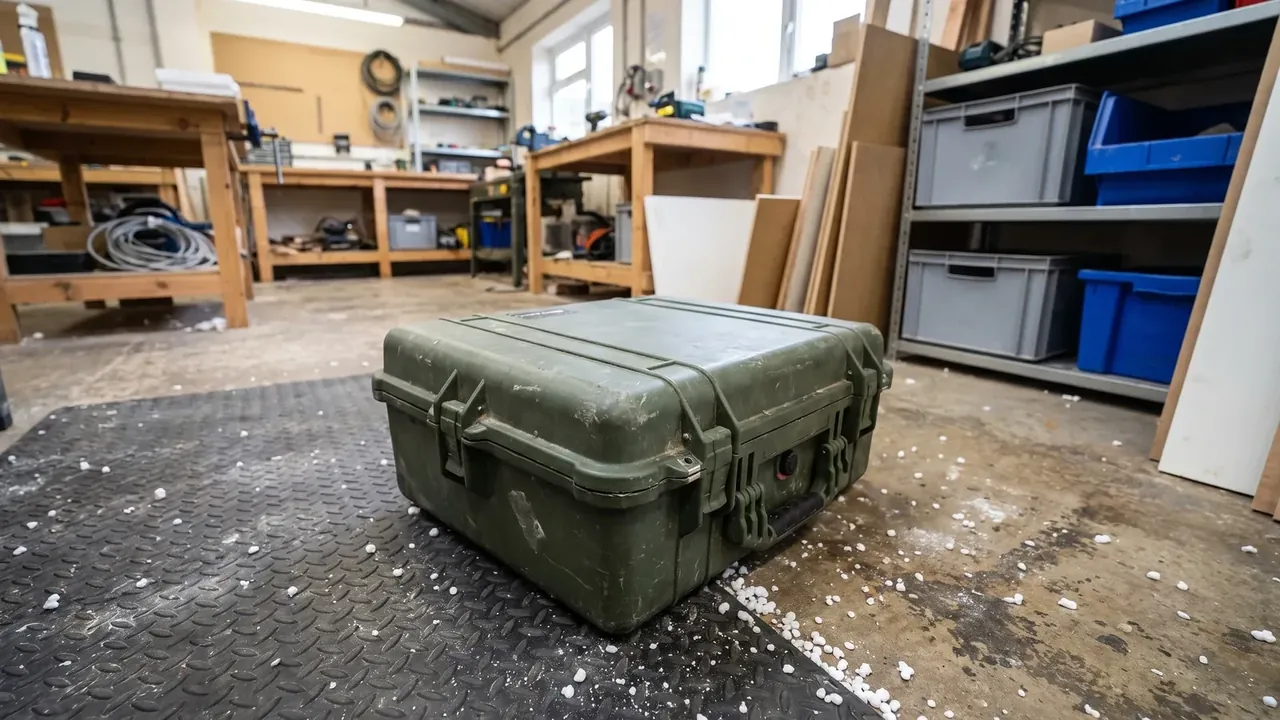
Quick answer: Flight Simulation Equipment Case inserts start from 35 kg, 15 mm of offset, 8 damping pads and 12 Hz, and keep reset drift under 0.2 mm.
This article covers the case side only: shell, damping, insert geometry and cable routing.
Table of contents
- Weight and centre of gravity of simulator units
- Where damping pads stop and hard mounts begin
- Verifying zero reset after transport
- Stowing harnesses and connectors
- How temperature and humidity move the calibration
- FAQ
1. Weight and centre of gravity of simulator units
Flight Simulation Equipment Case design starts on a scale, not in a catalogue. A single cockpit unit weighs 35 kg with its centre of gravity 15 mm off the geometric centre, so a 30-degree tilt puts the mass outside the footprint and the base corner of the foam collapses first. Weigh at four points, front and rear, left and right, and the readings draw the true centre.
Where the offset passes 15 mm the insert is built eccentric: thicker foam on the load side, thinner opposite, the difference about half the offset. A Flight Simulation Equipment Case carries that load through the feet, and small feet need a rigid pallet, or the foam is punched through and the floor panel bears on the housing.
Lift points on a Flight Simulation Equipment Case are marked on the outside of the shell. Loaded at 35 kg, two people lifting and one dragging load the case differently, so the points sit either side of the centre projection at equal distance, and one point alone puts the whole mass on one wrist.
| Area | Controlled | Limit |
|---|---|---|
| Base | load over foot footprint | 35 kg evenly |
| Panel | movement at mounts | 0.2 mm |
| Lid | cushion thickness | thicker on offset side |
| Cable zone | bend radius | sized to cable |
Centre of gravity belongs on the insert drawing, beside lift points and corner supports. Equal-thickness corners are the industrial default and the wrong answer here: they hand the load to the thinnest corner.
2. Where damping pads stop and hard mounts begin
On a Flight Simulation Equipment Case, pads and hard mounts are zones, not a choice. Pads take impact, hard mounts hold geometry; panels and stick bases keep their relative position, so they are hard mounted, while corners and base absorb impact through 8 pads. The pads divide 35 kg and sit two per corner.
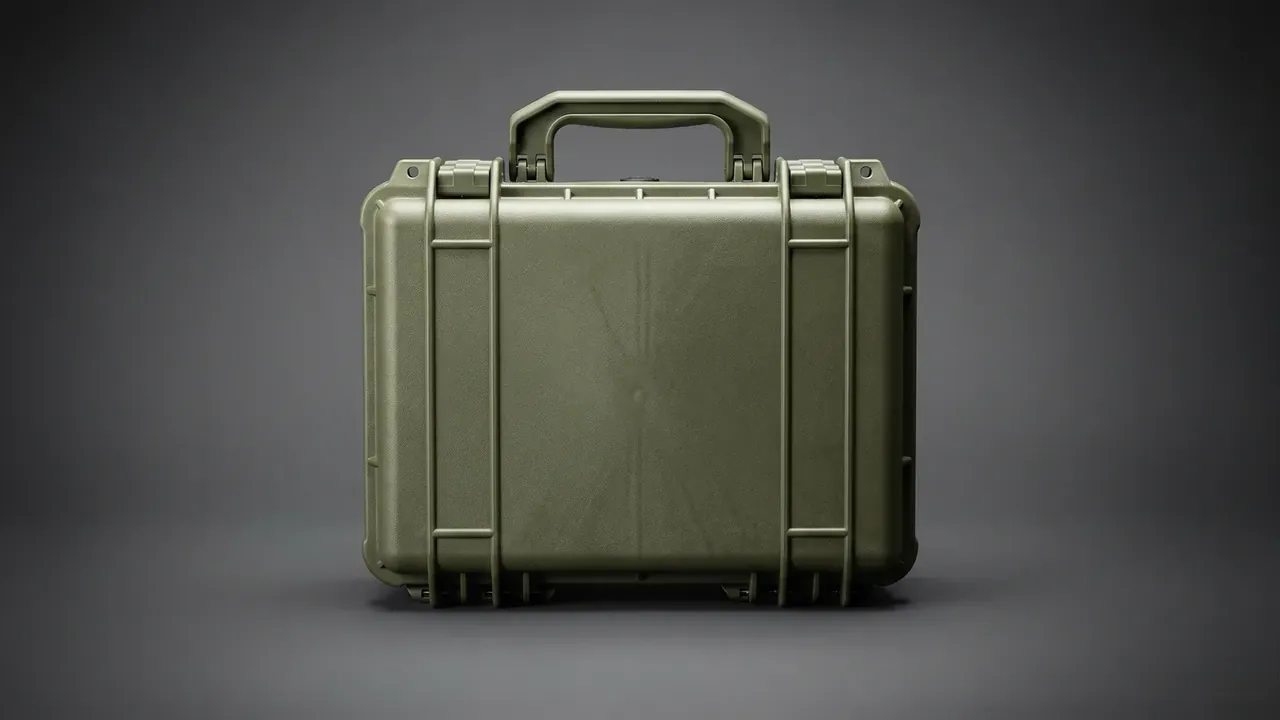
12 Hz anchors pad selection. When the unit's sensitive band sits near 12 Hz, pad frequency must be pushed away, or vibration is amplified instead of absorbed. Tap the wall with the unit inside: if it rings along, the frequencies have met.
Hard mounts come in pairs, aligned with the mounting holes. One missing point lets the unit rotate, and rotation shifts the zero. No foam goes under a hard mount, since foam turns a rigid joint into a spring and the reset figure stops meaning anything.
The dividing line rests on two questions: can the unit survive 0.2 mm of relative movement, and will the fall path drive force into it. Tolerable movement goes to the pads, the rest to hard mounts; the middle ground takes EVA at 25–45 kg/m³ with compression set between 10% and 20%.
| Joint | Where | Count | Rule |
|---|---|---|---|
| Pads | corners and base | 8 | clear of 12 Hz |
| Hard mount | panel, stick base | in pairs | 0.2 mm |
| EVA | middle ground | slotted | set 10%–20% |
3. Verifying zero reset after transport
Zero is the point of the whole Flight Simulation Equipment Case exercise. Mark four reference points between unit and case before dispatch, then read the same points with a dial gauge on arrival, with 0.2 mm as the ceiling. Marks go on hard mounts; on foam they measure recovery, not movement.
The check runs in three passes: a static pass within 2 h of arrival once shell and air balance in temperature, a loaded pass with the original counterweight refitted, and a climate pass after 24 h at 40% to 60% RH and 20 ±5 ℃.
A reset drift above 0.2 mm after transport, or damping pad compression set above 15%, sends the insert back for rework.
Drift in a Flight Simulation Equipment Case has to be sourced before it is fixed. At a hard mount the shell lacks stiffness; at a pad the pad has collapsed; at a harness a connector pulled the unit. Guessing wrongly leaves the next lot drifting.
| Pass | Measuring point | Limit |
|---|---|---|
| Static | four hard mounts | drift at or under 0.2 mm |
| Loaded | unit corners | no new movement with counterweight |
| Climate | same four points | no growth after 24 h |
4. Stowing harnesses and connectors
Harness routing decides whether the reset holds. A Flight Simulation Equipment Case carries 6 runs, power, signal and ground kept apart, each on the shortest path with a generous bend radius; a tight bend fatigues the copper, the signal drops in vibration, and the reset figure jumps a step.
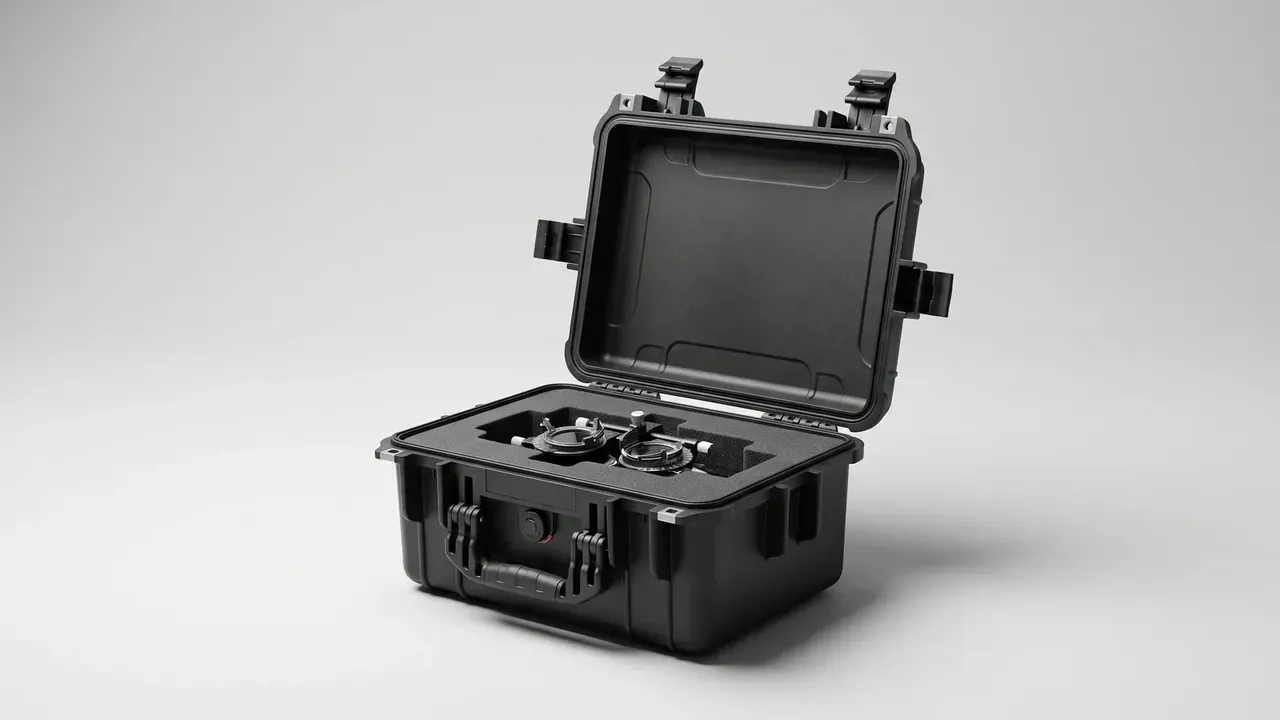
Connectors get their own pockets. A connector left hanging passes transport vibration into the socket solder joint, and a cracked joint shows up as zero drift that takes hours to trace. Each connector sits in an EVA pocket slightly larger than its body, enough grip to hold, not enough to fight the hand.
Leave slack where the harness crosses from base to lid, sized so a 90-degree opening does not pull the run straight. On lined lids press the run into the foam instead of laying it on the surface, where every open and close wears the sheath.
5. How temperature and humidity move the calibration
Temperature and humidity move the calibration, not the shell. 20 ±5 ℃ and 40% to 60% RH is the working band for a cockpit unit; outside it the internal reference voltage drifts and zero follows. The case slows the swing rather than blocking it.
Flight Simulation Equipment Case foam absorbs moisture. Closed-cell EVA takes it slowly, while open-cell foam at 60% RH for 24 h gains measurable weight and loses compression set, so ask for grade and cell structure before discussing thickness.
Condensation in a Flight Simulation Equipment Case is harder than plain humidity. A unit moved from a cold room into a warm one beads water on the inner wall, and water on a circuit board shifts zero further than vibration does. Let shell and air balance for 2 h and wipe the lid before opening.
The humidity record travels with the case: a desiccant pack swapped each season, and a log signed by whoever opens it.
Related Reading
- How damping differs between a case and a flight case
- Converting a flight case into an equipment case
- Heavy aluminium-frame flight cases for stage audio
- Protective case applications in aviation equipment
JUNZHIJIA
Related Products
- 8 Series — Gun Cases; Military Equipment Cases; Camera Equipment Cases; Drone Cases; Watch Cases; Knife Cases; First Aid Cases; Electronics Equipment Cases
- WL8-2812 PP Gun Case — model WL8-2812
- All protective cases and toolboxes: 7 series, 158 models