

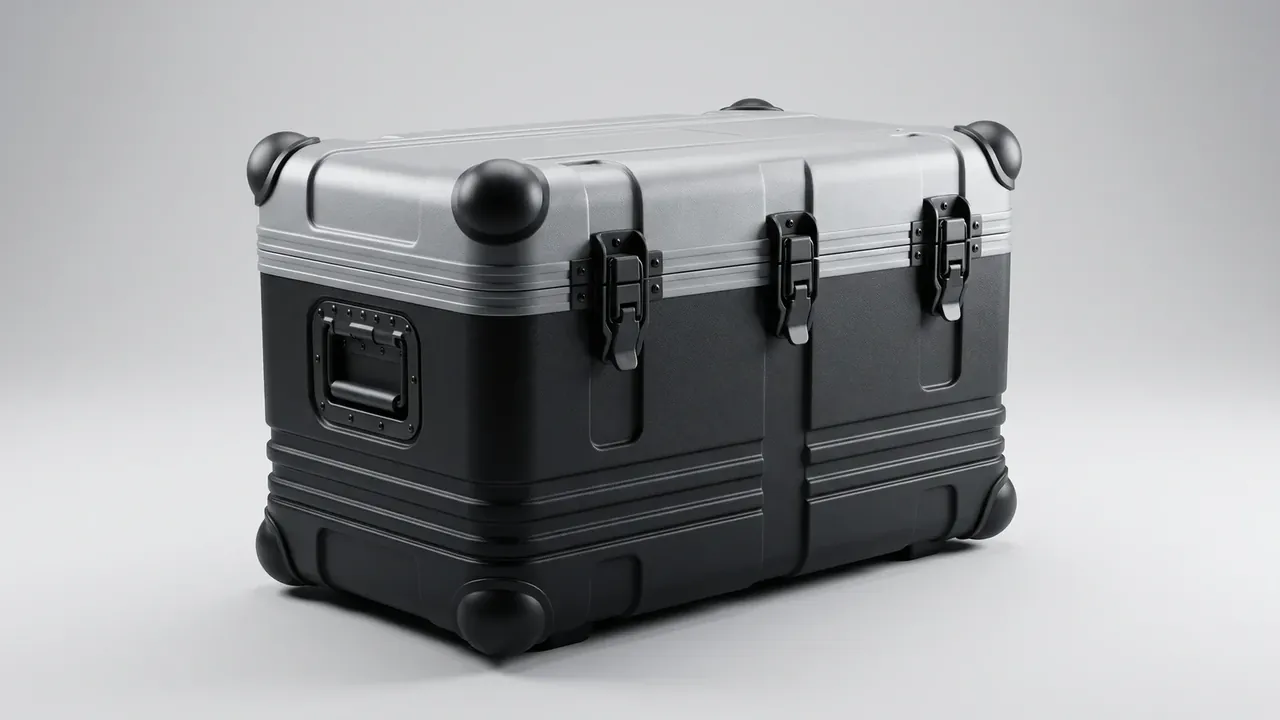
Quick answer: A flight case to protective case conversion pays below 60% of a new case: 576 CNY in seals and latches works, 1,444 CNY against 1,450 CNY does not.
Table of contents
- Turning the Cost into a Percentage
- Where the Structures Differ
- Sealing Is the Hardest Part
- Three Cases Worth Converting
- Four Cases Not Worth Converting
- Five Checks After the Work
- FAQ
1. Turning the Cost into a Percentage
The bill splits into two tiers, depending on whether the interior gets touched. A light conversion adds a gasket and latches: 6 m of EPDM at 28 CNY/m is 168 CNY, four compression latches 168 CNY, and 3 h of labour 240 CNY, for 576 CNY.
A heavy conversion adds corner plates and foam: eight latches at 42 CNY each come to 336 CNY, four corner sets 140 CNY, EVA lining 320 CNY, and 6 h of labour 480 CNY, for 1,444 CNY. A new rotomoulded case with the same 800 × 500 × 400 mm cavity quotes at 1,450 CNY, so the light tier lands at 40% and the heavy tier at 99%.
That sets the line: convert below 60% of a new case, replace above 80%. In the 20% band, the cavity decides.
2. Where the Structures Differ
The flight case wall is 9 mm birch plywood, edged with 30 × 30 mm aluminium extrusion and tied into one box by rivets and corner plates. The rotomoulded body is formed in one shot at 3.2 to 4.0 mm, with ribs moulded in the same material.
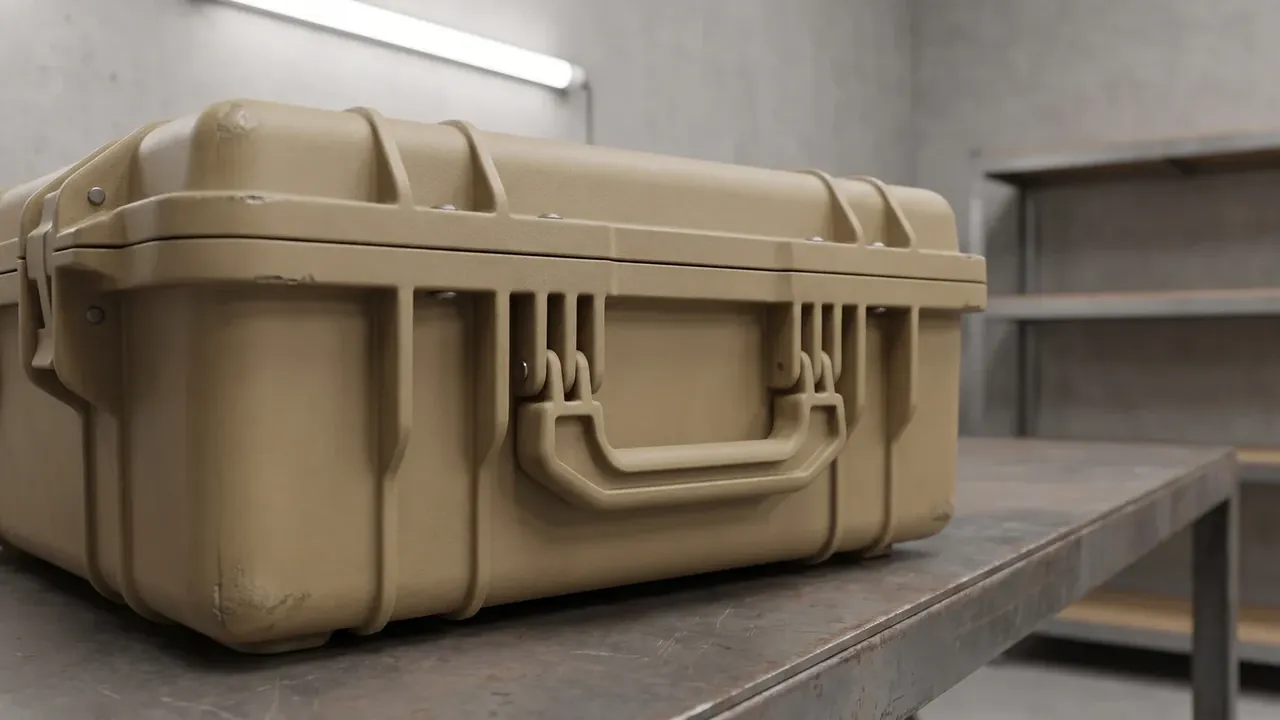
Stiffness comes from different places, and so does failure. Plywood resists bending by thickness: across a 1.5 m span under 80 kg it deflects 4 mm. The moulded body leans on its ribs, deflects 6 mm, then springs back inside 1.2 mm, while the board keeps a 2 mm permanent bow.
Weight is the bigger gap: 12.4 kg against 5.8 kg, so 60 cases in a 6 m truck differ by 396 kg. That figure alone decides most conversions.
Rivet pitch matters too. Edge fixing at 80 mm spreads the load along the panel; at 120 mm the same spot takes repeated shear, the holes open 0.4 mm after 200 handling cycles, and water starts at the edge.
3. Sealing Is the Hardest Part
Panels are joined on a seam, and a seam has no compression travel. Rain for 30 min pushes internal humidity from 45% to 78% before any work is done. Sealing starts with a groove 6 mm wide and 4.2 mm deep milled into the lid lip, 12 mm in from the board edge, with a 6 mm cord pressed into it.
Pressure points decide whether the cord stays in contact. Four butterfly latches concentrate force at two spots and the panel crowns in between; eight compression latches at 120 N each give 960 N and close the contact line.
Set the groove 1.8 mm shallower than the cord and compression sits near 30%, the range a timber box can hold; go deeper and a thicker cord is needed, the closing force climbs, and the latch toggle deforms first.
Repeat the rain test and internal humidity falls to 52%. That is better than 78%, but still short of IP67, because the board itself takes water: plywood at 8% to 12% moisture gains 3% of its mass in a 24 h soak, and vapour travels through the core, not past the gasket.
So a converted case reaches splash and short rain, not immersion.
4. Three Cases Worth Converting
- Cavity out of standard: 1,200 mm or longer, or with a shaped relief, where a new mould at 80,000 CNY spread over 50 units is 1,600 CNY each and the 1,444 CNY conversion wins
- Existing CNC lining and location blocks: a new case means new location work and re-validation, while a conversion leaves every fixing position untouched
- Fleet already running the same wheel base and loading table: a swap forces new stacking plans, a conversion keeps the lifting points and castors
All three point the same way: the value sits in the location work and load plan already done on that box, not in the shell.
5. Four Cases Not Worth Converting
- IP67 or 1 m immersion for 30 min is required: timber cannot pass, and the money is spent for nothing
- Board under 9 mm, or mould and delamination over 100 × 100 mm: the substrate has lost stiffness, so a gasket changes nothing
- Extrusion straightness beyond 2 mm, or three or more loose corner plates: the frame is distorted and no number of pressure points will close the gap
- Fewer than 5 units: tooling, setup and strip-down cannot be absorbed, and the unit price doubles
Conversion is bench work: 3 h per case does not fall until the batch passes five.
6. Five Checks After the Work
Without a check, the risk simply moves to the first shipment. Four items can be done in the workshop; the rain test needs a rig.
| Check | Limit | Tool |
|---|---|---|
| Lid lip straightness | 2 mm or less | 1 m straight edge and feeler gauge |
| Rain, 30 min | internal humidity 60% or less | spray rig plus logger |
| Pressure point force | 100 N or more at all eight | push-pull gauge |
| Screw torque | 3.5 N·m | preset torque wrench |
| Corner drop | 0.8 m on six corners, no seam opening, latches closed | drop rig |
Sampling runs at 10%, and every unit below five. One case per batch takes the rain test, with loggers in all four corners and the highest reading deciding.
Weight moves as well. Gasket, latches and corners add about 1.2 kg, from 12.4 kg to 13.6 kg; anything past 1.5 kg means over-thick corner plates or a double gasket.
| Item | Flight case as built | After conversion | Rotomoulded case |
|---|---|---|---|
| Wall | 9 mm plywood | 9 mm plywood | 3.2–4.0 mm |
| Weight | 12.4 kg | 13.6 kg | 5.8 kg |
| Internal humidity after 30 min rain | 78% | 52% | 48% |
| Ingress level | none | IPX4 class | IP67 |
| Cost per case | — | 576 to 1,444 CNY | 1,450 CNY |
Conclusion
The flight case to protective case decision reduces to one ratio. A 576 CNY light conversion at 40% of a new case keeps the lining and load plan intact, so it pays. A 1,444 CNY heavy conversion at 99% needs a non-standard cavity to justify itself. Sealing reaches IPX4 class and no further, weight grows 1.2 kg, and frame straightness has to sit within 2 mm.
This article discusses only the container (case body) side of specifications and design intent, and does not cover any handling, loading or use of the contents.
Related Reading
- Flight case alternatives in plastic: how to specify
- Case gasket replacement: compression, not age
- Drop testing a case on six faces
- Flight case structure for touring equipment
- Aluminium against plastic cases: weight and rigidity
Related Products
- 8 Series — Gun Cases; Military Equipment Cases; Camera Equipment Cases; Drone Cases; Watch Cases; Knife Cases; First Aid Cases; Electronics Equipment Cases
- WL8-2812 PP Gun Case — model WL8-2812
- All protective cases and toolboxes: 7 series, 158 models