

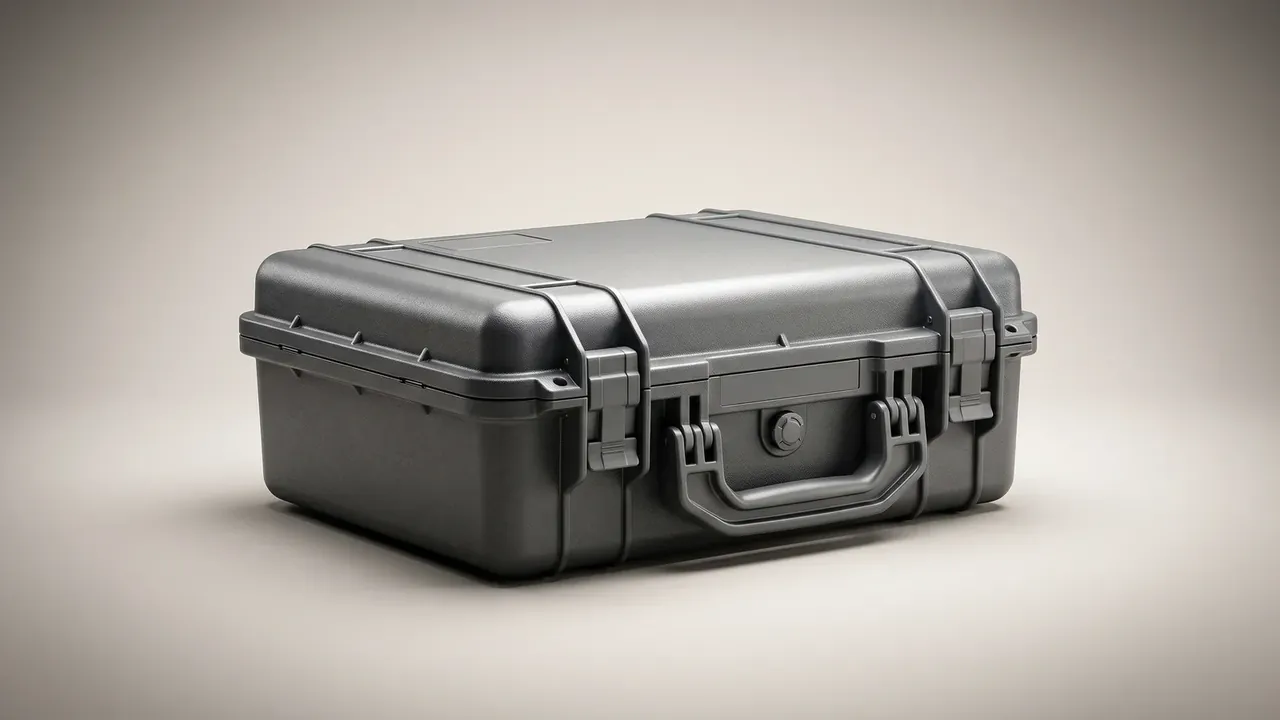
Quick answer: Foam bonding splits into three routes: hot-melt glue holding 1.5 N/cm of peel, nylon rivets that stay removable, and heat welding at 140 °C for 8 s. The wall material decides which route survives, and below 38 mN/m of dyne level the glued and riveted liners let go within three months.
Table of contents
- Three Decisions Before Any Foam Bonding
- Glue: Heat-Melt Window and Peel Strength
- Clips and Nylon Rivets: What Removability Costs
- Heat and Ultrasonic: Melting Foam to the Wall
- Surface Energy: Below 38 mN/m Nothing Holds
- Cost, Cycle Time and Rework Across Three Routes
- FAQ
1. Three Decisions Before Any Foam Bonding
A 6.2 kg instrument in a 60 L case does not load the bond with its own weight. In a 1 m drop on each face the foam compresses 12 mm and the adhesive sees shear of roughly eight times the item mass. The second decision is opening frequency: 40 openings a week over three years is 6,200 cycles, each pulling the bond a little. The third is cleaning: an alcohol wipe and an alkaline wash do not tolerate the same adhesive.
Cross one of those lines and the route changes. Above 15 kg or a 1.5 m drop requirement, glue alone creeps and a 1.5 mm backing board spreads the load. Under alkaline cleaning, ordinary EVA loses 30% of its peel after 24 h at pH 10, a figure no data sheet volunteers.
Ask the three questions and usually one route is left standing.
2. Glue: Heat-Melt Window and Peel Strength
The standard pairing is EVA foam on a modified PP wall: roller temperature 120–140 °C, coat weight 80–120 g/m², then 0.3 MPa for 10 s. Peel is measured to ASTM D903 at 180° and 25 mm/min, and the acceptance line sits at 1.5 N/cm; below it the foam comes away in one sheet after a 1.2 m drop.
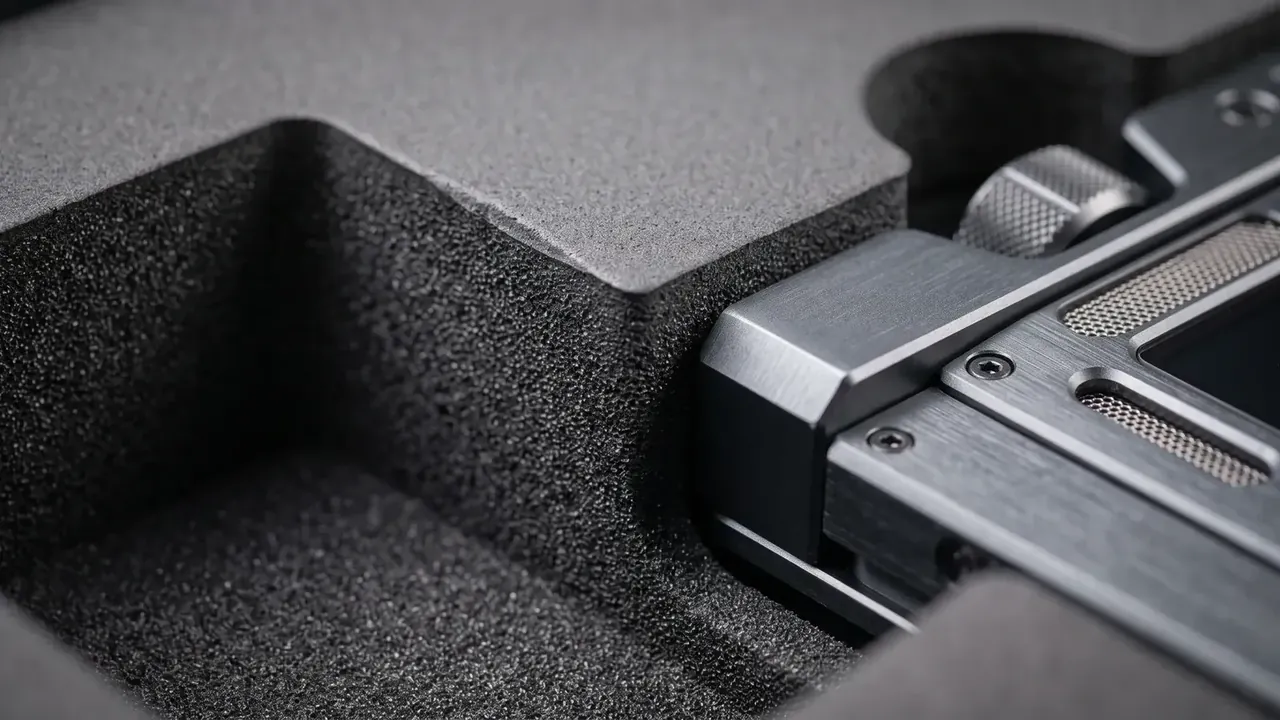
The window is narrow: under 120 °C viscosity climbs past 8,000 mPa·s, the roller starves and peel drops to 0.8 N/cm at 50 g/m². Over 150 °C the polymer oxidises, turning from pale yellow to dark brown in 30 min with a 20% loss of adhesion.
Solvent adhesives give 30–90 s of open time; past it green strength is too low and fixtures hold the part for 30 min.
Bond-line thickness stays at 0.1–0.2 mm: thinner leaves the wall texture unfilled, thicker cures into a hard lip at the edge. Cold is the real weakness — after 4 h at -20 °C the same batch measures 1.0 N/cm instead of 1.7 N/cm, a 40% loss that belongs in the acceptance clause.
3. Clips and Nylon Rivets: What Removability Costs
The clip route is mechanical locking, not adhesion. A PA66 clip with 1.2 mm engagement and 60–90 N insertion force seats on a 1.5 mm boss; nylon rivets run Ø5 mm at 150 mm pitch, about 18 per case.
The price is 0.4 CNY and 8 s per unit, and pressing 18 rivets stretches the cycle from 45 s to 53 s. What it buys is serviceability: a sheet worn through at one corner comes off whole.
Rivet holes are stress raisers: drilled through a wall under 2.5 mm, the edge shows a 0.3 mm whitening crack after three drops, so a Ø12 mm boss is mandatory. After 20 teardowns the hole grows 0.1–0.2 mm and stops gripping.
4. Heat and Ultrasonic: Melting Foam to the Wall
Heat welding needs matching polymers. PE foam on a PE wall at 140 °C, 0.4 MPa and 8 s gives a bead 5 mm wide that carries a 2 kg peel load after 20 s of cooling. EVA on PP does not co-melt.
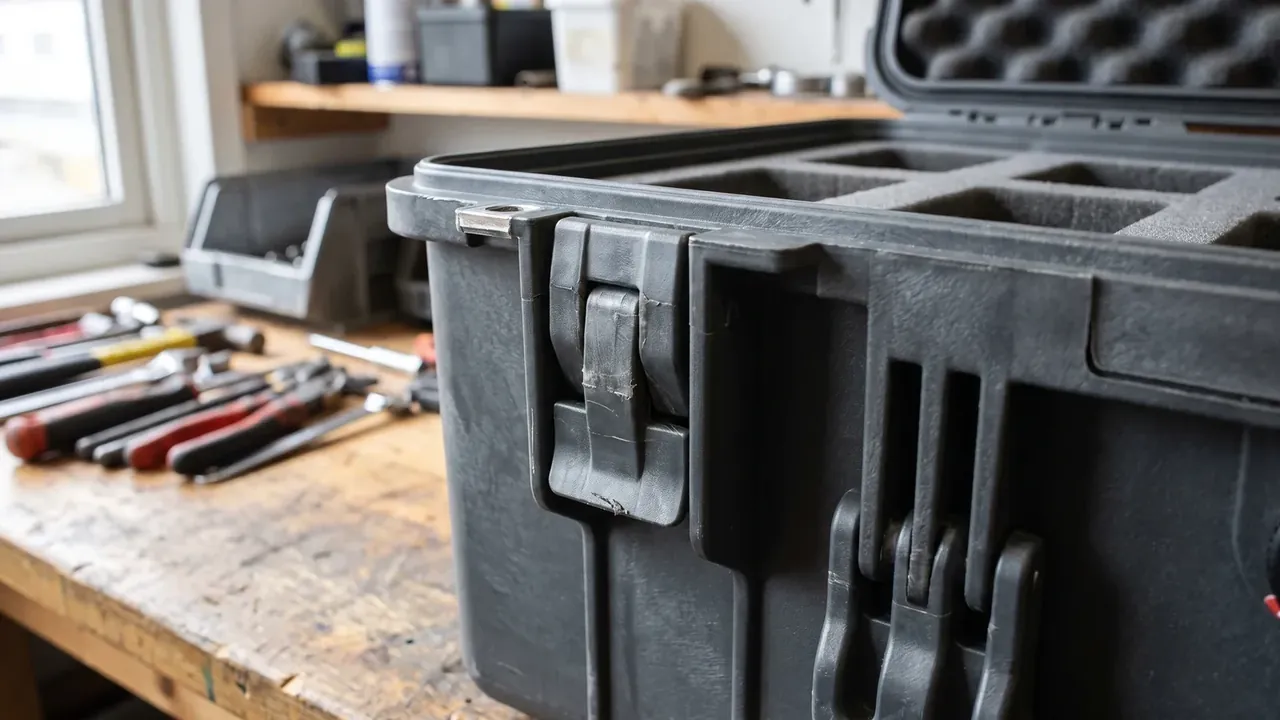
A 1.8 mm wall softens at 140 °C and sinks 0.5 mm within 5 s of the head lifting, so an aluminium backing or a contoured head is required.
Ultrasonic welding uses friction instead: 20 kHz, 40–60 μm amplitude, 0.2 MPa, 3–5 s per spot, with a 1–2 mm heat-affected zone that suits narrow rims and rib areas.
This route removes adhesive and solvent, but rework is the worst of the three: a peeled weld takes wall material with it.
5. Surface Energy: Below 38 mN/m Nothing Holds
Untreated PP measures 30–31 mN/m. Hot-melt and pressure-sensitive adhesives will not wet it. The contact angle passes 45°, and the real bonded area lands under 60% of the footprint. Stable bonding needs 38 mN/m. The threshold does not move with adhesive. Corona treatment lifts the wall to 42–46 mN/m, then decays to about 34 mN/m in 60 days, so treatment and bonding sit within 72 h of each other.
Flame treatment suits curved walls at gas to air 1:12 and 15 m/min; overheating powders the skin and drops the reading below 36 mN/m.
Checks use dyne pens, 3 cases per batch and 5 points each. Foam bonding on untreated walls fails in month three, and the cause is plasticiser migrating out of the wall.
6. Cost, Cycle Time and Rework Across Three Routes
On one 60 L case, the differences sit in four columns.
| Route | Added cost | Added cycle | Removable | Main limit |
|---|---|---|---|---|
| Hot-melt glue | 1.2 CNY | 25 s | No | Needs 38 mN/m or more |
| Nylon rivets | 0.4 CNY | 8 s | Yes | Boss under 2.5 mm wall |
| Heat welding | 0.3 CNY | 12 s | No | Same polymer only |
The decision table comes first:
| Service condition | Route | Reason |
|---|---|---|
| Vibration above 1.5 g | Rivets plus local glue | Lock does not creep |
| Cleanroom or medical | Heat weld or water-based glue | No solvent release |
| Wall of 1.8 mm or less | Rivets | Avoids local heating |
| Liner replaced on schedule | Rivets | 8 s per sheet |
Mixed routes are normal in foam bonding: rivets at the corners for location, hot-melt through the middle to keep the sheet flat, one extra pass at 9 s.
Residual adhesive belongs in the rework quote: above 0.2 mm a scraper plus IPA takes 4 min per sheet, 24 min on a six-sheet case.
Conclusion
Foam bonding has no universal answer, only a match. Mass and drop height decide whether a mechanical lock is needed, opening frequency decides whether adhesive survives, and cleaning chemistry decides the adhesive family. Write 38 mN/m, 1.5 N/cm and a 5 mm weld bead onto the drawing, and the price gap finally means something. Thin walls and cleanroom work point to heat welding, vibration-heavy freight to rivets plus local glue, and the rest to the 1.2 CNY adhesive route.
This article discusses only the container (case body) side of specifications and design intent, and does not cover any handling, loading or use of the contents.
Related Reading
- Foam lining selection and thickness
- Three foam types inside a case
- EVA versus PE foam compression and rebound
- Pick-and-pluck foam cells and preload
Related Products
- 8 Series — Gun Cases; Military Equipment Cases; Camera Equipment Cases; Drone Cases; Watch Cases; Knife Cases; First Aid Cases; Electronics Equipment Cases
- WL8-2812 PP Gun Case — model WL8-2812
- All protective cases and toolboxes: 7 series, 158 models