

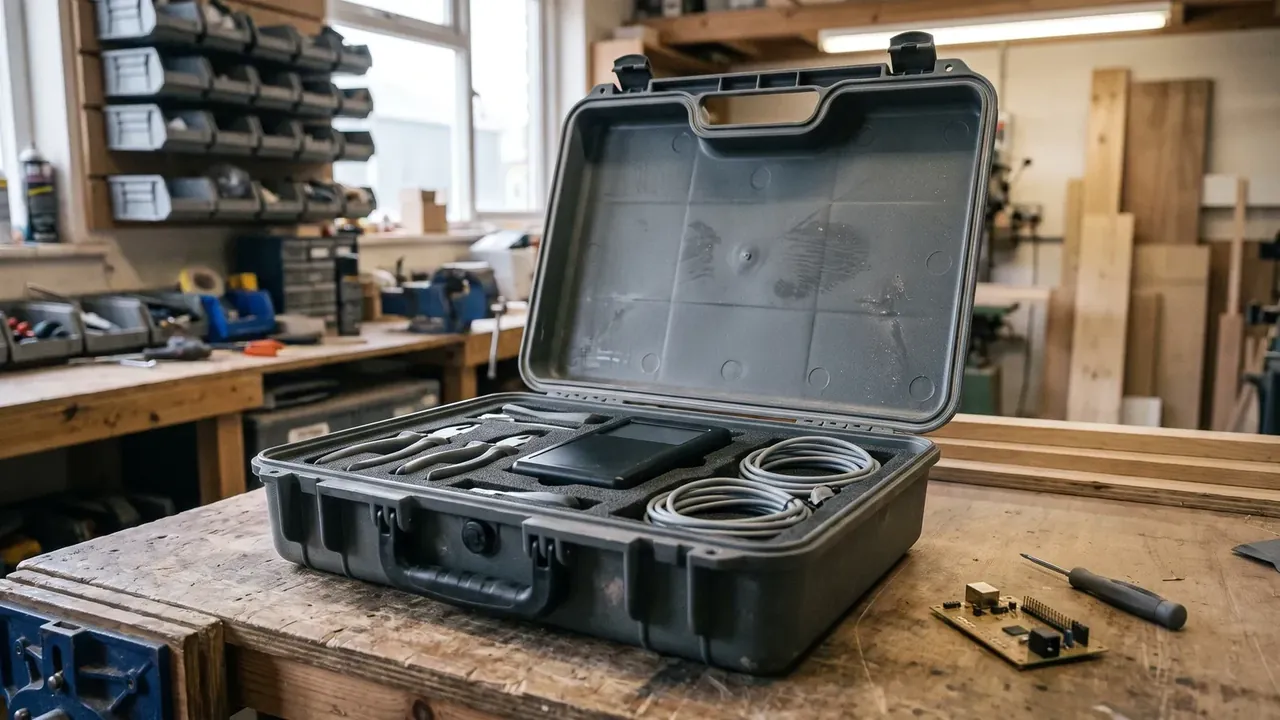
Quick answer: Foam Cutting is weighed against moulded trays, moulded pulp, corrugated dividers and air pillows. Under 800 units it wins; above 10,000 units, moulding takes over.
Table of contents
- Where Foam Cutting Draws the Line
- Two Cost Curves and One Hidden Line
- Drop Performance at the Same Height
- Revisions and Lead Time on the Third Drawing
- When to Walk Away from Foam Cutting
- FAQ
1. Where Foam Cutting Draws the Line
Most comparisons begin with one unit-price table mixing four forming logics. Foam Cutting is subtractive: pockets come out of a block. A moulded tray is additive: melt fills a steel tool. Pulp is slurry sucked onto a screen. A corrugated divider only folds and slots.
The cut route holds 120 mm of pocket depth, a 3 mm wall and plus or minus 0.5 mm on the outline. It cannot hold a threaded insert. Foam sits near 3 MPa, so one M6 screw crushes the wall, and locating 12 kg to 0.1 mm needs a bracket underneath.
| Option | Forming logic | Minimum | Unit price, CNY |
|---|---|---|---|
| Foam Cutting | Subtractive | 1 piece | 2.4 |
| Moulded tray | Melt in a steel tool | 3,000 | 4.6 |
| Moulded pulp | Slurry on a screen | 2,000 | 3.2 |
| Corrugated divider | Folded and slotted | 200 | 1.1 |
| Air pillow | Inflated film | 500 m | 0.6 |
2. Two Cost Curves and One Hidden Line
There is no tool, only CNY 120 of programming per revision. The steel tool is CNY 36,000, the pulp tool CNY 11,000, a corrugated die CNY 300. One line is quoted as sampling, the other as tooling, which is how the cheap route starts to look dear.
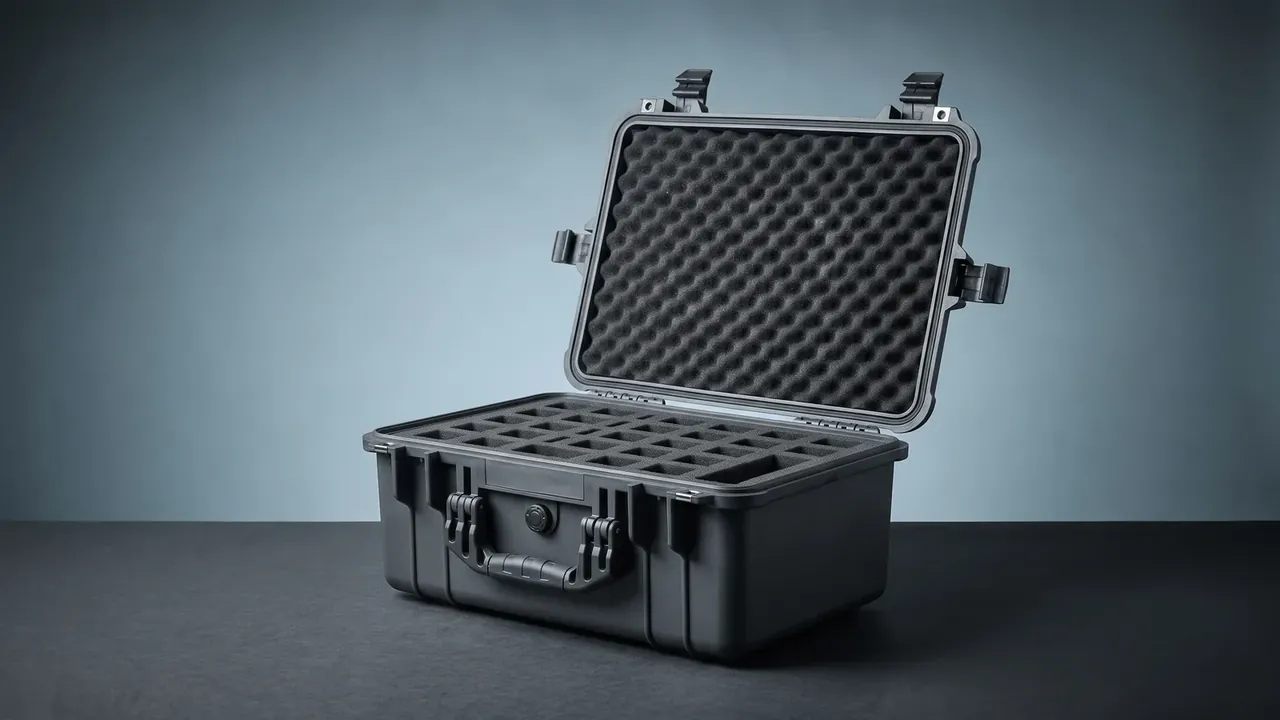
A 300 by 250 by 40 mm insert in 38 kg per cubic metre PE costs 2.4, of which 1.7 is material. The curves cross near 780 pieces; past 3,000 pulp and moulding pass it. Weight is the hidden line: 90 g against 240 g, or CNY 18,000 across ten thousand sets by air.
3. Drop Performance at the Same Height
On one rig, 4.2 kg dropped from 1.2 m, a 30 mm insert peaks at 62 g. EVA reads 85 g, pulp 108 g, corrugated 140 g.
| Item | Foam | EVA | Pulp | Corrugated |
|---|---|---|---|---|
| Peak acceleration at 1.2 m | 62 g | 85 g | 108 g | 140 g |
| Compression set, 25 percent, 70 C, 22 h | 5.8 percent | 4.2 percent | 9.5 percent | 21 percent |
| Attenuation by the eighth drop | 12 percent | 18 percent | corner crack | collapse |
| Insert weight | 90 g | 130 g | 165 g | 45 g |
4. Revisions and Lead Time on the Third Drawing
Moving one pocket is 40 minutes of programming and one scrap sheet. A mould means stripping, welding and repolishing: five days and CNY 4,000. Pulp means a new screen: seven days.
Lead times stack the same way: fifty pieces in three days, moulding 22 days to first batch. Only the cut route can run 5 mm oversize and finish the pocket once the hardware freezes.
5. When to Walk Away from Foam Cutting
Four requirements end the discussion: a threaded insert, a clear window, 0.1 mm repeatable location, or 20,000 pieces in one order. Compression also drifts, so a pocket that grips today can loosen 0.2 mm in three months.
| Requirement | First choice | Second choice | Reason |
|---|---|---|---|
| Under 300 pieces | Foam Cutting | Corrugated | Revisions are program edits |
| 300 to 3,000 pieces | Moulded pulp | Foam Cutting | Pulp passes foam after 3,000 |
| Above 10,000, hard location | Moulded tray | Foam plus bracket | Foam cannot hold an insert |
| Above 4 kg, six-face drop | Foam | EVA | Lowest peak of the four |
Under 500 pieces, a 4 mm wall between pockets or a weight target, the cut route wins. A tray 0.3 mm off will not seat, while foam absorbs that error. A 5 mm ABS plate at the locating points closes the stiffness gap for about 40 percent less than all-moulded cost.
Conclusion
No alternative wins on every axis; order quantity and locating requirement decide. Moulding wins on stiffness, pulp on the sustainability story, corrugated on price, Foam Cutting on revisions. That is why, in a pilot build, Foam Cutting remains the hardest option to replace.
This article discusses only the container (case body) side of specifications and design intent, and does not cover any handling, loading or use of the contents.
Related Reading
- Comparing cutting methods
- Die, CNC or hot wire
- What a custom foam insert is
- How to design internal dividers
Related Products
- 8 Series — Gun Cases; Military Equipment Cases; Camera Equipment Cases; Drone Cases; Watch Cases; Knife Cases; First Aid Cases; Electronics Equipment Cases
- WL8-2812 PP Gun Case — model WL8-2812
- All protective cases and toolboxes: 7 series, 158 models