

Quick answer: Judge foam cutting in a fixed order: cut face, kerf compensation, batch and tooling, material, then sampling. The first two decide whether the pocket accepts the part; the last three decide price and lead time.
Table of contents
- The Five Criteria and Why the Order Matters
- Criterion One: Cut Face and Pocket Mouth
- Criterion Two: Kerf Compensation and Tolerance
- Criterion Three: Batch, Tooling and Nesting
- Criteria Four and Five: Material and Sampling
- FAQ
1. The Five Criteria and Why the Order Matters
Quote the same insert as foam cutting to three suppliers and three documents return: a die price, a CNC time estimate, a promise to follow the drawing. Prices differ by a third and none compares: no shared criterion sits under the number.
The first two criteria are hard: a wrong pocket scraps the whole sheet. The last three are commercial. Reverse the order and you negotiate price, then thin a 30 mm pad by 5 mm because the pocket will not take the part.
| Criterion | Ask in writing | Cost if wrong |
|---|---|---|
| Cut face | How the wall and mouth are held | Edges collapse after 200 uses |
| Kerf | Kerf width, pocket opened by how much | Part will not enter, or rattles |
| Batch | Pieces before a die, utilisation | Material bill eats the saving |
| Material | Blade for this density, springback | Crushed section, short pocket |
| Sampling | First articles, days, checks | Whole batch reworked |
2. Criterion One: Cut Face and Pocket Mouth
Read the face in three places: the grain of the section, the verticality of the wall, the mouth. EVA at 45 kg/m³ shows a fine grain and a bright compressed line at the mouth; at 60 kg/m³ it springs back less and holds the mouth, but the blade is spent by 10,000 hits, not 20,000.
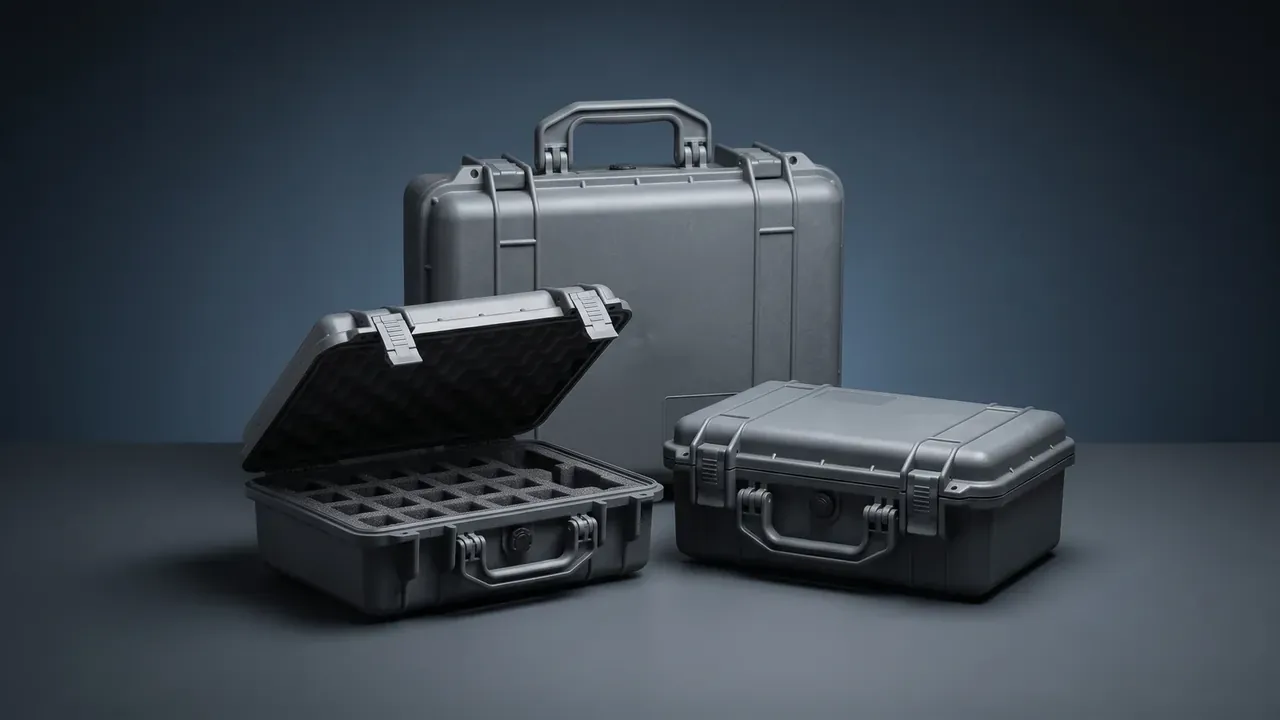
A 15 by 15 mm pluck grid saves tooling and lets users pick an outline, but the tear is serrated and 200 insertions leave crumbs. A cut pocket has straight walls, and anything deeper than 30 mm needs 0.5 mm of draft, or the part drags the wall up.
Load the part, invert the case ten seconds, watch whether it stays. One to two millimetres of interference is the band: under 1 mm it shifts, over 2 mm extraction takes both hands.
3. Criterion Two: Kerf Compensation and Tolerance
A die is not a zero-width cut. Blade stock is 0.71 mm, the foam springs back, and the opening ends 0.4 to 0.5 mm under the drawing. Pockets need half-kerf compensation: 0.45 mm kerf, 0.22 mm per side.
CNC oscillation carries no kerf and holds ±0.3 mm on a 1.2 by 2.4 m bed. Longer inserts are spliced with an unavoidable 0.2 mm step; on a 2.6 m insert, keep the splice off the centre of mass.
Tolerance follows the part: ±0.5 mm for aluminium housings, ±1.5 mm for pouches and textile gear. 'Per drawing' is the commonest hole.
4. Criterion Three: Batch, Tooling and Nesting
A die costs 800 to 1,500 CNY with about 20,000 hits: 16 to 30 CNY per piece at 50 off, below one yuan at 2,000. The crossover sits near 120 pieces.
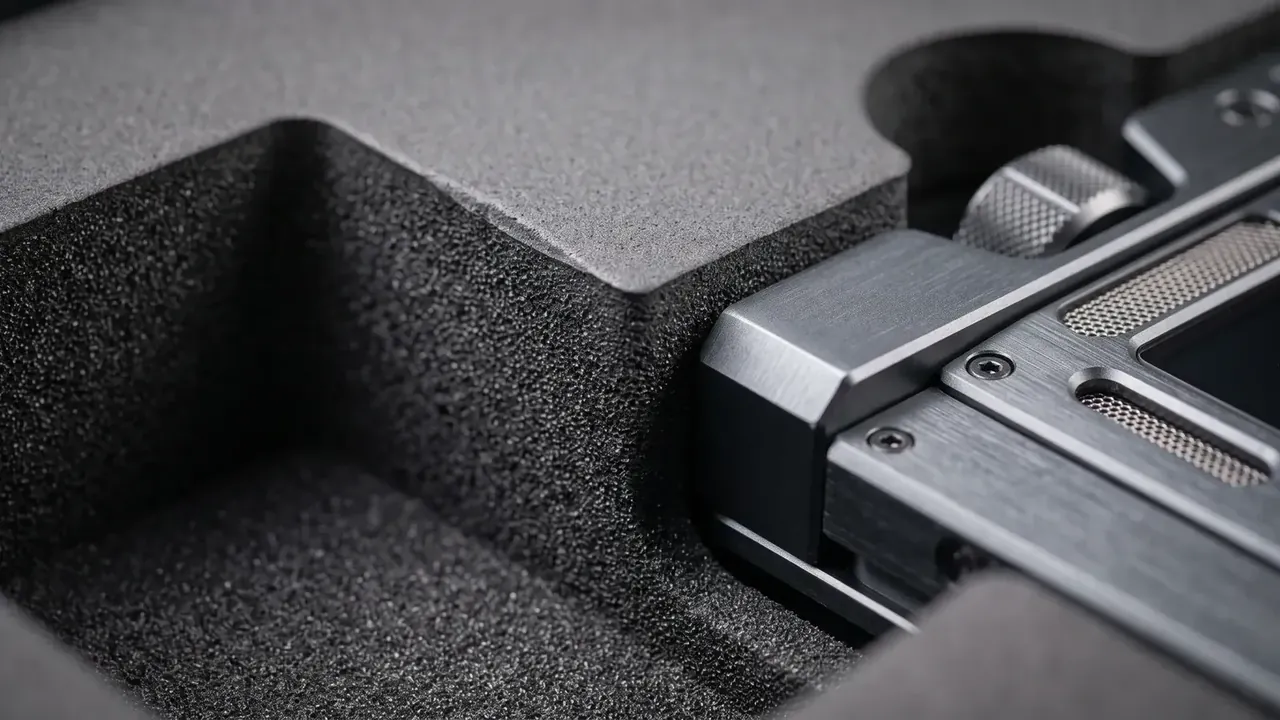
Two pocket shapes can share one plate if the bridge stays at 8 mm. In foam cutting, nesting is the unquoted line: 78 percent utilisation is ordinary, under 65 percent cancels the tooling saving.
5. Criteria Four and Five: Material and Sampling
EPE at 25 kg/m³ is too soft: a die crushes a 2 mm lip. PU sponge must be chilled to about -20 °C. EVA from 45 to 80 kg/m³ cuts well and holds the lowest rework rate in foam cutting.
Sampling needs three things fixed: pieces, days, checks. Three first articles in 48 hours, one loaded and dropped from 1.2 m, one sectioned for wall verticality, one kept as a colour reference.
| Item | Number on the order | Acceptance |
|---|---|---|
| Cut face | Wall within 1 mm, no chamfer | Section one, measure three points |
| Batch | 120 pieces minimum, 75 percent utilisation | Check nesting drawing |
| Sampling | 3 pieces in 48 hours | Load, invert ten seconds |
Conclusion
The first two decide whether the part goes in; the last three decide cost and timing. Cut face and kerf are the process floor, batch and nesting the cost floor, material and sampling the delivery floor. Agree all five as numbers and quotes compare. Foam cutting selection is five numbers settled before the die is made.
This article discusses only the container (case body) side of specifications and design intent, and does not cover any handling, loading or use of the contents.
Related Reading
- Comparing foam cutting methods by accuracy and batch size
- Which shapes each foam cutting process can cut
- Thickness, compression ratio and tolerance on custom foam inserts
- Fitting an insert into a case: contact, location and clearance
Related Products
- 8 Series — Gun Cases; Military Equipment Cases; Camera Equipment Cases; Drone Cases; Watch Cases; Knife Cases; First Aid Cases; Electronics Equipment Cases
- WL8-2812 PP Gun Case — model WL8-2812
- All protective cases and toolboxes: 7 series, 158 models