


Quick answer: Foam Inventory Management rests on one sheet walked every 14 days: press for rebound, gauge five points, look for chalking. A check past its trip point means replacement.
Table of contents
- Three Checks on the Walk-Through
- Cleaning: Dust, Oil Film and Metal Swarf
- When to Replace: Four Trip Points
- Stretch the Life: Flip, Trim, Rotate
- FAQ
1. Three Checks on the Walk-Through
Foam Inventory Management degrades fastest when the only verdict is a shrug. Three actions keep the judgement transferable between shifts: press, gauge, look. Forty sheets take a trained hand 6 minutes.
Press a sheet to 50% of its thickness and count the return. Back above 90% within 3 seconds, it still cuts clean; dragging to 5 seconds means the cells are tired and the pocket edge will slump.
Gauge four corners and the centre, 5 points. On a nominal 50 mm board, one reading of 47 mm is a 6% collapse, and that stack drops to void filler.
Look for chalking and chipped edges. A grey smear on the palm means ultraviolet light and ozone have broken the skin, and the cushion has lost 20% of its travel.
| Check | Interval | Trip point | Action past the line |
|---|---|---|---|
| Press rebound | 14 days | above 90% in 5 seconds | downgrade to filler |
| Five-point gauge | 14 days | any point down 2 mm | quarantine the stack |
| Chalking | 7 days | grey smear on the palm | scrap, no cutting |
| Chipped edge | 14 days | chip longer than 10 mm | trim, then downgrade |
2. Cleaning: Dust, Oil Film and Metal Swarf
Dust is cardboard fibre and cement powder, and on open-cell sheet it works into the pores. Blow it out at 0.3 MPa, nozzle 150 mm off the face, in one direction; holding the nozzle square to the surface furs the cell walls. Let the stack sit 10 minutes before rebuilding it.
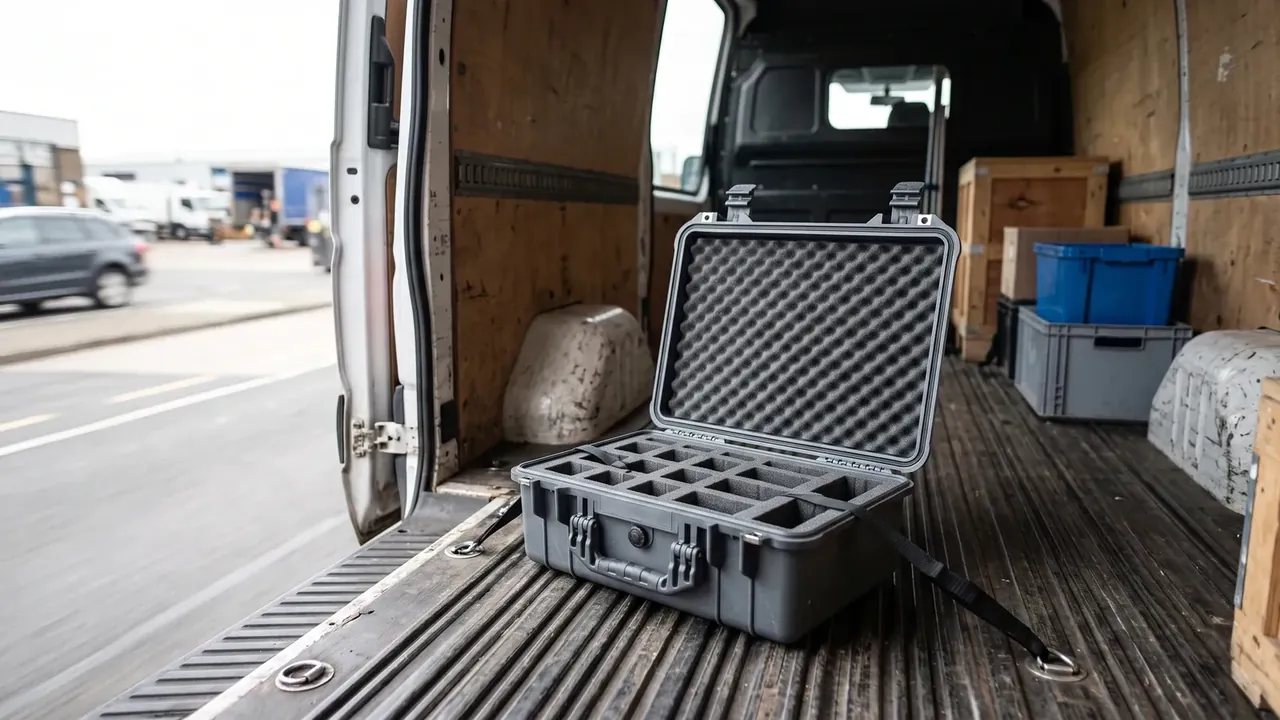
Oil film is the step that gets overdone. Fingerprints, fork-lift spray and adhesive from stretch film all count. Use neutral detergent at 2% in water at 30 °C, dab with a sponge, never immerse. A soaked board will not return to its thickness after 6 hours of drying.
Metal swarf is the worst. Beside a machining cell, chips cling to the face and a rag drags them into a groove. Wand first, tack roller twice, air line last; residue then falls below 0.5 g per square metre.
3. When to Replace: Four Trip Points
Replacement belongs on a form, not in a pair of hands: any of the four lines crossing sends the sheet out.
Compression set first. Hold 25% deflection for 22 hours, release for 30 minutes, gauge again: below 95% recovery the sheet has failed. Clamp positions seeing more than 1,000 lid closures reach this line first.
Density second. Fresh sheet runs 45 kg/m³; a 100×100×50 mm block weighing 20 g instead of 22.5 g has slid to 40 kg/m³, and the cushion follows.
Drift third: 3 mm of growth keeps the sheet out of its pocket, 3 mm of shrink makes it rattle. Contamination fourth: swarf deeper than 2 mm is past cleaning.
| Trip point | Method | Pass band | Action past it |
|---|---|---|---|
| Compression set | 25% for 22 hours | recovery of 95% or more | replace |
| Density | weigh a 100×100×50 mm block | 42 kg/m³ or more | downgrade |
| Dimensional drift | gauge length and width | within plus or minus 3 mm | replace |
| Embedded soil | visual plus probe | 2 mm deep at most | scrap |
Drift slips through: a sheet forced home reads as a tight fit. Weigh it instead.
4. Stretch the Life: Flip, Trim, Rotate
Flipping is free. A flat-stored board turned every 90 days rests each face; the same 50 mm sheet lasts 30 months flipped, and starts thinning at 20 months untouched.
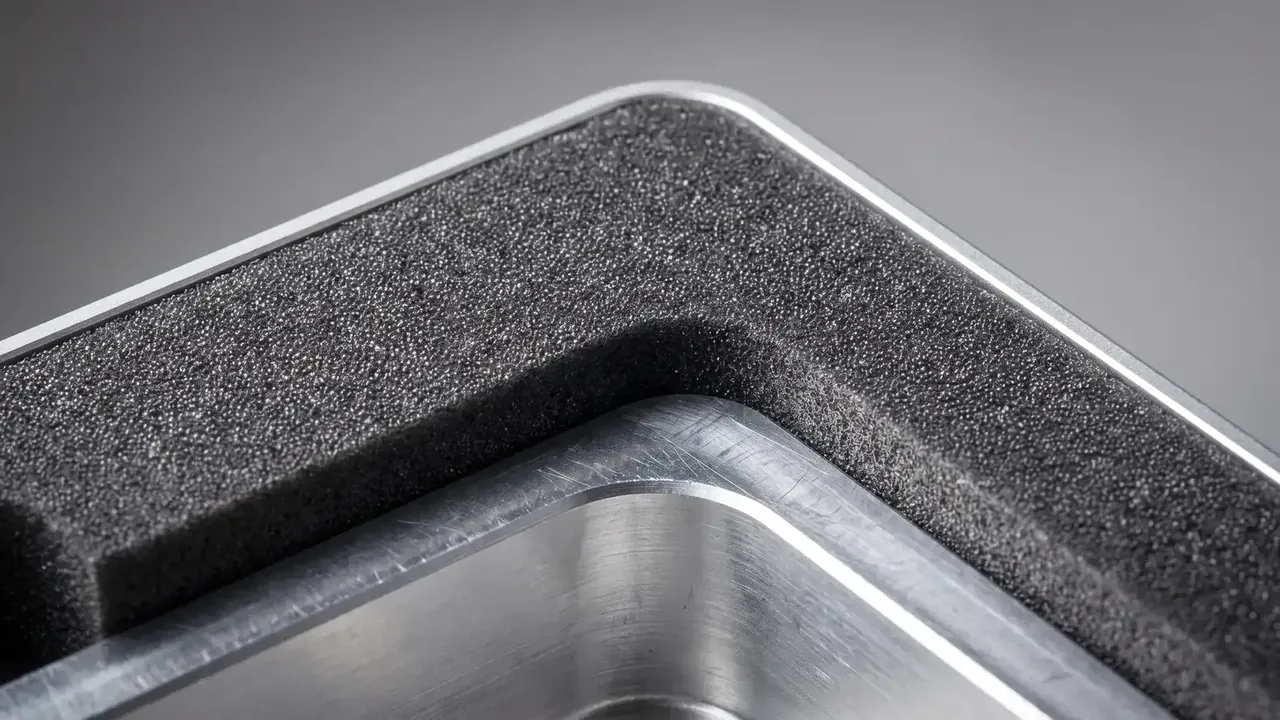
Trimming: a chip under 10 mm can be cut on a 45-degree bevel, dressed with 240 grit and used as filler for 2 more quarters. Round the edge to 2 mm, because square edges break first.
Zone rotation needs a roster: fresh stock in the fast tier, flipped stock in the middle, trimmed in the slow tier. That adds about 40% to average life.
Conclusion
Foam Inventory Management runs on a calendar, not a spring clean: 3 checks every 14 days, a look every 7, a flip every 90, replacement at 18 months. Print the four trip points on the rack end, and the swap stops depending on feel. That is when Foam Inventory Management is handed over to the floor.
This article discusses only the container (case body) side of specifications and design intent, and does not cover any handling, loading or use of the contents.
Related Reading
- Daily care routine for foam cutting equipment
- Upkeep checklist after an insert is fitted
- Periodic checks after an airdrop case lands
- Inspection calls on ammunition boxes
Related Products
- 8 Series — Gun Cases; Military Equipment Cases; Camera Equipment Cases; Drone Cases; Watch Cases; Knife Cases; First Aid Cases; Electronics Equipment Cases
- WL8-2812 PP Gun Case — model WL8-2812
- All protective cases and toolboxes: 7 series, 158 models