

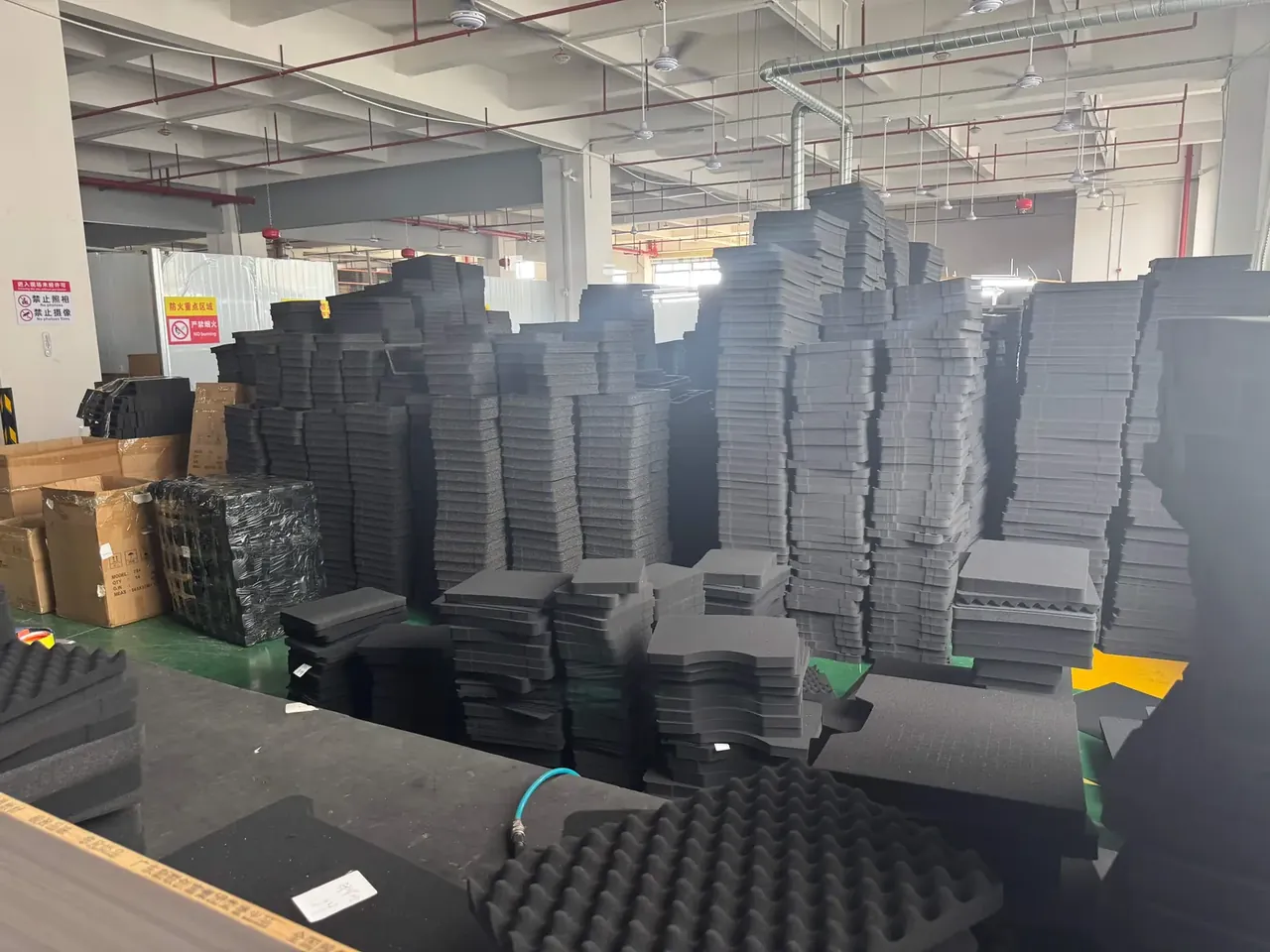
Quick answer: Foam Inventory Management answers three questions: which density zone a pallet belongs in, which posture a roll keeps, and how many wraps it needs. Put all three on the bin card and the count matches.
Table of contents
- What Foam Inventory Management controls
- Density tiers
- Rolls stood upright
- Three moisture layers
- Turnover decides what to cut
- FAQ
1. What Foam Inventory Management controls
Foam is not a standard part. Change material, density, thickness or width and the result is another line item: three density tiers, four thicknesses from 20 to 50 mm and two widths give twenty-four bins for one line.
The first job of Foam Inventory Management is numbering those bins: zone, row, level, position, so B-03-2-1 reads as row three, level two. Number the pallet, not the rack.
The second is knowing what a stack weighs. Twenty layers of ten pads at 1.2 kg is 240 kg; a floor rated at 500 kg per square metre takes two such stacks, and the third needs a new row. Get that wrong and the bottom foam flattens with no visible collapse.
2. Density tiers
Density is kilograms per cubic metre, the one figure you can judge by hand. Skipping it is the quietest failure in Foam Inventory Management, and the cost appears at the cutting station.
Four bands suffice: 25 to 30 for shims and light liners, 35 to 40 for ordinary inserts, 45 to 60 for heavy parts, and ethylene vinyl acetate from 60 to 90 for precision work.
Sort by thickness within a band: thin sheets under a tall stack take a permanent set and cut unevenly.
Goods-in weighs a 100 by 100 by 50 mm sample: 15 g in 0.0005 cubic metres reads as 30 kg per cubic metre, and 5 percent beyond nominal is a reject.
| Density, kg/m3 | Feel | Typical use | Bin | Reorder |
|---|---|---|---|---|
| 25–30 | soft, marks stay | shims, gap fill | A, dispatch side | 15 stacks |
| 35–40 | firm, edges hold | standard inserts | B, centre | 10 stacks |
| 45–60 | dense, hard to press | heavy parts | C, wall side | 6 stacks |
| 60–90 EVA | fine, barely wets | precision parts | D, cabinet | 3 stacks |
3. Rolls stood upright
Rolls hate lying down. A roll 600 mm across, 1.5 m wide and 40 kg presses its lower half flat, and after three months carries a 3 to 5 mm flat section that throws every pocket off line.
Upright is the default: core up, resting on a V cradle, on a 100 mm timber pallet. Rolls from one batch lean together at no more than 5 degrees, and load must land on the roll wall, not the hollow core.
Sheets stack flat below 1.2 m with 200 mm aisles; cut pads never share a stack with blanks.
| Form | Posture | Support | Never |
|---|---|---|---|
| Roll | upright | V cradle plus timber | flat for a month |
| Sheet | flat stack | pallet, 1.2 m limit | thin sheets underneath |
| Cut pad | racked, bagged | divider board | mixed with blanks |
4. Three moisture layers
Polyethylene takes under 1 percent water by volume and a splash wipes off. Ethylene vinyl acetate has an open surface layer, and above 70 percent humidity absorbs 3 to 5 percent, gaining weight and losing rebound. Three layers are the cheapest part of Foam Inventory Management.
Base: a pallet 100 to 150 mm off the floor, never onto bare concrete, where the bottom layer wets first.
Wrap: film the unopened stack to the pallet as one sealed block; bag the remainder and fold the neck twice.
Gap: 300 to 500 mm off the wall, 500 mm below the roof, clear of drip lines, with the room at 45 to 65 percent humidity.
| Layer | Method | Figure | Check |
|---|---|---|---|
| Base | pallet, plastic timber | 100–150 mm clear | weekly |
| Wrap | film, folded bag neck | sealed block | monthly |
| Gap | wall and roof clearance | 300–500 mm | quarterly |
5. Turnover decides what to cut
The books close on turnover: monthly issue weight divided by average stock weight. Hold common densities above 1.5 turns a month; under 0.5 goes to order-only purchasing.
Age must stay visible in Foam Inventory Management. Write the receipt date on the pallet card as a batch code, such as 2610-03: flag at 90 days, re-test at 180.
The re-test is one measurement: compress a sample 25 percent for 24 hours and read the recovery. Above 90 percent stays in service, 85 to 90 drops to gap filling, below 85 is scrap.
One plant cut twenty-four bins to twelve, moved six slow lines to order-only, and took stock value down 28 percent with no shortage in three months.
Conclusion
Close the three loops: density zones, upright rolls, sealed stacks, then let turnover shrink the slow tier. That is all Foam Inventory Management asks.
This article covers container-side specifications and design implications only, not the handling, loading or use of the contents.
Related Reading
- Setting safety stock for foam
- Comparing foam materials and densities
- How stacking relates to damp in stores
- Size and density factors in custom foam
Related Products
- 8 Series — Gun Cases; Military Equipment Cases; Camera Equipment Cases; Drone Cases; Watch Cases; Knife Cases; First Aid Cases; Electronics Equipment Cases
- WL8-2812 PP Gun Case — model WL8-2812
- All protective cases and toolboxes: 7 series, 158 models