

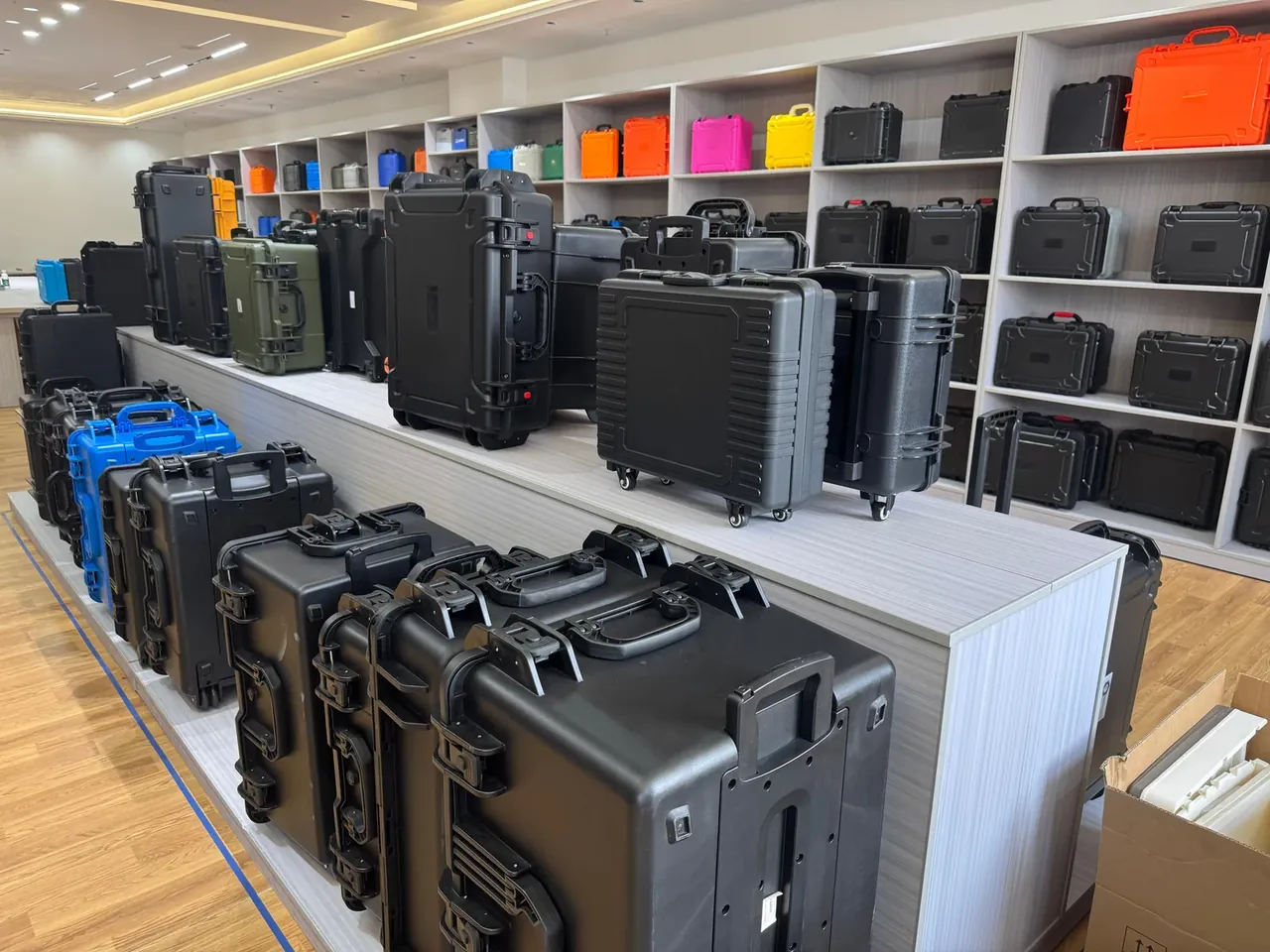
Quick answer: Forensic detection equipment box with custom foam cutouts: 8.5 mm walls, 38 kg/m³ EVA, collapse under 0.55 mm after 500 cycles, recovery above 90%.
Table of contents
- Slot-wall thickness of the Forensic detection equipment box with custom foam cutouts
- EVA foam density bands
- Wall-edge collapse after 500 pick-and-place cycles
- Thickness recovery after rest
- Density setpoint for the slotted batch
- FAQ
1. Slot-wall thickness of the Forensic detection equipment box with custom foam cutouts
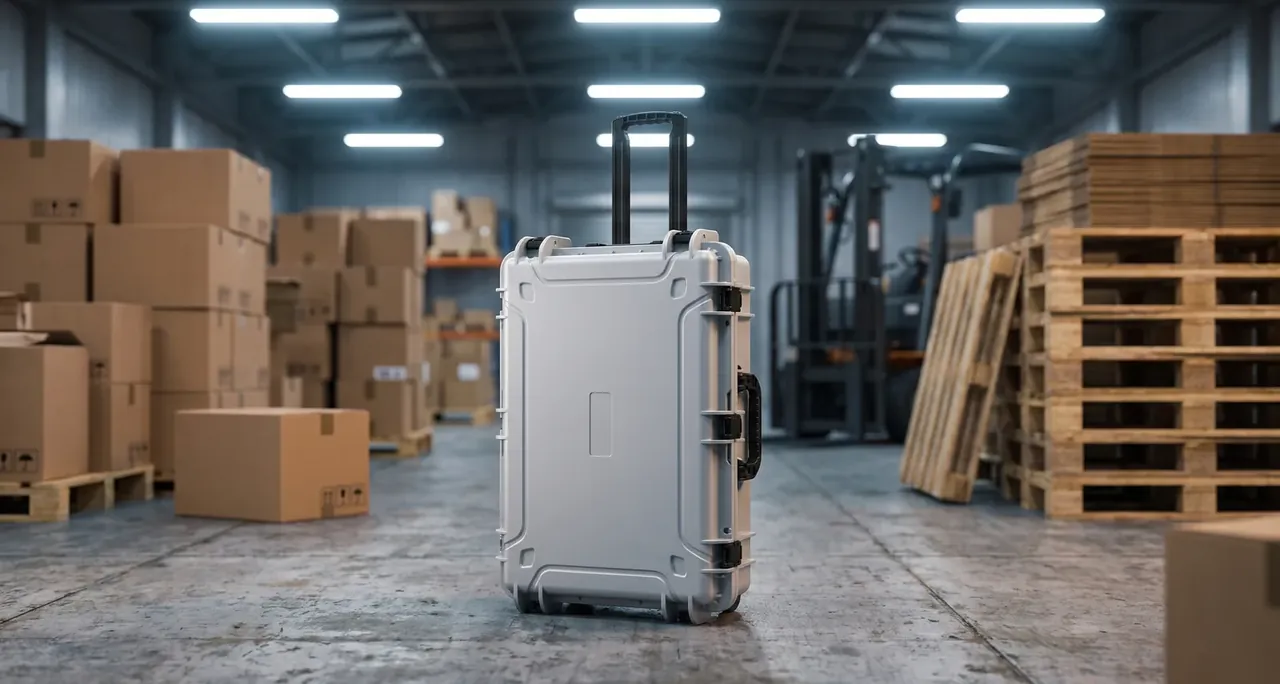
Lift one item out and set it back 500 times, and density has already settled whether the slot wall sags or springs back. The first dimension drawn for a Forensic detection equipment box with custom foam cutouts is the 8.5 mm slot wall, with more margin than the narrow cells inside a 455×305×135 mm cavity. A 520×365×190 mm shell of 4.1 mm wall gives the foam a flat seat, and the cut walls must hold the outline without being rubbed thin. CNC cutting holds tolerance inside ±0.5 mm and leaves an uncut skin at the cell floor, so the block stays whole during bonding. Empty 4.6 kg and loaded 11 kg size the shell only.
The 8.5 mm figure is the foam rib between two cells, while cell depth follows the seated outline. In the drawing for a Forensic detection equipment box with custom foam cutouts the rib is marked before the depth, and a caliper runs across three sections before bonding. A full-spread adhesive layer attaches the block to base and lid, with 2 mm bare at the corners so glue cannot lock the rib.
2. EVA foam density bands
Density is the variable most often skipped, yet it decides the shape after 500 cycles. EVA foam is split into three density bands around a 38 kg/m³ centre, one above and one below, and equal blocks from each are bonded into the cells of a Forensic detection equipment box with custom foam cutouts before the rig starts. The point is not to pick the hardest band; it is to find the one that resists sag and still returns its thickness.
| Density band | Nominal density | Measured wall |
|---|---|---|
| Low | 32 kg/m³ | 8.4 mm |
| Middle | 38 kg/m³ | 8.5 mm |
| High | 45 kg/m³ | 8.6 mm |
All three measured walls sit close to the 8.5 mm drawing value, and the spread only shows up after cycling. This section logs only the density-to-wall pairing, and the verdict table for a Forensic detection equipment box with custom foam cutouts is left blank here.
3. Wall-edge collapse after 500 pick-and-place cycles
The rig runs 500 cycles, lifting the same outline out of its cell and back on a fixed stroke and speed. At each pick-and-place station the crew reads collapse at the rib top, not how much the cell has widened. When the run ends the readings are lined up by cycle number, because the slope of the climb says more than the last value alone.
| Cycle number | Middle collapse | Low collapse |
|---|---|---|
| 100th | 0.10 mm | 0.18 mm |
| 300th | 0.24 mm | 0.41 mm |
| 500th | 0.36 mm | 0.68 mm |
By the 500th cycle the low row has passed the 0.55 mm line while the middle and high rows stay inside it, the high one reading 0.31 mm. A Forensic detection equipment box with custom foam cutouts is judged here on just two things: how far the edge drops, and whether the foam gives the lost thickness back.
4. Thickness recovery after rest
The blocks rest 24 h after 500 cycles, then the same caliper returns to the rib. Recovery is rested thickness over initial, with at least 90% asked by the drawing. The middle band returns to 8.3 mm (98%), the high to 8.4 mm (99%), the low only to 7.6 mm (89%), just short of the line. Recovery and collapse are read together, and the rest log of a Forensic detection equipment box with custom foam cutouts keeps the two columns side by side.
| Collapse reading | Rested thickness | Recovery |
|---|---|---|
| 0.68 mm | 7.6 mm | 89% |
| 0.36 mm | 8.3 mm | 98% |
| 0.31 mm | 8.4 mm | 99% |
The three rows are the low, middle and high bands. One seal at 18% compression is only cycled for fit, the 4200 open-close cycles sit in a separate ledger, and 2 latches at 350 N each plus IP65 are shell items only.
5. Density setpoint for the slotted batch
The setpoint takes the lowest band whose 500th-cycle collapse is still under 0.55 mm; anything softer is reassigned to static padding. The middle band at 38 kg/m³ sits right on that line: 0.36 mm collapse and 98% recovery leave margin on both counts without the cut burr of the high band.
Wall 8.5 mm, tolerance ±0.5 mm, density 38 kg/m³ and full-spread bonding go onto one sheet, with 2 latches at 350 N and IP65 beside them as shell notes. Later units of the Forensic detection equipment box with custom foam cutouts no longer re-pick a band per batch; they are spot-checked on collapse and recovery alone.
Conclusion
A Forensic detection equipment box with custom foam cutouts puts wall 8.5 mm, density 38 kg/m³ and tolerance ±0.5 mm on one drawing, and the 0.36 mm collapse with 98% recovery after 500 cycles is where that setpoint lands. The low band crossed at 0.68 mm and the high band carried cut burr, so the middle became the single batch value. Later spot checks cover density band, measured wall and collapse reading, while shell latches and seal fit follow their own drawing. JUNZHIJIA marks these items together on the delivery sheet so a Forensic detection equipment box with custom foam cutouts can be matched at a glance.
Related Reading
- Custom EVA Foam Insert for Cases: Size, Wall and Load
- How to Customize an EVA Foam Insert: The Full Process from Measurement to CNC Cutting
- Custom Case with Foam Insert Specs: Cavity, Layers, Drawings
- Custom Foam Inserts: EVA vs EPE vs PU, and How to Spec the Right One
Related Products
- 8 Series — Gun Cases; Military Equipment Cases; Camera Equipment Cases; Drone Cases; Watch Cases; Knife Cases; First Aid Cases; Electronics Equipment Cases
- WL8-2812 PP Gun Case — model WL8-2812
- All protective cases and toolboxes: 7 series, 158 models