

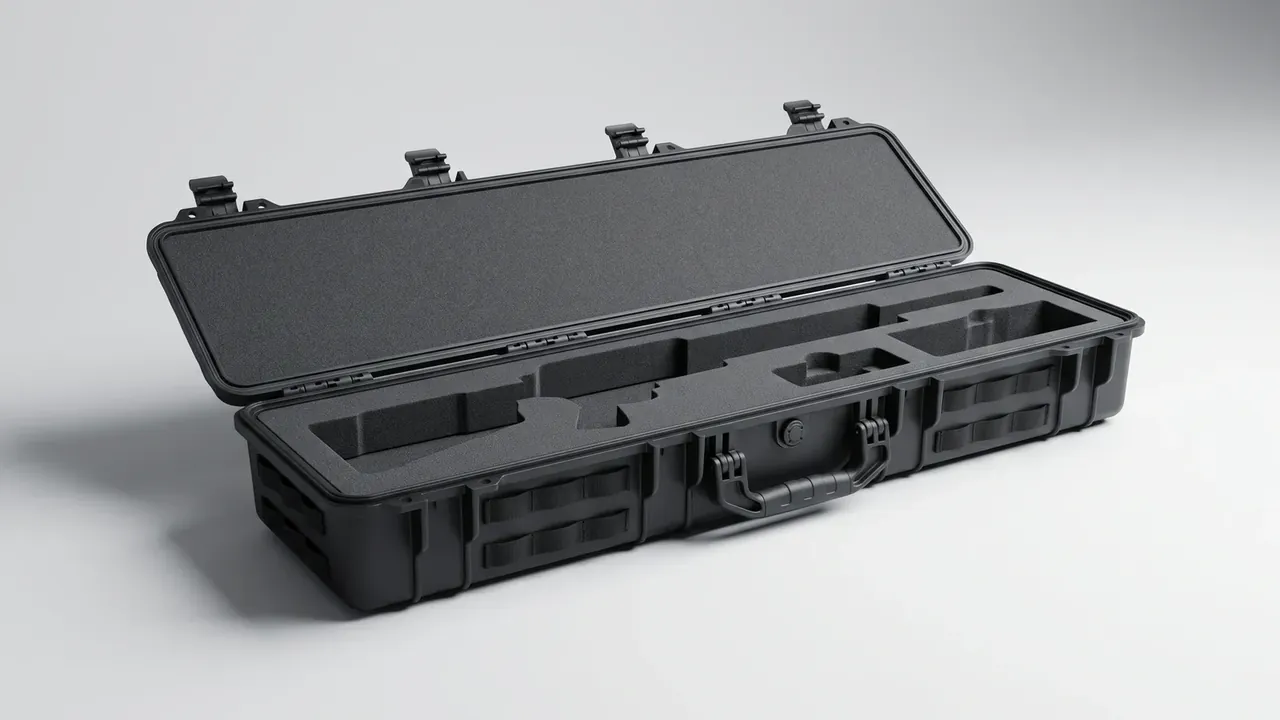
Quick answer: Most sampling reworks trace back to three interfaces, not a weak shell: lid to rim, insert to part, latch to rim. One rework, six values a buyer can measure: lid gap, cavity clearance, corner rebound, latch retention, stacking creep, empty weight.
Table of contents
- First sample: the lid gap on a Fuze Pack Assembly
- Cavity clearance decides how hands lift
- Corner rebound after the drop
- Latch retention and opening effort
- Stacking and the closing checks
- FAQ
1. First sample: the lid gap on a Fuze Pack Assembly
The first sample died at the bench before anyone argued about colour: a 0.8 mm feeler slid in at the corner where 0.5 mm was allowed, and slid in easily.
Pulling the tool found the cause: the land around the rim sat 1.2 mm narrower than the box mouth, so the latches bowed it rather than seating it. Corners cool faster and drag the land inward.
Measure three points, latches closed: centre front, both corners. Beyond 0.3 mm of spread, the hinge side lifts first.
| Criterion | Instrument | Pass line | This sample |
|---|---|---|---|
| Lid gap | 0.5 mm feeler | no entry at three points | 0.8 mm at corner |
| Land flatness | straight edge plus feeler | spread within 0.3 mm | 0.6 mm |
| Wall thickness | ultrasonic gauge | 6.5 mm mean | 5.6 mm at corner |
| Empty weight | platform scale | 11.2 kg plus or minus 0.3 | 11.9 kg |
2. Cavity clearance decides how hands lift
The second failure sat inside. The cavity was drawn 0.5 mm oversize per side, fine on paper and useless on the line: fingers cannot get under the part, so the operator tips the case out. Once tipping is routine, corners meet the floor far more often than any drop schedule assumes. A Fuze Pack Assembly needs its cavity derived from the pick action.
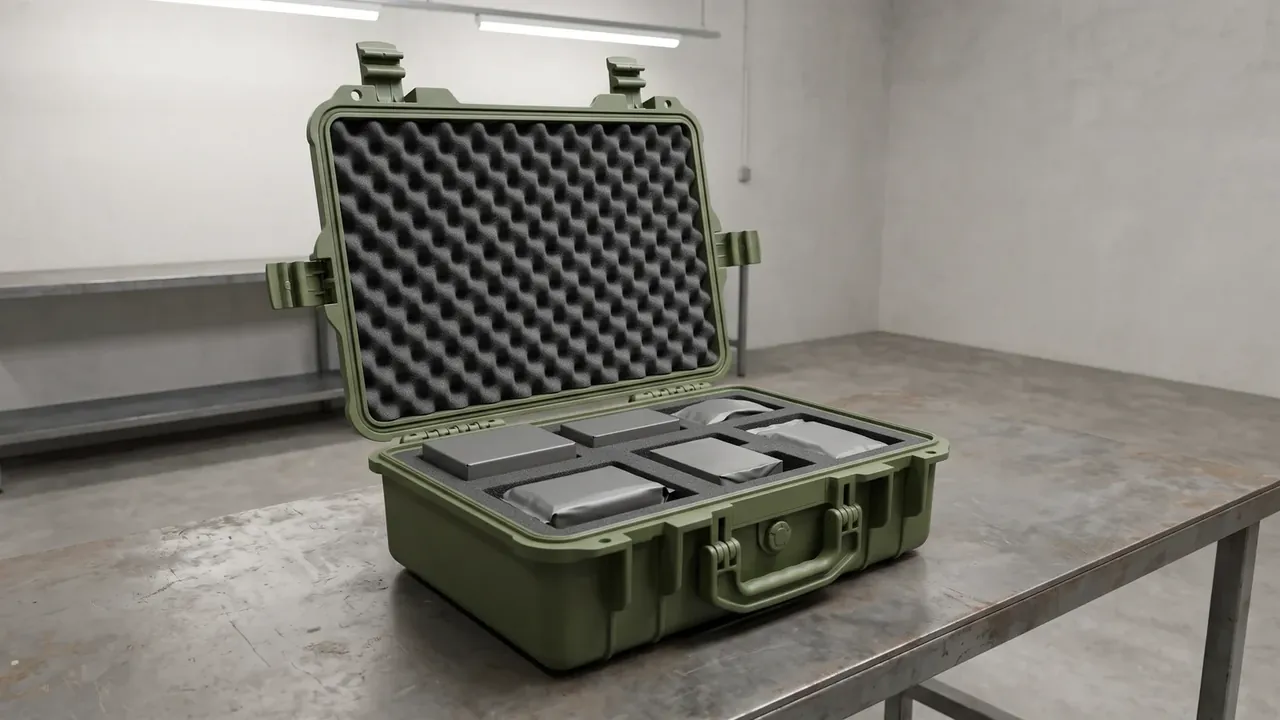
A 1.5 mm gap to the wall is enough; tighter and mouth flash shaves the insert during loading.
- 0.3 to 0.5 mm clearance per side, proved with a shim;
- pocket depth 1.2 mm above the part, room for lid foam;
- finger notch 25 mm wide and 20 mm deep.
Depth is where buyers give ground: a shallower pocket feels tighter, and it is, because the part is pinched and thrown against the rim.
3. Corner rebound after the drop
The old routine dropped a case once from 1.2 m and looked for cracks. This round used six faces, three edges and one corner, dent measured inside 45 seconds, capped at 2 mm, then re-checked after 30 minutes for 85 percent recovery.
Rebound says more than the dent: ribs hold a dent down, but they cannot fake recovery, which tracks whether the chains are intact. From the same batch, the poor case cracked at minus 18 degrees Celsius, ten centimetres of split from a latch hole. Cold soak is the step schedules cut when the calendar is tight, and it catches what room temperature hides.
4. Latch retention and opening effort
The latches on this Fuze Pack Assembly read 780 N on the pull gauge, inside the drawing, and opened at 60 N. Anything that light opens when a sleeve brushes it.
The bridge angle on the tongue was too flat to pass over centre. Raising it 1.5 degrees put opening at 90 to 120 N with an audible click; past 150 N a gloved hand cannot press it, people use a knee, and the hinge takes the load.
| Latch type | Retention | Usable case length | Feel |
|---|---|---|---|
| Plastic over-centre | 700 to 850 N | up to 800 mm | one finger, sharp click |
| Metal draw latch | above 1200 N | 1000 mm and up | two fingers, strong spring |
5. Stacking and the closing checks
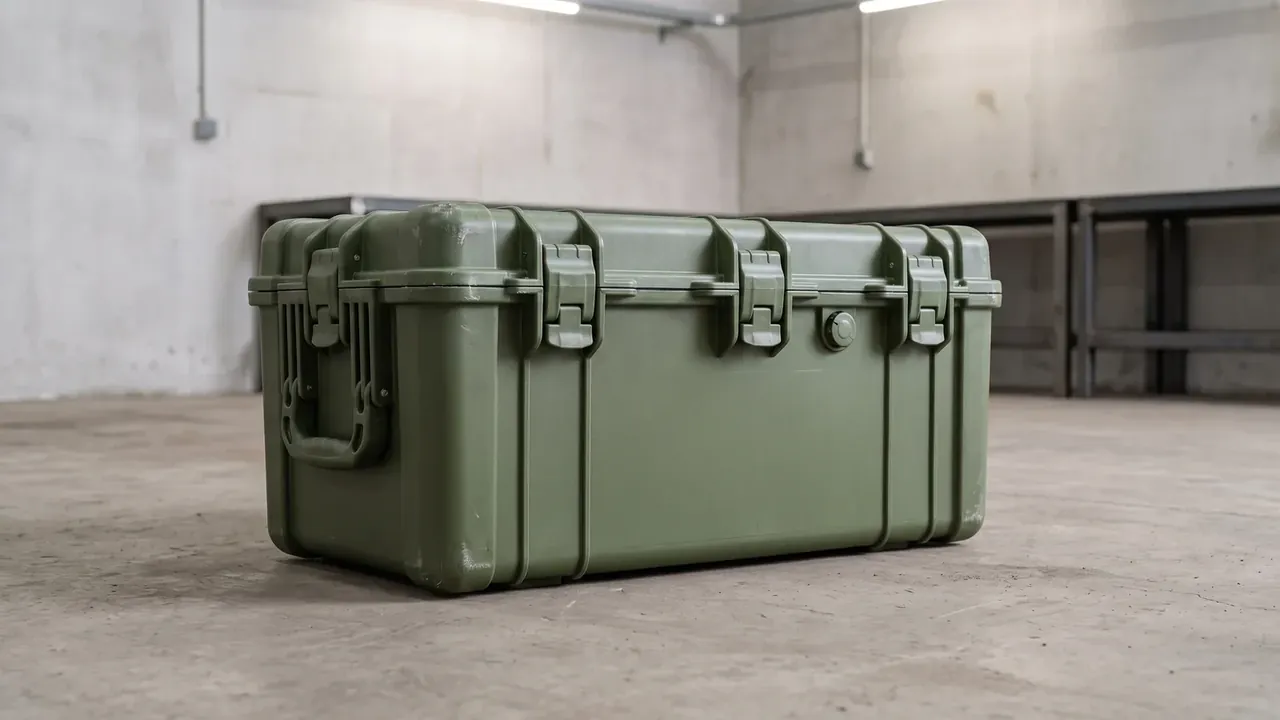
Stack four high, 68 kg on top, 24 hours, then measure the bottom corners: 1.5 mm of creep is the ceiling. Four cycles between minus 20 and 55 degrees Celsius follow, the lid closed as it leaves the chamber to hear the gasket grab.
Weight gets skipped. The Fuze Pack Assembly weighed 11.9 kg against 11.2 kg on the drawing, all of it in the ribs; twenty on a pallet is 14 kg.
Six numbers in range and the round closes: new cooling circuit, raised bridge, thinner ribs, a sample that passed 12 days later.
Conclusion
The lesson was sequence, not craft: measure the interfaces, drop, weigh, and sign only when all six numbers sit inside their lines. Fit on a Fuze Pack Assembly is measured, not eyeballed, and a feeler gauge settles more than experience does.
This article discusses only the container (case body) side of specifications and design intent, and does not cover any handling, loading or use of the contents.
Related Reading
- How a Fuze Pack Assembly is built in four layers
- Cushioning and location design inside a Fuze Pack Assembly
- Inside a case assembly line: stations and cycle time
- Inspection items and pass criteria for military packing boxes
Related Products
- 8 Series — Gun Cases; Military Equipment Cases; Camera Equipment Cases; Drone Cases; Watch Cases; Knife Cases; First Aid Cases; Electronics Equipment Cases
- WL8-2812 PP Gun Case — model WL8-2812
- All protective cases and toolboxes: 7 series, 158 models