

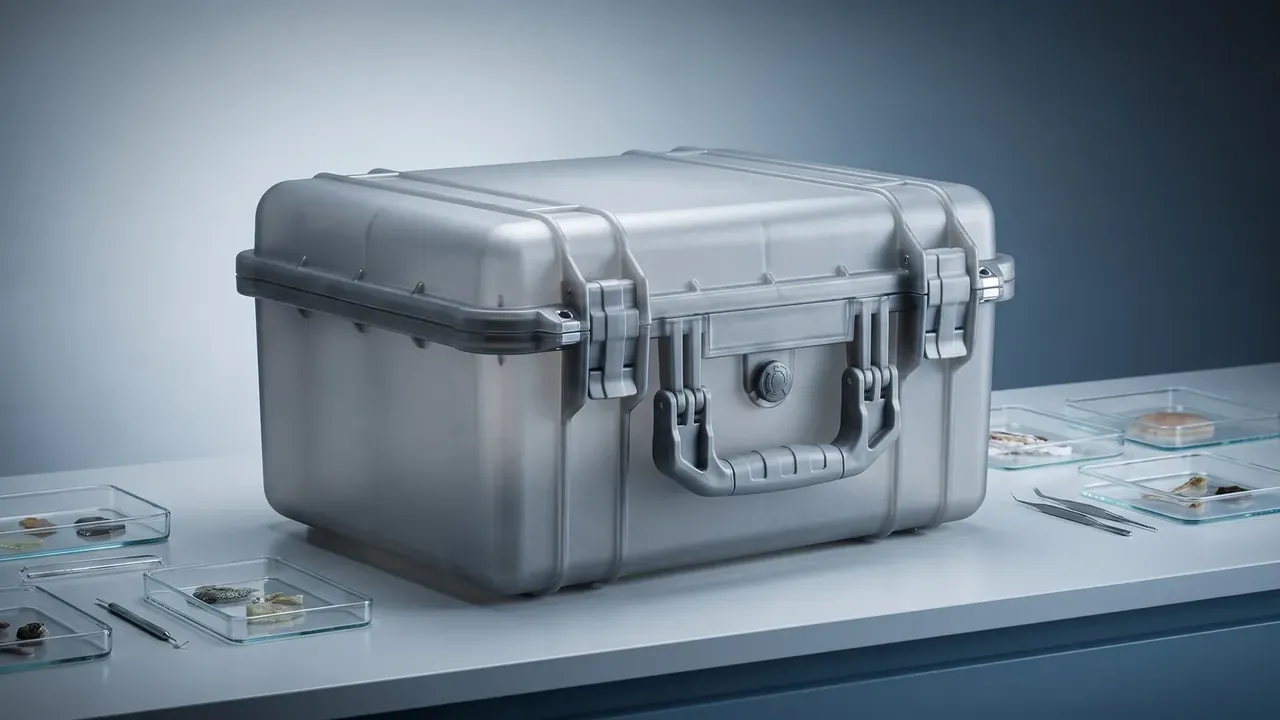
Quick answer: Gas Detector Case at 460×350×220 mm with 4 mm PP walls, 3.6 kg empty, a 12 mm divider splitting the instrument bay from the 0.6 L cylinder bay.
Table of contents
- Six Self-Checks Before the Unit Leaves for Calibration
- Separating the Cylinder Bay from the Charging Bay
- Three Lines a Case Must Pass in a Zone 1 Area
- Fixing the 0.6 L Cylinder and Clearing the Regulator
- Calibration Records and Material Traceability
- FAQ
1. Six Self-Checks Before the Unit Leaves for Calibration
A four-gas monitor for a Gas Detector Case is calibrated every 6 months, and the 20 km back to the bench causes more trouble than a week on site: a cracked hand valve, two bars of charge, a window caked in mud.
Six checks run in order and one miss stops the rest. Charge above 50%, since a calibration takes 3 min of continuous gas. Zero in clean air for 60 s, oxygen back to 20.9%. Response on 30 s of gas; a shift past ±5% means the window is cleaned first.
The cylinder fails most submissions. Below 1 MPa the regulator stutters and span drifts, and a bottle with under 3 months left never enters a Gas Detector Case. The case gets one check: grit in the O-ring means a new cord and a film of grease.
| Check | Pass mark | If it fails |
|---|---|---|
| Charge | 50% or more | top up 2 h first |
| Zero | O₂ 20.9%, LEL 0 | rest 10 min in clean air |
| Response | within ±5% in 30 s | clean the window, retest |
| Cylinder | 1 MPa or more, 3 months left | swap the bottle |
| Gasket | no dents, no grit | replace and grease |
| Shell | no whitening, latches snug | swap case or catch |
A 40×60 mm lid label carries the list.
2. Separating the Cylinder Bay from the Charging Bay
The interior of a Gas Detector Case splits into three zones: a 210×90×60 mm bay holding the monitor flat, a φ80×310 mm bay standing the cylinder upright, and a 12 mm divider compressed 3 mm into the foam.
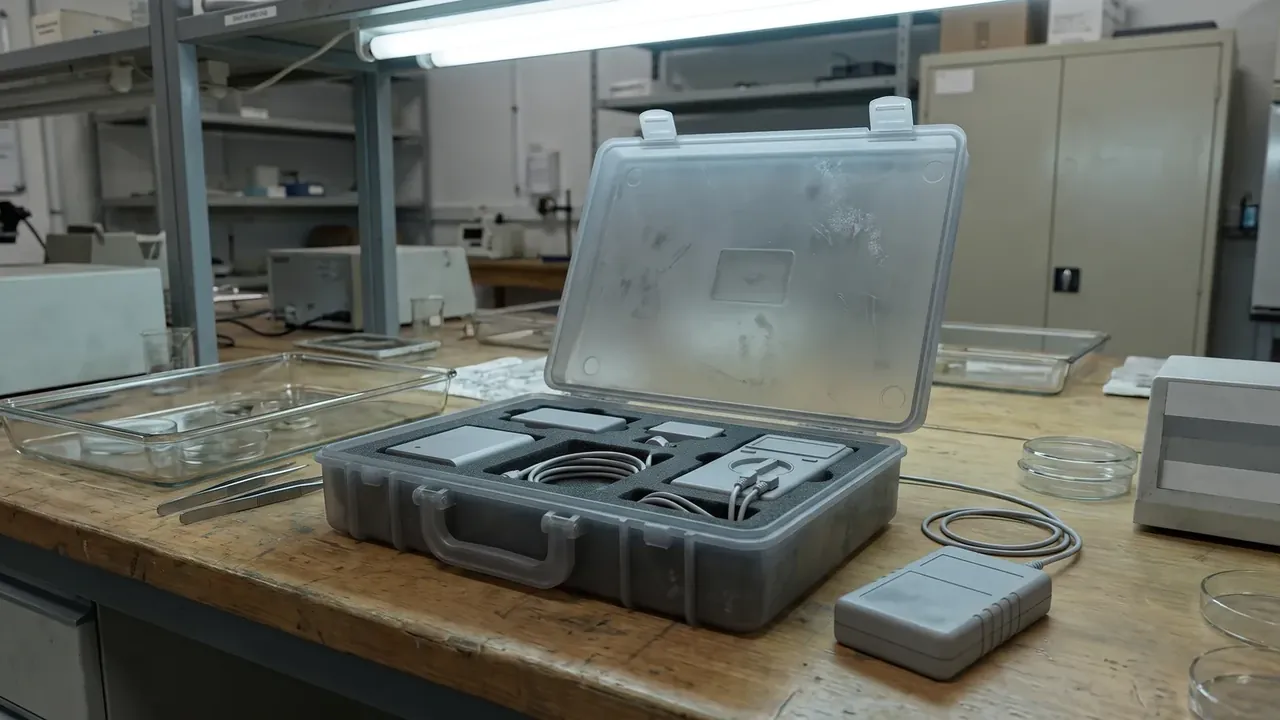
The split is not tidiness: a slow valve leak fills a closed bay with fuel gas, and in a shared bay the next opening drives the reading to full scale while the catalytic bead is already poisoned. Heat is the second issue: cells charge between 0 °C and 45 °C, and a case in summer reaches 55 °C.
| Bay | Contents | Size | Retention |
|---|---|---|---|
| Left | four-gas monitor | 210×90×60 mm | EVA cavity, 5 mm all round |
| Divider | solid wall | 12 mm, full height | molded with the shell |
| Right | 0.6 L cylinder | φ80×310 mm | two straps plus a cradle |
| Lid | cable and adapter | 180×120 mm | elastic mesh pocket |
There is no socket inside: a 20×12 mm notch lets the lead out and keeps the lid open while charging, and shut it the cell bay climbs 12 °C in 30 min.
3. Three Lines a Case Must Pass in a Zone 1 Area
Zone 1 means an explosive atmosphere is likely in normal operation, per IEC 60079-10-1, and carrying a case in makes it a candidate ignition source.
Static comes first. A plastic shell rubbed in dry air holds several thousand volts, enough for a brush discharge to light hydrogen. The IEC 60079 series caps non-metallic enclosure resistance at 10⁹ Ω; plain PP sits at 10¹⁴ to 10¹⁶ Ω, so a conductive masterbatch must bring it to 10⁶ to 10⁹ Ω.
Metal parts come second. An exposed latch can strike metal on metal and spark, so a Gas Detector Case sinks its catches 2 mm into the plastic and hides the hinge seats.
Surface temperature is third. T4 allows 135 °C and a shell at 65 °C in sun is far below it; what matters is a charging battery inside a Gas Detector Case. Black shells run 8 °C to 12 °C above silver ones, so outdoor units stay light.
4. Fixing the 0.6 L Cylinder and Clearing the Regulator
The cylinder for this Gas Detector Case is φ75×300 mm at 10 MPa, with a regulator 45 mm tall. The bay is cut at φ80×310 mm, 5 mm clear top and bottom, and two 25 mm straps pin the body to a cradle.
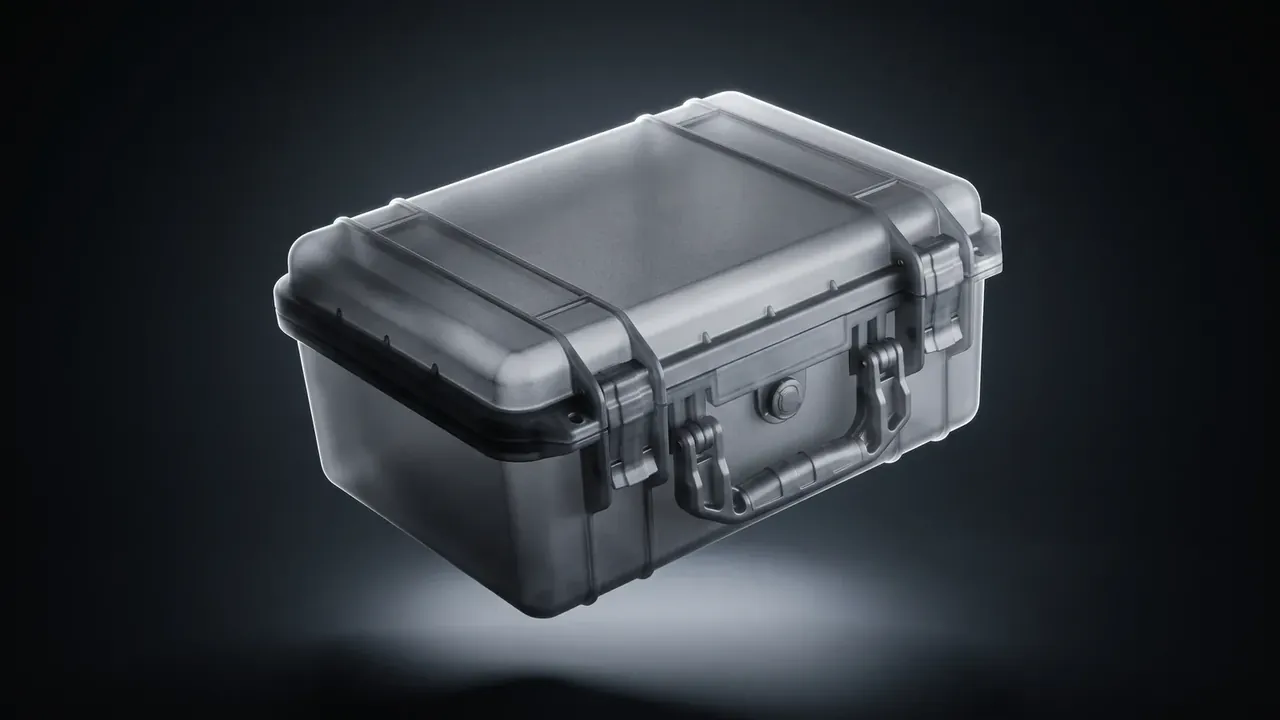
Foam alone will not hold it: EVA at 25% compression loses grip, and the bottle climbs 30 mm on a 1.2 m drop, putting the valve head into the lid first; straps plus a cradle cut that travel to 5 mm.
The regulator pocket sits on the side wall, φ50×60 mm, valve tipped 15° so the gauge faces the opening. Eight millimetres stay to the lid liner, so impact presses foam before the valve.
Temperature belongs in the calculation. As ideal gas, a bottle at 10 MPa and 15 °C reaches about 11 MPa at 50 °C. The bottle tolerates it; the diaphragm does not, hardening until flow drops from 0.5 L/min to 0.3 L/min and every calibration reads low without a fault. A Gas Detector Case therefore carries no insulation, and two 8 mm lid channels let heat out.
5. Calibration Records and Material Traceability
Four columns are enough for a Gas Detector Case record: instrument number, last calibration, next due, case number. Tying the two makes a Gas Detector Case traceable, since one case carrying three monitors spreads wear across three units.
The material column gets skipped. PP molds at 1.5% to 2.0% shrinkage, ABS at 0.4% to 0.7%, so the same tool in a different resin moves a cavity by 0.8 mm — the difference between a monitor dropping in and not fitting.
| Resin | Density | Shrinkage | Continuous heat | Cold behaviour |
|---|---|---|---|---|
| PP | 0.90 to 0.91 g/cm³ | 1.5% to 2.0% | 100 °C | notched impact falls below -10 °C |
| ABS | 1.04 to 1.07 g/cm³ | 0.4% to 0.7% | 85 to 95 °C | brittle near -20 °C |
| HDPE | 0.94 to 0.96 g/cm³ | 1.5% to 3.0% | 60 to 70 °C | tough at -40 °C |
A northern mine in winter is the dividing line. PP cracked at the corners on a -20 °C drop far more often than ABS, not from low strength but because chain segments freeze. For cold sites, specify HDPE or ABS rather than modifying PP.
A tool at 5,000 shots drifts about 0.2 mm, so a first-article check every 1,000 shots belongs in the record.
Conclusion
A Gas Detector Case is laid out backwards from the calibration routine: interval, then cylinder and charging positions, then wall and colour. Get that order right and 3.6 kg covers carry, separation and hazardous-area duty.
This article covers the container (case) side of specifications and design intent only; it does not address any handling, loading or use of the contents.
Related Reading
- Usable volume and cavity ratio of a case
- Portable gas detector protective box
- Matching inner height to foam thickness
- Plastic case versus wooden crate
Related Products
- 8 Series — Gun Cases; Military Equipment Cases; Camera Equipment Cases; Drone Cases; Watch Cases; Knife Cases; First Aid Cases; Electronics Equipment Cases
- WL8-2812 PP Gun Case — model WL8-2812
- All protective cases and toolboxes: 7 series, 158 models